

B1293 on 2013-2020 Ram 1500: Park Assist Sensor 6 Failure Causes & Fixes
Code B1293 on a Ram 1500 means a fault with the front passenger-side corner parking sensor. The most common fixes are cleaning the sensor face, checking for a loose connector, or replacing the sensor itself. An aftermarket sensor costs about $25-$80, while an OEM Mopar part can be over $250. For 2019 models, a software update may be required.
- B1293 specifically refers to the front, passenger-side corner parking sensor.
- The easiest and most common fixes are to clean the sensor face or simply unplug and replug its connector.
- A simple diagnostic trick is to swap sensor #6 with a neighboring sensor (#5) to see if the fault code follows the sensor.
- If you have a 2019 Ram 1500 (DT), the code may be a false positive caused by a software glitch that a dealer can update.
- Replacing the sensor is a simple DIY task that does not require special tools and can save significant money over dealership costs.
What's Unique About the 2013-2020 Ram 1500
The 2013-2020 year range covers two distinct Ram 1500 generations (4th Gen 'DS' and 5th Gen 'DT'), and the cause of B1293 can differ. For the fifth-generation Ram 1500 (DT), particularly the 2019 model year, this code can be triggered erroneously by a software glitch in the Parktronic System (PTS) module, which can be fixed with a dealer-installed update per TSB 08-047-19. On both generations, loose sensor connectors are also a documented issue, sometimes requiring nothing more than unplugging and replugging the sensor to fix. The sensor numbering scheme is consistent, with front sensors numbered 1-6 from driver to passenger side.
Diagnostic Flowchart
Tap your situation to follow the diagnostic path that matches what you're seeing on this vehicle.
Generation note: This range covers the end of the fourth generation (2013-2018, sold as 'Classic' from 2019+) and the beginning of the fifth generation (2019-2020). A key difference is TSB 08-047-19, which involves a software update to fix erroneous B1293 codes specifically on 2019 fifth-gen (DT) models. This TSB was later superseded by 08-082-20, which also included 2020 models. The physical diagnosis and sensor replacement are very similar for both generations, typically accessible from under the bumper without its removal. A critical difference is the location of the Park Assist Module (PAM): on 4th Gen trucks it is behind the driver's side kick panel, while on 5th Gen trucks it is located more centrally under the driver's side dashboard.
Symptoms You May Notice
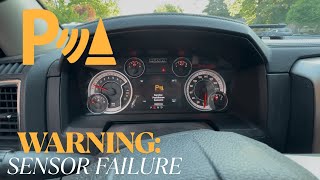
- "Service Park Assist System" or "ParkSense Unavailable" message on the dashboard.
- The park assist system is disabled and will not detect obstacles.
- The park assist on/off switch light may be illuminated or flashing.
- No audible beeps or chimes when approaching an object while parking.
- A constant, steady tone when shifting into reverse, which indicates a system fault.
- Replacing the wrong sensor. It is critical to correctly identify Sensor #6 as the front passenger-side corner sensor before replacement.
- Assuming the sensor is bad when a software update is needed. For 2019-2020 models, checking for the TSB is a crucial step before buying parts.
Most Likely Causes
- Obstructed or Dirty Sensor 🔴 High Probability The front bumper location makes sensors susceptible to collecting dirt, snow, ice, heavy bug splatter, or even thick layers of wax.
How to confirm: Visually inspect the face of the front passenger-side corner sensor. It should be clean and free of any debris or damage.
Typical fix: Thoroughly clean the sensor face with a soft cloth and mild soap or car wash solution. After cleaning, the ignition may need to be cycled for the fault to clear.
Est. part cost: $0 - Faulty Park Assist Sensor #6 🔴 High Probability → Shop Collision Avoidance Sensor The 'Signal Shape/Waveform Failure' definition strongly points to an internal electronic failure within the sensor itself, often from moisture or vibration over time.
How to confirm: Swap the suspected faulty sensor (#6) with an adjacent, working sensor (e.g., #5). Clear the codes. If the code changes to B1292 (for sensor #5), the sensor is confirmed bad. This is the most definitive DIY test.
Typical fix: Replace the faulty park assist sensor. This is a simple DIY task, usually requiring no tools or at most a small screwdriver to release the clips from behind the bumper.
Est. part cost: $25-$260 - Loose Electrical Connector 🟡 Medium Probability A manufacturer STAR case document highlights that loose connectors on park assist sensors can cause performance-related DTCs. Vibration can cause the connector to become unseated over time.
How to confirm: Access the back of the sensor from under the bumper. Firmly press on the connector to ensure it's seated. For a better check, disconnect it, inspect the pins for corrosion or damage, and reconnect it, listening for a click.
Typical fix: Disconnect and firmly reconnect the sensor's electrical connector, ensuring it clicks into place.
Est. part cost: $0 - Software Glitch (2019-2020 DT Models) 🟡 Medium Probability TSB 08-047-19 (later superseded by 08-082-20) was issued for 2019-2020 Ram 1500s because the PTS module could erroneously set this and other sensor codes. Owners on forums report this issue frequently for 2019 models.
How to confirm: A dealership can check your vehicle's VIN against TSB 08-082-20 to see if the software update applies and has not been performed. This is especially likely if multiple sensor codes appear at once.
Typical fix: Reprogram the Parktronic System (PTS) module with the latest software at a dealership.
Est. part cost: $0 if under warranty, otherwise dealer labor rates apply (~$150-$250).
Rare But Worth Checking
- Damaged Wiring Harness: While less common for a waveform code, physical damage to the wiring leading to sensor #6 from road debris, impact, or improper repairs can cause this fault. This should be suspected if the B1293 code returns after a sensor swap confirms the sensor itself is good. A visual inspection of the harness near the sensor is the first step.
- Faulty Park Assist Module (PAM): → Shop Collision Avoidance Sensor This is rare. The module that controls the parking system can fail, but you should exhaust all other possibilities (sensor, wiring, software) before considering module replacement. A failure of the module itself often presents with multiple sensor codes or a total loss of communication (U-code).
Diagnosis Steps
- Read the codes with an OBD-II scanner capable of reading Body (B-prefix) codes to confirm B1293 is present.
- Visually inspect and clean the front passenger-side corner parking sensor. Ensure it's free of dirt, ice, or damage.
- Clear the codes and cycle the ignition. Test the system by driving or putting the truck in reverse. If the code returns, proceed.
- Access the sensor from behind/under the front bumper. Disconnect its electrical connector, inspect pins for corrosion, and reconnect it firmly, listening for a click. Clear codes and re-test.
- (For 2019-2020 models) Contact a Ram dealer with your VIN to check if TSB 08-082-20 applies to your truck and has been performed.
- To definitively test the sensor, swap it with an adjacent sensor (like sensor #5, the passenger-side inner sensor). Clear the codes and test the system. Re-scan for codes. If the code has moved to B1292 (for sensor #5), the sensor itself is faulty and needs replacement.
- If the B1293 code returns after the swap, the problem lies in the wiring to that specific sensor location or the control module.
- Inspect the wiring harness leading to the sensor #6 connector for any signs of chafing, breaks, or corrosion. Trace it back as far as possible.
- If the sensor and wiring are confirmed to be good, the final step would be to diagnose the Park Assist Module (PAM), which is best left to a professional with advanced diagnostic tools.
Parts You'll Likely Need
- Park Assist Sensor
(OEM #1EW63TZZAA)— This is the most common point of failure for a B1293 code, especially with a 'waveform failure' description. This part number has many superseded numbers but is the most commonly referenced base part. Note: OEM sensors come unpainted.
Trusted brands: Mopar, Bosch (often the OEM manufacturer), Dorman (e.g., 684-051), Standard Motor Products, Crown, TRQ
OEM price range: $240-$260
Aftermarket price range: $25-$80
Related Codes That Often Appear With This One
- B1291, B1292, B1295, etc. — If multiple park assist sensor codes are present, it may point to a systemic issue like the software glitch mentioned in TSB 08-047-19/08-082-20, a wiring harness problem affecting multiple sensors, or a failing Park Assist Module.
Technical Service Bulletins (TSBs) & Recalls
- 08-242-25: Defines B1293-25 as PTS Sensor 6-Signal Shape/Waveform Failure.
- 9003059: Recommends checking for and cleaning obstructions like snow/mud/ice from sensors for waveform failures.
- 08-071-14: Defines B1293-25 as PTS SENSOR 6 - Signal Shape / Waveform Failure.
- 08-082-20: Supersedes TSB 08-047-19, expanding the software update fix for erroneous sensor codes to include 2020 models.
- 08-047-19: Notes that on 2019 DT models, this DTC can be set erroneously and requires a software update to fix.
- S2208000107 (STAR
Platform-Specific Known Issues
- TSB 08-047-19 / 08-082-20: Some 2019-2020 Ram 1500 (DT) models may set this code erroneously due to a software issue. The fix is a Park Assist Module (PAM) reprogram at the dealer.
- STAR Case S2208000107: A documented issue of loose sensor connectors causing park assist system failure. The recommended fix is to simply disconnect and reconnect the sensor to ensure a secure connection.
- Wiring Harness Pinch/Break: In some cases, the wiring harness can be pinched or wires can break, especially if the bumper has been impacted or removed/reinstalled. A user on YouTube found three broken wires in the harness leading to the sensors, which caused multiple faults.
Mechanic-Grade Diagnostic Values
- Park Assist Sensor Supply Voltage — expected: ~8.5 Volts. Failure: Significantly lower or no voltage indicates a problem with the Park Assist Module (PAM) or the supply circuit.
- Park Assist Sensor Internal Resistance (OEM) — expected: ~141 Ohms. Failure: A reading of open-loop (infinite resistance) or a dead short (near zero ohms) indicates a failed sensor.
- Sensor Ground Circuit Resistance — expected: Below 5.0 Ohms. Failure: Resistance above 5.0 Ohms indicates high resistance or an open in the ground circuit (X751), which can cause sensor communication issues.
Hidden / Shadow Codes Worth Checking
- B1293-25: Signal Shape/Waveform Failure. This is the most common suffix and typically points to an internal sensor failure. (see via Advanced OBD-II scanner capable of reading Body/PTS module codes.)
- B1293-11: Circuit Short to Ground. This indicates the signal wire is likely touching a ground source somewhere in the harness. (see via Advanced OBD-II scanner capable of reading Body/PTS module codes.)
- B1293-12: Circuit Short to Battery. This indicates the signal wire is likely touching a power source somewhere in the harness. (see via Advanced OBD-II scanner capable of reading Body/PTS module codes.)
Scan Tool Commands That Help
- AlfaOBD / wiTECH: Connect to 'Parktronic System (PTS) Module' or 'Park Assist Module (PAM)' — This is required to read the specific B-prefix codes and their suffixes (e.g., -11, -12, -25). A standard engine code reader will not see these codes. After a repair, codes must be cleared from this specific module.
Wiring & Ground Locations
- Park Assist Module (PAM) - 4th Gen (2013-2018) — Behind the driver's side kick panel, near the emergency brake pedal assembly.. This is the control unit for the system. If a sensor swap and wiring check don't solve the issue, testing needs to be done at this module. Knowing its location is the first step.
- Park Assist Module (PAM) - 5th Gen (2019-2020) — Under the driver's side dashboard, more centrally located than in the 4th Gen trucks.. Correctly locating the module is critical, and its position changed between generations. This is also the module that requires a software update per TSB 08-082-20.
- (D709) Park Assist Signal 6 circuit — The specific signal wire running from the PAM to the Sensor #6 connector.. This is the circuit that must be tested for continuity, shorts to ground, or shorts to power if a sensor swap test fails to resolve the B1293 code.
- Sensor Shared Power & Ground Wires — In the bumper wiring harness. Power is typically a Grey/Orange wire, and Ground is a Grey/Blue wire.. A break or short in these shared wires could potentially cause multiple sensor codes to appear at once. The colors are useful for targeted testing.
Real Owner Repair Stories
- YouTube user 'Fetch A Wrench' (2021 Ram (demonstrates a universal diagnostic process)) — 'Service Park Assist' message with multiple sensor codes active.
❌ Tried (didn't work) Replacing the sensors. The user swapped sensors between known good and bad locations, and the fault codes did NOT follow the sensors, remaining in the same harness positions.
✅ What actually fixed it A deep inspection of the wiring harness revealed three broken wires inside the loom near a pinch point. The user soldered the wires back together, sealed the repair, and all codes were resolved. - RamForum.com user (2017 Ram 1500) — 'Service Park Assist' message for front sensors.
❌ Tried (didn't work) Replacing one bad sensor with an aftermarket one from 1A Auto. The original service message remained.
✅ What actually fixed it The story was unresolved but highlights a critical issue: users reported that after installing aftermarket sensors, they would get new, different faults, such as the service message appearing only after reaching a certain speed (e.g., 8 mph). This suggests a potential incompatibility with non-OEM sensors.
When the Usual Fixes Don't Work
- While B1293-25 (waveform failure) most often points to a bad sensor, do not automatically assume the sensor is the final fix. As one detailed repair story shows, if swapping the sensor with a known-good one does not cause the trouble code to move to the new location, the problem is almost certainly in the wiring harness. In that case, the owner found three broken wires inside the harness loom, and repairing them solved the problem when new sensors did not. This confirms that even with a code that seems to point directly at the sensor, a wiring fault can be the true root cause and must be investigated before replacing the Park Assist Module.
OEM Part Supersession History
1EW63TZZAA→This is the current, most common part number.— This part number replaces a long list of previous versions, likely due to minor manufacturing updates, different paint codes (TZZAA is unpainted), or supplier changes.
Heads up: Supersedes: 1EW631AUAA, 1EW631CLAA, 1EW631EPAA, 1EW631LBAA, 1EW631SCAA, 1EW631Z0AA, 1EW63AB5AA, 1EW63AXRAA, 1EW63DX8AA, 1EW63FFBAA, 1EW63FHGAA, 1EW63FLCAA, 1EW63LAUAA, 1EW63LBGAA, 1EW63LXTAA, 1EW63P76AA, 1EW63P79AA, 1EW63PR4AA, 1EW63RXFAA, 1EW63S3XAA, and many others.
Model Year Variations Within This Range
- 2013-2018 (4th Gen 'DS'): The Park Assist Module (PAM) is located behind the driver's side kick panel, near the e-brake.
- 2019-2020 (5th Gen 'DT'): The Park Assist Module (PAM) is located under the driver's side dash, more centrally. These model years are also subject to TSB 08-082-20 for erroneous sensor codes requiring a software update.
Helpful Videos

The information in this article is provided for general reference and educational purposes only. Vehicle specifications, procedures, and part compatibility can vary by production date, trim level, and region. Always consult your vehicle's factory service manual and verify part numbers before purchasing or performing repairs. Safety-critical components such as airbags, seat belts, and braking systems should be installed by a qualified professional.
- Ram 1500:
- 🧭 Diagnostic Flowchart
- 🎬 Helpful Videos
- What's Unique About the 2013-2020 Ram 1500
- Symptoms You May Notice
- Most Likely Causes
- Rare But Worth Checking
- Diagnosis Steps
- Parts You'll Likely Need
- Related Codes That Often Appear With This One
- Technical Service Bulletins (TSBs) & Recalls
- Platform-Specific Known Issues
- Mechanic-Grade Diagnostic Values
- Hidden / Shadow Codes Worth Checking
- Scan Tool Commands That Help
- Wiring & Ground Locations
- Real Owner Repair Stories
- When the Usual Fixes Don't Work
- OEM Part Supersession History
- Model Year Variations Within This Range
- 🎟️ Get 5% Off