

B3935 on 2016-2020 Cadillac CT6: No-Start, Immobilizer Fault Causes and Fixes
Code B3935 on a Cadillac CT6 typically indicates an immobilizer fault causing a no-start or stall condition. Before replacing any parts, check for radio frequency (RF) interference from other key fobs or access cards on your keychain, as this is a well-documented cause in GM Technical Service Bulletins. This simple check costs nothing and is the most likely solution.
- B3935 on your CT6 almost always points to a security system issue between your key and your car.
- The most likely cause is interference from other keys or cards on your keychain. Separate your CT6 key and try again before doing anything else.
- If interference isn't the problem, the next most likely cause is a weak battery in your key fob, which is an easy and cheap fix.
- Do not allow a repair shop to replace expensive modules like the BCM or starter without first performing these simple checks.
- A persistent issue after these checks requires a professional with GM-specific diagnostic tools.
What's Unique About the 2016-2020 Cadillac CT6
The immobilizer system in the Cadillac CT6 and other GM vehicles of this era is notably sensitive to radio frequency interference. GM was aware of this and issued several TSBs (including PIC5650L and PIC5650M for the CT6) warning technicians *not* to immediately replace expensive components. The primary cause is often external interference from other RFID-enabled devices, a unique diagnostic starting point compared to other vehicles where a faulty component is usually the first assumption.
Diagnostic Flowchart
Tap your situation to follow the diagnostic path that matches what you're seeing on this vehicle.
Symptoms You May Notice
- Intermittent no-crank or no-start condition.
- Engine starts and immediately stalls.
- Security indicator light is illuminated on the dashboard.
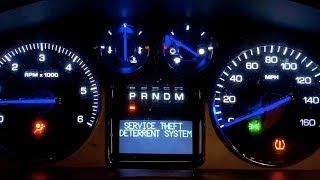
- "Service Theft Deterrent System" message on the driver information center. 🎬 See how to diagnose the Service Theft Deterrent System message.
- Replacing the Body Control Module (BCM)
- Replacing the Keyless Entry Control Module
- Replacing the starter or battery without proper diagnosis
Most Likely Causes
- Radio Frequency (RF) Interference 🔴 High Probability The vehicle's immobilizer system operates at a frequency (125 kHz) that is easily interfered with by other common RFID devices like other car keys, office access cards, or gas station payment fobs. This is explicitly called out in multiple GM service bulletins.
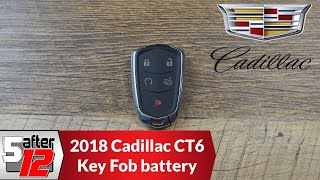
How to confirm: Remove all other key fobs, access cards, and RFID-enabled items from the same keychain as the CT6 key. Move them far away from the vehicle and attempt to start it with only the CT6 key present. 🎬 Watch: Troubleshooting a CT6 key fob that is not detected.
Typical fix: Isolate the CT6 key fob from other RF-emitting devices. No parts replacement is necessary.
Est. part cost: $0 - Weak Key Fob Battery 🟡 Medium Probability → Shop Vehicle Battery
How to confirm: Try starting the vehicle with your second key fob. If it works reliably, the first fob's battery is the likely issue. You can also try placing the weak key fob in the vehicle's transmitter pocket (usually located in the center console or glove box) which can amplify the signal enough to start the car.
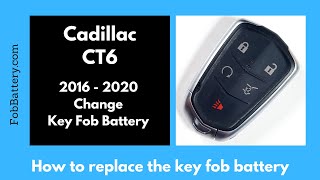
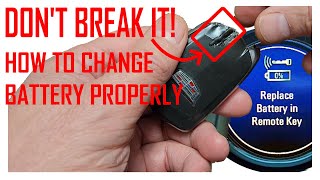
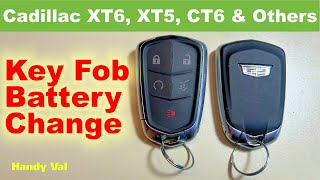
Typical fix: Replace the CR2032 battery inside the key fob. 🎬 Watch: A quick guide to replacing your CT6 key fob battery.
Est. part cost: $5-$10 - Faulty Key Fob ⚪ Low Probability → Shop Keyless Entry Transmitter
How to confirm: If a new battery does not solve the problem and the second key fob works without issue, the internal electronics of the first key fob may be damaged (e.g., from being dropped).
Typical fix: The key fob must be replaced and programmed to the vehicle by a dealer or a qualified automotive locksmith.
Est. part cost: $150-$400
Rare But Worth Checking
- Body Control Module (BCM) Software Glitch: → Shop Body Control Module On some other GM models, a similar issue was resolved with a BCM software update. While not specifically cited for the CT6 in this context, it's a possibility if all other causes are ruled out and the issue is persistent.
- Faulty Keyless Entry Control Module or Antenna: This is a rare cause. The official TSBs for the CT6 specifically advise against replacing these parts until all other possibilities, especially RF interference, have been thoroughly exhausted.
Diagnosis Steps
- Question the driver about items on their keychain. Specifically ask about other vehicle keys, building access cards, or payment fobs.
- Remove ALL items from the keychain except for the CT6 key fob. Move the other items away from the vehicle and attempt to start it.
- If the vehicle starts, the issue is RF interference. The fix is to keep the CT6 key separate.
- If the vehicle still does not start, try the second key fob.
- If the second key works, replace the battery (typically a CR2032) in the non-working key fob.
- If a new battery doesn't fix the first key, place it in the vehicle's designated transmitter pocket (check owner's manual for location) and try to start the engine. If it starts, it confirms a weak signal from the fob itself, which may be failing.
- If none of the above steps resolve the issue, the vehicle requires professional diagnosis with a scan tool to check the health of the Theft Deterrent Module (TDM), Body Control Module (BCM), and related antennas.
Parts You'll Likely Need
- Key Fob Battery — A weak battery is a common cause for an intermittent or weak transponder signal, which the car's security system will reject.
Trusted brands: Energizer, Duracell, Panasonic
OEM price range: $5-$10
Aftermarket price range: $2-$8 - Keyless Entry Transmitter (Key Fob) — If the fob's internal electronics are damaged, it will fail to authenticate with the vehicle even with a new battery. It must be replaced and programmed.
Trusted brands: ACDelco, GM Genuine Parts
OEM price range: $150-$300
Aftermarket price range: $80-$150
Related Codes That Often Appear With This One
- B3055 — This code relates to the key transponder. An authentication error (B3935) is often seen alongside a general transponder key problem code.
- B3060 — This code indicates an issue with the transponder antenna circuit. It can be set along with B3935 if there's interference or a fault in the signal path.
- C0750, C0755, C0760, C0765, C0775 — These are Tire Pressure Monitor (TPM) sensor codes. Since the TPM system and the Keyless Entry system both use radio frequencies and are managed by the BCM, severe RF interference or a BCM issue can sometimes trigger faults across both systems.
Technical Service Bulletins (TSBs) & Recalls
- PIC5650M: Addresses intermittent no crank, no start, or start stall with security light on, specifically mentioning DTC B3935.
- PIC5650L: Warns technicians not to replace parts for this concern and to ask the customer about their use of Radio Frequency Identification devices.
Platform-Specific Known Issues
- The 2016-2020 Cadillac CT6 is documented by GM as being highly susceptible to Radio Frequency Interference causing this specific code and a no-start condition. TSBs #PIC5650L and #PIC5650M were issued to prevent unnecessary parts replacement by directing technicians to investigate external RFID sources first.
Mechanic-Grade Diagnostic Values
- Passive Entry/Start System Frequency — expected: 125 kHz. Failure: Stray signals from other devices in the 120-135 kHz range can interfere with key authentication, setting DTC B3935.
- Remote Keyless Entry (RKE) & TPM Frequency — expected: 315 MHz or 433 MHz. Failure: While not directly related to the B3935 transponder authentication, severe RFI on these frequencies can sometimes cause general BCM communication issues. TSBs recommend checking all three frequencies (125kHz, 315MHz, 433MHz) when diagnosing RFI.
Hidden / Shadow Codes Worth Checking
- B3935 57: Transponder Authentication Error. The '57' is a symptom byte indicating the BCM/TDM received a valid transponder value, but the cryptographic challenge/response calculation between the key and the module failed. (see via A professional GM-specific scan tool like a Tech 2 or GDS2 will display the DTC with the symptom byte.)
Scan Tool Commands That Help
- GDS2 (GM Global Diagnostic System 2): Module Diagnostics -> Remote Control Door Lock Receiver -> Configure/Reset Functions -> Add/Replace Key Fobs — This function is used after replacing a key fob or if a fob needs to be relearned to the vehicle. It will not fix a hardware fault (like a bad antenna) or an RF interference issue, but it is a necessary step for any key replacement.
- SPS (Service Programming System): Replace and Program ECU — This is required if the Body Control Module (BCM) or Remote Control Door Lock Receiver (RCDLR) itself is replaced. The new module must be programmed with the vehicle's specific VIN and configuration data.
Wiring & Ground Locations
- Remote Control Door Lock Receiver (RCDLR) — Located in the trunk, under the left side of the rear shelf, between the large speaker and the smaller tweeter.. This module is the primary receiver for the key fob's signals. A fault in this module, its wiring, or its connection to the antennas can directly cause B3935.
- Body Control Module (BCM) — Behind the driver's side lower dashboard, to the left of the steering column, often accessible after removing the kick panel and hood release lever.. The BCM is the master controller for the theft deterrent system. It makes the final decision to enable or disable starting based on information from the RCDLR.
- Keyless Entry Antennas — The CT6 has multiple antennas. Known locations include one behind the rocker panel molding ('Left body keyless entry antenna') and another in the center of the dash ('Instrument panel compartment keyless entry antenna'). These connect to the RCDLR via inline harness connectors like X225.. These antennas are responsible for detecting the key fob's presence for passive entry and starting. A damaged antenna or wiring in a specific location can cause a 'No Remote Detected' symptom and set this code.
- General BCM Ground Warning — Vehicle-wide. A general GM service bulletin warns that BCMs can be internally damaged if a ground path is removed while the module is still supplied with battery power. Always disconnect the negative battery terminal before servicing any BCM ground connections to avoid causing further damage.
Real Owner Repair Stories
- YouTube Channel 'Dallas Auto Diag' (2016 Cadillac CT6) — Primary complaint of 'Key Fob Not Detected' and no-start. Scan tool showed lost communication codes with the BCM.
❌ Tried (didn't work) Initial checks and code clearing did not resolve the issue., The technician noted the vehicle had been to other shops and the dealer without a successful diagnosis.
✅ What actually fixed it The multi-part diagnostic series focused on identifying the faulty component through signal testing. The technician located the Remote Control Door Lock Receiver (RCDLR) under the rear shelf and traced signals from various keyless entry antennas, including one in the dash and one in the rocker panel, through connector X225. The detailed videos serve as a master class in diagnosing the system, confirming component locations and expected signals on an oscilloscope, even if the final 'one part' fix is not the main takeaway.
OEM Part Supersession History
Varies→Varies— Key Fob FCC ID Mismatch
Heads up: The key fob for the 2016-2020 CT6 uses FCC ID: HYQ2EB. Other Cadillac models from the same era use visually identical fobs with different FCC IDs (like HYQ2AB). Using a fob with the wrong FCC ID will result in a programming failure and can cause this code. Part must be matched by FCC ID, not just appearance.13580789→13584807 (and others)— Part Revision
Heads up: The Smart Keyless Entry Antenna Module has several part numbers associated with it, including 13584807, TN233800-0050, and 13580789. This suggests part revisions or multiple suppliers over the vehicle's production run. When replacing, ensure the replacement part is listed as compatible with the CT6.
Helpful Videos




We Have This Part in Stock


The information in this article is provided for general reference and educational purposes only. Vehicle specifications, procedures, and part compatibility can vary by production date, trim level, and region. Always consult your vehicle's factory service manual and verify part numbers before purchasing or performing repairs. Safety-critical components such as airbags, seat belts, and braking systems should be installed by a qualified professional.
- Cadillac CT6:
- 🧭 Diagnostic Flowchart
- 🎬 Helpful Videos
- 🛍️ Shop This Part
- What's Unique About the 2016-2020 Cadillac CT6
- Symptoms You May Notice
- Most Likely Causes
- Rare But Worth Checking
- Diagnosis Steps
- Parts You'll Likely Need
- Related Codes That Often Appear With This One
- Technical Service Bulletins (TSBs) & Recalls
- Platform-Specific Known Issues
- Mechanic-Grade Diagnostic Values
- Hidden / Shadow Codes Worth Checking
- Scan Tool Commands That Help
- Wiring & Ground Locations
- Real Owner Repair Stories
- OEM Part Supersession History
- 🎟️ Get 5% Off