

P0011 on 2005-2010 Pontiac G6: Causes, Symptoms, and Fixes
On a 2005-2010 Pontiac G6, code P0011 is most often caused by a faulty camshaft position actuator solenoid or low/dirty engine oil. The VVT solenoids use oil pressure to adjust timing, and their small internal screens can become clogged. Replacing a solenoid is a common DIY fix costing between $25 and $60 per solenoid. For the 3.6L V6, this code can be an early sign of a stretched timing chain.
- P0011 on a Pontiac G6 is most commonly caused by low/dirty oil or a bad camshaft position actuator solenoid.
- Always check your oil level and condition first; an oil change might fix the problem.
- Replacing the VVT solenoids is a common, affordable, and relatively easy DIY repair that often solves the issue.
- If you have the 3.6L V6 engine, be aware that this code could be an early sign of a more serious and expensive timing chain problem.
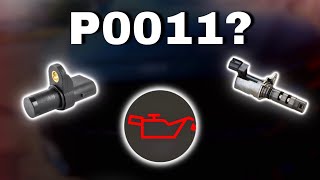
- Do not confuse the camshaft position sensor with the camshaft position actuator solenoid; the solenoid is the more likely culprit for P0011.
What's Unique About the 2005-2010 Pontiac G6
For the Pontiac G6, especially those with the 3.6L V6 (LY7) engine, P0011 can be an early warning of timing chain issues, a known problem for this engine family so significant that GM issued Special Coverage Program #11340C. However, for all engines (including the 2.4L I4, 3.5L, and 3.9L V6s), the most frequent and simplest cause is a failing camshaft position actuator solenoid, often due to infrequent oil changes using incorrect oil viscosity. The provided NHTSA TSBs confirm that this code is often seen with rough running conditions and may point to oil pressure problems or timing component wear across different V6 engines in the G6 lineup.
Diagnostic Flowchart
Tap your situation to follow the diagnostic path that matches what you're seeing on this vehicle.
Symptoms You May Notice
- Check Engine Light is on
- Rough or poor idling
- Engine stalling or hesitation
- Sluggish acceleration or jerky performance
- Reduced fuel economy
- Difficulty starting the engine
- Rattling noise from the engine, especially at startup
- Replacing the camshaft position sensor instead of the camshaft position actuator solenoid. The sensor reads the position, while the solenoid controls it. P0011 is a performance code, usually pointing to the control system (solenoid) or a mechanical issue (oil, timing chain).
Most Likely Causes
- Low or Dirty Engine Oil 🔴 High Probability The VVT system is hydraulically operated by engine oil. If the oil level is low or the oil is dirty and sludgy from extended change intervals, it cannot operate the actuators correctly. Using oil other than the recommended 5W-30 can also cause issues. Some owners have reported the code returning after an oil change, only to be resolved by a second change soon after, suggesting a large amount of sludge was present.
How to confirm: Check the engine oil level and condition using the dipstick. If the oil is below the 'add' line or appears very dark, thick, or sludgy, this is a likely contributing factor. 🎬 Watch: Why you should check your oil before replacing parts.
Typical fix: Perform an oil and filter change using a quality synthetic 5W-30 oil. Clear the code and see if it returns. An engine flush may be considered if sludge is suspected.
Est. part cost: $30-$70 - Faulty Camshaft Position Actuator Solenoid (VVT Solenoid) 🔴 High Probability → Shop Engine Camshaft These solenoids are a very common failure point on many GM vehicles of this era, including the G6. Debris or sludge from dirty oil can clog the fine mesh screens on the solenoids, causing them to stick or respond slowly.
How to confirm: The solenoids can be removed and inspected for torn or clogged screens. They can also be tested by applying 12V power to see if the internal plunger moves. The most common DIY method is to swap the intake and exhaust solenoids (they are identical on the 2.4L engine) and see if the code changes to P0014 (exhaust camshaft). If it does, the solenoid is bad.
Typical fix: Replace the Bank 1 intake camshaft position actuator solenoid. It's highly recommended to replace both the intake and exhaust solenoids as a pair since they are subjected to the same conditions. The repair on the 2.4L engine requires only a 10mm socket and can be done in under 30 minutes. 🎬 See this step-by-step walkthrough for replacing the VVT solenoid.
Est. part cost: $25-$60 per solenoid - Stretched Timing Chain 🟡 Medium Probability → Shop Engine Timing Chain The 3.6L V6 (LY7) engine is notorious for premature timing chain stretching. This was acknowledged by GM through Special Coverage Program #11340C, which extended the warranty for this specific issue to 10 years or 120,000 miles. The stretching causes the actual camshaft timing to deviate from what the computer expects, setting codes like P0011, often along with P0016, P0017, or P0008.
How to confirm: This is a complex diagnosis. A professional technician would use a scan tool to monitor desired vs. actual camshaft deviation angles at idle and specific RPMs. A significant, unwavering deviation often confirms a stretched chain. A rattling noise from the side of the engine is also a strong indicator.
Typical fix: Replacement of all three timing chains, guides, and tensioners. This is a labor-intensive and expensive repair, often costing over $2,000 at a shop.
Est. part cost: $400-$800 for a quality kit
Rare But Worth Checking
- Faulty Camshaft Position Sensor: → Shop Engine Camshaft Position Sensor While possible, the sensor that reads the camshaft's position is less likely to fail than the actuator solenoid that controls it. Usually, a failing sensor will trigger other specific sensor circuit codes (like P0340) rather than a performance code like P0011.
- Worn Camshaft Phaser (Actuator Gear): → Shop Engine Camshaft The phaser is the mechanical gear on the end of the camshaft that the solenoid directs oil to. Internal failure, blockage, or damage to the locking pin can cause timing issues, but this is far less common than solenoid failure.
- Low Engine Oil Pressure: As noted in TSB #PIP5064C, underlying low oil pressure from a failing oil pump or worn engine bearings can prevent the VVT system from working correctly. This indicates a more severe, widespread engine problem.
- Manufacturing Debris in Engine: A GM document (#PI0055B) noted that on some 2.4L engines, machining debris (casting sand or aluminum shavings) from the manufacturing process could get stuck in the camshaft phasers or solenoids, causing P0011 intermittently very early in the vehicle's life. The fix involved multiple oil and filter changes to flush the debris.
Diagnosis Steps
- Check the engine oil level and condition. Ensure it's full and clean. If in doubt, perform an oil and filter change with 5W-30 synthetic oil. This is the cheapest and most common fix.
- Scan for any other trouble codes. Codes like P0014, P0016, or P0300 provide critical clues to the root cause.
- Inspect the wiring and connectors for the Bank 1 intake and exhaust VVT solenoids for damage, corrosion, or oil contamination.
- For the 2.4L I4 engine, swap the intake and exhaust solenoids. They are identical parts located on top of the valve cover, held by a 10mm bolt. 🎬 Watch: How to diagnose stalling issues on the 2.4L engine. Clear the codes and drive. If the code changes to P0014, the solenoid you moved to the exhaust position is faulty and needs replacement.
- If the code does not change after the swap, or if you have a V6 where they may not be swappable, remove the intake solenoid. Inspect its screens for tears or metallic debris. You can try cleaning it with brake cleaner and testing it with a 12V source.
- If solenoids and oil are good, the next step is to check for a mechanical timing issue. For the 3.6L V6, this is the most likely next step. A professional should use a scan tool to observe the desired vs. actual cam angles to confirm a stretched timing chain.
- For V6 engines, if symptoms of rough running persist, check engine oil pressure with a mechanical gauge to rule out the issue described in TSB #PIP5064C.
Parts You'll Likely Need
- Intake Camshaft Position Actuator Solenoid (2.4L I4)
(OEM #12655420)— This is the most common part to fail on the 2.4L engine and cause P0011. It gets clogged with debris or fails electronically. It is identical to the exhaust solenoid.
Trusted brands: ACDelco, Dorman (917-215), Delphi
OEM price range: $40-$60
Aftermarket price range: $25-$45 - Exhaust Camshaft Position Actuator Solenoid (2.4L I4)
(OEM #12655421)— Often replaced as a pair with the intake solenoid on the 2.4L engine, as it is subjected to the same conditions and is likely to fail soon if the other has.
Trusted brands: ACDelco, Dorman (917-216), Delphi
OEM price range: $40-$60
Aftermarket price range: $25-$45 - VVT Solenoid / Actuator Magnet (3.5L/3.9L V6)
(OEM #12589784)— This is the corresponding solenoid for the pushrod V6 engines (3.5L and 3.9L). Failure is less common than on the 2.4L but is a known cause of P0011. One user on an LS1Tech forum fixed their 3.9L P0011 by replacing this part.
Trusted brands: ACDelco, Dorman (917-298)
Related Codes That Often Appear With This One
- P0014 — 'B' Camshaft Position - Timing Over-Advanced (Bank 1). This refers to the exhaust camshaft on the same bank. If both P0011 and P0014 appear, it often points to a common cause like low/dirty oil or a timing chain issue affecting both cams.
- P0016 — Crankshaft Position - Camshaft Position Correlation (Bank 1 Sensor A). This code indicates a direct conflict between the crank and cam sensors, often pointing strongly toward a stretched timing chain or a jumped tooth, especially on the 3.6L V6.
- P0300 — Random/Multiple Cylinder Misfire Detected. Incorrect camshaft timing disrupts the air/fuel mixture and combustion process, leading to misfires, as mentioned in TSB #PIP5064C.
Technical Service Bulletins (TSBs) & Recalls
- PIP4716F: Mentions P0011 in conjunction with engine rattle at startup.
- PIP5064C: Connects P0011 with rough running on V6 engines and advises checking oil pressure.
Platform-Specific Known Issues
- TSB #PIP4716F notes that P0011 can be associated with a "short, sharp rattle noise from the front of the engine at start up."
- TSB #PIP5064C links P0011 on V6 engines with rough running, idle surge, and misfire codes (P0300, P0016), and specifically advises checking engine oil pressure as a diagnostic step.
- The 3.6L V6 (LY7) engine is subject to GM Special Coverage Program #11340C for premature timing chain wear, a primary cause of P0011 on this engine. This extended the warranty on the chains to 10 years/120,000 miles.
- On the 2.4L I4 engine, the intake (P0011) and exhaust (P0014) VVT solenoids are identical and interchangeable, which provides an easy diagnostic test (swapping them).
Mechanic-Grade Diagnostic Values
- VVT Solenoid (Camshaft Position Actuator) Resistance — expected: 8 to 13 Ohms. Failure: A reading outside this range, or an open circuit (infinite resistance), indicates a faulty solenoid coil.
- VVT Solenoid Mechanical Function Test — expected: An audible 'click' and visible movement of the internal plunger/spool valve.. Failure: No movement or click when 12V is carefully applied to the solenoid's two pins indicates it is mechanically stuck or seized.
Scan Tool Commands That Help
- Tech2, GDS2, or equivalent professional scan tool: Camshaft Position Actuator Solenoid Control — This bidirectional test is used to verify if the camshaft phaser is responding to commands from the ECM. The technician can command the solenoid on (e.g., to 10%) and monitor the 'Desired vs. Actual' camshaft angle PIDs. If the actual angle does not change while the command is active, it points to a stuck phaser, a clogged oil passage, or a non-functional solenoid, helping to differentiate between a component and a wiring/ECM issue.
Wiring & Ground Locations
- G105 / G106 — These are primary engine grounds. G106 is located on the engine block or transmission stud, with specific locations varying by engine (e.g., left rear on 2.4L, front transmission stud on 3.5L). G105 is often on a transmission stud below the upper coolant hose.. The Engine Control Module (ECM) and Transmission Control Module (TCM) rely on these grounds. A corroded or loose connection at G105 or G106 can cause erratic behavior and fault codes from any sensor or actuator controlled by the ECM, including the VVT solenoids.
- VVT Solenoid Connectors (2.4L Engine) — On top of the valve cover at the front of the engine.. The intake solenoid has a gray electrical connector, and the exhaust solenoid has a black one. As they are located next to each other, they can be accidentally swapped during service. This will cause the wrong solenoid to be activated, leading to immediate performance issues and setting codes like P0011 or P0014.
Real Owner Repair Stories
- Common DIY diagnostic pattern (2007 Pontiac G6 2.4L I4) — Check Engine Light with code P0011, rough idle.
❌ Tried (didn't work) Performing an oil and filter change.
✅ What actually fixed it The owner swapped the intake and exhaust VVT solenoids. The code cleared and a new code, P0014 (Exhaust Camshaft Position), appeared. This confirmed the original intake solenoid was faulty. Replacing the faulty solenoid with a new part (moved to the exhaust position) resolved all codes and symptoms. - Reddit user experience (Pontiac G6 (engine not specified, but likely 3.6L V6)) — Persistent P0011 code for two years.
❌ Tried (didn't work) Implied attempts to fix with common solutions like oil changes or solenoids., An engine flush with Seafoam was suggested but the final fix was more invasive.
✅ What actually fixed it The ultimate cause was a bad (stretched) timing chain, which required a full timing chain replacement job to resolve the code permanently.
OEM Part Supersession History
12655420→12679099— Updated part design or manufacturer change for the 2.4L Intake VVT Solenoid.12655421→12679100— Updated part design or manufacturer change for the 2.4L Exhaust VVT Solenoid.
Model Year Variations Within This Range
- 2005-2010: Code P0011 is primarily applicable to G6 models with the 2.4L I4, 3.6L V6, and 3.9L V6 engines, all of which feature a camshaft phasing VVT system. The common 3.5L V6 engines (LX9, LZ4) did not use this system and are not a typical source for this code, despite being mentioned in a general TSB.
Helpful Videos

We Have This Part in Stock


The information in this article is provided for general reference and educational purposes only. Vehicle specifications, procedures, and part compatibility can vary by production date, trim level, and region. Always consult your vehicle's factory service manual and verify part numbers before purchasing or performing repairs. Safety-critical components such as airbags, seat belts, and braking systems should be installed by a qualified professional.
- Pontiac G6:
- 🧭 Diagnostic Flowchart
- 🎬 Helpful Videos
- 🛍️ Shop This Part
- What's Unique About the 2005-2010 Pontiac G6
- Symptoms You May Notice
- Most Likely Causes
- Rare But Worth Checking
- Diagnosis Steps
- Parts You'll Likely Need
- Related Codes That Often Appear With This One
- Technical Service Bulletins (TSBs) & Recalls
- Platform-Specific Known Issues
- Mechanic-Grade Diagnostic Values
- Scan Tool Commands That Help
- Wiring & Ground Locations
- Real Owner Repair Stories
- OEM Part Supersession History
- Model Year Variations Within This Range
- 🎟️ Get 5% Off