

P0016 on 2008-2013 Audi A3 2.0T: Timing Chain & Sensor Guide
On a 2008-2013 Audi A3 with the 2.0T engine, P0016 almost always means the timing chain has stretched due to a failed tensioner. This is a critical issue requiring immediate attention to prevent catastrophic engine failure. Expect a professional repair cost of $1,300 to $2,500 for a full timing chain kit replacement.
- P0016 on a 2008-2013 Audi A3 2.0T is a critical code that signals a high probability of a stretched timing chain.
- Do not drive the vehicle. Continued operation can lead to catastrophic engine failure.
- The most reliable diagnostic step is to check the 'Camshaft Adaptation' value with a VAG-specific scan tool. A value more negative than -5 degrees confirms a stretched chain.
- The correct repair is a full timing chain kit replacement, including the updated tensioner design, chain, and guides. This is not a job for a novice DIYer.
- Do not waste money replacing the camshaft or crankshaft sensors unless they have failed their own specific circuit tests.
What's Unique About the 2008-2013 Audi A3
The EA888 engine (Gen 1 and Gen 2) used in this generation of Audi A3 has a well-documented, notorious issue with its timing chain tensioner. Early versions of the tensioner were prone to premature failure, which allows the timing chain to become loose, stretch, and potentially jump a tooth on the sprockets. This isn't just a minor issue; because this is an interference engine, a jumped or broken timing chain can cause the pistons and valves to collide, leading to catastrophic engine damage that often requires a full engine replacement. Therefore, a P0016 code on this specific vehicle is considered a very serious warning sign that should not be ignored.
Symptoms You May Notice
- Check Engine Light is on
- Engine rattles loudly on cold startup (often called 'death rattle'), then the noise may fade as oil pressure builds
- Rough, unstable, or shaking idle
- Engine is hard to start or has a long crank time
- Sluggish acceleration and noticeable loss of power
- Engine misfires (may be accompanied by P0300, P0301, etc.)
- EPC (Electronic Power Control) light may be illuminated
- Metallic ringing or clacking noise from the timing cover area while running
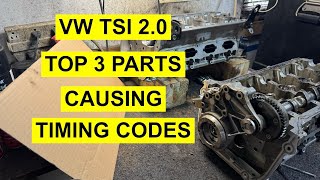
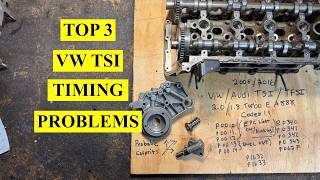
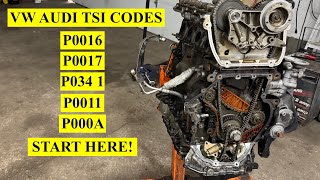
- Replacing the camshaft position sensor or crankshaft position sensor without checking the mechanical timing first. On this engine, the P0016 code is almost always a mechanical problem (stretched chain), not a sensor failure. 🎬 See a breakdown of the top 3 parts causing timing codes.
- Clearing the code and continuing to drive. The problem is mechanical and will not resolve itself; ignoring it leads to catastrophic engine failure.
Most Likely Causes
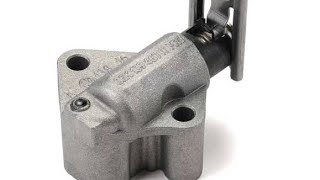
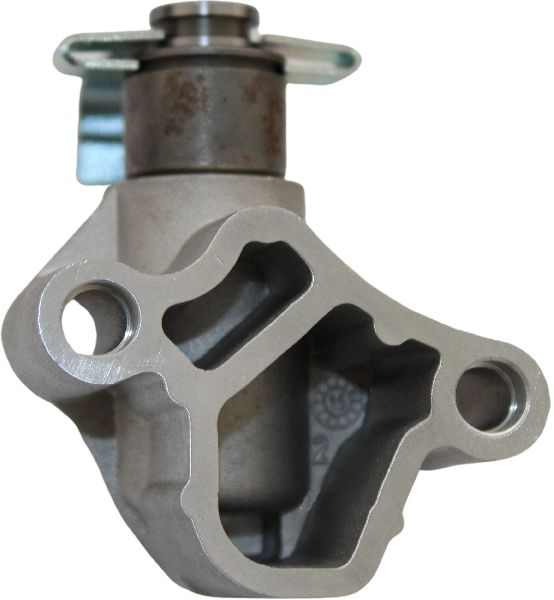
- Stretched Timing Chain and/or Failed Timing Chain Tensioner 🔴 High Probability → Shop Engine Timing Chain The original timing chain tensioner design on early EA888 engines is a known weak point that is prone to failure, leading to chain stretch. A class-action lawsuit was filed over this issue. The updated tensioner is part number 06K109467K.
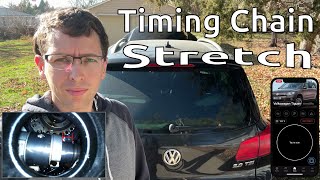
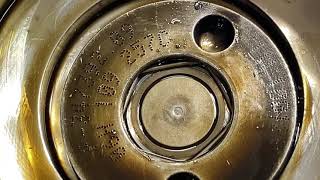
How to confirm: Use a VW/Audi specific scan tool (like VCDS) to check 'Camshaft Adaptation' in Measuring Block 93. A value more negative than -5.0 degrees strongly indicates a stretched chain. A visual inspection of the tensioner through the inspection port on the lower timing cover can also confirm; if more than 6-7 ridges (or 'teeth') on the tensioner piston are visible, the chain is stretched and needs replacement.
Typical fix: Replace the timing chain, tensioner, and all related guides and hardware with an updated kit. This is a labor-intensive job. It is also highly recommended to replace the lower timing cover and balance shaft chain/guides at the same time.
Est. part cost: $400-$600 - Low or Dirty Engine Oil 🟡 Medium Probability The timing chain tensioner and VVT system are hydraulically operated by engine oil. Low oil level, low pressure, or using oil that doesn't meet the required VW 502 00 specification can cause the tensioner to malfunction or accelerate wear on timing components.
How to confirm: Check the oil level on the dipstick and verify its condition. If the level is low or the oil is very dark, sludgy, or past its service interval, this is a likely contributor.
Typical fix: Perform an oil and filter change using high-quality full-synthetic oil that meets the VW 502 00 specification. Clear codes and see if the fault returns. This is a good first step but rarely a permanent fix if the chain is already stretched.
Est. part cost: $70-$120 - Faulty Camshaft Adjuster Magnet (N205 Solenoid) or Spool Valve ⚪ Low Probability → Shop Engine Camshaft This solenoid controls oil flow to the camshaft phaser. It can become clogged with sludge or fail electronically, preventing proper camshaft adjustment. The spool valve it actuates can also get stuck. Debris from a failing camshaft bridge screen is a common cause of N205 failure.
How to confirm: Test the solenoid's operation using a scan tool. Inspect the central pin of the control valve it actuates; if the pin is stuck out, the valve has failed. Oil found inside the electrical connector is a sure sign of internal failure.
Typical fix: Replace the N205 solenoid (Part number can vary, e.g., 06L109259D) and the control valve if necessary.
Est. part cost: $120-$180
Rare But Worth Checking
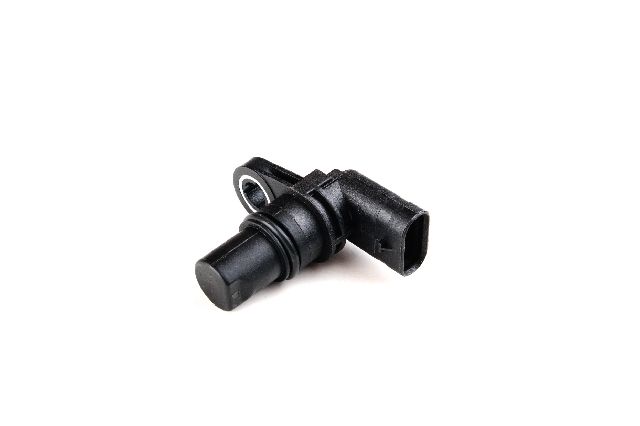
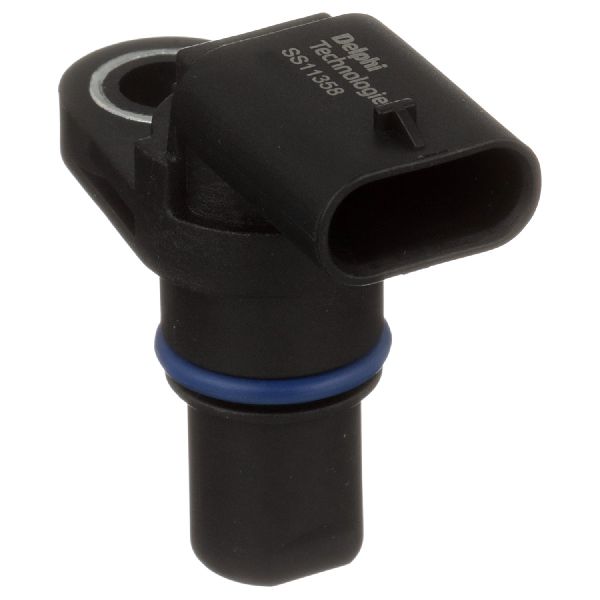
- Faulty Camshaft or Crankshaft Position Sensor: → Shop Engine Crankshaft Position Sensor While these sensors can fail, it's much less common than mechanical timing issues on this engine. A sensor failure will typically throw a specific sensor circuit code (like P0341) in addition to P0016. Do not replace sensors without first ruling out a stretched timing chain via Measuring Block 93 or tensioner inspection.
- Worn/Failed Camshaft Bearing Bridge: → Shop Engine Camshaft A TSB (2045732/15-17-02) was issued for EA888 engines where a small metal screen on the camshaft bridge can detach, get caught in the timing components, and/or block oil passages. This can starve the VVT system, causing P0016. Technicians are advised to remove the screen if the bridge is ever serviced.
- Skipped Timing Tooth: If the tensioner fails suddenly, the chain can jump one or more teeth on the camshaft or crankshaft sprockets. This will immediately put the engine out of time and cause a P0016 code, along with very rough running or a no-start condition. This requires a full timing job to correct.
Diagnosis Steps
- Check the engine oil level and condition. Ensure it is full and clean. If not, perform an oil change with VW 502 00 specification oil, clear the code, and see if it returns.
- Use a VAG-specific scan tool (like VCDS or OBDeleven) to read the fault codes and check live data.
- Navigate to Engine Measuring Value Block 93 and observe the 'Camshaft Adaptation' or 'Phase Position Bank 1' value at a warm idle. If this value is more negative than -5.0° (e.g., -6°, -8°), it is a strong confirmation of a stretched timing chain.
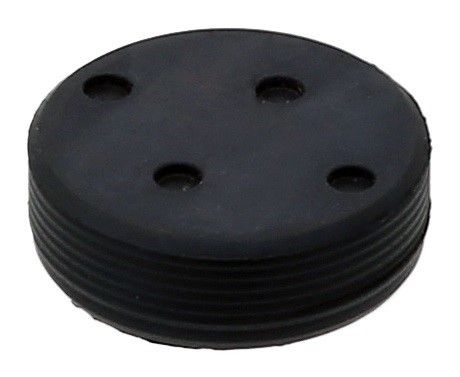
- Perform a visual inspection of the timing chain tensioner. Remove the small plastic inspection plug on the lower timing cover. Using a mirror and flashlight, observe how far the tensioner piston is extended. If more than 6-7 ridges are visible, the chain is stretched and needs replacement.
- If the adaptation value is within spec, test the N205 camshaft adjuster solenoid for proper function using the scan tool's output tests and inspect for oil in the connector.
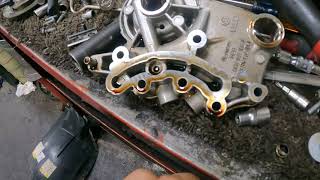
- If the camshaft bridge is accessible (upper timing cover removed), inspect for the presence and condition of the oil screen. Per TSBs, it should be removed if found. 🎬 Watch: How to inspect and replace a blown cam bridge screen.
- If all other tests are inconclusive, a full mechanical timing check is required, which involves removing the timing covers to align the crankshaft and camshaft timing marks manually.
Parts You'll Likely Need
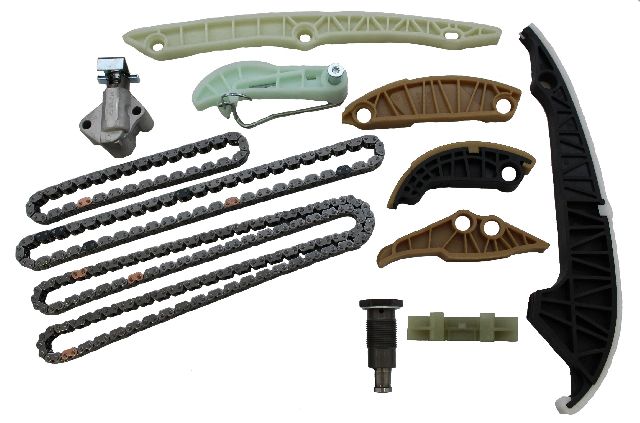
- Timing Chain Kit — This is the most common failure. The kit should include the updated timing chain tensioner (06K109467K), the timing chain itself, and all three guide rails.
Trusted brands: INA, FCP Euro, Genuine VW/Audi
OEM price range: $500-$650
Aftermarket price range: $350-$500 - Camshaft Adjustment Control Valve (N205 Solenoid)
(OEM #06L109257F (or 06L109259D, varies by year))— This solenoid can fail or get clogged, causing timing control issues. It's often replaced preventatively during a timing chain job, especially if debris from a failed cam bridge screen is suspected.
Trusted brands: Pierburg, Genuine VW/Audi
OEM price range: $120-$180
Aftermarket price range: $70-$120 - Lower Timing Cover
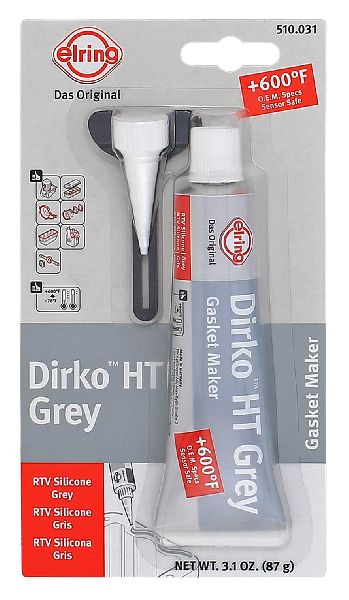
(OEM #06H109210QG)— The original cover is a thin, stamped metal part sealed with RTV that is often bent or damaged during removal. Many comprehensive kits include a new cover with a pre-installed seal.
Related Codes That Often Appear With This One
- P0011 — Indicates 'Camshaft Position 'A' - Timing Over-Advanced'. It often appears with P0016 because a stretched chain or faulty VVT system affects the camshaft's ability to be in the correct position.
- P0341 — Indicates a problem with the Camshaft Position Sensor circuit. The erratic movement of a loose timing chain can cause an implausible signal that the ECM interprets as a sensor fault, even if the sensor itself is good.
- P0300, P0301, P0302, P0303, P0304 — These are misfire codes. Incorrect valve timing from a stretched chain leads to poor combustion, causing the engine to misfire on one or multiple cylinders.
Technical Service Bulletins (TSBs) & Recalls
- TSB 15-12-01 / TPI 2028302: Referenced for no-start conditions related to timing chain problems on VW/Audi 2.0T engines.
- TSB 2045732 / 15-17-02: Addresses the failing screen on the camshaft bearing bridge, advising technicians to remove it during service to prevent future engine damage.
Platform-Specific Known Issues
- The 2008-2012 models are particularly susceptible to the original, faulty timing chain tensioner design. A failure of this part is the primary cause of P0016 on these engines.
- There is an inspection port on the lower timing cover specifically for checking the tensioner's extension, which is a key diagnostic step for this platform.
- The screen on the camshaft bearing bridge is a known failure point that can break off and cause oil starvation or jam timing components, leading to P0016 or catastrophic failure.
Mechanic-Grade Diagnostic Values
- Camshaft Adaptation Intake Bank 1, Phase Position (VCDS MVB 93) — expected: 0° to -4.9° at warm idle. Failure: A value more negative than -5.0° (e.g., -5.5°, -8.0°) indicates a stretched timing chain.
- Camshaft Adjustment Control Valve (N205) Internal Resistance — expected: 10 - 18 Ohms (Ω) at ~20°C. Failure: A reading outside this range, or an open circuit, indicates a faulty solenoid coil.
- Camshaft Position Sensor (G40) Supply Voltage (Pin 1 to Pin 3) — expected: Approx. 5.0 Volts with Key On, Engine Off.. Failure: No voltage or significantly lower voltage points to a wiring or ECM issue.
- Camshaft Spool Valve Torque Specification — expected: Exactly 35 Nm. Failure: Over-torquing this valve can cause it to bind, preventing proper camshaft adjustment and triggering P0016 even with correct timing.
Scan Tool Commands That Help
- VCDS or OBDeleven: Read Measuring Value Block (MVB) 93 — This is the primary diagnostic step to quantify timing chain stretch without disassembly. It shows the phase deviation in degrees, with > -5.0° being the threshold for replacement.
- VCDS or OBDeleven: Reset All Adaptations — This should be performed after replacing the timing chain or other major components. However, it will NOT fix a P0016 code caused by existing mechanical issues. Some users report needing this step to clear a persistent code after a successful repair.
Wiring & Ground Locations
- G40 Camshaft Position Sensor Connector (T3q) — On the upper timing cover, connected directly to the G40 sensor.. This is the primary access point for testing the G40 sensor's electrical integrity. Pin 1 is supply voltage (~5V), Pin 2 is the signal wire, and Pin 3 is ground. Probing these pins confirms if the sensor has power and ground before condemning the sensor itself.
- Main Engine Ground Strap — Typically a braided strap from the engine block to the chassis frame rail in the engine compartment.. A poor engine ground can cause erratic behavior and incorrect readings from multiple sensors, including the G40 and G28, potentially leading to a false P0016 code.
Real Owner Repair Stories
- AudiWorld Forums User (2012 Audi A4 2.0T (EA888)) — P0016 code, extended crank (4-7 seconds), and inconsistent rough idle.
❌ Tried (didn't work) Replaced timing chain, guides, and tensioner., Verified mechanical timing was correct multiple times., Replaced spark plugs, ignition coils, PCV valve, fuel rail pressure sensor, cam sensor, crank sensor, and N205 VVT solenoid/magnet., Reset all adaptation values with VCDS.
✅ What actually fixed it The issue was suspected to be an over-torqued camshaft spool valve (the valve actuated by the N205 solenoid). A forum expert noted the valve must be torqued to exactly 35 Nm, and over-tightening can cause it to jam, leading to a persistent P0016 even after a full timing job. - AudiWorld Forums User (2009 Audi A4 2.0T) — P0016 code immediately after a jump start, long crank when fault is present.
❌ Tried (didn't work) Replaced timing chain, tensioner, and guides with updated parts., Replaced camshaft and crankshaft sensors., Cleaned cam bridge and VVT control valve (spool valve)., Verified mechanical timing marks were perfect multiple times.
✅ What actually fixed it The user's final update indicated the camshaft adjuster itself (the phaser/variator gear on the end of the camshaft) had failed internally. Even though the timing marks were aligned, the phaser was not responding correctly to oil pressure commands from the N205 solenoid, causing the correlation error. Replacing the camshaft adjuster resolved the P0016 code.
OEM Part Supersession History
06H109467 (and revisions like 06H109467T, 06H109467N)→06K109467K (and later revisions like 'P' or 'S')— The original tensioner used a ratchet mechanism with a clip that was prone to failure, allowing the tensioner piston to retract and the chain to lose tension. The updated design is more robust.
Model Year Variations Within This Range
- 2008-2013: Within this range, vehicles can have either a CCTA (49-state emissions) or CBFA (California PZEV emissions) engine code. The CBFA has a secondary air injection system and a third oxygen sensor located on the turbocharger housing, whereas the CCTA's sensor is in the downpipe. While the core cause of P0016 (timing chain/tensioner) is the same for both, be aware of these differences when ordering parts like turbochargers or airboxes.
- 2008-2012 vs 2013: Vehicles produced from roughly mid-2012 onwards are more likely to have the updated timing chain tensioner from the factory. However, they still used the older revision timing chain which is prone to stretch. A 2013 model is not immune to P0016 but is less likely to suffer from sudden, catastrophic tensioner failure compared to a 2008-2011 model.
Diagnostic Flowchart
Real Owner Stories
Aggregated from forums and TSBs cited above. Mileages and costs reflect what owners reported in those sources.
2010 Audi A4 2.0T
Symptoms: Experienced an intermittent P0016 code.
What fixed it: Confirmed as timing chain stretch. The owner was advised to stop driving immediately and replace the timing chain.
Source hint: AudiWorld forum thread titled 'Dreaded p0016'
2012 Volkswagen GTI 2.0T
Symptoms: Sputtering engine accompanied by a P0016 code and multiple misfire codes.
What fixed it: Identified as a jumped timing tooth due to a failed tensioner, requiring timing component replacement per VW TSBs.
Source hint: GolfMK6.com thread titled 'Sputtering with a P0016 & more'
Audi 2.0T (EA888)
Symptoms: Triggered a P0016 code and was quoted for a full timing chain replacement.
What fixed it: Proper diagnosis revealed the issue was actually a faulty cam adjuster, which was a much cheaper repair than the full timing chain job.
Source hint: Reddit r/Audi thread 'Is 3k for a timing chain replacement a fair price?'
VW/Audi 2.0T (EA888)
Symptoms: Experienced an extended crank issue and a P0016 code after a recent timing chain replacement, with a camshaft adaptation value reading -20.63 degrees.
What fixed it: Required a full mechanical timing check to manually align the crankshaft and camshaft timing marks, as the adaptation value indicated the mechanical timing was significantly off.
Source hint: Ross-Tech forum discussion thread 25393
2012 VW Eos 2.0T (EA888 Gen 2)
Symptoms: Threw a P0016 code due to timing issues.
What fixed it: Performed a full DIY timing chain job. The owner specifically noted removing the camshaft bridge screen, referring to it as a 'mini grenade' waiting to fail.
Source hint: Reddit r/Justrolledintotheshop post 'I wrote a step by step guide to replace the...'
Related OBD-II Codes
Frequently Asked Questions
How can I check if my 2008-2013 Audi A3 2.0T has a stretched timing chain without taking the engine apart?
What is the updated part number for the timing chain tensioner on the EA888 engine?
I have a P0016 code and a loud metallic rattle on cold startup. Should I keep driving my A3?
Does TSB 2045732 apply to my P0016 code?
What kind of oil should I use to prevent timing chain and VVT issues on my 2.0T TSI?
My mechanic says I need a new N205 solenoid for my P0016 code. What is that?
Helpful Videos
We Have This Part in Stock

The information in this article is provided for general reference and educational purposes only. Vehicle specifications, procedures, and part compatibility can vary by production date, trim level, and region. Always consult your vehicle's factory service manual and verify part numbers before purchasing or performing repairs. Safety-critical components such as airbags, seat belts, and braking systems should be installed by a qualified professional.
- Audi A3:
- 🧭 Diagnostic Flowchart
- 🎬 Helpful Videos
- 🛍️ Shop This Part
- What's Unique About the 2008-2013 Audi A3
- Symptoms You May Notice
- Most Likely Causes
- Rare But Worth Checking
- Diagnosis Steps
- Parts You'll Likely Need
- Related Codes That Often Appear With This One
- Technical Service Bulletins (TSBs) & Recalls
- Platform-Specific Known Issues
- Mechanic-Grade Diagnostic Values
- Scan Tool Commands That Help
- Wiring & Ground Locations
- Real Owner Repair Stories
- OEM Part Supersession History
- Model Year Variations Within This Range
- Real Owner Stories
- 2010 Audi A4 2.0T
- 2012 Volkswagen GTI 2.0T
- Audi 2.0T (EA888)
- VW/Audi 2.0T (EA888)
- 2012 VW Eos 2.0T (EA888 Gen 2)
- Related OBD-II Codes
- Frequently Asked Questions
- 🎟️ Get 5% Off