

P0016 on 2005-2010 Pontiac G6: Crank-Cam Correlation, Timing Chain & Sensor Fixes
On the 2005-2010 Pontiac G6, P0016 almost always points to a stretched timing chain, especially on the 3.6L V6 engine. This is a serious, labor-intensive repair costing over $1,000. A major contributing factor was GM's overly optimistic Oil Life Monitor (OLM) system, which led to oil degradation and accelerated chain wear. Less common causes include faulty camshaft or crankshaft sensors or VVT solenoids.
- For a Pontiac G6 with a 3.6L V6, P0016 strongly suggests a stretched timing chain, a serious and expensive repair.
- Before assuming the worst, always check the engine oil level and condition first, as low or dirty oil can trigger this code.
- Replacing camshaft or crankshaft sensors is a cheap but often incorrect fix for this code on this specific vehicle; mechanical timing should be investigated first.
- Do not continue to drive the vehicle with this code, as a complete timing chain failure can destroy the engine.
- Due to the complexity of the timing chain replacement, this repair should be handled by a professional mechanic.
What's Unique About the 2005-2010 Pontiac G6
The Pontiac G6, particularly models with the 3.6L LY7 V6 engine, is notorious for premature timing chain stretching. This was such a widespread issue that General Motors issued multiple Technical Service Bulletins (TSBs) and a special warranty extension. A key reason for this high failure rate is attributed to the early GM Oil Life Monitor (OLM) system, which allowed for excessively long oil change intervals. This led to oil breakdown, sludge formation, and inadequate lubrication for the timing chains, causing them to wear and stretch prematurely. While the 2.4L Ecotec can also set this code, it's more often due to failed plastic guides or tensioners rather than the chain itself stretching.
Diagnostic Flowchart
Tap your situation to follow the diagnostic path that matches what you're seeing on this vehicle.
Symptoms You May Notice
- Check Engine Light is on
- Engine rattles on startup, especially when cold
- Rough or unstable idle
- Reduced engine power and sluggish acceleration
- Engine cranks but fails to start
- Poor fuel economy
- Engine stalling unexpectedly
- Replacing only the camshaft or crankshaft position sensors without checking timing chain slack first. On the 3.6L V6, the chain is the most likely culprit, and replacing sensors will not fix a mechanical timing issue. Forum users frequently warn against this.
- Replacing just one component of the timing system, like a single chain or tensioner. The entire system (chains, guides, tensioners) wears together and should be replaced as a complete kit to ensure a lasting repair.
Most Likely Causes
- Stretched Timing Chain(s) 🔴 High Probability → Shop Engine Timing Chain The 3.6L LY7 V6 has a well-documented design flaw exacerbated by long oil change intervals recommended by the Oil Life Monitor, leading to premature chain wear. GM acknowledged this with TSBs #12-06-01-009F and Special Coverage Adjustment #11340C, which directly link P0016 to stretched timing chains.
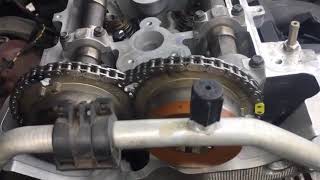
How to confirm: A mechanic can use a scan tool to observe cam/crank correlation data; deviations greater than a few degrees suggest slack. A physical inspection is the definitive method 🎬 Watch: How to diagnose if you need a new timing chain., which involves removing the front engine cover to measure chain slack and check tensioner extension.
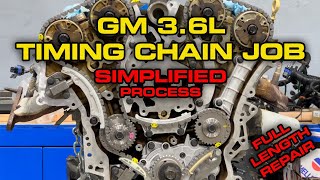
Typical fix: Replacement of all three timing chains, the tensioners, guides, and often the water pump with an updated kit. This is a major, labor-intensive job often quoted at 10+ hours. 🎬 See this full removal and install walkthrough for the 3.6L V6.
Est. part cost: $200-$450 for a quality kit - Low or Dirty Engine Oil 🟡 Medium Probability The variable valve timing (VVT) system and hydraulic timing chain tensioners rely on clean oil at the correct pressure. Degraded or low oil can cause the VVT phasers to respond slowly or the tensioners to lose pressure, creating a correlation error and accelerating chain wear. Some owners on forums have reported codes appearing when oil is low and disappearing after an oil change, though this is often a temporary reprieve if mechanical wear has already begun.
How to confirm: Check the oil level on the dipstick and inspect its condition. If the oil is dark, gritty, or below the 'add' line, this is a critical first step.
Typical fix: Perform an oil and filter change using a quality full synthetic oil of the manufacturer-specified viscosity (e.g., 5W-30). Clear codes and re-test.
Est. part cost: $50-$100 - Failed Camshaft or Crankshaft Position Sensor ⚪ Low Probability → Shop Engine Crankshaft Position Sensor While less common than chain issues on the V6, sensors can fail on any engine, providing incorrect data to the PCM and falsely triggering a correlation code. However, it's a common misdiagnosis; many owners replace sensors only to have the code return because the underlying issue is mechanical.
How to confirm: Use a multimeter to test the sensor's resistance or an oscilloscope to monitor its live signal for dropouts or an erratic waveform. Swapping the suspect Bank 1 intake cam sensor with the Bank 2 sensor is a common diagnostic trick.
Typical fix: Replace the faulty sensor. The crankshaft sensor is on the engine block near the transmission bellhousing, while the camshaft sensors are on the front of the cylinder heads. 🎬 Watch: How to replace the camshaft position sensor yourself.
Est. part cost: $30-$90 per sensor - Failed Timing Chain Tensioner(s) or Guides ⚪ Low Probability → Shop Engine Timing Chain On the 2.4L Ecotec, the plastic guides can become brittle and break, and tensioners can fail, causing chain slack and noise. On the 3.6L, tensioner failure is usually a secondary result of the chain stretching, but a stuck tensioner can also cause slack.
How to confirm: This is typically confirmed during a physical inspection for a stretched timing chain. A distinct startup rattle is a strong indicator. Broken plastic pieces may be found in the oil pan.
Typical fix: Replace the tensioners and guides, which is always done as part of a full timing chain kit replacement.
Est. part cost: $50-$150 (if bought separately)
Rare But Worth Checking
- Slipped Crankshaft Reluctor Wheel: → Shop Engine Crankshaft A known issue on the 3.6L LY7 engine family where the toothed ring that the crankshaft sensor reads can physically move on the crankshaft. This is detailed in TSB PIP3423L/P. It will cause a persistent P0016 code even with new sensors and chains. The only fix is to replace the entire crankshaft, a massive repair.
- Faulty VVT Solenoid (Camshaft Actuator): This solenoid controls oil flow to the cam phaser. If it gets clogged with sludge or fails electronically, it can cause the camshaft to be in the wrong position, triggering the code. On the 2.4L Ecotec, swapping the intake and exhaust solenoids (if identical) is a common diagnostic step. For the 3.6L LY7, an example part is Dorman 917-298.
Diagnosis Steps
- Check the engine oil level and condition. If it is low, dirty, or the wrong viscosity, correct this first, clear the codes, and see if the problem returns. This is the cheapest and easiest first step.
- Use a professional scan tool to check for any other accompanying trouble codes and view live data. Check the cam/crank variance or deviation parameter; a value that is not zero at idle after warm-up indicates a timing discrepancy.
- Listen for a rattling noise from the front of the engine upon a cold startup, which is a strong indicator of a loose timing chain or broken guides.
- Inspect the wiring and connectors for the Bank 1 intake camshaft position sensor and the crankshaft position sensor for any damage, corrosion, or loose connections.
- As a diagnostic test, consider swapping the Bank 1 intake VVT solenoid with the exhaust solenoid (on the 2.4L) or the Bank 2 intake solenoid (on the 3.6L) to see if the code follows the solenoid (e.g., changes to P0017 or P0018).
- The definitive diagnosis for the 3.6L V6 requires accessing the timing chain assembly to physically check for slack in the chains and wear on the guides, per TSBs #12-06-01-009F and #PIP3423P.
Parts You'll Likely Need
- Engine Timing Chain Kit
(OEM #12651450 (often superseded by newer kits like 12693218))— This is the most common fix for P0016 on the 3.6L V6 due to the high incidence of stretched chains. A complete kit includes all three chains, tensioners, guides, and sometimes sprockets and gaskets.
Trusted brands: ACDelco (GM Original Equipment), Cloyes, Melling
OEM price range: $300-$450
Aftermarket price range: $200-$300 - Crankshaft Position Sensor
(OEM #12588992 (ACDelco 213-3826))— A potential but less common cause. If the sensor fails, it can send incorrect data, causing a correlation code. Often replaced as a 'while you're in there' part during a timing chain job.
Trusted brands: ACDelco, Delphi, Bosch
OEM price range: $50-$90
Aftermarket price range: $30-$60 - Camshaft Position Sensor
(OEM #12588993 (ACDelco 213-3827))— A potential but less common cause. The sensor can fail and send incorrect data. It's often misdiagnosed as the primary failure when the timing chain is the real issue.
Related Codes That Often Appear With This One
- P0017 — This code indicates a correlation issue with the exhaust camshaft on Bank 1. It's common to see both P0016 and P0017 together when a timing chain has stretched, as it affects both camshafts on that bank.
- P0008 — A more general engine timing code indicating a bank-to-bank correlation issue. It is frequently triggered by the same stretched timing chain problem and is often the first code to appear.
- P0018 & P0019 — These are the equivalent correlation codes for Bank 2 (the cylinder bank closer to the radiator). Seeing all four codes (P0016, P0017, P0018, P0019) strongly suggests a primary timing chain issue affecting both banks.
- P0335 — This code indicates a fault in the crankshaft position sensor circuit itself. It can appear with P0016 if the sensor has failed electrically or if the reluctor wheel has slipped.
Technical Service Bulletins (TSBs) & Recalls
- 12-06-01-009F: Discusses the availability of updated timing chain kits for repairing stretched chains that cause DTCs P0008, P0009, P0016, P0017, P0018, and/or P0019.
- PIP3423P (and later versions like L): Provides diagnostic guidance when timing codes like P0016 are set. It instructs technicians to first check for loose timing chains, but if none are found, to inspect for a slipped crankshaft reluctor wheel, which requires crankshaft replacement.
- 11340C (Special Coverage): Extended warranty coverage to 10 years/120,000 miles for premature timing chain wear on certain 3.6L V6 engines, acknowledging the issue. It also included an ECM reprogram. The Pontiac G6 was not explicitly listed in all versions of this TSB, but the underlying engine issue is identical.
Platform-Specific Known Issues
- The 3.6L LY7 V6 engine has a widely recognized design issue leading to premature timing chain stretching. GM released TSB #12-06-01-009F to address this, recommending the replacement of the timing chains with updated parts.
- GM also issued a Special Coverage Adjustment (No. 11340C) for some vehicles with this engine, extending the warranty for timing chain replacement to 10 years or 120,000 miles. This program acknowledged that the original oil change intervals could lead to premature wear. This warranty has now expired for all 2005-2010 G6 models.
- On the 2.4L Ecotec engine, P0016 is more commonly associated with failed plastic timing chain guides or a faulty tensioner, often caused by running the engine with low oil.
Mechanic-Grade Diagnostic Values
- VVT Solenoid (Camshaft Actuator) Resistance on 2.4L Ecotec — expected: 8 to 13 Ohms. Failure: A reading outside this range, or a reading that fluctuates wildly when wiggling the connector pins, indicates a faulty solenoid.
Scan Tool Commands That Help
- GM Tech2 / GDS2: Crankshaft Position Variation Learn — This procedure is required after replacing the crankshaft position sensor, the crankshaft itself, or the ECM. Failure to perform this relearn can cause a persistent P0315 code and may contribute to other timing correlation issues. The engine must be warmed up (minimum 155°F) before initiating the test.
Wiring & Ground Locations
- G105 — On the left rear side of the engine compartment, on an engine-to-transmission stud, below the upper coolant hose (3.5L V6).. This is a primary engine ground. A poor connection here can cause erratic behavior from various engine sensors, including the cam and crank sensors, leading to false correlation codes.
- G107 — Located on the left rear of the engine for the 3.6L V6.. This is another critical engine ground point. Corrosion or a loose connection at G107 can introduce noise into sensor signals, potentially triggering a P0016 code.
- ECM/PCM Connectors — Located on the left side of the engine compartment, often in front of the battery.. The signals from the crankshaft and camshaft position sensors terminate here. Specific pins for the 3.6L LY7 are J2-63 (Crank Sensor Signal - DK BLU/WHT wire) and J2-59 (Cam Sensor Signal - BRN/WHT wire). Verifying signal integrity at these pins is a key diagnostic step.
Real Owner Repair Stories
- Camaro5 Forums user (Modified GM vehicle with LSX engine and E38 ECM (similar architecture to G6's V6)) — Major misfire in upper RPM range (5,000+), P0016 code.
❌ Tried (didn't work) Replaced both Crankshaft and Camshaft position sensors., Checked all wiring for continuity between sensors and ECM., Reflashed the ECU., Replaced the timing chain set with an upgraded version after finding a broken tensioner (timing marks still lined up).
✅ What actually fixed it The crankshaft reluctor wheel had spun. The first attempt to fix it by welding it worked for a month, but the issue returned. The ultimate diagnosis confirmed the reluctor wheel had moved again, requiring crankshaft replacement. This confirmed the P0016 was a mechanical issue unrelated to the sensors or even the timing chain's alignment itself.
OEM Part Supersession History
Various early 3.6L LY7 timing chain kits→GM P/N 12651450, later kits like 12693218— The original timing chains were prone to premature stretching. Updated kits feature more robust chains and improved tensioner designs to increase longevity and combat the issues leading to P0016 and related codes.2.4L Intake VVT Solenoid: 12628347, 12646783→12655420, 12679099— Internal design and material improvements to resist failure from oil contamination and electronic faults.
Heads up: On the 2.4L Ecotec, the intake (gray connector) and exhaust (black connector) solenoids are not interchangeable, despite looking physically similar.
Model Year Variations Within This Range
- 2007: The 3.6L LY7 V6 engine with 252 hp was introduced on GTP models, paired with a 6-speed automatic transmission. This replaced the previous 3.9L pushrod V6 in the top trim.
- 2008-2010: While the G6 primarily used the LY7 version of the 3.6L V6, GM introduced the improved LLT version (with direct injection) in other vehicles starting in 2008. While not in the G6, parts from the LLT (like improved timing chains) became the basis for repair kits for the earlier LY7.
- 2009.5: A mid-year refresh in 2009 resulted in revised front/rear fascias and an updated dashboard/radio with Bluetooth. These changes are cosmetic and do not affect the diagnosis of P0016.
Helpful Videos
We Have This Part in Stock


The information in this article is provided for general reference and educational purposes only. Vehicle specifications, procedures, and part compatibility can vary by production date, trim level, and region. Always consult your vehicle's factory service manual and verify part numbers before purchasing or performing repairs. Safety-critical components such as airbags, seat belts, and braking systems should be installed by a qualified professional.
- Pontiac G6:
- 🧭 Diagnostic Flowchart
- 🎬 Helpful Videos
- 🛍️ Shop This Part
- What's Unique About the 2005-2010 Pontiac G6
- Symptoms You May Notice
- Most Likely Causes
- Rare But Worth Checking
- Diagnosis Steps
- Parts You'll Likely Need
- Related Codes That Often Appear With This One
- Technical Service Bulletins (TSBs) & Recalls
- Platform-Specific Known Issues
- Mechanic-Grade Diagnostic Values
- Scan Tool Commands That Help
- Wiring & Ground Locations
- Real Owner Repair Stories
- OEM Part Supersession History
- Model Year Variations Within This Range
- 🎟️ Get 5% Off