

P0018 on 2004-2008 Audi S4 4.2L V8: Timing Chain Guide Failure Causes and Fixes
P0018 on the B6/B7 Audi S4 almost always means the timing chain system has failed, specifically the plastic guides. This is a severe issue requiring engine removal for repair, with costs typically ranging from $6,000 to $15,000. A rattling noise from the back of the engine on startup is the classic, near-universal symptom.
- P0018 on a B6/B7 S4 is a serious code that almost always points to a major mechanical failure in the timing chain system.
- A rattling noise from the engine on startup is the classic symptom of the failing plastic timing chain guides.
- The only correct fix is a complete, engine-out timing chain service, which is one of the most expensive repairs for this car.
- Diagnosis with VCDS (Measuring Block 093) is crucial to confirm the mechanical timing deviation before committing to repairs.
- Do not continue to drive the vehicle, as a complete guide failure can cause the chain to jump, leading to catastrophic engine failure.
What's Unique About the 2004-2008 Audi S4
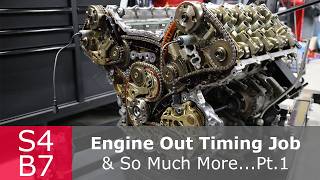
On the 4.2L V8 (BBK) engine used in the B6 and B7 generation S4, this code is infamous. The timing chain system, which includes four chains, multiple tensioners, and guides, is located at the rear of the engine against the firewall. The original timing chain guides were made of a plastic material that becomes brittle with heat cycles and age, causing them to crack and fail. This failure causes chain slack and the dreaded 'startup rattle'. Because of the system's location, any repair requires the entire engine and transmission to be removed from the vehicle, making it one of the most expensive and labor-intensive repairs for this platform.
Generation note: This guide covers both the B6 (2004-2005) and B7 (2005.5-2008) generations of the Audi S4. Both generations use the 4.2L V8 (BBK) engine and share the same rear-mounted timing chain system design, making them equally susceptible to this specific failure.
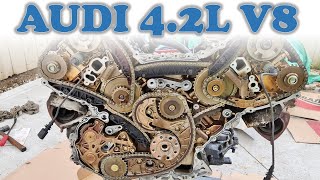
🎬 Watch: Why these Audi V8 engines are so notoriously difficult.Symptoms You May Notice
- Engine rattle noise on startup, lasting 1-5 seconds (often called 'chain rattle' or 'death rattle'). This is the most common and telling symptom.
- Check Engine Light illuminated with code P0018 and potentially others.
- Rough or unstable idle, sometimes described as a 'thump' or misfire feel.
- Noticeable loss of engine power and acceleration.
- Engine misfires, potentially with corresponding codes (e.g., P0300, P0305, P0306, P0307, P0308 for Bank 2).
- In severe cases, the engine may stall, be hard to start, or fail to start at all if timing has jumped significantly.
- Replacing only the camshaft position sensor without performing further diagnosis. While the sensor can fail, it is rarely the root cause of P0018 on this specific engine.
- Assuming the issue is a simple oil change fix. While correct oil is critical, once P0018 is set due to mechanical wear, an oil change will not solve the problem, though it may quiet it temporarily.
- Replacing the camshaft adjusters without replacing the guides and tensioners. If the engine is already out, it is a critical mistake not to replace all wear components in the timing system.
Most Likely Causes
- Broken or Worn Plastic Timing Chain Guides 🔴 High Probability → Shop Engine Timing Chain The original guides are made of a plastic composite that becomes brittle from engine heat cycles and age, causing them to crack and break apart. This is the most common failure point in the system and the primary design flaw.
How to confirm: The definitive diagnosis is a physical inspection, which requires engine removal. A key indicator is a rattling noise from the back of the engine on startup. A borescope inspection through sensor ports may sometimes reveal guide damage, but this is not always possible. Checking cam phase deviation in VCDS Measuring Block 093 showing values beyond +/- 6 degrees is a strong confirmation of a mechanical issue.
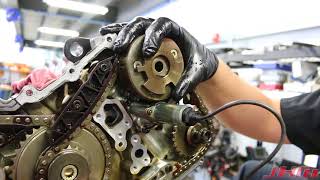
Typical fix: Replace all timing chains, guides, and tensioners. It is highly recommended to use upgraded guide rails from the B7 RS4 (metal-backed) or aftermarket kits (e.g., JHM, FCP Euro) that are made of more durable materials. 🎬 Watch this visual walkthrough of the JHM timing kit installation.
Est. part cost: $1500-$2500 for a complete kit. - Failed Timing Chain Tensioners 🔴 High Probability → Shop Engine Timing Chain The hydraulic tensioners can lose their ability to hold oil pressure, especially on startup after the car has sat, or fail mechanically. This allows the chain to go slack and slap against the guides, accelerating wear and causing the startup rattle.
How to confirm: Diagnosed by checking camshaft deviation values ('Phase Position') in VCDS Measuring Block 093. Values consistently outside the +/- 6 degree specification at warm idle strongly suggest a tensioning or guide problem. The startup rattle is also a primary symptom.
Typical fix: Replace all timing chain tensioners and their seals/gaskets as part of a complete timing chain service. This is never done in isolation.
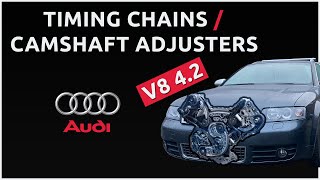
Est. part cost: Included in the complete timing chain kit. - Failed Camshaft Adjuster (Phaser) 🟡 Medium Probability → Shop Engine Camshaft The internal locking pin mechanism of the adjuster can wear out, or the hole it locks into can become ovalized, preventing it from locking in its base position at idle. This causes a timing correlation fault even if the chains and guides are intact. It can also be a source of rattling noise. 🎬 See a real-world example of timing chain and adjuster replacement.
How to confirm: This is difficult to distinguish from guide/tensioner failure without disassembly. A mechanic may observe the adjuster failing to lock when turning the engine by hand during service. JHMotorsports makes a repair kit for the adjuster sprocket side, which is a common failure point.
Typical fix: Replace the faulty camshaft adjuster(s) during the timing chain service. It is often recommended to replace both as a preventative measure, or use an aftermarket repair kit for the sprocket.
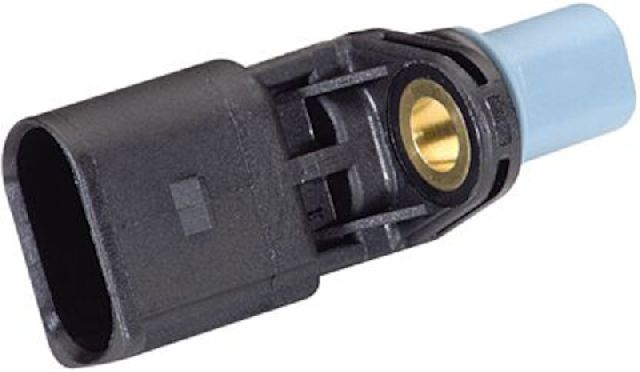
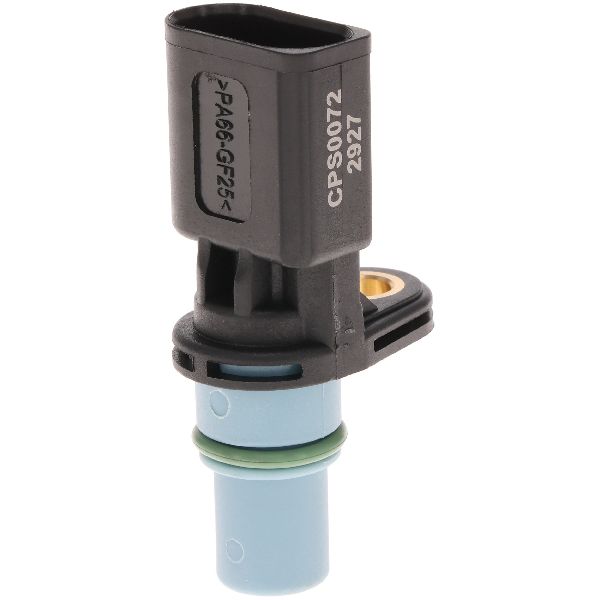
Est. part cost: $400-$700 per adjuster. - Faulty Bank 2 Camshaft Position Sensor ⚪ Low Probability → Shop Engine Camshaft Position Sensor
How to confirm: Swap the camshaft position sensors between Bank 1 (passenger side) and Bank 2 (driver side). Clear the codes and run the engine. If the fault code changes to P0016 (Bank 1 Correlation), the sensor is bad. If P0018 returns, the problem is mechanical.
Typical fix: Replace the faulty camshaft position sensor. This is a cheap and easy first step, but rarely the actual solution for this code on this car.
Est. part cost: $40-$100
Rare But Worth Checking
- Low Oil Level or Pressure / Incorrect Oil: The timing system's hydraulic tensioners and adjusters rely on correct oil pressure. Chronically low oil, infrequent oil changes, or using the wrong viscosity oil can starve the tensioners, cause symptoms, and dramatically accelerate wear on the mechanical components.
- Faulty Camshaft Adjuster Solenoid (N208): → Shop Engine Camshaft The solenoid (actuator) controls oil flow to the camshaft adjuster. If it gets clogged with sludge or fails electrically, it can prevent the cam from phasing correctly, triggering the code. This is less common than mechanical failure and can sometimes be cleaned or tested before replacement.
Diagnosis Steps
- Listen for a distinct rattling sound from the rear of the engine upon cold startup. The rattle lasting more than 1-2 seconds is a strong indicator of a problem.
- Connect a VAG-COM/VCDS diagnostic tool and navigate to Engine -> Measuring Blocks -> Group 093.
- Observe the values for 'Phase Position Bank 1' and 'Phase Position Bank 2' at warm idle. These values represent the camshaft deviation.
- If the value for Bank 2 is consistently greater than +/- 6 degrees (e.g., -8, -10, etc.), it confirms a significant mechanical timing deviation that requires physical repair. Some forum users report seeing values of -9 or -11 degrees before failure.
- As a simple, low-cost check, swap the camshaft position sensors between Bank 1 and Bank 2. Clear codes. If P0018 returns, the issue is mechanical. If the code changes to P0016, the sensor you moved to Bank 1 is faulty.
- Check engine oil level and condition. If low or very dirty, correct it, but understand this is unlikely to fix an existing P0018 code.
- If diagnostic data points to a mechanical fault, the next step is engine removal for a full inspection and replacement of the timing chain guides, tensioners, and adjusters.
Parts You'll Likely Need
- Complete Timing Chain Service Kit
(OEM #Multiple; kits are assembled. Key upgrade is RS4 guide 079109469AD.)— This is the definitive fix. A comprehensive kit includes all four chains, all plastic guides, all hydraulic tensioners, and necessary gaskets and seals. It is critical to use a kit with the upgraded metal-backed RS4 center guide.
Trusted brands: Audi (OEM), JHMotorsports (offers adjuster repair kits), FCP Euro (offers comprehensive kits), ECS Tuning (offers comprehensive kits)
OEM price range: $2000-$3000
Aftermarket price range: $1500-$2200 - Camshaft Adjuster (Phaser), Bank 2
(OEM #079109088M (or later revision))— Often fails alongside the guides/tensioners, or can be the sole cause. The internal locking pin wears out. It is strongly recommended to replace during a timing service to avoid a repeat engine-out procedure.
Trusted brands: Audi (OEM), JHMotorsports (offers a repair kit for the sprocket portion)
OEM price range: $600-$800
Aftermarket price range: $250 (JHM repair kit) - Camshaft Position Sensor, Bank 2
Related Codes That Often Appear With This One
- P0016 — Crankshaft/Camshaft Correlation code for Bank 1. Seeing both codes could indicate a more widespread timing failure affecting both sides of the engine, or a failure of the main, lower chain.
- P0300, P0305, P0306, P0307, P0308 — Random or specific cylinder misfire codes for Bank 2. Incorrect cam timing directly impacts combustion, leading to misfires on the affected bank.
Platform-Specific Known Issues
- The primary issue is the location of the timing service at the rear of the engine, which mandates engine removal for what would be a more straightforward job on other vehicles.
- The OEM plastic timing chain guides are a known major failure point due to material degradation from heat and age.
Mechanic-Grade Diagnostic Values
- Camshaft Adjustment Solenoid (N208) Resistance — expected: 5.0 to 8.0 Ohms at ~20°C (68°F). Failure: A reading outside this range indicates a faulty solenoid.
- VCDS Measuring Block 093 - Camshaft Phase Position — expected: At warm idle, the values for Bank 1 and Bank 2 should be within +/- 6 degrees.. Failure: A consistent reading beyond +/- 6 degrees (e.g., -8, -9, -11) on Bank 2 strongly indicates a mechanical timing issue (guide, tensioner, or chain stretch).
- Camshaft Position Sensor (G163) Signal — expected: The sensor is a three-wire Hall effect sensor. It receives a reference voltage (typically 5V or 12V) from the ECU, has a ground wire, and sends a signal voltage back to the ECU.. Failure: Lack of a signal or an erratic signal. Swapping the sensor with the one from Bank 1 (P0016) is the most common diagnostic step to confirm sensor failure.
Scan Tool Commands That Help
- VCDS (VAG-COM): Engine -> Measuring Blocks -> Group 093 — This is the primary diagnostic step to quantify camshaft deviation. It is used to confirm a mechanical timing fault when P0018 is present, differentiating it from a simple sensor or solenoid issue.
- VCDS (VAG-COM): Engine -> Output Tests -> Camshaft Adjustment — This function allows the user to manually activate the camshaft adjustment solenoids (N205 and N208). An audible click should be heard from the solenoid. This helps test the electrical integrity and basic mechanical function of the solenoid before replacement.
Wiring & Ground Locations
- G12 — Located at the center of the firewall in the engine bay.. This ground point serves the Engine Control Module (ECM). A corroded or loose connection here can cause a wide range of erratic engine codes and sensor reading issues, including correlation faults.
- G18 / G19 — Located near the ignition coils. G19 is used on the 4.2L V8.. These grounds are for the ignition coils. While not directly related to the camshaft sensor circuit, poor grounds can introduce electrical noise that may interfere with sensitive sensor signals, contributing to intermittent issues.
- Camshaft Position Sensor (G163) Connector — On the rear of the Bank 2 (driver's side) cylinder head.. This is the direct connection point for the sensor triggering the P0018 code. The three pins are typically: Pin 1 - Signal to ECU, Pin 2 - Power from ECU (5V or 12V), Pin 3 - Ground. Checking for voltage and ground at this connector is a key step in diagnosing a sensor vs. wiring problem.
- Firewall Ground — A specific ground wire on the firewall behind the intake manifold.. This ground, primarily for the secondary air injection motor, is known to have wiring that becomes brittle and disintegrates. While not directly for the timing system, any failing ground in the engine bay can cause unpredictable electrical problems.
Real Owner Repair Stories
- Ross-Tech Forums user 'Tracylhammond' (2011 Audi S4 3.0T (Note: Different engine, but same code and diagnostic principle)) — P0018 code appeared 10 minutes into the first test drive after installing a used engine with a brand new timing chain, phasers, tensioners, and guides.
❌ Tried (didn't work) Swapping cam sensors between banks., Swapping cam adjuster solenoids between banks., Considering resetting adaptation values (which would not fix a mechanical timing error).
✅ What actually fixed it The diagnosis from a professional user was that the engine was 'Clearly out of time'. Despite using the cam locking tools during installation, a slight error was made, proving that even with new parts, the initial mechanical timing setup is absolutely critical and unforgiving. The engine had to be removed again to be re-timed correctly. - Reddit user 'kappakingtut2' (Unspecified year/model) — P0018 code. Initially, the engine had no oil on the dipstick. An oil change made the light go away for a few days, but it returned. No other symptoms like noise or roughness were present.
❌ Tried (didn't work) Oil change (only a temporary fix).
✅ What actually fixed it The final cause was a timing chain issue. The user noted they drove on it for too long, which led to other problems, culminating in a nearly $4,000 repair. - Audi Owner Report (NHTSA ODI #11233069) — An owner reported that at approximately 63,000 miles, the check engine light illuminated with code P0018, which subsequently caused the vehicle to fail an emissions test.
OEM Part Supersession History
079109469AC→079109469AD— The original center upper guide for early 2004 models was superseded. The new part (079109469AD), which was also the B7 RS4 guide, is now the standard replacement for all B6/B7 S4 models.
Heads up: The original 'AC' guide had a non-functional holding nub with an O-ring used for assembly line purposes, which is absent on the newer 'AD' part. They are functionally interchangeable for repair purposes.
Model Year Variations Within This Range
- 2004-2008: While the B6 (2004-2005) and B7 (2005.5-2008) S4s both use the 4.2L BBK V8 engine, there were minor running changes. However, for the purpose of the P0018 code, the timing system design, failure mode, and repair procedure are virtually identical. The main cosmetic and interior differences between B6 and B7 do not affect this specific repair. It's important to note the BBK is a port-injected, 40-valve engine, not to be confused with the later FSI (direct injection) V8s found in the B7 RS4, which has a different timing setup.
Diagnostic Flowchart
Other Known Issues on This Vehicle
Issues unrelated to this code that are worth knowing about as an owner of this generation:
- Intake Valve Carbon Buildup 🟠 Medium — Common on all 4.2L V8s, typically requires cleaning every 60,000-80,000 miles. The BBK is port-injected, which reduces this issue compared to the FSI RS4, but it is still a known problem.
- High Oil Consumption 🟠 Medium — Very common across the fleet, with many owners reporting consumption of 1 quart every 1,000-1,500 miles. Some cases are more severe.
- Control Arm Bushing Failure 🟡 Low — Extremely common wear item. Expect to replace front control arms every 60,000-90,000 miles.
- Valve Cover Gasket Leaks 🟡 Low → Shop Engine Valve Cover — Common oil leak point, especially on higher mileage vehicles.
- Auxiliary Radiator Failure 🟠 Medium — Common failure point, especially in colder climates where road salt is used.
Used vs. New Parts: Buying Guide for This Vehicle
When a used part is the smart pick: For this specific repair, using used parts is almost never a smart choice. The failure is due to wear and material degradation of plastic guides and tensioners. A used part will have unknown wear and could fail shortly after the extremely expensive engine-out labor is completed. The only scenario where a used component makes sense is sourcing a complete, low-mileage, documented-history BBK engine to replace one that has suffered catastrophic failure (e.g., pistons hit valves).
Donor-vehicle mileage cap: roughly under 60000 miles for the part to have meaningful remaining life.
What to inspect on the donor part:
- For a complete used engine: demand VCDS scan showing Measuring Block 093 values are well within spec (-1 to -5 degrees).
- For a complete used engine: demand a video of a cold start to listen for any startup rattle.
- Ask for vehicle VIN to verify history and mileage.
- Avoid any engine that has been sitting outside or has open ports.
OEM-only on this vehicle (don't cheap out):
- Timing Chain Tensioners
- Camshaft Adjuster Solenoids (N208)
Aftermarket brands forum-validated for this vehicle:
- JHMotorsports (Kits and adjuster repair solutions)
- FCP Euro (Comprehensive kits, often using OEM suppliers)
- ECS Tuning (Comprehensive kits)
- Iwis (Often the OEM supplier for the chains themselves)
Brands owners have reported issues with on this vehicle:
- No-name, unbranded timing chain kits from marketplaces like eBay or Amazon. The quality of the plastic guides and tensioner hydraulics is critical, and failure of a cheap component will lead to a repeat of the 30+ hour labor job.
Real Owner Stories
Aggregated from forums and TSBs cited above. Mileages and costs reflect what owners reported in those sources.
2004-2008 Audi S4 4.2L V8
Symptoms: Engine rattle noise on startup, lasting 1-5 seconds (often called 'chain rattle' or 'death rattle').
What fixed it: Replace all timing chains, guides, and tensioners using upgraded guide rails from the B7 RS4 or aftermarket kits (e.g., JHM, FCP Euro).
Cost: $1500-$2500
Source hint: Reddit r/Audi thread titled 'B6 S4 timing chain rattle'
2004 Audi S4 4.2L V8 (BBK)
Symptoms: Check Engine Light with code P0018; VCDS Measuring Block 093 showed values of -9 or -11 degrees.
What fixed it: Full timing chain service including replacement of broken plastic timing chain guides and tensioners.
Source hint: Audizine.com forum thread 'FAQ-Are-you-looking-to-purchase-a-B6-B7-S4-Here-is-what-you-need-to-know'
Audi Q5 (Cross-Model Reference)
Symptoms: Check engine light illuminated with code P0018 at approximately 63,000 miles, leading to a failed emissions test.
What fixed it: Diagnosis at a dealership confirmed the correlation fault (NHTSA ODI #11233069).
Related OBD-II Codes
Frequently Asked Questions
I have a startup rattle that lasts about 3 seconds on my B6 S4; is this the 'death rattle' mentioned for the BBK engine?
Can I use parts from the B7 RS4 to fix the P0018 timing issue on my S4?
Is it possible to diagnose a P0018 mechanical failure on the 4.2L V8 without pulling the engine?
Could a simple sensor swap rule out a mechanical timing failure on my Bank 2 (driver side)?
Are there aftermarket kits available to fix the camshaft adjuster rattle without replacing the whole unit?
Helpful Videos
We Have This Part in Stock




The information in this article is provided for general reference and educational purposes only. Vehicle specifications, procedures, and part compatibility can vary by production date, trim level, and region. Always consult your vehicle's factory service manual and verify part numbers before purchasing or performing repairs. Safety-critical components such as airbags, seat belts, and braking systems should be installed by a qualified professional.
- Audi S4:
- 🧭 Diagnostic Flowchart
- 🎬 Helpful Videos
- 🛍️ Shop This Part
- What's Unique About the 2004-2008 Audi S4
- Symptoms You May Notice
- Most Likely Causes
- Rare But Worth Checking
- Diagnosis Steps
- Parts You'll Likely Need
- Related Codes That Often Appear With This One
- Platform-Specific Known Issues
- Mechanic-Grade Diagnostic Values
- Scan Tool Commands That Help
- Wiring & Ground Locations
- Real Owner Repair Stories
- OEM Part Supersession History
- Model Year Variations Within This Range
- Other Known Issues on This Vehicle
- Used vs. New Parts: Buying Guide for This Vehicle
- Real Owner Stories
- 2004-2008 Audi S4 4.2L V8
- 2004 Audi S4 4.2L V8 (BBK)
- Audi Q5 (Cross-Model Reference)
- Related OBD-II Codes
- Frequently Asked Questions
- 🎟️ Get 5% Off