

P0018 on 2015-2019 Ford Fiesta: Crankshaft/Camshaft Correlation Causes and Fixes
On a 2015-2019 Ford Fiesta, code P0018 is almost always caused by a sticking Variable Camshaft Timing (VCT) solenoid due to oil debris, an issue highlighted in multiple Ford TSBs. The fix is often replacing the VCT solenoid, which costs about $75-$90 for the part and is a straightforward DIY job. An oil and filter change is critical at the same time.
- Code P0018 on a Fiesta almost always points to the Variable Camshaft Timing (VCT) system.
- The most likely cause is a VCT solenoid sticking due to dirty or low engine oil. Always check your oil first.
- Before replacing expensive parts, try swapping the VCT solenoids or having a mechanic run Ford's 'HK' diagnostic test to clean them.
- Replacing a VCT solenoid is an affordable and accessible DIY repair that often solves the problem.
- If the issue persists after addressing the VCT solenoids, the mechanical timing belt should be inspected, especially on vehicles with over 100,000 miles.
What's Unique About the 2015-2019 Ford FIESTA
The 2015-2019 Ford Fiesta is uniquely prone to VCT-related codes like P0018 due to a well-documented issue with debris in the engine oil. Multiple Ford TSBs state that small particles can cause the VCT solenoids to stick, leading to timing correlation faults. This is so common that Ford advises technicians to perform a specific solenoid cleaning cycle test (Pinpoint Test HK12) before replacing any major components. Furthermore, the 1.0L EcoBoost engine uses a timing belt-in-oil ('wet belt') design that can degrade over time, shedding material that clogs oil passages and the VCT system, leading to oil starvation and timing faults. Therefore, oil condition and VCT solenoid function are the absolute first things to check on this car.
Diagnostic Flowchart
Tap your situation to follow the diagnostic path that matches what you're seeing on this vehicle.
Symptoms You May Notice
- Check Engine Light is on
- Rough or uneven idle
- Engine hesitates or stumbles during acceleration
- Loss of engine power
- Engine may stall at low speeds or when stopping
- Decreased fuel mileage
- A rattling or chain-like slapping noise on cold starts, which goes away after a few seconds (especially common with 1.0L EcoBoost wet belt issues)
- Replacing camshaft or crankshaft sensors before checking the VCT solenoids and oil condition.
- Assuming a major timing job is needed before performing the simple VCT solenoid tests and replacement.
- On the 1.0L EcoBoost, replacing VCT components without addressing the root cause of a degrading wet belt, which will cause the new parts to fail again.
Most Likely Causes
- Sticking or Failed VCT Solenoid 🔴 High Probability → Shop Engine Variable Valve Timing (VVT) Solenoid As documented in Ford TSBs SSM 50067, 48423, and others, these solenoids are susceptible to sticking from small debris in the engine oil. This is the most common cause for this code on this platform.
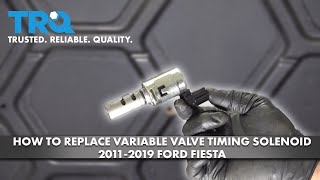
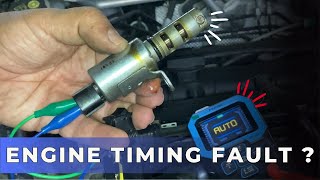
How to confirm: Use a scan tool to perform Ford's pinpoint test 'HK12' which cycles the solenoid 10 times to attempt to clear debris. 🎬 See this video for a deep dive into VCT solenoid diagnostics. You can also swap the intake and exhaust solenoids to see if the code changes (e.g., to P0019). Resistance can be checked with a multimeter and should be between 6-12 ohms. Applying 12V power to a removed solenoid should cause the internal plunger to move.
Typical fix: Replace the faulty VCT solenoid. It is highly recommended to change the engine oil and filter at the same time to remove the debris that caused the failure. Lightly lubricate the O-rings on the new solenoid with fresh engine oil before installation.
Est. part cost: $75-$90 - Low or Dirty Engine Oil 🔴 High Probability The VCT system is operated by oil pressure. Contaminated or low oil is the primary cause of the sticking VCT solenoid issue. On the 1.0L EcoBoost, using oil other than the specified grade can accelerate wet belt degradation, leading to oil contamination. Some owners on forums have reported the code appearing simply due to low oil levels.
How to confirm: Check the oil level on the dipstick and inspect its color and consistency. An oil change is overdue if the oil is dark, thick, or has visible particles.
Typical fix: Perform an engine oil and filter change using the manufacturer-specified grade of oil (especially critical for the 1.0L EcoBoost). This simple step can sometimes resolve the code on its own.
Est. part cost: $40-$70 - Stretched/Degraded Timing Belt or Failed Tensioner 🟡 Medium Probability → Shop Engine Timing Chain The 1.6L Ti-VCT engine uses a timing belt that requires replacement at regular intervals (approx. 100k-150k miles). The 1.0L EcoBoost uses a 'wet belt' which is known to degrade over time, shedding rubber material that clogs the oil pickup tube and VCT system, eventually causing the belt to stretch or jump a tooth.
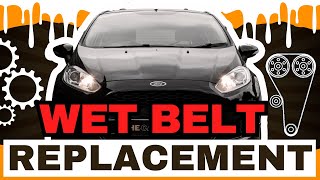
How to confirm: Physical inspection of the timing components is required, which involves significant engine disassembly. For the 1.0L EcoBoost, signs of black rubber specks 🎬 Watch: See what a failing 1.0L EcoBoost wet belt looks like. in the engine oil during an oil change are a strong indicator of wet belt failure.
Typical fix: Replace the timing belt (or wet belt), tensioner, and often the water pump as a complete kit. This is a labor-intensive job.
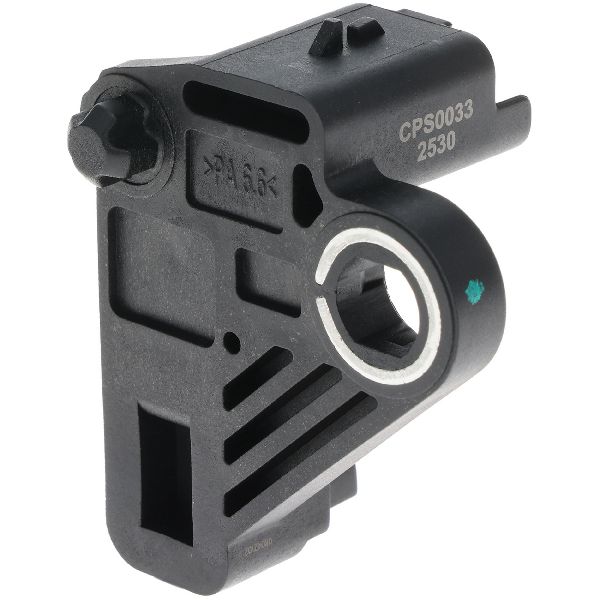
Est. part cost: $150-$350 - Failed Camshaft or Crankshaft Position Sensor ⚪ Low Probability → Shop Engine Crankshaft Position Sensor
How to confirm: Use a scan tool to monitor live data from the sensors. Test the sensor's resistance with a multimeter or check for a signal with an oscilloscope. Swapping a suspect sensor with a known good one is also a valid diagnostic step.
Typical fix: Replace the failed sensor. This is a common misdiagnosis; always check VCT solenoids and oil first.
Est. part cost: $30-$60
Rare But Worth Checking
- Damaged VCT Phaser (Camshaft Sprocket): The VCT phaser is the mechanical gear that the solenoid acts upon. It can fail mechanically, but this is much less common than a solenoid failure. This is often a more expensive repair.
- Wiring Harness Damage: Check for frayed or corroded wiring and connectors leading to the VCT solenoids and camshaft/crankshaft sensors, especially if other work has recently been done in the engine bay.
- Powertrain Control Module (PCM) Fault: → Shop Engine Control Module (ECM) This is extremely rare. In some forum discussions, owners have replaced multiple components with no fix, only to find the ECU itself was faulty, but this should be the last resort. All other possibilities should be exhausted before considering a PCM replacement.
Diagnosis Steps
- Check the engine oil level and condition. If it is low or dirty, perform an oil and filter change using the correct OEM-spec oil before proceeding. This may resolve the issue.
- Use an OBD-II scanner to check for any other accompanying trouble codes.
- Inspect the wiring and connectors for the VCT solenoids and the camshaft/crankshaft position sensors for any visible damage or corrosion.
- Using a capable scan tool, access the Ford-specific pinpoint test 'HK12' to command the VCT solenoids to cycle 10 times. This can dislodge debris and may clear the fault.
- If the test fails or is unavailable, swap the intake and exhaust VCT solenoids. Clear the codes and drive the vehicle. If the code changes to P0019 (Bank 2, Exhaust), the solenoid you moved is faulty.
- If a solenoid is suspected, remove it and test its resistance with a multimeter (typically 6-12 ohms). You can also apply 12V to check if the internal plunger actuates. Inspect the solenoid screens for metallic debris or sludge.
- When installing a new solenoid, apply a light coat of fresh engine oil to the O-rings to ensure a good seal and prevent damage.
- If solenoids and oil are good, the next step is to inspect the mechanical timing. This involves removing the valve cover and timing covers to check the timing belt's condition, tension, and alignment marks. For the 1.0L, check the oil for rubber particles.
- If timing is correct, test the camshaft and crankshaft position sensors for proper signal output.
Parts You'll Likely Need
- Variable Camshaft Timing (VCT) Solenoid
(OEM #1.6L: 1366329 / 1793476. 1.0L: CN1G6L713AC. Causal Part in TSB: 6M280.)— This is the most common failure point for code P0018 on this vehicle, as identified by multiple Ford TSBs.
Trusted brands: Motorcraft, Dorman, Standard Motor Products
OEM price range: $80-$110
Aftermarket price range: $45-$90 - Camshaft Position Sensor
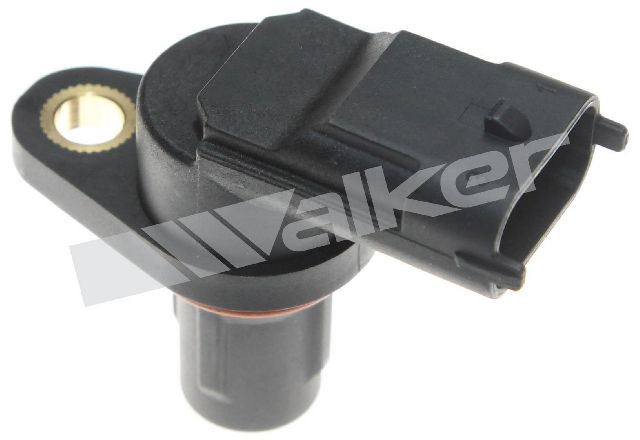
(OEM #4M5Z-6B288-A)— A less common but possible cause. If the VCT system checks out, this sensor could be sending incorrect data.
Trusted brands: Motorcraft, Bosch, NGK/NTK
OEM price range: $35-$60
Aftermarket price range: $20-$45 - Crankshaft Position Sensor
(OEM #1.6L Ti-VCT (non-turbo): BE8Z-6C315-A (Motorcraft DY1705). 1.0L/1.6L EcoBoost (turbo): BM5Z-6C315-A (Motorcraft DY-1196).)— A possible but less likely cause than the VCT system. A failure here would disrupt the PCM's ability to correlate cam and crank signals.
Trusted brands: Motorcraft, Bosch, Delphi
OEM price range: $25-$55
Aftermarket price range: $20-$40
Related Codes That Often Appear With This One
- P0016 — This is the equivalent code for Bank 1, Intake Cam. Since the Fiesta only has Bank 1, this code is more common and points to the same set of VCT/timing issues.
- P0017 — This is the code for Bank 1, Exhaust Cam. It often appears with P0016 and points to the same family of VCT system problems.
- P0011, P0012, P0014, P0015 — These are all VCT-related codes for timing over-advanced or over-retarded conditions, all of which are listed in the same Ford TSBs and point back to sticking VCT solenoids or oil issues.
Technical Service Bulletins (TSBs) & Recalls
- SSM 50067: Notes that various VCT codes, including P0018, may be caused by debris in the VCT solenoid on 2015-2021 Ford vehicles and recommends running pinpoint test HK12 to cycle the solenoid before replacement.
- SSM 48423: Similar to SSM 50067, points to sticking VCT solenoids from debris as the cause for P0018 and other timing codes.
- SSM 54366: Mentions P0018 and directs technicians to use Pinpoint test HK for diagnosis.
- SSM 47170: An earlier TSB that also identifies sticking VCT solenoids from oil debris as the likely cause for a range of timing correlation codes including P0018.
Platform-Specific Known Issues
- A series of Ford Special Service Messages (SSMs), including SSM 50067 and SSM 48423, directly address this code. They state: 'Some 2015-2021 Ford and Lincoln vehicles may exhibit an illuminated MIL with diagnostic trouble codes (DTC) P0011, P0012, P0014, P0015, P0016, P0017, P0018, P0019... This may be due to small debris causing the VCT solenoid to stick.'
- The official Ford diagnostic procedure per TSB SSM 50067 is to first run Pinpoint Test HK12, which attempts to clear the debris by cycling the solenoid 10 times before authorizing a replacement.
- Real-world owner experience: An owner of a 2018 Ford with 141k miles reported a P0018 code along with shuddering and erratic idle. Replacing the Bank 2 VCT solenoid (a $51 part) resolved the issue and the Check Engine Light did not return.
Mechanic-Grade Diagnostic Values
- VCT Solenoid Internal Resistance — expected: 7 to 14 Ohms. Some sources state 6-12 Ohms or 5-20 Ohms.. Failure: Infinite resistance (OL) indicates an open coil. Very low resistance (under 2 Ohms) indicates a shorted coil.
- Camshaft Position Sensor Resistance (1.6L Ti-VCT) — expected: Approximately 482 Ohms, with a tolerance that can include readings like 453 Ohms.. Failure: A reading significantly outside the specified range, or an open/short circuit.
- VCT Solenoid Power Supply Voltage — expected: Battery voltage (approx. 12.3V) with key on, engine off.. Failure: No voltage or significantly low voltage indicates a wiring or fuse issue.
- Camshaft Position Sensor Signal Wire Voltage (3-wire Hall effect type) — expected: Fluctuates between 0V and 5V as the engine runs. Should read around 4.8V to 5V when probing the signal wire with the sensor connected and ignition on.. Failure: No voltage fluctuation, or a constant zero or 5V reading, indicates a failed sensor or circuit issue.
- FORScan VCT PID Monitoring (Hot Idle) — expected: VCT_EXH_DSD (Exhaust Desired) = 0 degrees, VCT_INT_DSD (Intake Desired) = 20 degrees, VCT_DIF (Difference) = 0 degrees.. Failure: Large deviations from these values or a VCT_DIF that swings wildly indicates a problem with the VCT system's ability to control timing.
Scan Tool Commands That Help
- FORScan / Ford IDS: VCT Solenoid On/Off Command (part of Pinpoint Tests) — To manually cycle the VCT solenoids to check for mechanical sticking. Ford's TSBs mention a specific test, HK12, that cycles the solenoid 10 times to attempt to dislodge debris. This can confirm if the solenoid is responding to commands from the PCM.
- FORScan / Ford IDS: Monitor VCT PIDs (e.g., VCT_INT_DSD, VCT_INT_ACT, VCT_DIF) — To observe the desired vs. actual camshaft timing angles in real-time. A large, persistent difference (VCT_DIF) between desired and actual angles points directly to a VCT system fault (solenoid, phaser, or oil pressure).
Wiring & Ground Locations
- Main Engine Ground — A heavy black cable attached to the body under the battery tray, which then connects to a bolt on the engine block or transmission bell housing.. A poor main engine ground can cause erratic behavior in all engine sensors, including the camshaft and crankshaft sensors, leading to correlation codes.
- PCM/ECM Ground — On the frame rail below the air box.. The Powertrain Control Module (PCM) relies on a clean ground reference to accurately interpret sensor signals. A faulty PCM ground can cause misinterpretation of cam/crank signals, triggering P0018.
- Secondary Grounds — Two ground bolts are often located near the brake master cylinder.. Multiple grounds contribute to the overall health of the vehicle's electrical system. While not directly for the cam/crank sensors, poor grounds in this area can introduce electrical noise that affects sensitive sensor circuits.
Real Owner Repair Stories
- Ford F150 Forum (similar 5.0L Ti-VCT engine logic) (2018 Ford F-150 with 5.0L engine) — Rough idle, stalling at stoplights, and a shuddering feeling after long highway drives. Code P0022 (Bank 2 over-retarded, a related VCT code) was present.
❌ Tried (didn't work) Initial diagnosis was uncertain between VCT solenoids and more serious timing phaser issues.
✅ What actually fixed it The user monitored VCT data with FORScan, which showed the Bank 2 intake solenoid was not behaving correctly (swinging wildly). The final recommendation, based on the data, was to replace both the intake and exhaust VCT solenoids on the affected bank.
Model Year Variations Within This Range
- 2015+: Part way through the 2015 model year, the 1.6L EcoBoost engine (used in the Fiesta ST) received an updated cylinder head design to improve cooling and address potential cracking issues seen in other applications of this engine. While this doesn't directly cause P0018, it's a notable mid-cycle engine change.
- 2016+: Vehicles from 2016 onward received the SYNC 3 infotainment system, which is unrelated to this code but helps identify the vehicle's production timeframe. The air intake was also slightly different.
Helpful Videos
We Have This Part in Stock


The information in this article is provided for general reference and educational purposes only. Vehicle specifications, procedures, and part compatibility can vary by production date, trim level, and region. Always consult your vehicle's factory service manual and verify part numbers before purchasing or performing repairs. Safety-critical components such as airbags, seat belts, and braking systems should be installed by a qualified professional.
- Ford FIESTA:
- 🧭 Diagnostic Flowchart
- 🎬 Helpful Videos
- 🛍️ Shop This Part
- What's Unique About the 2015-2019 Ford FIESTA
- Symptoms You May Notice
- Most Likely Causes
- Rare But Worth Checking
- Diagnosis Steps
- Parts You'll Likely Need
- Related Codes That Often Appear With This One
- Technical Service Bulletins (TSBs) & Recalls
- Platform-Specific Known Issues
- Mechanic-Grade Diagnostic Values
- Scan Tool Commands That Help
- Wiring & Ground Locations
- Real Owner Repair Stories
- Model Year Variations Within This Range
- 🎟️ Get 5% Off