

P0019 on 2011-2017 Chrysler 200 3.6L: Crankshaft-Camshaft Correlation Causes and Fixes
On the 3.6L Pentastar V6, P0019 is most often caused by low or dirty engine oil, or a failing VVT solenoid on the Bank 2 (front) exhaust camshaft. Always check the oil level and condition first. If the oil is fine, the VVT solenoid is a likely and affordable fix, costing around $30-$60 for the part. In some cases, a loose oil galley plug under the front valve cover can cause a localized oil pressure drop, triggering the code.
- Always check your engine oil level and condition first. Low or dirty oil is the #1 cause of P0019 on this engine.
- The code refers to the exhaust camshaft on Bank 2, which is the cylinder bank at the FRONT of the vehicle, near the radiator.
- If oil isn't the issue, the VVT solenoid and the camshaft position sensor are the next most likely culprits and are affordable, accessible parts.
- Do not assume a major mechanical failure like a stretched timing chain is the cause until you have definitively ruled out oil, sensor, and solenoid issues.
- If you hear a rattling noise on startup along with this code, the probability of a timing chain issue increases significantly.
What's Unique About the 2011-2017 Chrysler 200
The 3.6L Pentastar V6 uses a Variable Valve Timing (VVT) system that is hydraulically operated and notoriously sensitive to engine oil level, quality, and viscosity. Consequently, a simple issue like overdue oil changes can trigger this code before any hardware has actually failed. Furthermore, this engine is known for specific mechanical issues like rocker arm bearing failure (the 'Pentastar Tick') and loose oil galley plugs under the valve cover, which can also be root causes for P0019.
Generation note: This range covers the first generation (2011-2014) and the second generation (2015-2017) Chrysler 200. Both used the 3.6L Pentastar V6, and the common causes and fixes for P0019 are largely the same. However, early models (2011-2013) are also subject to a specific left cylinder head defect (TSB 09-002-14) which, while typically causing misfire codes, indicates a weakness in the valvetrain on Bank 2. An upgraded version of the Pentastar was introduced in 2016 with a revised VVT system, but the fundamental causes of P0019 remain consistent.
Symptoms You May Notice
- Check Engine Light is on
- Rough or unstable idle
- Hesitation or stumbling during acceleration
- Reduced engine power
- Poor fuel economy
- Engine stalling at low speeds
- Rattling noise from the engine on startup, suggesting a timing chain issue.
- A rhythmic ticking noise ('Pentastar Tick') from the top of the engine, suggesting rocker arm failure.
- Replacing the crankshaft position sensor when the code points specifically to a camshaft correlation issue on Bank 2.
- Replacing the camshaft sensor or VVT solenoid without first checking the engine oil level and condition, which is the most common cause.
- Replacing parts on Bank 1 (firewall side) instead of Bank 2 (radiator side).
Most Likely Causes
- Low, Dirty, or Incorrect Viscosity Engine Oil 🔴 High Probability The Pentastar's cam phasers are hydraulically actuated and highly sensitive to oil pressure and cleanliness. Old or incorrect oil can clog passages in the VVT solenoids and phasers, preventing proper operation.
How to confirm: Check the engine oil dipstick for level and inspect the oil's color and consistency. If it's low, dark, or sludgy, an oil and filter change is the first and most crucial step.
Typical fix: Perform an engine oil and filter change using the manufacturer-specified oil viscosity (typically 5W-20 or 5W-30, check your owner's manual) and a quality filter.
Est. part cost: $40-$80 - Failed VVT Solenoid (Oil Control Valve) 🟡 Medium Probability The solenoid can get clogged with debris from dirty oil or fail electrically, causing it to get stuck in one position and preventing proper camshaft phasing.
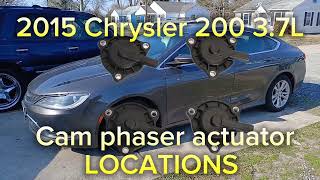
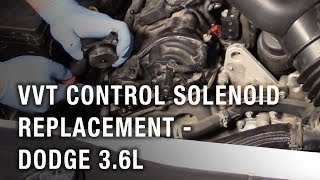
How to confirm: Swap the Bank 2 exhaust solenoid with the Bank 2 intake solenoid (they are identical). Clear the codes and drive. If the code changes to P0018 (Bank 2 Intake), the solenoid is faulty. The Bank 2 solenoids are on the front valve cover, making them relatively accessible. 🎬 Watch: How to locate and remove the VVT solenoids.
Typical fix: Replace the Bank 2 exhaust VVT solenoid.
Est. part cost: $30-$100 - Failed Camshaft Position Sensor 🟡 Medium Probability → Shop Engine Camshaft Position Sensor Sensors are exposed to extreme heat cycles and can fail over time. The notorious Pentastar oil filter housing leak can also drip oil onto the sensor and its connector, causing a failure.
How to confirm: Swap the Bank 2 exhaust sensor with the Bank 1 exhaust sensor (if they are the same part number). Clear codes and drive. If the code changes to P0017 (Bank 1 Exhaust), the sensor is bad. Alternatively, test the sensor's signal with a multimeter or oscilloscope.
Typical fix: Replace the Bank 2 exhaust camshaft position sensor.
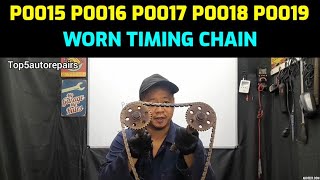
Est. part cost: $25-$75 - Stretched Timing Chain or Failed Tensioner/Guides ⚪ Low Probability → Shop Engine Timing Chain Timing chain stretch is a documented issue on Pentastar engines, typically appearing after 100,000 miles. Wear in the chain, tensioners, or guides creates slack, altering the base cam/crank timing and causing a persistent correlation fault.
How to confirm: This is an advanced diagnosis. A scan tool showing a consistent cam/crank deviation of 8-10 degrees or more is a strong indicator. A rattling noise on startup that quiets down is also a common symptom. Visual inspection requires removing the engine timing cover.
Typical fix: Replace the timing chains, tensioners, and guides. This is a labor-intensive job with shop costs often exceeding $2,000.
Est. part cost: $250-$600 - Failed Camshaft Phaser ⚪ Low Probability → Shop Engine Camshaft The phaser is a mechanical gear that can fail internally, get stuck due to oil sludge, or have its locking pin break, preventing it from adjusting cam timing correctly.
How to confirm: Requires removing the valve cover and possibly the timing cover for inspection. A qualified technician can command the phaser with a bi-directional scan tool to check its response.
Typical fix: Replace the Bank 2 exhaust camshaft phaser. This is often done along with a timing chain service.
Est. part cost: $100-$250
Rare But Worth Checking
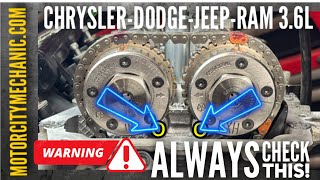
- Loose Oil Galley Plugs: Under the Bank 2 (front) valve cover, there are 13mm oil galley plugs that can loosen over time, causing a localized drop in oil pressure to the phasers and valvetrain. This is a well-known issue in the mechanic community. If the valve cover is off for any other diagnosis, it is critical to check that these plugs are tight (torque spec is 156 in-lbs or ~13 ft-lbs). 🎬 See why checking these loose oil galley plugs is critical.
- Slipped Camshaft Tone Ring: → Shop Engine Camshaft The reluctor wheel that the camshaft sensor reads is press-fit onto the camshaft. In rare cases, it can slip, causing a persistent timing correlation error that won't be fixed by replacing sensors or solenoids.
- Failed Rocker Arms: The widespread 'Pentastar Tick' is caused by failing rocker arm bearings. A seized rocker can score the camshaft lobe, impeding its rotation and potentially causing enough drag to throw off the cam/crank correlation, triggering a P0019 code.
Diagnosis Steps
- Check Engine Oil: Verify the oil level is full and the oil is clean and of the correct viscosity (5W-20 or 5W-30). If low or dirty, perform an oil and filter change, clear the code, and see if it returns. This is the most common and cheapest fix.
- Scan for Other Codes: Use an OBD-II scanner to see if any other codes are present. Codes for misfires (P0302, P0304, P0306) or other cam sensor faults (P0018, P0394) can help narrow down the diagnosis.
- Inspect Wiring: Visually inspect the wiring harness and connector for the Bank 2 (front, exhaust) camshaft position sensor and VVT solenoid. Look for signs of damage, corrosion, or oil contamination from a leaking oil filter housing.
- Test the VVT Solenoid: Swap the Bank 2 exhaust VVT solenoid with the Bank 2 intake solenoid (they are identical and located on the front valve cover). Clear the codes. If the fault code changes to P0018, the solenoid is bad and needs to be replaced.
- Test the Camshaft Sensor: If the solenoid swap doesn't identify the issue, swap the Bank 2 exhaust camshaft sensor with the Bank 1 exhaust sensor (rear bank). Clear the codes. If the fault changes to P0017, the sensor is bad.
- Advanced Mechanical Diagnosis: If all previous steps fail, the issue is likely mechanical. This involves removing the valve cover to inspect for loose oil galley plugs, failed rocker arms, or a damaged camshaft. If those are fine, the next step is inspecting the cam phaser and timing chain system, which should be performed by a professional technician.
Parts You'll Likely Need
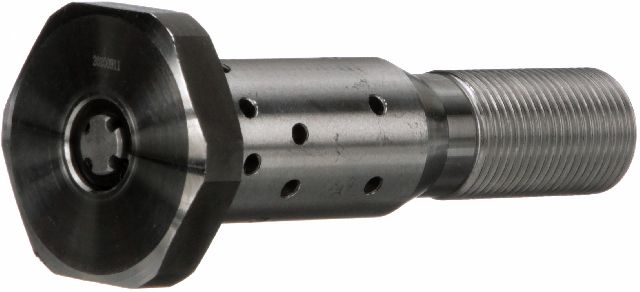
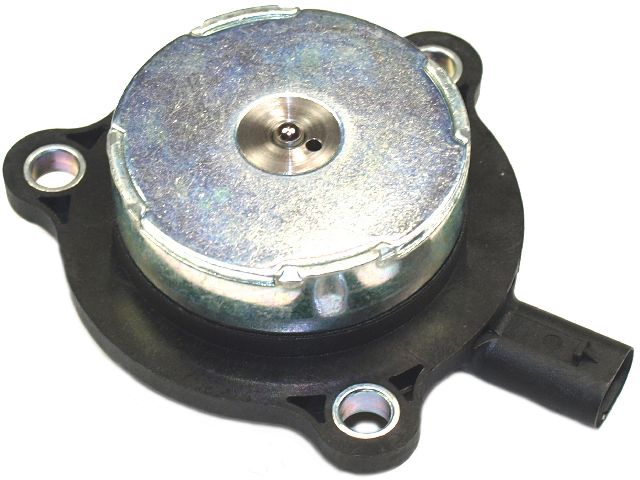
- Variable Valve Timing (VVT) Solenoid / Oil Control Valve
(OEM #5184101AG (superseded by 5184101AH))— This solenoid controls oil flow to the cam phaser and is a frequent failure
Related Codes That Often Appear With This One
- P0018 — This is the correlation code for the intake camshaft on the same bank (Bank 2). If both appear together, it strongly suggests a problem affecting the entire bank, like a stretched timing chain, a bank-wide oil pressure issue (e.g., loose galley plugs), or a problem with the main timing gear for that bank.
- P0349 / P0394 — These codes indicate an intermittent circuit fault for the Bank 2 camshaft sensors ('B' sensor is P0394). They can appear with P0019 if the sensor is failing electrically, its wiring is damaged, or if a mechanical issue (like a bad phaser or damaged tone ring) is causing erratic readings.
- P0300, P0302, P0304, P0306 — These are random and specific cylinder misfire codes for Bank 2 (cylinders 2, 4, 6). Incorrect exhaust cam timing disrupts the engine's breathing, leading to incomplete combustion and misfires on the affected cylinders. On 2011-2013 models, these codes are also the primary symptom of the left cylinder head defect.
Technical Service Bulletins (TSBs) & Recalls
- While not directly for P0019, related TSBs like 18-059-16 and 18-049-20 were issued for other camshaft sensor codes (P0394, P0390) on Pentastar engines due to the PCM software being overly sensitive. This indicates a history of software-related timing fault detection issues that could be relevant.
Platform-Specific Known Issues
- The 3.6L Pentastar engine is known for a ticking noise caused by failing rocker arm bearings. If left unaddressed, this can cause damage to the camshafts, potentially contributing to timing codes.
- The oil filter/cooler housing assembly, located in the engine valley, is made of plastic and is prone to cracking, causing oil leaks that can drip down and contaminate sensors and wiring at the back of the engine, including the Bank 2 sensor connector.
Mechanic-Grade Diagnostic Values
- Engine Oil Pressure (Warm Engine) — expected: Minimum 5 PSI at curb idle; Minimum 30 PSI at 1200 RPM; 62-139 PSI from 3501-6400 RPM. The Pentastar uses a two-stage oil pump, with stage 1 pressure around 30 PSI and stage 2 (above 3000 RPM) around 75 PSI.. Failure: Pressure below the minimum specification at any given RPM, especially at idle, can prevent the VVT phasers from operating correctly.
- Cam/Crank Difference (Live Scan Tool Data) — expected: Ideally less than +/- 5 degrees at idle on a warm engine.. Failure: A consistent deviation of more than 8-10 degrees that does not resolve with an oil change or solenoid replacement strongly suggests a mechanical timing issue (stretched chain, slipped tone ring).
- VVT Solenoid (Oil Control Valve) Resistance — expected: Approximately 6.9 to 7.9 ohms at 68°F (20°C). Some sources suggest a broader range of 6 to 12 ohms.. Failure: A reading of 0 ohms (short circuit) or infinite resistance (open circuit) indicates a failed solenoid.
- Camshaft Position Sensor Voltage (Key On, Engine Off) — expected: A 5-volt supply should be present on the supply wire. The signal wire should toggle between 5V and 0V when a magnet is passed over the sensor tip.. Failure: Absence of the 5V supply points to a wiring or PCM issue. A signal that does not switch indicates a faulty sensor.
Scan Tool Commands That Help
- wiTECH, Autel, Snap-on, or other professional bidirectional scanner: VVT Solenoid Actuator Test — To verify the mechanical function of the VVT solenoid. The command cycles the solenoid on and off; the technician should listen for an audible click and observe a change in engine idle, confirming the solenoid is not stuck.
- wiTECH, Appcar DiagFCA, or equivalent: Cam/Crank Relearn — This is mandatory after replacing a camshaft sensor, crankshaft sensor, PCM, or any physical timing components (chain, phasers). It synchronizes the new components' positions with the PCM. The engine must be warmed up for the procedure to run.
Wiring & Ground Locations
- Bank 2 Camshaft Position Sensor Connector — On the Bank 2 (front, near radiator) valve cover. It is a 4-pin connector for a sensor body that contains two separate sensors (intake and exhaust). Access requires removing the upper intake manifold.. This is the primary connection point for testing the sensor and its circuit. It is prone to oil contamination from leaks. The pinout is: Pin 1: Exhaust CMP Signal (for P0019/P0394), Pin 2: Sensor Ground, Pin 3: Intake CMP Signal, Pin 4: 5-Volt Supply.
- Ground G302 — Located at the left kick panel inside the vehicle.. This is a common data ground point. While not a direct engine ground, a poor connection here can cause a variety of data-related DTCs and communication issues with the PCM.
- Harness Chafe Points — The wiring harness leading to the Bank 1 (rear) sensor is known to be short and under strain, but similar stress can occur on the Bank 2 harness. Check where the harness routes around the back of the cylinder head and near brackets.. Constant tension or rubbing can cause intermittent wire breaks or shorts, leading to sensor circuit codes (like P0394) that may accompany P0019.
Real Owner Repair Stories
- YouTube Channel 'MotorCity Mechanic' (2014 Dodge Avenger 3.6L Pentastar (similar setup to Chrysler 200)) — Check engine light with timing codes P0018 and P0019.
❌ Tried (didn't work) The vehicle had already been to another shop where VVT solenoids and camshaft sensors were replaced without fixing the issue.
✅ What actually fixed it The technician removed the Bank 2 (front) valve cover and found two loose oil galley plugs. He tightened them to the specified torque (13 ft-lbs). This restored proper oil pressure to the cam phasers and resolved the codes.
OEM Part Supersession History
5184101AG→5184101AH— Likely an internal revision to improve reliability or address a known failure mode in the VVT solenoid (Oil Control Valve).5149141AD, 5149141AE→5149141AF— Revisions to the camshaft position sensor to improve durability and signal accuracy.
Heads up: While aftermarket sensors exist, using an OEM Mopar sensor is often recommended to avoid compatibility issues with the PCM.
Model Year Variations Within This Range
- 2011-2015: These models use the first-generation Pentastar V6. The recommended oil viscosity was originally 5W-30, but a TSB later recommended switching to 5W-20 to improve VVT system performance in some conditions. The 2011-2013 models are particularly susceptible to the left cylinder head failure.
- 2016-2017: These models feature the upgraded Pentastar engine (PSU). Changes include a two-stage variable valve lift (VVL) system, cooled EGR, and an increased compression ratio (11.3:1). While more efficient, the fundamental VVT system design and its sensitivity to oil quality remain, and it is still susceptible to the same causes for P0019.
Diagnostic Flowchart
Other Known Issues on This Vehicle
Issues unrelated to this code that are worth knowing about as an owner of this generation:
- Cracked Oil Filter Housing/Cooler Assembly 🔴 High — Extremely common across all Pentastar applications. The plastic housing becomes brittle from heat cycles and cracks, causing significant oil and/or coolant leaks into the engine valley.
- Rocker Arm Bearing Failure ('Pentastar Tick') 🔴 High — A widespread and well-documented issue where the needle bearings in the rocker arms fail, causing a distinct ticking sound. If ignored, it can lead to camshaft lobe damage, misfires, and catastrophic engine failure.
- Left Cylinder Head Defect 🔴 High — Primarily affects 2011-2013 models. A manufacturing defect caused premature wear of the valve guides on the left cylinder head (Bank 2), leading to misfires on cylinders 2, 4, and 6. (Ref: TSB 09-002-14; Extended Warranty X56 (10 years/150,000 miles))
- Totally Integrated Power Module (TIPM) Failure 🟠 Medium — Some first-generation models experienced issues with the TIPM, leading to random electrical problems, including fuel pump failure or random airbag deployment. (Ref: Recalls were issued for other FCA models but not specifically for the 200, though the issue is similar.)
Used vs. New Parts: Buying Guide for This Vehicle
When a used part is the smart pick: For this repair, used parts are generally not recommended due to the critical nature of timing components and the high failure rate of sensors and solenoids. A used valve cover or wiring connector could be a viable option if the original is physically damaged.
Donor-vehicle mileage cap: roughly under 80000 miles for the part to have meaningful remaining life.
What to inspect on the donor part:
- For any used part, ensure the donor vehicle was not in a severe front-end collision.
- If sourcing an engine component, ask for the VIN to check the vehicle's history for regular maintenance.
- Inspect connectors for brittle plastic, corrosion, or cut wires.
- Avoid parts from engines with visible oil sludge or heavy external leaks.
OEM-only on this vehicle (don't cheap out):
- Camshaft Position Sensor: Strongly recommended to use OEM Mopar (part no. 5149141AF) as many aftermarket versions have been reported to fail prematurely or cause compatibility issues.
- Timing Chain Kit (Chains, Guides, Tensioners): This is a critical, labor-intensive job. Using OEM Mopar or a top-tier aftermarket kit (e.g., Cloyes) is essential for longevity.
- Camshaft Phasers: Due to their complexity and importance, OEM phasers are the safest choice.
Aftermarket brands forum-validated for this vehicle:
- VVT Solenoid: Standard Motor Products (SMP), NTK/NGK.
- Oil Filters: Mopar, Wix, Purolator, Mobil 1.
- Engine Oil: Any full synthetic oil meeting Chrysler MS-6395 specification (e.g., Pennzoil Platinum, Mobil 1, Valvoline Advanced).
Brands owners have reported issues with on this vehicle:
- Unbranded 'white-box' sensors and solenoids from online marketplaces are a significant risk and often fail quickly.
- Avoid using conventional oil or blends; the Pentastar VVT system is designed for and performs best with full synthetic oil.
Real Owner Stories
Aggregated from forums and TSBs cited above. Mileages and costs reflect what owners reported in those sources.
2012 Chrysler Town & Country 3.6L Pentastar
Symptoms: Vehicle threw a P0019 code.
What fixed it: The owner investigated and found the issue was related to the crankshaft/camshaft position correlation on Bank 2.
Source hint: https://www.allpar.com/threads/p0019-code-on-my-2012-t-c-3-6.168515/
2012 Dodge Grand Caravan 3.6L Pentastar
Symptoms: P0019 and P0018 codes present; replacing sensors and solenoids did not resolve the issue.
What fixed it: Found loose oil galley plugs under the valve cover.
Source hint: Reddit - r/MechanicAdvice
2011-2017 Chrysler 200 3.6L Pentastar — ~100000 miles
Symptoms: Rattling noise from the engine on startup and a persistent correlation fault.
What fixed it: Replacement of the timing chains, tensioners, and guides due to chain stretch.
Cost: $2,000+
Source hint: Article Context - Common Causes (Stretched Timing Chain)
Related OBD-II Codes
Frequently Asked Questions
Could the 'Pentastar Tick' I hear in my Chrysler 200 be related to the P0019 code?
I have a P0019 on my 2012 Chrysler 200; are there any software updates for this?
Can a leak from my oil filter housing cause a P0019 code?
Is it true that loose parts inside the engine can cause this code on the 3.6L Pentastar?
What is the most common first step for a P0019 on a Chrysler 200 with the 3.6L engine?
Helpful Videos

We Have This Part in Stock

The information in this article is provided for general reference and educational purposes only. Vehicle specifications, procedures, and part compatibility can vary by production date, trim level, and region. Always consult your vehicle's factory service manual and verify part numbers before purchasing or performing repairs. Safety-critical components such as airbags, seat belts, and braking systems should be installed by a qualified professional.
- Chrysler 200:
- 🧭 Diagnostic Flowchart
- 🎬 Helpful Videos
- 🛍️ Shop This Part
- What's Unique About the 2011-2017 Chrysler 200
- Symptoms You May Notice
- Most Likely Causes
- Rare But Worth Checking
- Diagnosis Steps
- Parts You'll Likely Need
- Related Codes That Often Appear With This One
- Technical Service Bulletins (TSBs) & Recalls
- Platform-Specific Known Issues
- Mechanic-Grade Diagnostic Values
- Scan Tool Commands That Help
- Wiring & Ground Locations
- Real Owner Repair Stories
- OEM Part Supersession History
- Model Year Variations Within This Range
- Other Known Issues on This Vehicle
- Used vs. New Parts: Buying Guide for This Vehicle
- Real Owner Stories
- 2012 Chrysler Town & Country 3.6L Pentastar
- 2012 Dodge Grand Caravan 3.6L Pentastar
- 2011-2017 Chrysler 200 3.6L Pentastar — ~100000 miles
- Related OBD-II Codes
- Frequently Asked Questions
- 🎟️ Get 5% Off