

P0073 on 2016-2020 Ram 2500: Causes and Fixes for Ambient Air Temperature Sensor
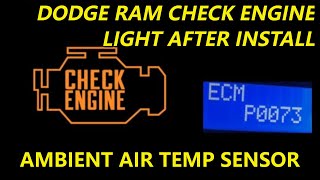
P0073 on a 2016-2020 Ram 2500 almost always means the Ambient Air Temperature (AAT) sensor is faulty or its wiring is damaged. The sensor is often located in the driver's side mirror, making it a common and inexpensive DIY fix, with parts costing around $15-$50. Broken wires in the door jamb boot are an extremely common cause and should be inspected before replacing parts.
- P0073 on a 2016-2020 Ram 2500 points to a high voltage signal from the Ambient Air Temperature (AAT) sensor.
- The most common cause is a failed sensor, often located in the driver's side mirror, or damaged wiring in the door jamb.
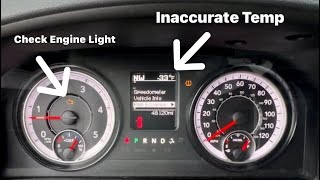
- Symptoms include a Check Engine Light, incorrect outside temperature on the dash (e.g., -40°F), and malfunctioning automatic A/C.
- The fix is usually simple and inexpensive: replace the sensor (a $15-$50 part) or repair the wiring.
- Before buying parts, always inspect the wiring in the driver's door boot first, as this is a known weak point.
What's Unique About the 2016-2020 Ram 2500
On many 4th and 5th generation Ram trucks, the ambient air temperature sensor is located in the driver's side mirror assembly. This placement makes it particularly vulnerable to damage from side-swipes, car washes, and moisture intrusion. The wiring that runs through the rubber boot in the door jamb is a very common failure point due to repeated opening and closing of the door, causing wires to fatigue and break. This code is also frequently triggered after installing aftermarket tow mirrors that either lack the sensor, use a low-quality one that fails under heat, or are installed without a necessary relocation harness.
Diagnostic Flowchart
Tap your situation to follow the diagnostic path that matches what you're seeing on this vehicle.
Generation note: This range covers the end of the Fourth Generation (2016-2018) and the start of the Fifth Generation (2019-2020). For both generations, the AAT sensor is commonly found in the driver's side mirror, making the causes and fixes very similar. However, on some trims or earlier models, the sensor might be located behind the grille, so always verify the location on your specific truck before purchasing parts.
Symptoms You May Notice
- Check Engine Light is on.
- Incorrect outside temperature displayed on the dashboard (often showing a default low value like -40°F).
- Automatic climate control (A/C and heat) does not work properly or at all.
- Remote start features tied to temperature (like heated seats/wheel) may not activate correctly.
- A/C blows hot air because the system thinks it is extremely cold outside.
- Replacing the A/C compressor or other climate control components before diagnosing the AAT sensor circuit.
- Replacing the Intake Air Temperature (IAT) sensor, which is a different sensor used for engine management.
- Replacing the AAT sensor multiple times when the actual fault is a broken wire in the door jamb.
Most Likely Causes
- Damaged Wiring or Connector 🔴 High Probability The wiring harness that runs through the rubber boot between the driver's door and the A-pillar is a well-documented, high-failure area. The constant flexing from the door opening and closing causes the wires to fatigue and break over time, creating an open circuit that triggers P0073.
How to confirm: Peel back the rubber boot in the driver's door jamb and thoroughly inspect the wires for breaks, chafing, or damage. The AAT sensor wires are often the first to break. Check the sensor connector under the mirror for corrosion or pushed-out pins. Use a multimeter to check for continuity between the sensor connector and the Driver Door Module (DDM) connector.
Typical fix: Repair the broken wire(s). This involves soldering the broken ends, ideally adding a small section of new wire for flexibility, and protecting the repair with heat shrink tubing. Some owners replace the entire door harness if multiple wires are broken.
Est. part cost: $1-$10 for repair materials - Faulty Ambient Air Temperature (AAT) Sensor 🟡 Medium Probability → Shop Ambient Air Temperature Sensor The sensor is located in the driver's side mirror on many models, exposing it to weather, moisture, and physical damage. The plastic can become brittle and break. Aftermarket sensors included with cheap mirror assemblies are also known to fail, sometimes only when heated by the sun.
How to confirm: Visually inspect the sensor for physical damage. Test the sensor's internal resistance with a multimeter. At ~79°F (26°C), it should read around 9.45 kOhms. An open circuit (infinite resistance) means the sensor is bad.
Typical fix: Replace the AAT sensor. This is often a simple process of removing a small panel under the mirror, disconnecting the old sensor, and plugging in the new one.
Est. part cost: $15-$50 - Incorrect Aftermarket Mirror Installation 🟡 Medium Probability Many owners install aftermarket towing mirrors. If these mirrors do not include a provision for the AAT sensor or if the owner doesn't transfer the old one, it will immediately trigger a P0073 code.
How to confirm: Check if the code appeared immediately after installing new mirrors. Verify if the aftermarket mirrors are equipped with an AAT sensor. Many require a separate harness to be purchased and installed.
Typical fix: Install a dedicated sensor relocation harness, such as those from Boost Auto Parts, which adds the sensor and wiring into the mirror's connector. Alternatively, replace the mirrors with a model that correctly incorporates the sensor.
Est. part cost: $30-$60 for a relocation harness
Rare But Worth Checking
- Faulty Powertrain Control Module (PCM) or Body Control Module (BCM): → Shop Engine Control Module (ECM) This is extremely rare. Before suspecting the PCM or BCM, all other possibilities (sensor, wiring, connectors) must be exhaustively ruled out. TSB S2208000162 points to a wiring issue before a module issue.
- Blown Fuse: While less common for a 'circuit high' code, it's worth checking related fuses. On some Ram trucks, fuse F99 (10A) in the main fuse box is associated with temperature sensor circuits and should be inspected. 🎬 Watch: How to check the fuse for ambient temperature sensor issues.
Diagnosis Steps
- Verify the code P0073 is active using an OBD-II scanner.
- Check the outside temperature reading on the dashboard. An illogical value like -40°F is a strong indicator of an open circuit fault.
- Visually inspect the AAT sensor, which is typically a small probe on the underside of the driver's side mirror. Check for obvious damage, corrosion, or if it's missing entirely.
- Crucial Step: Carefully peel back the rubber boot between the driver's door and the truck body. Thoroughly inspect the bundle of wires for any breaks, pinches, or chafed insulation. This is the most common point of failure.
- If wiring in the door jamb is intact, disconnect the sensor connector under the mirror. Check for a 5-volt reference signal on the signal wire (often designated G31) with the key on. A reading above 5.2V could indicate a short to voltage, while no voltage could mean a break further up the harness.
- If wiring seems okay, test the sensor itself. Measure the resistance across the sensor's pins. It should not be an open circuit (infinite resistance). The resistance should be around 9.45 kOhms at 79°F (26°C).
- If a new aftermarket mirror was recently installed, confirm it came with a sensor or that a relocation harness was correctly installed. The white and black wires from the harness typically go into specific empty slots in the main mirror connector. 🎬 See how to install a relocation harness after adding tow mirrors.
- If the sensor and wiring test good, the problem could be intermittent or, in very rare cases, an issue with the Driver Door Module (DDM) or Body Control Module (BCM).
Parts You'll Likely Need
- Ambient Air Temperature Sensor
(OEM #68457701AA)— This is a common failure point for this code, though wiring should be checked first. The sensor itself fails due to exposure or physical damage. The OEM part number 68457701AA supersedes 68138681ab, 68138681ac, 68138681ad, and 68138681ae.
Trusted brands: Mopar, Dorman, Standard Motor Products (SMP)
OEM price range: $11-$20
Aftermarket price range: $12-$30 - Ambient Air Temperature Sensor Relocation Harness — This is required if aftermarket tow mirrors are installed without a built-in AAT sensor. It provides the sensor and wiring to plug into the factory mirror harness to resolve the CEL.
Trusted brands: Boost Auto Parts
OEM price range: N/A
Aftermarket price range: $30-$50
Related Codes That Often Appear With This One
- P0072 — This code is for 'Ambient Air Temperature Sensor Circuit Low,' which is the opposite fault for the same sensor. Seeing both could indicate an intermittent wiring problem. The TSB #18-044-26 lists them together.
- U113D-00 — TSB #S2208000162 cites this code, 'Lost Communication with Master Power Window Switch,' alongside P0073. This strongly suggests a wiring issue within the driver's door harness, as both the AAT sensor and window switch signals run through it.
Technical Service Bulletins (TSBs) & Recalls
- 18-044-26: Mentions P0073-00 - Ambient Air Temperature Sensor Circuit "A" High.
- S2208000080: Cites P0073 Ambient Air Temperature Sensor Circuit High.
- S2208000162: Cites P0073 Ambient Air Temperature Sensor Circuit High along with a window switch communication code, strongly indicating a door harness issue.
Platform-Specific Known Issues
- TSB #18-044-26 mentions P0073-00 as a potential code that may be active or stored, related to sensor performance.
- TSB #S2208000080 links P0073 to a circuit high condition, potentially shorted to battery or open, confirming the code's meaning.
- TSB #S2208000162 documents P0073 appearing alongside a communication loss code for the power window switch (U113D-00), pointing directly to a likely wiring harness issue in the driver's door jamb where both circuits run.
Mechanic-Grade Diagnostic Values
- AAT Sensor Connector Voltage (Key On, Sensor Disconnected) — expected: ~5.0 Volts. Failure: Voltage above 5.2V suggests a short to voltage; no voltage suggests an open wire upstream.
- AAT Signal Circuit to DDM Resistance — expected: Below 5.0 Ohms. Failure: Resistance above 5.0 Ohms indicates an open or high resistance in the signal wire.
- AAT Sensor Resistance at -40°F (-40°C) — expected: ~336 kOhms. Failure: Infinite resistance (Open Line) indicates a failed sensor.
- AAT Sensor Resistance at ~79°F (26°C) — expected: ~9.45 kOhms. Failure: A reading of infinite resistance or one that doesn't change with temperature points to a bad sensor.
Scan Tool Commands That Help
- High-end scan tool (e.g., wiTECH, Autel): Read Live Data from Body Control Module (BCM) and Driver Door Module (DDM) — Use this to see the raw temperature data being reported by the DDM to the BCM. This can help determine if the fault is between the sensor and DDM, or between the DDM and other modules.
Wiring & Ground Locations
- (G31) AAT Signal Circuit — This is the specific wire running from the AAT sensor connector to the Driver Door Module (DDM) inside the driver's door panel.. An open or high resistance in this specific wire is the direct cause of a P0073 code. Diagnostic procedures require checking continuity on this circuit between the sensor and the DDM.
- Driver Door Module (DDM) — Located inside the driver's door panel, behind the main interior trim.. The AAT sensor's two wires connect directly to the DDM. The DDM reads the sensor's resistance, converts it to a temperature value, and sends it to the BCM over the CAN bus. A fault in the DDM itself can cause P0073.
- Door Harness Connector — The large, main electrical connector located inside the rubber boot between the driver's door and the A-pillar.. This is the most common physical location for wire fatigue and breakage due to the door's movement, affecting the (G31) signal circuit among others.
- AAT Sensor Wires (at sensor) — Typically a Black wire and a White wire within a small 3-pin connector under the driver's mirror, though only two wires are used.. Knowing the wire colors helps in testing and when installing aftermarket harnesses, which may require pinning these wires into the main mirror connector.
Real Owner Repair Stories
- Owner forums, corroborated by technical articles (2016 Ram 1500) — P0073 code, -40°F temperature display, and A/C not working.
❌ Tried (didn't work) Replacing the AAT sensor multiple times.
✅ What actually fixed it The final fix was replacing the Driver Door Module (DDM). The module itself had failed internally, preventing it from correctly reading the (good) sensor and sending the data to the BCM. This was suspected because other door-related codes like U113D-00 were also present. - 2CarPros Forum (2016 Ram 1500) — P0073 and -40°F reading after installing aftermarket mirrors.
❌ Tried (didn't work) Assuming the included sensor was correct or compatible.
✅ What actually fixed it The issue was an open circuit because the aftermarket mirror's sensor was not pinned correctly for the truck's door module. The fix required identifying the correct two wires in the door harness (violet/light green and violet/brown in one example) and ensuring the new sensor was properly connected to them, or installing a dedicated relocation harness.
OEM Part Supersession History
68138681ab, 68138681ac, 68138681ad, 68138681ae→68457701AA— Standard part evolution, likely for improved durability, material composition, or supplier change. No known incompatibility issues.
Model Year Variations Within This Range
- 2016-2020: While the P0073 fault logic is consistent, the data path is a key detail. The AAT sensor signals the Driver Door Module (DDM), which then communicates to the Body Control Module (BCM), which finally relays the information to the Powertrain Control Module (PCM) where the code is ultimately set. This multi-step communication path means a failure can occur at the DDM or BCM level, not just at the sensor or its direct wiring.
Helpful Videos

We Have This Part in Stock



The information in this article is provided for general reference and educational purposes only. Vehicle specifications, procedures, and part compatibility can vary by production date, trim level, and region. Always consult your vehicle's factory service manual and verify part numbers before purchasing or performing repairs. Safety-critical components such as airbags, seat belts, and braking systems should be installed by a qualified professional.
- Ram 2500:
- 🧭 Diagnostic Flowchart
- 🎬 Helpful Videos
- 🛍️ Shop This Part
- What's Unique About the 2016-2020 Ram 2500
- Symptoms You May Notice
- Most Likely Causes
- Rare But Worth Checking
- Diagnosis Steps
- Parts You'll Likely Need
- Related Codes That Often Appear With This One
- Technical Service Bulletins (TSBs) & Recalls
- Platform-Specific Known Issues
- Mechanic-Grade Diagnostic Values
- Scan Tool Commands That Help
- Wiring & Ground Locations
- Real Owner Repair Stories
- OEM Part Supersession History
- Model Year Variations Within This Range
- 🎟️ Get 5% Off