

P0087 on 2010-2019 Ford Taurus 3.5L EcoBoost: Low Fuel Rail Pressure Causes and Fixes
On the 3.5L EcoBoost Taurus, P0087 almost always points to a failing High-Pressure Fuel Pump (HPFP). Expect to pay $300-$600 for an OEM pump. Before replacing it, check for a faulty Fuel Pump Driver Module (FPDM) and the low-pressure fuel pump, which are common and cheaper failure points that can starve the HPFP.
- P0087 on a 3.5L EcoBoost Taurus means the high-pressure fuel system is failing.
- The most common cause is a failing High-Pressure Fuel Pump (HPFP), a known issue on this engine.
- Before spending money on an expensive HPFP, always check the cheaper and easier to replace Fuel Pump Driver Module (FPDM), as it is also a common failure point.
- Use a scan tool to watch desired vs. actual fuel rail pressure under load; a large discrepancy points directly to a bad HPFP.
- If you replace the HPFP, you must also replace the cam follower (tappet) to avoid damaging the new pump.
What's Unique About the 2010-2019 Ford Taurus
The 3.5L EcoBoost V6 is a Gasoline Direct Injection (GDI) engine, which operates with extremely high fuel pressures—often over 2,000 PSI, with some systems capable of 3,625 PSI. Unlike traditional port-injected engines, this system has both a low-pressure and a high-pressure fuel pump. The High-Pressure Fuel Pump (HPFP) is a known failure point on this platform and is the most common cause of a P0087 code. Additionally, the Fuel Pump Driver Module (FPDM), which controls the in-tank low-pressure pump, is also a frequent point of failure and can cause symptoms that mimic a bad pump. A failing FPDM can starve the HPFP, leading to the P0087 code even if the HPFP is healthy.
Symptoms You May Notice
- Check Engine Light is on
- Significant loss of power, especially during acceleration or under load
- Engine hesitation or stumbling, particularly above 4,000 RPM
- Rough or uneven idle
- Engine stalling, sometimes without warning
- Difficulty starting the engine
- Reduced fuel economy
- Replacing the in-tank (low-pressure) fuel pump without first diagnosing the FPDM and HPFP. The low-pressure pump is less likely to be the sole cause of P0087 on this engine.
- Replacing the HPFP without confirming the low-pressure fuel system (FPDM and in-tank pump) is supplying it with adequate pressure.
Most Likely Causes
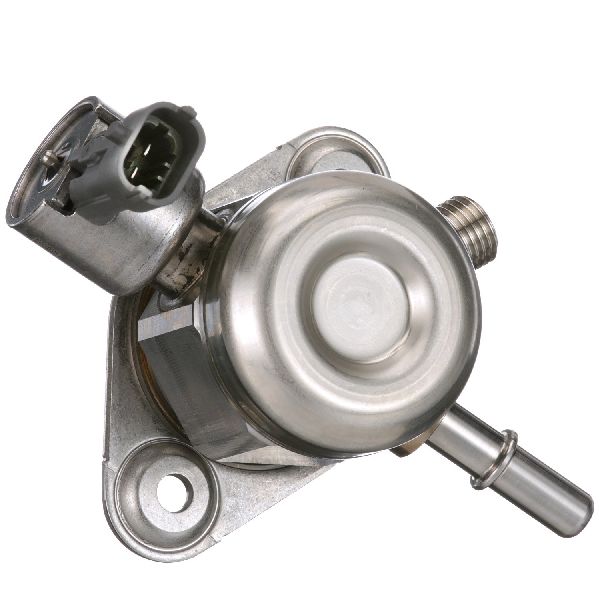
- Failing High-Pressure Fuel Pump (HPFP) 🔴 High Probability → Shop Fuel Pump The HPFP is a mechanical pump driven by the camshaft. It is a common wear item on the 3.5L EcoBoost platform and is frequently the root cause of P0087. The pump's internal components can wear out, reducing its ability to generate the high pressures required for direct injection.
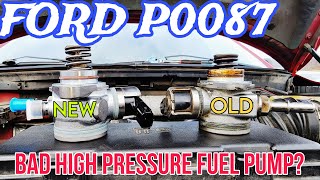
How to confirm: Use a capable OBD-II scanner to monitor 'Fuel Rail Pressure (Desired)' vs. 'Fuel Rail Pressure (Actual)'. Under load (e.g., hard acceleration), if the actual pressure cannot keep up with the desired pressure and drops significantly, the HPFP is likely failing. 🎬 Watch: How to diagnose a failing high pressure fuel pump. A visual inspection after removal may show a compressed internal spring compared to a new unit. Also inspect the cam follower for wear.
Typical fix: Replace the High-Pressure Fuel Pump and the associated cam follower (tappet). It is critical to replace the follower to prevent premature failure of the new pump. Some owners on forums like SHOForum.com report this as the definitive fix after ruling out the low-pressure system.
Est. part cost: $300-$800 - Faulty Fuel Pump Driver Module (FPDM) 🟡 Medium Probability → Shop Fuel Pump The FPDM (also called Fuel Pump Control Module) is known to fail on this platform, sometimes due to overheating. Ford issued a recall (16S31 / NHTSA 16V621000) for this part on 2013-2015 models, but failures occur outside the recall scope as well. A bad module can't properly command the in-tank pump, starving the HPFP of fuel.
How to confirm: Check for related trouble codes (like P008A). Test for power at the in-tank fuel pump while cranking. The module is located behind the rear passenger seat trim panel and can be tested or swapped with a known-good unit. 🎬 See how to troubleshoot a faulty fuel pump driver module. A diagnostic check with a DVOM can verify the duty cycle signal from the PCM and the output to the pump.
Typical fix: Replace the Fuel Pump Driver Module. This is a relatively simple and inexpensive fix compared to the HPFP. The Motorcraft part is CM5250.
Est. part cost: $60-$100 - Failing Fuel Rail Pressure Sensor ⚪ Low Probability → Shop Fuel Pressure Sensor
How to confirm: Compare the fuel pressure reading from a mechanical gauge to the data reported by the sensor on a scan tool. If the readings are significantly different, the sensor is likely faulty. However, accessing this sensor is extremely difficult as it is located under the intake manifold, making this a labor-intensive diagnosis. Owners on forums like 2CarPros have confirmed the difficult location.
Typical fix: Replace the fuel rail pressure sensor. This is labor-intensive due to its location, with shops quoting 4-5 hours of labor.
Est. part cost: $70-$150 - Failing In-Tank Low-Pressure Fuel Pump ⚪ Low Probability → Shop Fuel Pump
How to confirm: Connect a mechanical fuel pressure gauge to the low-pressure fuel system. The pressure should be steady and within manufacturer specifications (typically around 65-75 PSI). If the pressure is low or erratic, the in-tank pump may be failing. A user on SHOForum.com noted that for the turbo application, the correct Motorcraft part is PFS1024.
Typical fix: Replace the in-tank fuel pump assembly. On 2010-2019 models, this can be accessed under the rear seat without dropping the fuel tank.
Est. part cost: $200-$400
Rare But Worth Checking
- Leaking Fuel Injector: → Shop Fuel Injector A fuel injector stuck open can cause a drop in rail pressure, but it will usually be accompanied by a misfire code for a specific cylinder (e.g., P030X) and excessive smoke from the exhaust. A forum member on SHOForum.com mentioned this is a typical cause when P0087 is coupled with a misfire.
- Worn Camshaft Lobe: → Shop Engine Camshaft The HPFP is driven by a lobe on the camshaft. In very high-mileage or poorly maintained engines, this lobe can wear down, preventing the pump from generating sufficient pressure. This should be inspected when the HPFP is replaced. A related manufacturer report, NHTSA ODI #11360172, notes instances where the high-pressure pump grinding into the top of the camshaft caused fuel rail failure and code P0087.
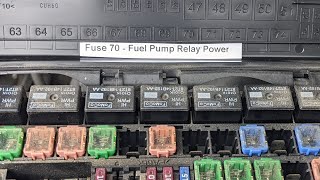
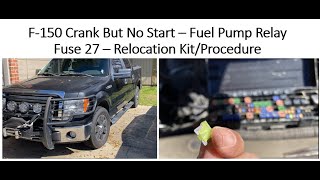
- Melted Fuse F27 in Battery Junction Box: On some related Ford platforms like the F-150, a TSB (15-0137) was issued for the fuel pump power fuse (F27) overheating and melting, causing a stall or no-start. While not specific to the Taurus, it's a known Ford issue from this era that can cause fuel delivery failure. The fix involves relocating the fuse to an unused slot with a heavier-duty wire using a kit (EL3Z-14293-A). 🎬 Watch: How to perform the Fuse 27 relocation TSB fix.
- Failed Diverter Valve: While less common on the Taurus, NHTSA ODI #11633930 describes a case on a similar Ford engine where a failed diverter valve caused a loss of acceleration and triggered code P0087.
Diagnosis Steps
- Use an OBD-II scanner to confirm P0087 and check for any other codes, like P008A or misfire codes.
- Monitor live data: Watch 'Desired Fuel Rail Pressure' and 'Actual Fuel Rail Pressure'.
- Perform a test drive with hard acceleration. If 'Actual' pressure drops significantly and does not match 'Desired' pressure, the HPFP is the primary suspect.
- If pressures are low even at idle, investigate the low-pressure side first. Check the operation of the Fuel Pump Driver Module (FPDM). Test for power to the in-tank pump and check the FPDM's duty cycle with a DVOM.
- If the FPDM is working, test the low-pressure fuel pump's output with a mechanical gauge. It should be stable and within spec (typically 65-75 PSI).
- Check Fuse 27 in the battery junction box for signs of overheating or melting, as this can interrupt power to the fuel pump system.
- If the low-pressure system is healthy but high-pressure is still low under load, the HPFP is the most likely cause.
- Before replacing the HPFP, consider the fuel rail pressure sensor. However, due to its difficult location under the intake manifold, it's often diagnosed by eliminating other possibilities first.
- When replacing the HPFP, always inspect the camshaft lobe for wear and replace the cam follower (tappet).
Parts You'll Likely Need
- High-Pressure Fuel Pump (HPFP)
(OEM #BL3Z-9350-D (supercedes AA5Z9350A, BL3Z-9350-C))— This is the most common failure component that causes code P0087 on the 3.5L EcoBoost engine.
Trusted brands: Motorcraft, Bosch
OEM price range: $400-$800
Aftermarket price range: $250-$500 - Fuel Pump Driver Module (FPDM)
(OEM #Motorcraft CM5250)— A very common failure on Ford vehicles of this era that can starve the HPFP of fuel, causing a P0087 code. It's a much cheaper and easier part to replace than the HPFP.
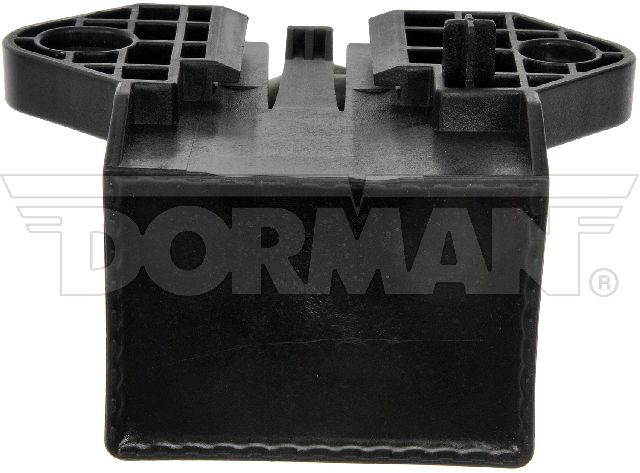
Trusted brands: Motorcraft, Dorman (601-225)
OEM price range: $80-$120
Aftermarket price range: $60-$100 - Fuel Rail Pressure Sensor
(OEM #BL3Z-9F792-B)— Can fail and send incorrect readings to the PCM, but is less common than pump failures. Its difficult location under the intake manifold makes it a last-resort replacement.
Trusted brands: Motorcraft, Standard Motor Products
OEM price range: $100-$150
Aftermarket price range: $70-$100
Related Codes That Often Appear With This One
- P008A — This code stands for 'Low Pressure Fuel System Pressure - Too Low' and often indicates a problem with the in-tank fuel pump or the Fuel Pump Driver Module, which can lead to the P0087 code if the HPFP is starved of fuel.
- P0300-P0306 — Misfire codes can occur because the low fuel pressure is causing a lean condition in one or more cylinders, preventing proper combustion. This is often seen when the engine is under load.
- P027A / P064A — These codes may appear alongside P0087 if there is a failure in the fuel pump control module circuit, as noted in NHTSA ODI #11568117.
Technical Service Bulletins (TSBs) & Recalls
- TSB 15-0137: While for the F-150, this TSB is highly relevant as it addresses a crank/no-start or stall caused by an overheating fuel pump fuse (F27) in the battery junction box. This issue can mimic a fuel pump or FPDM failure and is a worthwhile check on any related Ford platform from this era.
Platform-Specific Known Issues
- Recall 16S31 (NHTSA Campaign 16V621000): Ford recalled 2013-2015 Taurus models with the 3.5L EcoBoost engine for a faulty Fuel Pump Control Module that could overheat and cause the engine to stall. Even if a vehicle is not in the recall, this module is a known weak point and a common cause of fuel pressure issues.
- Forum Consensus: Across forums like SHOForum.com and 2CarPros.com, the diagnostic path for P0087 is consistent: first, rule out the low-pressure side (FPDM, in-tank pump, fuse), and if that system is healthy, the HPFP is the overwhelming culprit.
Mechanic-Grade Diagnostic Values
- Low-Pressure Fuel System Pressure (In-tank pump output) — expected: 65-75 PSI, stable reading.. Failure: Pressure is below 60 PSI, is erratic, or drops under load. This suggests a failing in-tank pump or FPDM issue.
- High-Pressure Fuel System Pressure at Idle — expected: 250-500 PSI (approx. 1.7 - 3.4 MPa), actual should closely match desired.. Failure: Actual pressure is significantly lower than desired pressure, or is erratic.
- High-Pressure Fuel System Pressure Under Load (WOT) — expected: Should climb to 2,000+ PSI (13.8+ MPa) and closely track the desired pressure value.. Failure: Actual pressure fails to rise with desired pressure, lags significantly, or drops off sharply during acceleration. This is a classic sign of a failing HPFP.
- FPDM Command Signal (from PCM) — expected: 5% to 51% duty cycle during normal operation.. Failure: Signal is absent or outside the expected range, suggesting a PCM or wiring issue.
- FPDM Diagnostic Signal (to PCM) — expected: 50% duty cycle indicates normal operation.. Failure: A 75% duty cycle indicates a fault in the fuel pump secondary circuit (pump or wiring). A 25% duty cycle indicates the command signal from the PCM was out of range. 0% or 100% indicates the FPDM is offline or has lost power.
Scan Tool Commands That Help
- Ford IDS / FORScan: Fuel Pump Driver Module (FPDM) Duty Cycle Command — This bidirectional control allows a technician to manually command the low-pressure fuel pump to run at a specific speed. It's used to isolate a weak in-tank pump from a faulty FPDM or PCM command issue. If the pump fails to achieve pressure when commanded, the pump is likely bad.
- Ford IDS / FORScan: HPFP Electrical Connector Disconnect/Reconnect Test — This is an informal test. While the engine is running, unplugging the HPFP's electrical connector should stop the pump's audible clicking. Plugging it back in should cause the clicking to resume. If the pump clicks but builds no pressure, its internal mechanical section has failed.
- Ford IDS / FORScan: Reset All Adaptations — This function should be performed after replacing a major fuel system component like the HPFP or fuel rail pressure sensor. It clears the learned fuel trim and pressure values, allowing the PCM to re-learn with the new components.
Wiring & Ground Locations
- FPDM Connector (C433) — Behind the rear passenger-side seat trim panel, connected to the Fuel Pump Driver Module.. This is the central connection for the low-pressure fuel system. A corroded or damaged connector can cause a loss of power to the in-tank pump or a loss of signal from the PCM, leading to P0087. Key pins to test are Pin 5 (Violet/Green - command from PCM) and Pin 1 (Yellow/Gray - power to pump).
- Ground G304 — Located in the rear of the vehicle, near the FPDM and other rear components.. This is a common ground point for several rear components, including the FPDM. A loose or corroded G304 ground can cause intermittent or complete failure of the FPDM, mimicking a bad fuel pump.
- Fuse 27 (Battery Junction Box) — In the under-hood fuse box (Battery Junction Box).. This fuse powers the fuel pump circuit. On many Fords of this era, the fuse terminal can overheat and melt, causing an intermittent or permanent loss of fuel pump power. This was subject to TSB 15-0137 on F-150s but the failure pattern can occur on the Taurus.
Real Owner Repair Stories
- YouTube channel 'ZB Auto Repair' (2013 Ford F-150 3.5L EcoBoost (same engine and system)) — P0087, hard to start, rough run. Scan tool showed desired pressure at 1000-2000 kPa but actual was only 400 kPa and dropping.
❌ Tried (didn't work) The owner had replaced the in-tank fuel pump multiple times.
✅ What actually fixed it Replacement of the High-Pressure Fuel Pump (HPFP). The technician confirmed the pump was being commanded on by unplugging it and hearing the clicking stop, then resume when reconnected. The visual sign of failure was the piston on the old pump was collapsed and stuck, while the new pump's piston was extended by a spring. - YouTube channel 'CJ's Automotive Services' (2013 Ford Taurus 3.5L) — Crank no start. No fuel coming out of the low-pressure line when disconnected. Received a code for 'fuel pump circuit A'.
✅ What actually fixed it Replacement of the Fuel Pump Driver Module (FPDM) located behind the rear passenger seat. The vehicle started immediately after the new module was installed. - Ford F-150 Forums / TSB 15-0137 (2009-2014 Ford F-150 (similar electrical architecture)) — Sudden stall while driving or crank-no-start. Melted 20A fuse in slot F27 of the underhood fuse box.
❌ Tried (didn't work) Replacing the fuse repeatedly, only for it to melt again.
✅ What actually fixed it Performing the fix outlined in TSB 15-0137, which involves using a special kit (EL3Z-14293-A) to relocate the fuel pump power wire to a different, unused fuse slot in the fuse box that can handle the electrical load without overheating. - NHTSA ODI #11568117 — An owner reported that an IDS test found codes P064A, P027A, P0087, and P008A. The diagnosis revealed that Pin 25 in connector C1035A had melted, causing a poor connection for the fuel pump control module.
- NHTSA ODI #11318285 — An owner reported that the check engine light came on and the low oil light appeared when the car was about to die. While diagnostics showed a P0087 error, the dealership determined the root cause was a defective fuel rail sensor.
OEM Part Supersession History
AA5Z-9350-A, AA5Z-9350-B, BL3Z-9350-C→BL3Z-9350-D— Improved internal components and materials to increase durability and prevent premature wear of the pump's mechanical piston assembly.N/A→AG9Z-9G756-A— This is the one-time-use high-pressure fuel line that connects to the HPFP. It must be replaced whenever it is removed to ensure a proper seal, as the soft iron seat will only seal once.
Heads up: Re-using the old line is a common cause of high-pressure fuel leaks after an HPFP replacement.
Model Year Variations Within This Range
- 2013-2015: These model years were subject to Ford recall 16S31 (NHTSA 16V621000) for the Fuel Pump Control Module (FPDM). While the module can fail on any year, this specific recall suggests a higher failure rate or a specific manufacturing defect during this period.
- 2013+: The 3.5L EcoBoost engine received an update in 2013. While the fundamental diagnosis for P0087 remains the same, always verify part numbers for components like the HPFP and sensors, as they may differ between the 2010-2012 and 2013-2019 engines.
Diagnostic Flowchart
Other Known Issues on This Vehicle
Issues unrelated to this code that are worth knowing about as an owner of this generation:
- Internal Water Pump Failure 🔴 High — Commonly occurs between 80,000 and 150,000 miles. A leak can cause coolant to mix with engine oil, leading to catastrophic engine failure if not caught immediately.
- Power Transfer Unit (PTU) Overheating/Failure 🔴 High — The PTU fluid can break down quickly from heat, leading to failure as early as 30,000-60,000 miles. Ford's 'lifetime fluid' recommendation is widely disputed by owners who advise changing the fluid every 15,000-30,000 miles to prevent failure.
- Timing Chain Stretch & Cam Phaser Rattle 🟠 Medium — Primarily affects earlier (2010-2015) models. Causes a distinct rattle on cold startup for a few seconds. If ignored, it can lead to timing jump and engine damage. (Ref: TSB 18-2305, TSB 23-2143)
- Cracked Rear Suspension Toe Links 🔴 High — Affects 2013-2018 models, particularly SHO and Police Interceptor packages. The toe links can fracture, causing a sudden loss of vehicle control. (Ref: Recall 20S04 (NHTSA 20V072000))
Used vs. New Parts: Buying Guide for This Vehicle
When a used part is the smart pick: A used Fuel Pump Driver Module (FPDM) from a low-mileage, collision-damaged vehicle can be a cost-effective option, as it is an electronic module without mechanical wear parts. Other non-wear items like connectors or wiring pigtails are also good candidates for used parts.
Donor-vehicle mileage cap: roughly under 80000 miles for the part to have meaningful remaining life.
What to inspect on the donor part:
- For an FPDM, check the connector for any signs of corrosion, melted plastic, or pushed-out pins.
- Ensure the donor vehicle was not involved in a flood.
- Verify the part number on the used module matches the original or its known-good replacement.
OEM-only on this vehicle (don't cheap out):
- High-Pressure Fuel Pump (HPFP)
- Fuel Rail Pressure Sensor
Aftermarket brands forum-validated for this vehicle:
- Bosch (for the HPFP, as they are often the original equipment manufacturer)
- Dorman (for the Fuel Pump Driver Module, part 601-225 is a common replacement)
Brands owners have reported issues with on this vehicle:
- No-name, unbranded High-Pressure Fuel Pumps from online marketplaces like Amazon or eBay. Forum users consistently report premature failure, often within a few thousand miles.
Real Owner Stories
Aggregated from forums and TSBs cited above. Mileages and costs reflect what owners reported in those sources.
2015 Ford Taurus 3.5L EcoBoost
Symptoms: Owner experienced a P0087 code and sought the location of the fuel rail pressure sensor due to low pressure readings.
What fixed it: The diagnosis confirmed the sensor is located under the intake manifold, requiring significant labor to access and replace.
Source hint: https://www.2carpros.com/questions/2015-ford-taurus-code-p0087-where-is-the-fuel-rail-pressure-sensor-located
2010-2019 Ford Taurus 3.5L EcoBoost
Symptoms: Misfires and P0087 code occurring specifically when the engine reached 4,000 RPM and higher.
What fixed it: Replacing the High-Pressure Fuel Pump (HPFP) after ruling out the low-pressure system (FPDM and in-tank pump).
Source hint: https://www.shoforum.com/threads/p0087-misfire-4k-and-up-rpm.145155/
Ford GDI Platform Owner
Symptoms: An owner reported that their vehicle read code P0087 for fuel rail pressure too low, along with P2196 (O2 sensor stuck rich) and P1450 (unable to bleed up fuel tank vacuum).
What fixed it: As described in NHTSA ODI #11160628, the diagnostic indicated that the fuel pressure sensor needed to be replaced.
Related OBD-II Codes
Frequently Asked Questions
Is there a recall for the fuel system on my 2013-2015 Ford Taurus 3.5L EcoBoost?
My Taurus is stumbling above 4,000 RPM but idles fine. What is the most likely cause?
Can a blown fuse cause the P0087 low pressure code on this vehicle?
Where is the Fuel Rail Pressure Sensor located on the 3.5L EcoBoost V6?
What specific part should I use if I need to replace the in-tank fuel pump on my Taurus SHO?
Do I need to replace anything else when I install a new High-Pressure Fuel Pump?
Helpful Videos

Used OEM Parts in Stock
New Aftermarket Parts Available


The information in this article is provided for general reference and educational purposes only. Vehicle specifications, procedures, and part compatibility can vary by production date, trim level, and region. Always consult your vehicle's factory service manual and verify part numbers before purchasing or performing repairs. Safety-critical components such as airbags, seat belts, and braking systems should be installed by a qualified professional.
- Ford Taurus:
- 🧭 Diagnostic Flowchart
- 🎬 Helpful Videos
- 🛍️ Shop This Part
- What's Unique About the 2010-2019 Ford Taurus
- Symptoms You May Notice
- Most Likely Causes
- Rare But Worth Checking
- Diagnosis Steps
- Parts You'll Likely Need
- Related Codes That Often Appear With This One
- Technical Service Bulletins (TSBs) & Recalls
- Platform-Specific Known Issues
- Mechanic-Grade Diagnostic Values
- Scan Tool Commands That Help
- Wiring & Ground Locations
- Real Owner Repair Stories
- OEM Part Supersession History
- Model Year Variations Within This Range
- Other Known Issues on This Vehicle
- Used vs. New Parts: Buying Guide for This Vehicle
- Real Owner Stories
- 2015 Ford Taurus 3.5L EcoBoost
- 2010-2019 Ford Taurus 3.5L EcoBoost
- Ford GDI Platform Owner
- Related OBD-II Codes
- Frequently Asked Questions
- 🎟️ Get 5% Off