

P0087 on 2012-2016 Mercedes-Benz E-Class: Low Fuel Rail Pressure Causes and Fixes
On the M276 engine, code P0087 is most often caused by a failing High-Pressure Fuel Pump (HPFP), a known wear item. Other possibilities include a weak in-tank low-pressure pump or a clogged fuel filter, which is integrated into the pump assembly. The code typically appears under hard acceleration. Expect a repair cost of $800-$2000, as diagnosis and repair are complex.
- P0087 means the high-pressure fuel system has dangerously low pressure.
- The most likely cause on your E-Class is a failing High-Pressure Fuel Pump (HPFP).
- Do not drive extensively with this code, as the engine could stall at any time.
- Diagnosis should start by monitoring fuel rail pressure with a scan tool and testing the low-pressure pump's output.
- This is not a beginner-friendly DIY repair due to the extreme pressures and complexity of the system; professional service is strongly recommended.
What's Unique About the 2012-2016 Mercedes-Benz E-Class
The M276 engine's direct injection system operates at extremely high pressures (up to 200 bar or ~2900 PSI), making it sensitive to any disruption in fuel supply. Unlike older port-injection systems, a failure in either the low-pressure or high-pressure side can trigger this code. While many components could be at fault, the mechanically-driven High-Pressure Fuel Pump (HPFP) is a known wear item and a frequent culprit for the P0087 code on this platform. The issue often manifests specifically under heavy load or high RPMs when fuel demand is greatest.
Symptoms You May Notice
- Check Engine Light illuminated
- Engine hesitation or sputtering, especially during hard acceleration.
- Significant loss of engine power.
- Vehicle enters 'limp home mode', limiting engine RPM.
- Long crank time or difficulty starting.
- Rough or unstable idle.
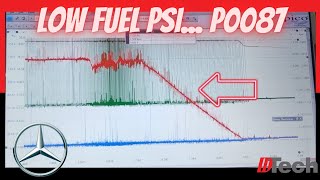
- Engine stalling unexpectedly, sometimes after high-load situations. 🎬 Watch: A real-world diagnostic walkthrough for a stalling Mercedes.
- Replacing the fuel rail pressure sensor without verifying the actual fuel pressure with a mechanical gauge. The sensor is usually reporting a real problem, not causing it.
- Replacing the High-Pressure Fuel Pump (HPFP) without first confirming that the low-pressure fuel pump is supplying adequate pressure and volume. A weak in-tank pump will starve the HPFP.
Most Likely Causes
- Failing High-Pressure Fuel Pump (HPFP) 🔴 High Probability → Shop Fuel Pump The HPFP is a mechanical, single-piston pump driven by the camshaft. It is a high-stress component that can wear out over time, leading to an inability to generate the required pressure, especially under load. It is widely cited as the most common cause for P0087 on the M276 engine.
How to confirm: A technician will use a diagnostic scan tool (like Xentry or a capable OBD2 tool) to monitor requested vs. actual fuel rail pressure. At idle, pressure should be stable. During a wide-open throttle (WOT) pull, if the actual pressure drops significantly below the requested pressure (e.g., requested 180-200 bar, actual drops to 150 bar or less), and the low-pressure system is confirmed healthy, the HPFP is the likely culprit.
Typical fix: Replacement of the High-Pressure Fuel Pump. It is highly recommended to replace the cam follower (tappet) that rides on the camshaft at the same time, as it can also wear down.
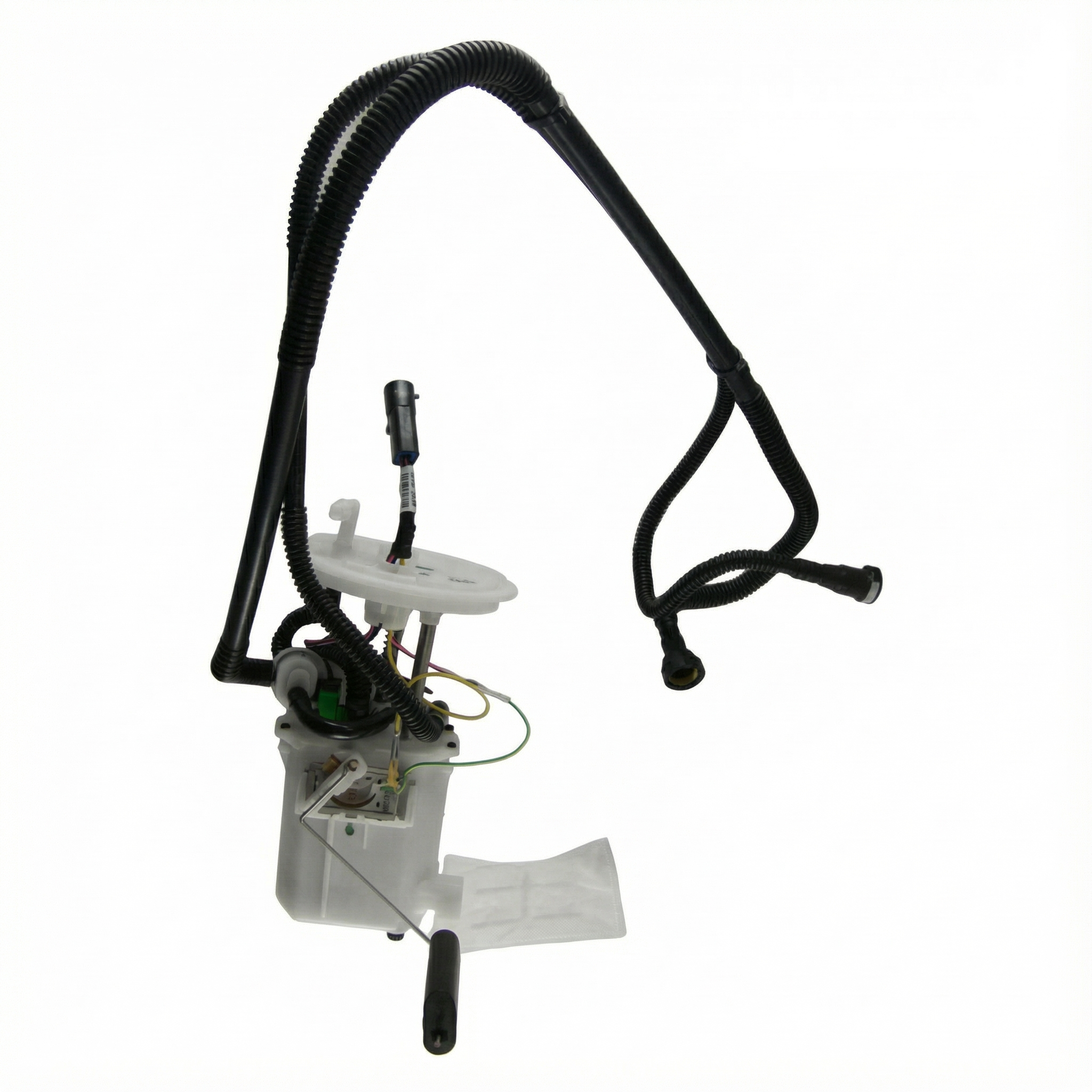
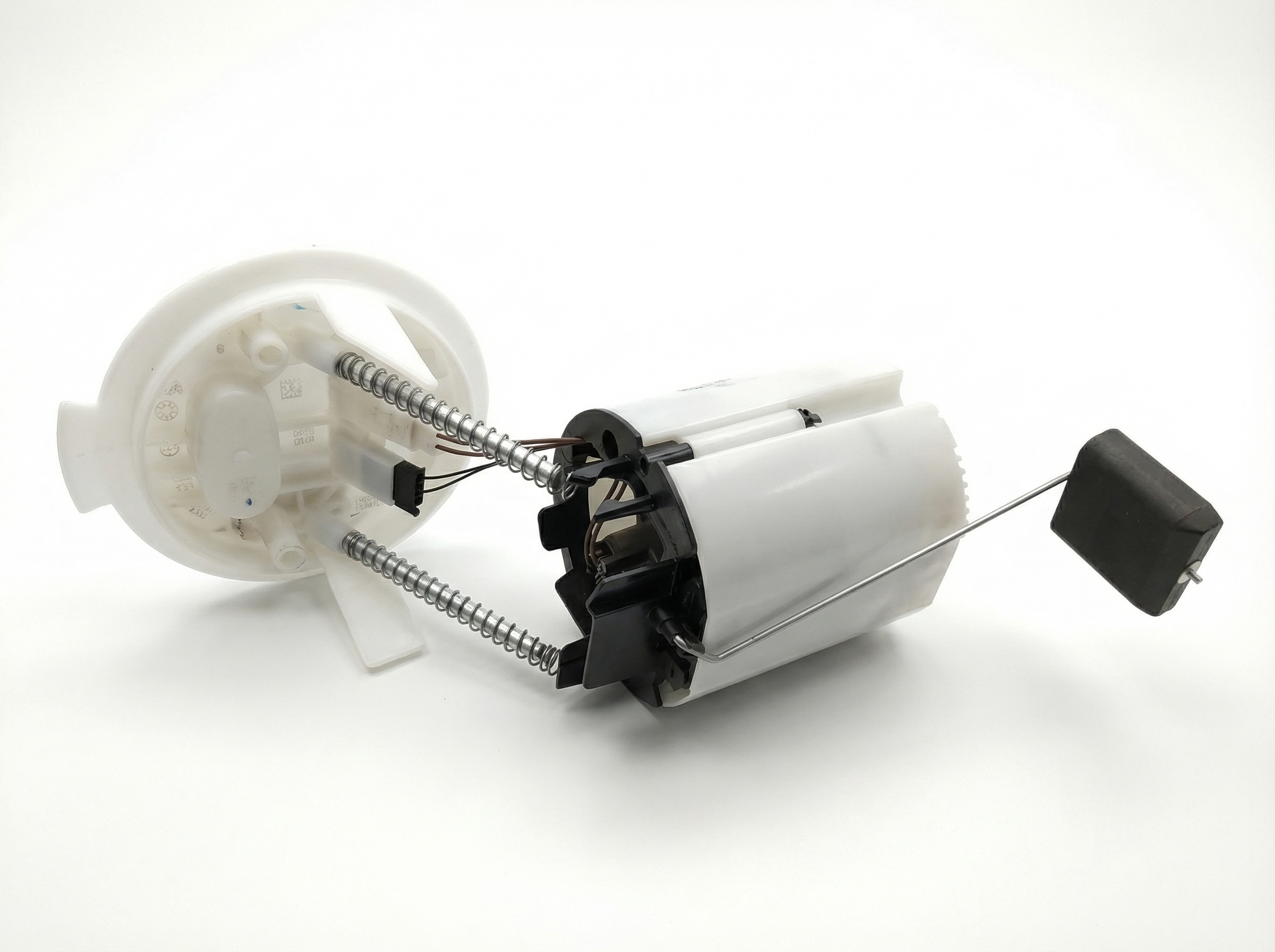
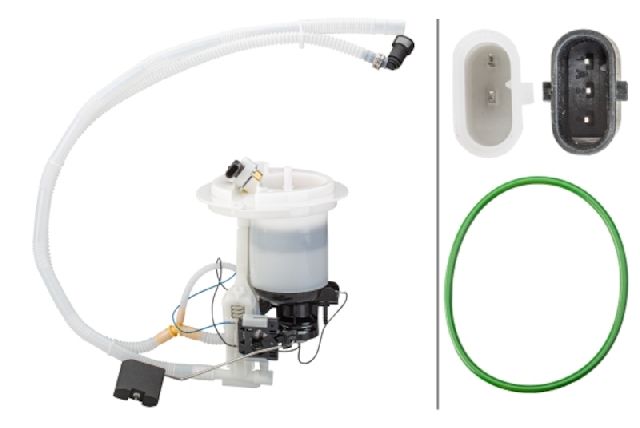
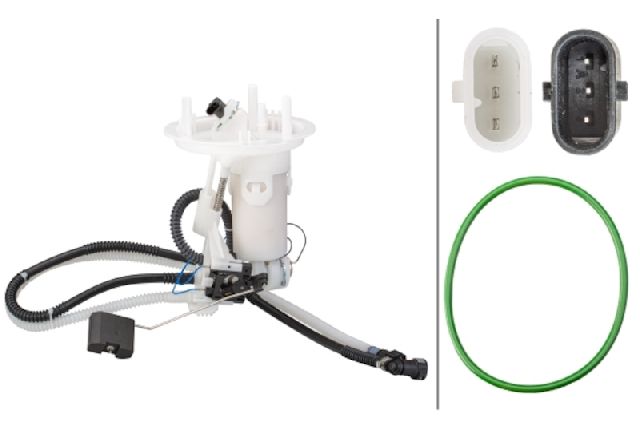
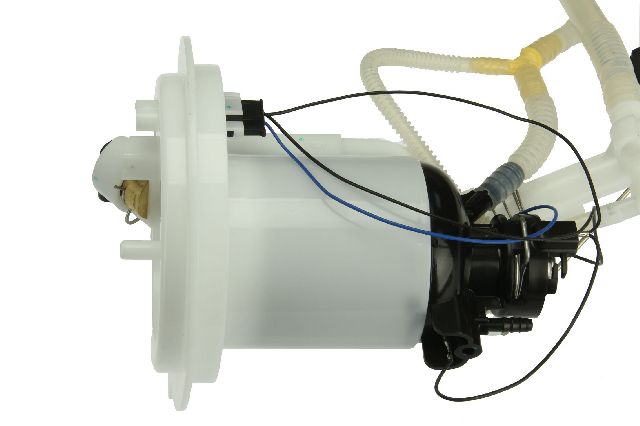
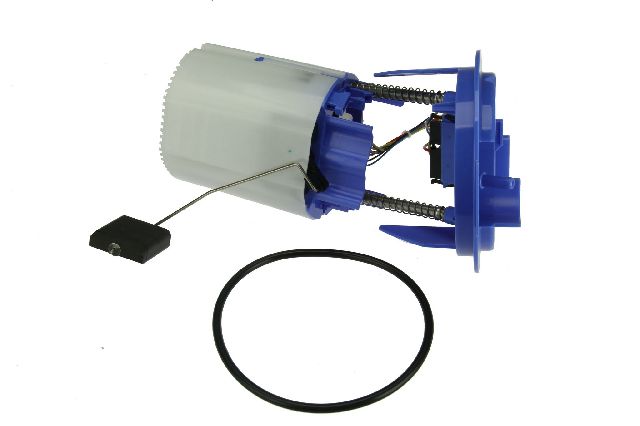
Est. part cost: $400-$700 - Failing Low-Pressure Fuel Pump or Clogged Fuel Filter 🟡 Medium Probability → Shop Fuel Filter The in-tank fuel filter is integrated into the fuel pump sending unit assembly and is not a separately serviceable item. If the filter becomes clogged or the low-pressure pump weakens, it cannot supply the HPFP with enough volume, starving it and causing low pressure on the high side, especially under high demand.
How to confirm: Test the fuel pressure from the in-tank pump before it reaches the HPFP. A healthy low-pressure pump should supply a steady pressure of around 4.5 to 6.7 bar (approx. 65-97 PSI). If this pressure drops under load, the low-pressure pump/filter assembly is failing.
Typical fix: Replacement of the in-tank fuel pump and sender assembly, which includes the integrated fuel filter. 🎬 See this step-by-step guide for replacing the in-tank fuel pump.
Est. part cost: $300-$500 - Faulty Fuel Rail Pressure Sensor ⚪ Low Probability → Shop Fuel Pressure Sensor While electronic sensors can fail, they are less likely to be the root cause than the mechanical pumps. The sensor is often correctly reporting a true low-pressure condition caused by another component. Misdiagnosis is common. In some cases of sensor failure, the ECU may substitute a fixed value like 6.02 bar, which is a strong clue the sensor itself is bad.
How to confirm: Compare the sensor's readings on a scan tool with a reading from a known-good mechanical pressure gauge connected to the fuel rail. If the readings differ significantly, the sensor is faulty. This is a job for a professional due to the extremely high pressures involved. A static test with key-on, engine-off should show around 0.5V on the signal wire.
Typical fix: Replacement of the fuel rail pressure sensor.
Est. part cost: $80-$150
Rare But Worth Checking
- Leaking Fuel Injector(s): → Shop Fuel Injector A fuel injector stuck partially open can bleed pressure from the fuel rail, causing the P0087 code. This may also be accompanied by misfire codes for a specific cylinder (e.g., P0301-P0306) and a smell of fuel. An injector leak-off test can help identify a faulty injector.
- Worn Camshaft Lobe/Follower: → Shop Engine Camshaft The HPFP is driven by a lobe on the camshaft via a roller or flat tappet (follower). If this lobe or the pump's follower wears down excessively, the pump's stroke is reduced, leading to lower output pressure even with a perfectly good HPFP. The follower should always be inspected and likely replaced when changing the HPFP.
Diagnosis Steps
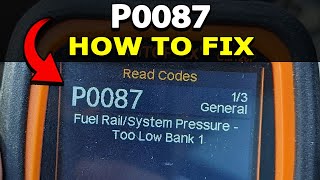
- Connect an OBD-II scanner to read the code and check for any other stored codes, such as misfire (P030x) or fuel pressure regulator (P0089) codes.
- Use a scan tool with live data capabilities to monitor 'Specified Fuel Rail Pressure' and 'Actual Fuel Rail Pressure'.
- First, test the low-pressure system. The in-tank pump should provide a steady pressure of 4.5-6.7 bar. Check this value at idle and under load to ensure it doesn't drop off.
- If the low-pressure system is healthy, focus on the high-pressure side. Observe the pressure readings at idle, during steady cruising, and during hard acceleration (WOT). The code is often set when the 'Actual' pressure cannot keep up with the 'Specified' pressure under load.
- A significant, sustained drop in actual pressure compared to the specified value during acceleration points towards a failing HPFP or a worn cam lobe/follower.
- Visually inspect the High-Pressure Fuel Pump (HPFP), fuel lines, and injectors for any signs of external leaks.
- If replacing the HPFP, it is critical to also inspect and likely replace the cam follower (tappet) that it rides on.
- If diagnostics are inconclusive, consider the possibility of a leaking injector or, less commonly, a faulty rail pressure sensor. An injector leak-down test can help identify a faulty injector.
Parts You'll Likely Need
- High-Pressure Fuel Pump
(OEM #A2760700601)— This is the most common failure point for code P0087 on the M276 engine due to the high stress it endures.
Trusted brands: Bosch (OEM supplier, part 0261520217 or HDP-5)
OEM price range: $500-$700
Aftermarket price range: $350-$550 - Low-Pressure Fuel Pump / Filter Assembly
(OEM #218-470-00-94)— The fuel filter is integrated into this assembly and can become clogged, or the pump can weaken, starving the HPFP of fuel.
Trusted brands: VDO, Bosch
OEM price range: $400-$550
Aftermarket price range: $250-$400 - HPFP Cam Follower / Tappet — This small part sits between the camshaft lobe and the HPFP piston. It is a wear item and should be inspected and replaced with the HPFP to ensure proper pump actuation.
Trusted brands: INA, Genuine Mercedes-Benz
OEM price range: $30-$60
Aftermarket price range: $20-$40
Related Codes That Often Appear With This One
- P0089 — This code relates to 'Fuel Pressure Regulator Performance'. It can appear if the system is struggling to control pressure due to the underlying cause of P0087.
- P0300-P0306 — These are misfire codes. Insufficient fuel pressure can lead to a lean condition, causing random or specific cylinder misfires, especially under load.
- P2540 — This code for 'Low Pressure Fuel System Sensor Circuit Range/Performance' may appear alongside P0087 if the issue originates from the in-tank pump, indicating it is failing to supply the HPFP.
- P008792 — This is a Mercedes-specific variant of P0087, often seen on dealer-level scanners like Xentry. The '92' suffix typically points to a functional fault or performance issue, confirming the pressure is genuinely too low rather than a sensor circuit error.
Technical Service Bulletins (TSBs) & Recalls
- TSB LI05.10-P-056435: While not directly for P0087, this is a critical TSB for M276 owners. It addresses a common cold-start rattle by installing updated s
Platform-Specific Known Issues
- cause: A user on MBWorld.org with a 2014 E63 (M157 engine, similar fuel system) experienced P0087 only during hard driving. The discussion confirmed the integrated fuel filter and the need to log fuel pressure to diagnose.
- cause: Another MBWorld.org thread on an E350 with P0087 documented a frustrating repair journey, replacing multiple parts including fuel rails, pumps, and sensors, highlighting the diagnostic complexity. The community suggested checking for excessive injector leak-down as a possible cause.
Mechanic-Grade Diagnostic Values
- Low-Pressure Fuel System Pressure — expected: 4.5 to 6.7 bar (approx. 65 to 97 PSI). Failure: Pressure drops significantly under load or does not meet the minimum specification at idle.
- High-Pressure Fuel System Pressure (at idle) — expected: 120 to 200 bar (approx. 1740 to 2900 PSI). Failure: Pressure is unstable or significantly below 120 bar.
- Fuel Rail Pressure Sensor Signal Voltage (Key On, Engine Off) — expected: ~0.5 V. Failure: Voltage is 0V, 5V, or a value that doesn't correspond to atmospheric pressure.
- Fuel Rail Pressure Sensor Signal Voltage (Engine Idling) — expected: Voltage should climb from the static ~0.5V reading as pressure builds.. Failure: Voltage does not increase or provides erratic readings as the engine runs.
- ECU Substituted Value for Failed Rail Pressure Sensor — expected: A suspiciously steady 6.02 bar. Failure: If live data shows a perfectly flat 6.02 bar, the ECU has detected a sensor failure and is using a default value.
Hidden / Shadow Codes Worth Checking
- P008792: The sub-code '92' indicates a functional disturbance or performance issue. It confirms the ECU has determined the fuel pressure is genuinely too low, as opposed to an electrical circuit fault with a sensor. (see via Mercedes-Benz Xentry/DAS diagnostic software.)
Scan Tool Commands That Help
- Xentry/DAS: Fuel pump actuation test — To command the low-pressure fuel pump to run without the engine starting. This allows for checking the low-side pressure and volume delivery to isolate it from the high-pressure system.
- Xentry/DAS: High pressure tests (e.g., Quantity control valve test) — To run guided diagnostics on the high-pressure pump and its integrated quantity control valve to check for response and pressure-building capability.
- Xentry/DAS: Reset adaptation values for fuel system — After replacing a major fuel system component like the HPFP, fuel rail sensor, or injectors, this function resets the learned fuel trim and pressure values, forcing the ECU to relearn with the new components.
- Xentry/DAS or DTS Monaco: Coding of Fuel Pump Control Unit (N118) — If the Fuel Pump Control Unit is replaced, it must be coded with the vehicle's VIN and correct configuration to communicate properly with the ECM over the CAN bus. Failure to do so can cause stalling and communication fault codes.
Wiring & Ground Locations
- N118 (FSCU - Fuel System Control Unit) — For the W212 E-Class, the fuel pump control unit is located below the paneling on the right rear door sill. Some sources also indicate it may be under the right rear seat cushion near the door.. This module directly powers and controls the low-pressure fuel pump. A faulty module, poor connection, or bad ground (W15/1, right footwell) can mimic a failed low-pressure pump, leading to P0087.
- Y94 (Fuel Quantity Control Valve) — Integrated into the High-Pressure Fuel Pump (HPFP) at the rear of the engine.. This solenoid is controlled by the ECM via a PWM signal to regulate the output of the HPFP. A wiring issue between the ECM and this valve can prevent the HPFP from building pressure, even if the pump itself is mechanically sound.
Real Owner Repair Stories
- MBWorld.org user (E350 W212 BlueEfficiency) — P0087 fault code, random engine cut-outs, would restart immediately. Later went into limp mode and would still cut out under hard acceleration.
❌ Tried (didn't work) Replaced both fuel rails, Replaced high-pressure pump diverter valve, Replaced high-pressure pump, Replaced in-tank low-pressure pump, Replaced fuel pressure sensor, Replaced fuel pressure regulator, Replaced fuel filter
✅ What actually fixed it The user had replaced nearly the entire fuel system without a fix. A forum contributor suggested that, similar to issues on Duramax diesel engines, excessively leaking fuel injectors could be bypassing so much fuel back to the tank that the HPFP cannot keep up, even though the pump itself is good. The final resolution was not posted, but this points to injector leak-down as a critical, often-overlooked cause after all common parts are replaced. - NHTSA ODI #11423626 — An owner reported that the vehicle enters limp mode and loses power, which is described as very unsafe when pulling over or going uphill. The error code was P0087 for low fuel rail pressure, though the vehicle returned to normal after shutting off and restarting.
- NHTSA ODI #11638804 — In a report involving a similar Mercedes-Benz fuel system, an owner noted that after a service, the car would not start, repeating the same issues that led to the initial repair, despite no reference to the P0087 code in the customer summary report.
OEM Part Supersession History
A2760700101→A2760700601— Likely internal improvements to durability and performance to address wear issues.
Heads up: The newer part number A2760700601 is the correct replacement for the original. Using old stock of the original part number is not recommended.
Model Year Variations Within This Range
- 2012-2014 (approx.): Primarily used the M276 DE35, a 3.5L naturally aspirated V6. This engine has a three-lobe camshaft to drive the HPFP.
- 2014-2016 (approx.): Introduced the M276 DE30LA, a 3.0L V6 bi-turbo engine (e.g., in the E400). This engine uses a four-lobe camshaft to drive the HPFP, potentially for more stable pressure delivery. While the P0087 code applies to both, the specific HPFP and some diagnostic values may differ slightly.
Diagnostic Flowchart
Other Known Issues on This Vehicle
Issues unrelated to this code that are worth knowing about as an owner of this generation:
- Timing Chain Tensioner Rattle on Cold Start 🔴 High — Common on earlier M276 engines (pre-2014). A rattle for 2-10 seconds on cold start indicates tensioners are losing oil pressure. If ignored, can lead to timing chain stretch and catastrophic engine failure. (Ref: TSB LI05.10-P-056435 recommends installing updated tensioners and new check valves to hold oil pressure.)
- Oil Leaks from Camshaft Position Sensors 🔴 High → Shop Engine Camshaft — Oil can leak through the sensor's internal seal and wick through the wiring harness, contaminating the engine control unit (ECU) and other electronics, leading to costly and complex electrical failures.
- Oil Leaks from Front Timing Covers 🟠 Medium — The sealant on the upper front timing covers can degrade, causing oil to leak down the front of the engine, often onto the alternator.
- Carbon Buildup on Intake Valves 🟠 Medium — As a direct-injection engine, fuel does not wash over the intake valves. Over time (typically 80k-100k miles), carbon deposits can build up, causing rough idle, reduced performance, and poor fuel economy.
- Plastic Cooling System Components Cracking 🟠 Medium — Various plastic coolant hoses and flanges can become brittle from heat cycles and age, leading to coolant leaks and potential overheating.
Used vs. New Parts: Buying Guide for This Vehicle
When a used part is the smart pick: For this specific P0087 issue, used parts are generally not recommended for the primary failure components (pumps). A used fuel rail pressure sensor from a verified low-mileage vehicle could be a cost-effective option if the sensor is confirmed to be the sole problem.
Donor-vehicle mileage cap: roughly under 50000 miles for the part to have meaningful remaining life.
What to inspect on the donor part:
- Verify the donor vehicle's mileage.
- Check for any signs of physical damage or corrosion on the part.
- For electronic modules, ensure the part number matches exactly.
- Avoid parts from vehicles with known flood or fire damage.
OEM-only on this vehicle (don't cheap out):
- High-Pressure Fuel Pump (HPFP)
- Low-Pressure Fuel Pump Assembly
Aftermarket brands forum-validated for this vehicle:
- Bosch (OEM supplier for the HPFP and other fuel system components)
- VDO (Often an OEM supplier for the low-pressure pump assembly)
Brands owners have reported issues with on this vehicle:
- Unbranded, no-name HPFPs or low-pressure pumps from online marketplaces. The high pressures and precise tolerances of the GDI system make using cheap, unverified parts extremely risky, often leading to repeat failures.
Real Owner Stories
Aggregated from forums and TSBs cited above. Mileages and costs reflect what owners reported in those sources.
2014 Mercedes-Benz E63 AMG M157
Symptoms: Experienced P0087 only during hard driving; the vehicle required logging fuel pressure to identify the drop under load.
What fixed it: Diagnosis confirmed the issue was related to the integrated fuel filter within the fuel pump assembly.
Source hint: MBWorld.org Forums - 'Need help diagnosing P0087 - Fuel Rail/System Pressure - Too Low'
Mercedes-Benz E350 M276
Symptoms: A frustrating repair journey involving a persistent P0087 code despite replacing multiple parts.
What fixed it: The community suggested checking for excessive injector leak-down as the potential root cause after pumps and sensors were already replaced.
Source hint: MBWorld.org Forums - 'P0087' (User details replacing nearly the entire fuel system)
Mercedes-Benz E-Class M278
Symptoms: The car entered limp mode specifically when accelerating hard past 4000 RPMs on the highway.
What fixed it: Identified as a fuel rail pressure issue occurring under high-demand scenarios.
Source hint: MBWorld.org Forums - 'Mysterious P0087 on m278'
Mercedes-Benz E-Class M276 3.0L Turbo
Symptoms: Fuel pressure dropped from a target of 188 BAR to 150 BAR during wide-open throttle (WOT).
What fixed it: The drop in actual vs. requested pressure pointed to a failing High-Pressure Fuel Pump.
Source hint: MBWorld.org Forums - 'How to diagnose P0087 Fuel Rail Pressure Low / Fuel Pressure Sensor'
Related OBD-II Codes
Frequently Asked Questions
My 2014 E350 is throwing P0087; can I just replace the fuel filter?
What should the fuel pressure readings be for a healthy M276 E-Class?
Is there a TSB for the cold start rattle I'm hearing along with my fuel issues?
My E-Class only enters limp mode during hard acceleration; is this typical for P0087?
Should I replace the cam follower when I change the High-Pressure Fuel Pump?
Could a faulty sensor be lying about the low pressure?
Helpful Videos

Used OEM Parts in Stock
New Aftermarket Parts Available



The information in this article is provided for general reference and educational purposes only. Vehicle specifications, procedures, and part compatibility can vary by production date, trim level, and region. Always consult your vehicle's factory service manual and verify part numbers before purchasing or performing repairs. Safety-critical components such as airbags, seat belts, and braking systems should be installed by a qualified professional.
- Mercedes-Benz E-Class:
- 🧭 Diagnostic Flowchart
- 🎬 Helpful Videos
- 🛍️ Shop This Part
- What's Unique About the 2012-2016 Mercedes-Benz E-Class
- Symptoms You May Notice
- Most Likely Causes
- Rare But Worth Checking
- Diagnosis Steps
- Parts You'll Likely Need
- Related Codes That Often Appear With This One
- Technical Service Bulletins (TSBs) & Recalls
- Platform-Specific Known Issues
- Mechanic-Grade Diagnostic Values
- Hidden / Shadow Codes Worth Checking
- Scan Tool Commands That Help
- Wiring & Ground Locations
- Real Owner Repair Stories
- OEM Part Supersession History
- Model Year Variations Within This Range
- Other Known Issues on This Vehicle
- Used vs. New Parts: Buying Guide for This Vehicle
- Real Owner Stories
- 2014 Mercedes-Benz E63 AMG M157
- Mercedes-Benz E350 M276
- Mercedes-Benz E-Class M278
- Mercedes-Benz E-Class M276 3.0L Turbo
- Related OBD-II Codes
- Frequently Asked Questions
- 🎟️ Get 5% Off