

P0088 on 2015-2019 Ford Transit 3.2L Diesel: Causes and Fixes for High Fuel Pressure
P0088 on a 3.2L Power Stroke Transit most often points to a failed fuel pressure regulator, also known as a volume control valve (VCV) or fuel metering valve, located on the high-pressure fuel pump. This part is difficult to access and requires a scan tool for a relearn procedure after replacement. The OEM part number for the regulator is often cited as BK2Q-9358-AA.
- P0088 means fuel pressure is dangerously high. Do not continue to drive the vehicle.
- The most likely cause on your 3.2L Transit is a faulty fuel pressure regulator on the high-pressure pump, not the pump itself.
- Diagnosis requires a scan tool to compare desired vs. actual fuel pressure.
- This is not a beginner-friendly DIY repair. The regulator is very hard to get to, and a relearn procedure is mandatory after replacement.
- Before replacing parts, always check for wiring damage to the fuel pressure sensor and regulator.
What's Unique About the 2015-2019 Ford Transit
On the 3.2L Power Stroke diesel (part of the 'Puma' engine family), the high-pressure fuel system is robust but has specific failure points. The most commonly discussed cause for P0088 is not the main high-pressure pump itself, but the fuel pressure regulator (often called a metering valve or volume control valve) that is mounted directly on it. This part is notoriously difficult to access on the Transit, tucked away at the rear of the engine. Unlike some fuel system faults, this specific issue often requires a diagnostic scan tool to perform a "pump learn" or "regulator relearn" procedure after the part is replaced to calibrate the new valve.
Symptoms You May Notice
- Check Engine Light is on
- Engine goes into "limp mode" with reduced power
- Unstable or rough idle
- Engine stalling or cutting out intermittently
- Hard starting or no-start condition
- Audible engine knocking or rattling noise from the injectors (injector knock)
- Black smoke from the exhaust
- Poor fuel economy
- Visible diesel fuel leak from the fuel rail pressure relief valve
- A winding sound detected while driving at highway speeds, as reported in NHTSA ODI #11515513
- Replacing the fuel rail pressure sensor when the actual fault is the fuel pressure regulator on the pump. A forum user with a similar engine reported doing this, which did not solve the problem.
- Replacing the high-pressure fuel pump (HPFP) when only the much cheaper fuel pressure regulator (VCV) was faulty. Since the regulator is mounted to the pump, some shops may recommend replacing the entire unit.
Most Likely Causes
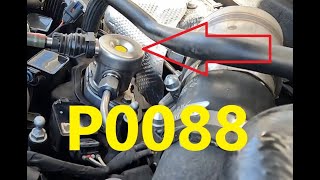
- Faulty Fuel Pressure Regulator (Volume Control Valve / Metering Valve) 🔴 High Probability → Shop Fuel Injection Pressure Regulator This regulator, mounted on the high-pressure fuel pump, can stick internally or fail electronically, causing it to command maximum pressure 🎬 Watch: Common causes and fixes for the P0088 code when not needed. Forum and video evidence for the Transit platform and related 3.2L engines point to this as a very common culprit for P0088. The valve can become contaminated with debris or simply wear out. Manufacturer Bulletin #20B41 notes that if a fuel orifice becomes dislodged, it can travel down and damage the pressure control valve pintle, resulting in DTC P0088.
How to confirm: Use a scan tool to monitor desired vs. actual fuel rail pressure. If actual pressure is significantly higher than the desired, the regulator is the prime suspect. The valve can also be bench-tested for resistance (typically 2-3.5 ohms) 🎬 Watch: How to test and check the fuel pressure regulator and operation if removed.
Typical fix: Replace the fuel pressure regulator on the high-pressure pump. This is a labor-intensive job due to its location at the rear of the engine. After replacement, a "pump learn" or "regulator relearn" procedure must be performed using a capable scan tool to calibrate the new part.
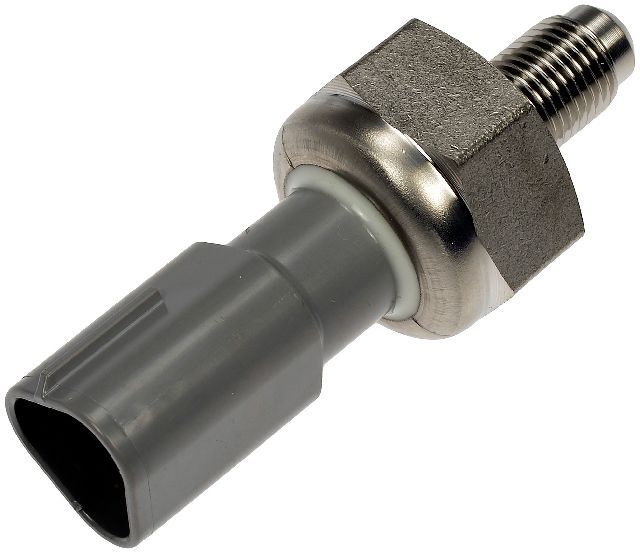
Est. part cost: $80-$200 - Faulty Fuel Rail Pressure (FRP) Sensor 🟡 Medium Probability → Shop Fuel Pressure Sensor While less common for a high-pressure code, the FRP sensor can fail by sending an incorrectly high voltage signal to the PCM. On the 3.2L Transit, these sensors have also been known to leak fuel directly from the sensor body into the electrical connector, causing erratic signals and a fire hazard.
How to confirm: With the engine off (KOEO), the fuel rail pressure on a scan tool should read close to zero. If it shows significant pressure, the sensor is likely faulty. Also, visually inspect the sensor and its connector for any signs of diesel fuel leakage. A technician in a video found a leaking sensor with a disconnected pigtail 🎬 See this example of a leaking sensor and wiring issue on a 2016 Transit 3.2L.
Typical fix: Replace the fuel rail pressure sensor. On some models, the sensor is sold only as part of the complete fuel rail assembly, though aftermarket sensors are available.
Est. part cost: $50-$250 - Restricted Fuel Return Line ⚪ Low Probability This is a generic cause for P0088. If the path for excess fuel to return to the tank is blocked or kinked, pressure will build up in the rail. While not specific to the Transit, it's a possibility in any common rail system. An iATN forum post for a different vehicle confirmed a restricted return line was the ultimate fix for a P0088 after sensors were replaced.
How to confirm: Visually inspect all fuel return lines from the engine back to the tank for any kinks, damage, or blockages.
Typical fix: Clear the restriction or replace the damaged section of the fuel line.
Est. part cost: $20-$100
Rare But Worth Checking
- Failing High-Pressure Fuel Pump (HPFP): → Shop Fuel Pump While the regulator on the pump is more common, a mechanical failure within the pump itself can cause it to over-pressurize the system. This is a much more expensive repair. A post on the Diesel Technician Society forum mentioned a 3.2L Transit with P0088 required an HPFP repair.
- Wiring Harness Issue: Damage to the wiring for the fuel pressure regulator or the fuel rail pressure sensor can cause a short to voltage, tricking the PCM into seeing high pressure or commanding it incorrectly. This can be caused by chafing against other engine components.
- PCM Software or Internal Fault: In rare cases, the issue can be with the Powertrain Control Module itself or outdated software. A Ford TSB for other models with P0088 suggests checking for PCM updates before replacing hardware. Always check for available TSBs related to PCM updates before replacing expensive hardware.
Diagnosis Steps
- Connect a diagnostic scan tool and verify that P0088 is the primary code. Note any other fuel-related codes like P0089 or P0087.
- Use the scan tool's live data function to observe 'Desired Fuel Rail Pressure' vs. 'Actual Fuel Rail Pressure'.
- At idle, the values should be very close. If the actual pressure is significantly higher than the desired pressure, the problem is likely with the fuel pressure regulator (VCV) or a restriction in the return system.
- If the actual pressure reads extremely high even with the Key On, Engine Off (KOEO), suspect a faulty Fuel Rail Pressure (FRP) sensor or a wiring short.
- Visually inspect the FRP sensor and its electrical connector for any signs of diesel fuel leakage or corrosion. A known issue on this platform is the sensor leaking fuel into the connector.
- Inspect the wiring harnesses for both the FRP sensor and the fuel pressure regulator on the pump for any signs of damage, chafing, or rodent activity.
- Trace the fuel return lines to check for any visible kinks or blockages.
- If evidence points to the fuel pressure regulator on the high-pressure pump, prepare for its replacement. This is a difficult job due to tight access at the rear of the engine. It may require removing EGR components for better access.
- After replacing the regulator, clear all DTCs. Then, use a capable scan tool to perform the 'Fuel Pump Learn' or 'Pressure Regulator Relearn' procedure as specified by the manufacturer. This step is critical for proper operation.
Parts You'll Likely Need
- Fuel Pressure Regulator / Volume Control Valve
(OEM #BK2Q-9358-AA)— This is the most frequently failing component that causes P0088 on this platform by sticking and causing the high-pressure pump to create excessive pressure.
Trusted brands: Motorcraft, Bosch, VDO
OEM price range: $150-$250
Aftermarket price range: $80-$150 - Fuel Rail Pressure Sensor
(OEM #55PP19-02 (Verify by VIN))— Fails less often for this specific code, but can cause it by sending an incorrect high-pressure signal or leaking fuel into its connector.
Trusted brands: Motorcraft, Bosch, Standard Motor Products
OEM price range: $100-$250
Aftermarket price range: $50-$120
Related Codes That Often Appear With This One
- P0087 — Fuel Rail/System Pressure - Too Low. While it's the opposite code, a failing regulator or sensor can behave erratically, causing pressure to be too high at times and too low at others, potentially logging both codes.
- P0089 — Fuel Pressure Regulator 1 Performance. This code is directly related to the performance of the regulator and is often seen with P0088, indicating the regulator is the source of the problem.
- P1250 — Fuel Pressure Regulator Control Circuit. This code points more specifically to an electrical fault in the regulator's control circuit and can accompany P0088.
- P228D — Fuel Pressure Regulator 1 Exceeded Control Limits - Pressure Too High. This is a more specific code that directly implicates the regulator in the over-pressure event.
Technical Service Bulletins (TSBs) & Recalls
- While no TSB was found specifically for P0088 on the 3.2L Transit, a similar SSM (Special Service Message) for 6.7L trucks with P0088 suggests checking simple items like fuses before proceeding to complex diagnostics. This reinforces the need for a structured diagnostic approach.
- Manufacturer Bulletin #SSM 49185 notes that some diesel engines may exhibit an illuminated MIL with DTC P0088 due to the pressure control valve in the fuel rail, requiring replacement of the fuel rail and pressure control valve.
- TSB 11-4-22 is a known publication regarding a lack of power and DTC P0088, as cited by an owner in NHTSA ODI #10721001.
Platform-Specific Known Issues
- Extreme Difficulty Accessing Fuel Pressure Regulator: → Shop Fuel Injection Pressure Regulator The fuel pressure regulator (VCV) is located on the back of the high-pressure fuel pump, which is at the rear of the engine against the firewall. Access is extremely limited. A repair video shows the technician needing to remove EGR components and work with long extensions and universal joints to reach the two bolts holding the regulator.
Mechanic-Grade Diagnostic Values
- Fuel Pressure Regulator (VCV/SCV) resistance — expected: 2.0 - 3.5 Ohms. Failure: A reading outside this range indicates an electrical failure of the valve's coil.
- Scan tool live data: Desired vs. Actual Fuel Rail Pressure at idle — expected: Desired and Actual should both be approximately 23,500 kPa (3400 PSI).. Failure: If Actual pressure is significantly higher than Desired pressure, the Fuel Pressure Regulator is likely stuck or failing.
- Fuel Rail Pressure (FRP) sensor voltage at idle — expected: Approximately 1.0 Volt (corresponding to ~23,500 kPa).. Failure: A voltage reading that is static, at 0V, or near 5V, or that doesn't correlate with pressure changes, indicates a faulty sensor or wiring.
- Fuel Rail Pressure (FRP) sensor voltage with Key On, Engine Off (KOEO) — expected: Close to 0.5 Volts, representing near-zero rail pressure.. Failure: A significantly high voltage reading (e.g., 4.8V) with the engine off points to a faulty sensor or a short-to-voltage in the signal wire.
Hidden / Shadow Codes Worth Checking
- P0088:24: Fuel Pressure Too High - Signal Stuck High. This is a Ford-specific sub-code. (see via This level of detail is typically only visible using a dealer-level scan tool like Ford IDS, which provides more specific failure information than a generic OBD-II reader.)
Scan Tool Commands That Help
- Ford IDS (Integrated Diagnostic System): Fuel pump learn — This procedure is required after replacing the fuel pressure regulator or the high-pressure pump to calibrate the new component to the PCM. It is also sometimes performed after a PCM replacement or software update.
- Advanced Aftermarket Scan Tools (e.g., ThinkCar, Autel): Injector pump learn / Pressure regulator relearn — Found under 'Special Functions' or 'Service Resets', this command performs the same critical calibration as the OEM tool after replacing the fuel pressure regulator. The tool will guide the user through steps like warming the engine and cycling the ignition.
Wiring & Ground Locations
- PCM Location — On the driver's side fender.. The PCM is the control center for the fuel system. A wiring diagram shows the fuel injector control wires originating from the gray 48-pin plug at the PCM. Any damage to this harness could affect fuel control signals.
Real Owner Repair Stories
- Ford Transit Forum user (2014 Ford Transit 2.2L (Puma family engine, similar to 3.2L)) — Engine cutting out, unstable idle, not revving cleanly, with codes P0088 and P228D.
❌ Tried (didn't work) Replaced the fuel rail pressure sensor (as part of the entire fuel rail assembly).
✅ What actually fixed it The problem was ultimately solved by replacing the fuel pressure regulator (suction control valve) located on the high-pressure fuel pump. The fault did not return after 200 miles of testing. - YouTube repair video (2008 Ford Transit 3.2 TDCI) — Vehicle broke down with fault codes P0088, P0089, P1169, and P1250.
✅ What actually fixed it Replaced the fuel pressure regulator valve on the back of the high-pressure fuel pump. The video also notes the over-pressure event caused the fuel rail pressure relief valve to leak diesel, which required resealing. A 'pump relearn' procedure was performed with a scan tool after the repair. - NHTSA ODI #11515513 — An owner reported that while driving approximately 50-55 MPH, a winding sound was detected and code P0088 was displayed, requiring the vehicle to be towed to a dealer.
OEM Part Supersession History
BK2Q-9358-AA→BK2Q-9358-AB— Part revision or update from the manufacturer. The 'AA' to 'AB' suffix change typically denotes a newer version of the part.
Heads up: The 'AB' version is noted for Euro 5 models, but both are generally listed as compatible for the 2.2L/3.2L Puma engine family. Always verify the correct part number for your specific VIN, but be aware that an 'AB' part is a valid, and likely newer, replacement for an 'AA'.
Diagnostic Flowchart
Real Owner Stories
Aggregated from forums and TSBs cited above. Mileages and costs reflect what owners reported in those sources.
Ford Transit 3.2L TDCI
Symptoms: Vehicle had a P0088 code and a leaking pressure relief valve caused by an over-pressure event.
What fixed it: Replaced the failed fuel pressure regulator (which was extremely difficult to access) and performed a critical 'pump learn' procedure using a ThinkScan tool.
Source hint: YouTube: 'Ford Transit 3.2 TDCI Fuel Pressure Regulator Replacement / Fuel Pump Relearn'
2016 Ford Transit 3.2L
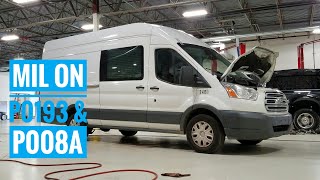
Symptoms: Check engine light was on with fuel pressure codes. Found the Fuel Rail Pressure (FRP) sensor connector completely disconnected and full of diesel fuel.
What fixed it: Replaced the failed Fuel Rail Pressure (FRP) sensor that was leaking fuel through its body into the pigtail.
Source hint: YouTube: '3.2 Powerstroke - MIL on DTC P0193 & P008A'
Ford Transit 3.2L
Symptoms: Customer vehicle presented with a P0088 code.
What fixed it: Required a High-Pressure Fuel Pump (HPFP) repair.
Source hint: Diesel Technician Society - 'Transit 3.2 first one'
Related OBD-II Codes
Frequently Asked Questions
Is there a specific TSB for the P0088 code on the 2015-2019 Transit 3.2L?
Why is replacing the fuel pressure regulator so labor-intensive on the Transit 3.2L?
I replaced the fuel pressure regulator on my Transit, but it's still in limp mode. What did I miss?
I smell diesel fuel under the hood and have a P0088 code. What should I check?
Can a restricted fuel return line cause a P0088 on my Power Stroke?
Are other Ford vehicles prone to this same P0088 issue?
Helpful Videos


We Have This Part in Stock


The information in this article is provided for general reference and educational purposes only. Vehicle specifications, procedures, and part compatibility can vary by production date, trim level, and region. Always consult your vehicle's factory service manual and verify part numbers before purchasing or performing repairs. Safety-critical components such as airbags, seat belts, and braking systems should be installed by a qualified professional.
- Ford Transit:
- 🧭 Diagnostic Flowchart
- 🎬 Helpful Videos
- 🛍️ Shop This Part
- What's Unique About the 2015-2019 Ford Transit
- Symptoms You May Notice
- Most Likely Causes
- Rare But Worth Checking
- Diagnosis Steps
- Parts You'll Likely Need
- Related Codes That Often Appear With This One
- Technical Service Bulletins (TSBs) & Recalls
- Platform-Specific Known Issues
- Mechanic-Grade Diagnostic Values
- Hidden / Shadow Codes Worth Checking
- Scan Tool Commands That Help
- Wiring & Ground Locations
- Real Owner Repair Stories
- OEM Part Supersession History
- Real Owner Stories
- Ford Transit 3.2L TDCI
- 2016 Ford Transit 3.2L
- Ford Transit 3.2L
- Related OBD-II Codes
- Frequently Asked Questions
- 🎟️ Get 5% Off