

P0101 on 2003-2013 Audi A3 1.6L TDI: MAF Sensor Range/Performance Causes and Fixes
For the Audi A3 1.6L TDI, code P0101 most often points to a dirty or faulty Mass Air Flow (MAF) sensor or an air leak in the intake system. Cleaning the MAF sensor is a common first step, but if that fails, a replacement sensor or fixing a vacuum leak is the likely solution. On vehicles with the 'Dieselgate' emissions software update, a missing 'flow straightener' in the airbox is a highly specific and common cause.
- P0101 on the A3 1.6L TDI means the MAF sensor reading is out of the expected range.
- Before replacing any parts, your first and cheapest step should be to clean the MAF sensor with a dedicated cleaner.
- Thoroughly inspect the entire intake system for air leaks between the MAF sensor and the engine; this is a very common cause.
- If the car has had the 'dieselgate' emissions software update, ensure the required 'flow straightener' part is installed in the airbox.
- If cleaning the sensor and checking for leaks doesn't solve the issue, the MAF sensor itself may need replacement, but also consider issues with the EGR system.
What's Unique About the 2003-2013 Audi A3
On the 1.6L TDI engine used in the Audi A3 (engine code CAYC), the P0101 code is frequently linked not just to the MAF sensor itself, but also to issues with the EGR (Exhaust Gas Recirculation) system and intake air leaks. Furthermore, many of these engines were subject to the 'dieselgate' emissions scandal software update (ECU software version 9978 is a known version). If this update was performed without installing a required 'flow straightener' in the intake tract, it can cause turbulent air that leads to this specific code, often during deceleration or at highway speeds. Owners and technicians on forums frequently report that simply replacing the MAF sensor does not solve the problem, pointing to these more complex, platform-specific issues.
Symptoms You May Notice
- Check Engine Light is on
- Blinking glow plug light on the dashboard, often triggered during deceleration
- Reduced engine power and sluggish acceleration
- Vehicle enters 'limp mode'
- Rough or unstable idle
- Engine hesitation or jerking
- Poor fuel economy
- Black smoke from the exhaust
- Replacing the MAF sensor without first checking for vacuum leaks. An air leak after the sensor is a very common cause and a new sensor will not fix it.
- Replacing the MAF sensor when the actual fault lies with the EGR system.
- Replacing parts without checking for the missing 'flow straightener' on cars that have had the emissions software update.
Most Likely Causes
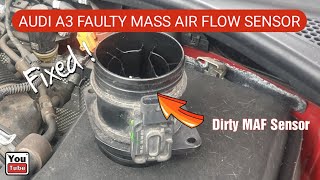
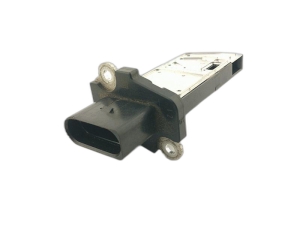
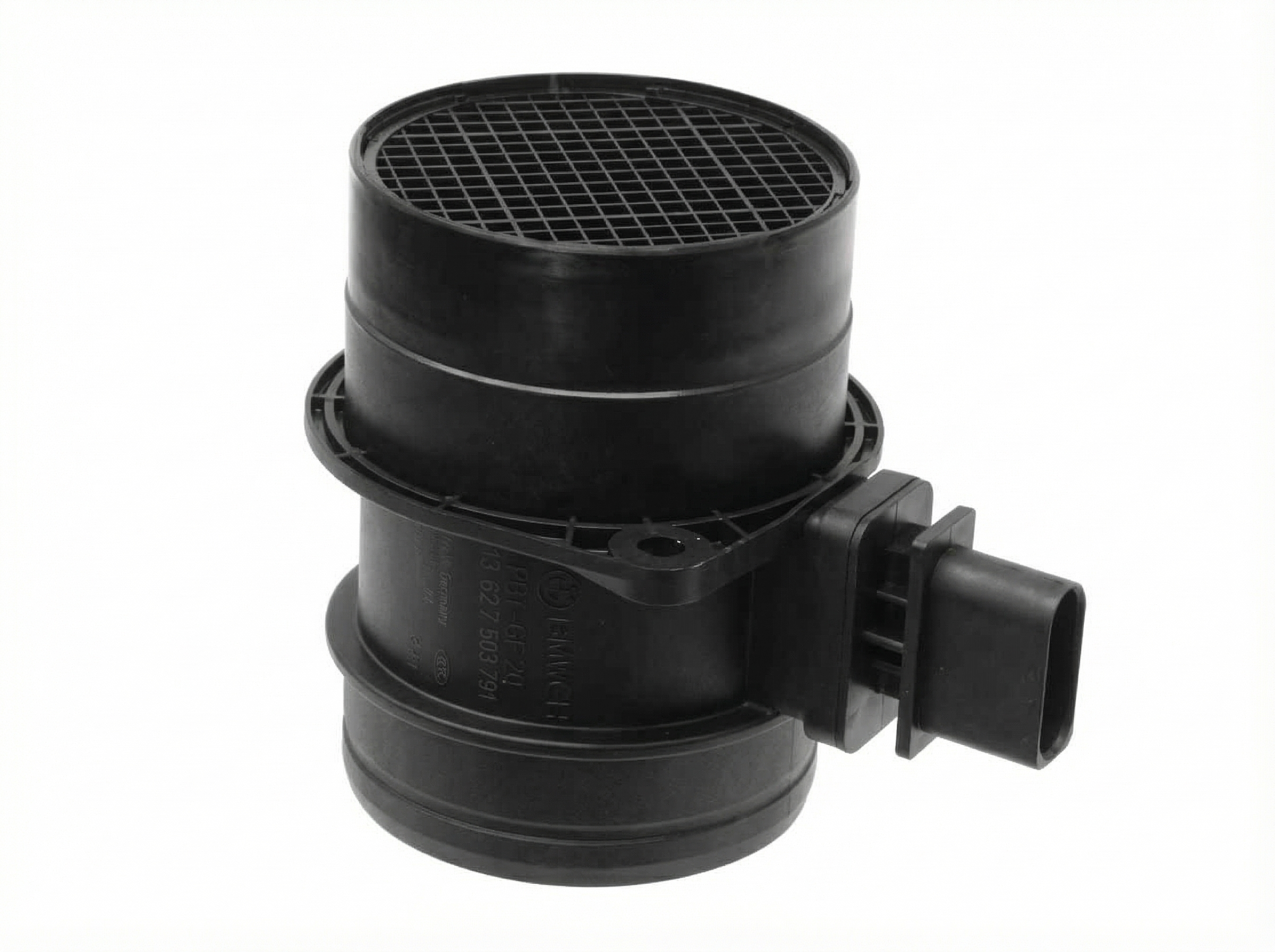
- Dirty or Contaminated MAF Sensor 🔴 High Probability → Shop Fuel Injection Air Flow Meter The MAF sensor's delicate hot-wire element can become coated with dust, oil, or other debris from the intake air, skewing its readings. This is a very common first point of failure for this code across all vehicles.
How to confirm: Remove the MAF sensor and visually inspect the sensing element. If it appears dirty, cleaning it is a good first step.
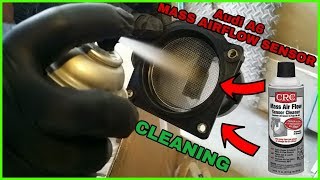
Typical fix: Clean the sensor using a dedicated MAF sensor cleaner spray. 🎬 Watch: A quick guide on cleaning your MAF sensor properly. Do not use brake cleaner or carb cleaner, as they can damage the sensitive electronics.
Est. part cost: $10-$20 for cleaner spray - Vacuum or Intake Air Leak 🔴 High Probability Hoses in the intake system, especially the large ducts to and from the intercooler, can become cracked, split, or have loose clamps over time, allowing unmetered air to enter the engine after the MAF sensor. This causes a discrepancy between the air the MAF measures and the air the engine actually receives.
How to confirm: Visually inspect all intake hoses and connections between the MAF sensor and the engine. A smoke test is the most effective way to find hidden leaks. 🎬 See how a smoke machine quickly identifies hidden intake leaks.
Typical fix: Replace the cracked or leaking hose or tighten the loose connection.
Est. part cost: $20-$150 depending on the hose - Missing Intake 'Flow Straightener' Post-Emissions Update 🔴 High Probability For vehicles that have had the VW/Audi emissions software update (Dieselgate), a specific part called a 'flow straightener' or 'Strömungsberuhiger' must be installed in the airbox before the MAF sensor. If this part is missing or was never installed during the recall service, it causes turbulent airflow that leads to the P0101 code. This is a very common cause on post-update CAYC engines.
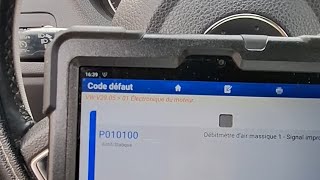
How to confirm: Open the air filter box and inspect the tract leading to the MAF sensor. The flow straightener, a small grid-like plastic insert, should be present. Its absence is a strong indicator of the problem's source if the car has had the emissions update (often identifiable by ECU software version 9978 🎬 Watch this diagnostic walkthrough for the P0101 code on 1.6 TDI.).
Typical fix: Install the genuine flow straightener. The part number is typically 3C0129363.
Est. part cost: $5-$20 - Faulty MAF Sensor 🟡 Medium Probability → Shop Fuel Injection Air Flow Meter The electronic components within the MAF sensor can fail with age and heat cycles, leading to incorrect or no signal output. However, many owners replace the sensor when the fault lies elsewhere.
How to confirm: After confirming no leaks and cleaning the sensor, if the code returns, the sensor itself is likely faulty. You can monitor live data with a scan tool to see if the g/s reading changes smoothly with RPM. If the reading is stuck, erratic, or doesn't change, the sensor is likely bad.
Typical fix: Replace the MAF sensor. It is highly recommended to use a genuine OEM or high-quality OEM-supplier part (like Bosch or Pierburg) as these engines can be sensitive to aftermarket sensor quality.
Est. part cost: $100-$250 - Faulty EGR Valve 🟡 Medium Probability On TDI engines, a stuck or malfunctioning EGR valve can disrupt expected airflow through the intake manifold, causing the ECU to see an implausible reading from the MAF sensor. Owners on forums for the CAYC engine report this as a common related issue, sometimes triggering P0101.
How to confirm: This is more difficult to diagnose. It may require a scan tool (like VCDS) to actuate the EGR valve and check for a response. A user on a Ross-Tech forum replaced a damaged EGR valve but the P0101 code remained, indicating it can be a related but not always the root cause.
Typical fix: Clean or replace the EGR valve.
Est. part cost: $200-$500 - Clogged or Dirty Air Filter ⚪ Low Probability → Shop Air Cleaner Assembly
How to confirm: Inspect the engine air filter. If it is visibly dirty or clogged, it can restrict airflow and trigger the code.
Typical fix: Replace the engine air filter.
Est. part cost: $20-$40
Rare But Worth Checking
- Incorrect Timing Belt Position: In at least one documented case on a CAYC engine, a P0101 code was ultimately traced to a timing belt that was off by one tooth. This caused the engine's mechanical timing to be out of sync with its sensors, leading to the implausible airflow reading.
- Wiring Harness or Connector Issue: Damage to the wiring leading to the MAF sensor, or corrosion in the connector pins, can interrupt the signal to the ECU. This can be intermittent and hard to find. A visual inspection of the harness and checking for stable voltage at the connector is a valid diagnostic step.
- Clogged Diesel Particulate Filter (DPF): A severely clogged DPF can increase exhaust backpressure to the point that it affects airflow dynamics through the engine, potentially contributing to a P0101 code. This is usually accompanied by other DPF-specific fault codes (like P2458) and symptoms.
Diagnosis Steps
- Read the fault code with an OBD-II scanner to confirm P0101 is present. Note any other codes.
- If the vehicle has had the emissions software update (Dieselgate recall), verify that the flow straightener (Part No. 3C0129363) is installed in the airbox. This is a primary suspect.
- Visually inspect the entire air intake system from the airbox to the turbo for any obvious cracks, splits, or loose clamps. Pay close attention to all rubber and plastic hoses.
- Inspect the engine air filter and replace it if it is dirty or clogged.
- Remove the MAF sensor. Inspect its connector for corrosion or damage. Clean the sensor's internal elements carefully using only dedicated MAF sensor cleaner spray. Let it dry completely before reinstalling.
- Clear the fault code and test drive the vehicle, paying attention to conditions like deceleration from highway speed, to see if the code returns.
- Use a scan tool to monitor the MAF sensor's live data (measured in grams per second, g/s). The reading should be low at idle and increase smoothly as you raise the engine RPM. If the reading is stuck, erratic, or jumps to a very high value when decelerating, it points to a problem.
- Perform a smoke test on the intake system to definitively check for any air leaks that are not visually apparent.
- If the code persists, investigate the EGR valve for proper operation using a scan tool to run actuation tests.
- As a final, less common check, verify the integrity of the timing belt installation if other symptoms like rough running are present.
Parts You'll Likely Need
- Mass Air Flow (MAF) Sensor
(OEM #03L906461A)— This is the primary sensor that fails or gets dirty, directly causing the P0101 code. While cleaning is often successful, replacement is the next step if cleaning fails or the sensor's electronics have failed.
Related Codes That Often Appear With This One
- P0401 - Exhaust Gas Recirculation (EGR) Flow Insufficient Detected
Platform-Specific Known Issues
- On models with the CAYC engine that received the emissions scandal software update (version 9978), a missing 'flow straightener' piece in the air intake is a known cause for P0101.
Mechanic-Grade Diagnostic Values
- Mass Air Flow (Actual) at Idle — expected: 2.00–5.00 g/s. Failure: Readings are significantly outside this range, are stuck, or jump erratically, especially during deceleration.
- MAF Sensor Specified vs. Actual (VCDS Live Data) — expected: The 'MAF actual' and 'MAF requested' (or specified) values should closely match each other as engine RPM changes.. Failure: If the 'MAF actual' value is very different from the 'MAF requested' value, or if the 'actual' value plateaus and stops rising with RPM, it indicates a sensor or system fault.
- EGR Valve Potentiometer Voltage (Fully Closed) — expected: Above 0.3V. Failure: A reading below 0.3V can indicate a faulty potentiometer within the EGR valve, preventing successful adaptation even on a new part.
Hidden / Shadow Codes Worth Checking
- 7329 - Mass Air Flow Sensor (G70) - P0101 00 - Implausible Signal: → Shop Fuel Injection Air Flow Meter This is the more detailed fault description provided by dealer-level scan tools like VCDS. It explicitly names the G70 sensor and confirms the 'Implausible Signal' nature of the fault, which is more specific than the generic P0101 definition. (see via VCDS (VAG-COM) or ODIS (dealer software).)
Scan Tool Commands That Help
- VCDS (VAG-COM): Basic Settings: 'Test of plausibility of mass air flow sensor' — This guided test runs the engine through specific conditions to check if the MAF sensor's response is logical. A result of 'System not OK' confirms the fault detected by the ECU.
- VCDS (VAG-COM): Output Tests: 'Exhaust Gas Recirculation Valve (N18)' — This allows you to manually cycle the EGR valve to check for mechanical movement. You can listen for clicks or observe the valve's position change in live data to see if it's stuck.
- VCDS (VAG-COM): Basic Settings: EGR Valve Adaptation (e.g., IDE00785 for UDS controllers) — After replacing the EGR valve, this procedure is required to teach the ECU the new valve's closed and open positions. Failure to adapt can cause persistent airflow-related codes like P0101.
Wiring & Ground Locations
- Engine Compartment Ground Points — There are several key ground points in the engine bay of an A3 8P: next to the battery, on the left longitudinal member (frame rail), and under the scuttle panel near the ECU.. The MAF sensor (G70) and ECU rely on a clean, solid ground connection to function. A corroded or loose ground point can introduce electrical noise or incorrect reference voltage, causing an implausible signal and triggering a P0101 code.
- MAF Sensor (G70) Connector — The electrical connector plugs directly into the MAF sensor, which is located in the intake tract right after the air filter box.. The connector pins for power, ground, and signal must be clean and make solid contact. Checking for 12V power and a good ground at the connector is a critical step before replacing the sensor itself.
Real Owner Repair Stories
- Ross-Tech Forums user (2010 Audi A3 8P 1.6 TDI (CAYC)) — Flashing glow plug light, P0101 code would not reset.
❌ Tried (didn't work) Running all basic settings tests with VCDS., Attempting to run the EGR adaptation procedure (IDE00785), which would not complete.
✅ What actually fixed it The owner had replaced the original EGR with a new BorgWarner OEM unit. After extensive troubleshooting, they discovered the new valve's potentiometer was faulty, reporting a voltage below the required 0.3V threshold in the fully closed position. Replacing the new (but faulty) EGR valve with another new genuine part finally resolved the issue and allowed the adaptation to complete. - MHH Auto forum user (2011 Audi A3 8P 1.6L CAYC with ECU software 9978) — P0101 code (7329 - Implausible Signal) appears around 100 km/h. VCDS MAF test reports 'system not OK'.
❌ Tried (didn't work) Replacing the EGR valve with a new BorgWarner unit., Performing a smoke test, which found no leaks.
✅ What actually fixed it The user noted their ECU had software version 9978, which is associated with the emissions recall. The final confirmed fix was installing the missing 'flow straightener' (Strömungsberuhiger) in the air intake tract before the MAF sensor.
"I Checked Everything" — The Actual Cause
- In a documented case on an Audi A3 1.6L TDI (CAYC), the owner performed a smoke test and found no intake leaks, yet the P0101 code persisted. The EGR valve was also replaced. The ultimate cause was determined to be the missing 'flow straightener' grid in the airbox, a required part after the emissions software update, which was causing air turbulence and fooling the MAF sensor.
OEM Part Supersession History
03L906461→03L906461A— This is a common revision update for VW/Audi parts. The 'A' suffix typically indicates a revised or improved version of the original part.
Heads up: The parts are generally interchangeable, but it is always recommended to use the latest revision (03L906461A) for this application.
Model Year Variations Within This Range
- 2009-2013: The 1.6L TDI CAYC engine was introduced around 2009 as part of the A3 (8P) facelift. Models prior to this will have different engines and the causes/fixes may not apply. Furthermore, vehicles that received the 'Dieselgate' emissions software update (ECU version 9978 is a known example) have a unique and very common cause for P0101: a missing 'flow straightener' grid in the airbox that was supposed to be installed during the recall service.
Diagnostic Flowchart
Other Known Issues on This Vehicle
Issues unrelated to this code that are worth knowing about as an owner of this generation:
- Fuel Injector Failure 🔴 High — A widely reported problem on the CAYC engine. Can occur from 60,000 miles onwards. Often, one injector fails, but replacing all four is sometimes recommended. (Ref: No official recall, but owners report Audi sometimes provided warranty or goodwill replacements with updated parts.)
- Diesel Particulate Filter (DPF) Blockage 🟠 Medium — Common, especially for vehicles used primarily for short, urban journeys which prevent successful DPF regeneration cycles.
- EGR Valve/Cooler Failure 🟠 Medium — The EGR valve can stick due to carbon buildup, and the EGR cooler is known to develop leaks. This is a common issue on modern diesel engines, including the 1.6 TDI.
- Water Pump Failure 🔴 High — The water pump, driven by the timing belt, can fail, leading to coolant loss and overheating. It is strongly recommended to replace it whenever the timing belt is changed.
- Dual-Mass Flywheel (DMF) Failure (Manual Gearbox) 🟠 Medium — Owners report rattling or chattering noises at idle, which disappear when the clutch is pressed. This often indicates a failing DMF, typically occurring at higher mileage (80k+ miles).
- Door Wiring Loom Breakage 🟡 Low — Wires inside the rubber boot between the door and the car body can fatigue and break over time, causing issues with windows, speakers, central locking, and mirror indicators.
Used vs. New Parts: Buying Guide for This Vehicle
When a used part is the smart pick: For this repair, used parts are generally not recommended for electronic components. However, obtaining used structural intake parts like hoses or the airbox from a low-mileage donor vehicle can be a cost-effective way to fix cracks or leaks.
Donor-vehicle mileage cap: roughly under 80000 miles for the part to have meaningful remaining life.
What to inspect on the donor part:
- For intake hoses, inspect for any hairline cracks, brittleness, or soft/oily spots.
- For an airbox, ensure all clips are intact and there are no cracks, especially around the MAF sensor mounting point.
- Verify the donor vehicle did not have a front-end collision.
OEM-only on this vehicle (don't cheap out):
- Mass Air Flow (MAF) Sensor: The CAYC engine is notoriously sensitive to the quality of the MAF sensor. Forum users and specialists strongly advise against cheap, unbranded aftermarket sensors, as they often fail quickly or provide inaccurate readings out of the box, leading to a repeat of the P0101 code.
- EGR Valve: Given the complexity and the requirement for software adaptation, using a genuine or high-quality OEM supplier (like Pierburg, Wahler, or BorgWarner) is critical. A documented case showed even a new OEM supplier part can be faulty, highlighting the risk of using a used or low-quality unit.
Aftermarket brands forum-validated for this vehicle:
- Bosch (for MAF Sensor)
- Pierburg (for MAF Sensor)
- Hella (for MAF Sensor)
- BorgWarner (for EGR Valve - though be aware of potential for defects)
Brands owners have reported issues with on this vehicle:
- Unbranded or generic 'eBay' MAF sensors are frequently reported to be defective or cause persistent issues on this engine.
Real Owner Stories
Aggregated from forums and TSBs cited above. Mileages and costs reflect what owners reported in those sources.
2010 Audi A3 1.6L TDI (CAYC)
Symptoms: Weird issue where the P0101 code would trigger specifically on this 105HP model.
What fixed it: The issue was related to the MAF sensor readings being implausible, requiring diagnosis of the sensor and intake tract.
Source hint: mhhauto.com thread titled 'Weird issue with Audi a3 1.6TDI 105HP MY2010 P0101'
2010 VW Golf Mk6 1.6L TDI (CAYC)
Symptoms: P0101 MAF fault appearing on the 1.6 TDI engine platform.
What fixed it: Cleaning the MAF sensor or addressing EGR system issues, which are common on this shared platform.
Source hint: Reddit r/MechanicAdvice '10 VW Golf 16tdi p0101 maf fault'
Audi A3 1.6L TDI
Symptoms: P0101 code persisting even after some components were checked.
What fixed it: Investigation into the EGR valve and ensuring no air leaks were present in the intake ducting.
Source hint: https://forums.ross-tech.com/index.php?threads/39622/
Related OBD-II Codes
Frequently Asked Questions
I just had the Dieselgate emissions update on my 1.6L TDI and now I have a P0101 code. What should I check first?
Why does my glow plug light flash when I let off the accelerator pedal?
Can I use standard brake cleaner to fix the MAF sensor on my A3?
Is it common for the EGR valve to cause a MAF code on the CAYC engine?
Should I replace my MAF sensor immediately if I see P0101?
What part number should I look for if my airbox is missing the flow straightener?
Helpful Videos
We Have This Part in Stock

The information in this article is provided for general reference and educational purposes only. Vehicle specifications, procedures, and part compatibility can vary by production date, trim level, and region. Always consult your vehicle's factory service manual and verify part numbers before purchasing or performing repairs. Safety-critical components such as airbags, seat belts, and braking systems should be installed by a qualified professional.
- Audi A3:
- 🧭 Diagnostic Flowchart
- 🎬 Helpful Videos
- 🛍️ Shop This Part
- What's Unique About the 2003-2013 Audi A3
- Symptoms You May Notice
- Most Likely Causes
- Rare But Worth Checking
- Diagnosis Steps
- Parts You'll Likely Need
- Related Codes That Often Appear With This One
- Platform-Specific Known Issues
- Mechanic-Grade Diagnostic Values
- Hidden / Shadow Codes Worth Checking
- Scan Tool Commands That Help
- Wiring & Ground Locations
- Real Owner Repair Stories
- "I Checked Everything" — The Actual Cause
- OEM Part Supersession History
- Model Year Variations Within This Range
- Other Known Issues on This Vehicle
- Used vs. New Parts: Buying Guide for This Vehicle
- Real Owner Stories
- 2010 Audi A3 1.6L TDI (CAYC)
- 2010 VW Golf Mk6 1.6L TDI (CAYC)
- Audi A3 1.6L TDI
- Related OBD-II Codes
- Frequently Asked Questions
- 🎟️ Get 5% Off