

P0101 on 2008-2017 Audi Q5 2.0L TDI: MAF Sensor Range/Performance Causes and Fixes
On the Audi Q5 2.0L TDI, code P0101 is most often caused by a dirty or non-OEM air filter, an air leak in the intake system (post-MAF), or a dirty MAF sensor. Before replacing the sensor for around $150-$250, check for disconnected hoses, consider cleaning the sensor with a dedicated cleaner, and replace the air filter with a genuine OEM part. A smoke test is the most reliable way to find hidden intake leaks.
- Before buying any parts, check the air filter and inspect the entire intake system for air leaks. A loose hose clamp is a common culprit.
- Try cleaning the MAF sensor with a dedicated cleaner before replacing it.
- On a TDI engine, P0101 can be related to the EGR system. If you also have EGR codes, investigate that system thoroughly.
- Avoid cheap, no-name MAF sensors. If you must replace it, use a genuine OEM or reputable brand like Bosch, as these cars are sensitive to sensor quality.
- Do not automatically assume the MAF sensor is bad. It is a common misdiagnosis that leads to wasted money. The problem is often a much simpler and cheaper fix.
What's Unique About the 2008-2017 Audi Q5
On the Audi Q5 2.0L TDI (often using the EA189 engine family), the P0101 code is frequently interconnected with other systems, particularly the air intake and emissions components like the EGR (Exhaust Gas Recirculation) and DPF (Diesel Particulate Filter). Owners often find that the problem is not the MAF sensor itself, but rather an unmetered air leak after the sensor, a clogged or poor-quality air filter, or a malfunctioning EGR valve. A Ross-Tech forum user's experience highlights this, where after replacing the MAF sensor, a P0402 (EGR Excessive Flow) code appeared, indicating the two systems are closely linked. Simply replacing the MAF sensor without a thorough diagnosis of the entire intake path often fails to resolve the issue.
Generation note: The 2008-2017 year range covers the first generation of the Audi Q5 (Typ 8R). This generation received a facelift in 2012, which included minor cosmetic and mechanical updates. However, the causes and diagnostic procedures for code P0101 on the 2.0L TDI engine (part of the EA189 family) remain consistent across the entire generation. These engines were also part of the 'Dieselgate' emissions recall, which involved software updates that can affect engine and emissions system behavior.
Symptoms You May Notice
- Check Engine Light is on
- Reduced engine power and sluggish acceleration
- Vehicle may enter 'limp mode'
- Flashing glow plug light on the dashboard
- Rough or unstable idle
- Increased fuel consumption
- Black smoke from the exhaust under acceleration
- Hard starting
- Hesitation during acceleration
- Immediately replacing the MAF sensor. Many owners and even shops replace the sensor one or more times only to find the problem was a simple air leak, a dirty/non-OEM air filter, or a bad wiring connection. Always perform a full diagnostic check for leaks and filter quality first.
Most Likely Causes
- Air Leak in Intake System 🔴 High Probability The complex plumbing of a turbocharged engine has many connection points that can loosen or crack over time. Leaks of unmetered air *after* the MAF sensor are a primary cause.
How to confirm: Visually inspect all intake hoses and connections between the MAF sensor and the engine for cracks, loose clamps, or complete disconnection. A common culprit is the turbo boost inlet hose coming loose. A smoke test is the most effective way to find small, hidden leaks.
Typical fix: Secure loose clamps or replace the cracked/damaged hose or seal. A forum user on Ross-Tech forums reported a bad O-ring at the MAF sensor connection to the airbox was the cause.
Est. part cost: $10-$150 - Dirty or Incorrect Air Filter 🔴 High Probability → Shop Air Cleaner Assembly A restrictive or improper air filter can disrupt the airflow reading. Aftermarket oiled filters, if over-oiled, are notorious for contaminating the MAF sensor element.
How to confirm: Inspect the engine air filter. If it is dirty, clogged, or a non-OEM filter that looks restrictive, it should be replaced.
Typical fix: Replace the engine air filter with a high-quality OEM or equivalent filter (e.g., Mann, Mahle).
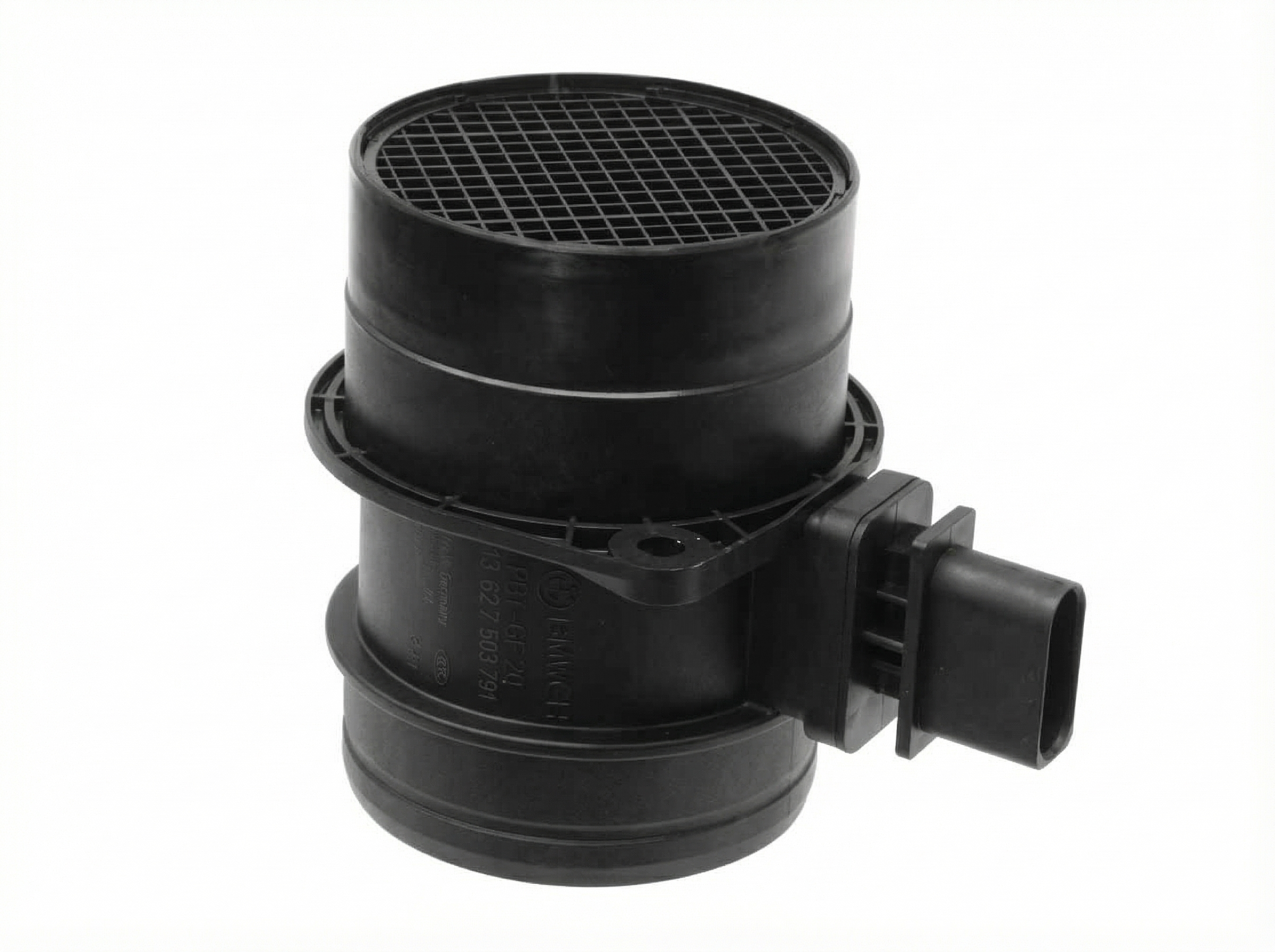
Est. part cost: $25-$60 - Dirty or Faulty Mass Air Flow (MAF) Sensor 🟡 Medium Probability → Shop Fuel Injection Air Flow Meter The sensor's delicate wires can become contaminated with dirt, oil, or other debris over time, skewing its readings. This is often a secondary result of other issues like a dirty/oiled filter or crankcase ventilation system problems.
How to confirm: Remove the MAF sensor and inspect the sensing element. If it appears dirty, cleaning it with a dedicated MAF sensor cleaner spray is a good first step. To confirm a faulty sensor, use a scan tool (like VCDS) to monitor the MAF reading (in g/s) at idle and under load and compare it to specified values. A faulty sensor may show readings that are illogically low or drop to zero under throttle.
Typical fix: First, attempt to clean the sensor. If cleaning doesn't work and all other causes are ruled out, replace the MAF sensor with a genuine OEM part, preferably Bosch.
Est. part cost: $150-$250 - EGR System Malfunction 🟡 Medium Probability On TDI engines, the MAF and EGR systems are closely linked to control emissions. A stuck-open or malfunctioning EGR valve can allow unmetered exhaust gas into the intake, which conflicts with the MAF sensor's readings, causing the ECU to see an implausible airflow value.
How to confirm: Use a diagnostic tool to check EGR valve operation and for EGR-related fault codes. A common companion code is P0402 (Excessive Flow). A user on the Ross-Tech forums noted that after replacing a MAF for a P0101, a P0402 code immediately appeared, confirming the relationship.
Typical fix: Clean or replace the EGR valve and/or EGR cooler. This can be a labor-intensive job.
Est. part cost: $200-$800
Rare But Worth Checking
- Blocked Diesel Particulate Filter (DPF): While a blocked DPF usually throws its own specific codes (like P2002), severe exhaust restriction can affect airflow readings and contribute to a P0101 code. An AudiWorld user reported a garage suspected a blocked DPF was the root cause of a P0101 after multiple MAF swaps failed to fix it.
- Faulty MAF Sensor Wiring or Connector: → Shop Fuel Injection Air Flow Meter If multiple MAF sensors have been tried without success, the issue may lie in the wiring harness or the connector pins. A technician on JustAnswer advised checking the power, ground, and signal wire continuity back to the ECU before replacing a sensor a second time.
- Intake Manifold Runner/Flap Issues: → Shop Engine Intake Manifold The intake manifold on these engines has flaps that adjust airflow. If a vacuum actuator controlling these flaps fails, it can disrupt airflow and potentially trigger a P0101. A mechanic on JustAnswer mentioned this as a known issue on VAG cars that can be tested with a vacuum pump.
Diagnosis Steps
- Read all fault codes with an OBD-II scanner to see if other codes are present, which can provide valuable clues (e.g., P0402, P2002).
- Inspect the engine air filter. Replace if it is dirty, clogged, or a low-quality/oiled aftermarket part. This is a cheap and very common fix.
- Perform a thorough visual inspection of the entire air intake tract from the airbox to the turbocharger. Look for any disconnected hoses, loose clamps, or visible cracks. Pay close attention to the large diameter hoses connected to the turbo.
- Carefully remove the MAF sensor and inspect its sensing element. Clean it using a dedicated MAF sensor cleaner spray. Do not touch the delicate wires. Allow it to dry completely before reinstalling.
- Inspect the MAF sensor's electrical connector and wiring for any signs of damage, corrosion, or loose pins.
- If the code returns, perform a smoke test on the intake system to identify any hard-to-see air leaks. This is the most definitive way to rule out vacuum leaks.
- Using an advanced scan tool (like VCDS for Audi), monitor the live data from the MAF sensor at idle and while driving. Compare the 'specified' vs. 'actual' airflow values to see if they deviate significantly. A healthy sensor should show increasing g/s readings with RPM.
- Check the operation of the EGR valve using the scan tool to ensure it is not stuck open or closed.
- If all other steps fail to identify the problem, consider replacing the MAF sensor with a high-quality OEM part (e.g., Bosch). Ensure you are using the correct part number for your specific engine.
Parts You'll Likely Need
- Mass Air Flow (MAF) Sensor
(OEM #03L906461A (Bosch), 06J906461D (Verify by VIN))— This is a potential cause if it's dirty or has failed internally, but should only be replaced after ruling out air leaks and filter issues. Bosch is the OEM supplier.
Trusted brands: Bosch, Hitachi
OEM price range: $200-$250
Aftermarket price range: $80-$150 - Engine Air Filter — A clogged or improper air filter is a very common and inexpensive cause for this code. Sticking to OEM-spec filters is highly recommended.
Trusted brands: Mann-Filter, Mahle, Genuine Audi
OEM price range: $40-$60
Aftermarket price range: $25-$40 - Intake Air Hose / Boot — Cracks or loose connections in the intake hoses are a primary cause of unmetered air leaks that trigger P0101.
Trusted brands: Genuine Audi, Vaico
OEM price range: $75-$150
Aftermarket price range: $40-$90
Related Codes That Often Appear With This One
- P0402 — Indicates 'EGR Flow Excessive'. A malfunctioning EGR system can directly cause implausible MAF readings, so these codes often appear together as the ECU struggles to correlate the two inputs.
- P2196 — Indicates 'O2 Sensor Signal Stuck Rich'. A faulty MAF sensor under-reporting airflow can cause the ECU to believe the engine is running rich, triggering this code. This is a known pattern on the 2.0L TDI engine family.
- P2002 — Indicates 'DPF Efficiency Below Threshold'. Issues in the intake and airflow measurement can lead to poor combustion, which in turn can affect DPF performance and trigger this code. An AudiWorld forum thread shows a car presenting with both P0101 and P2002.
Platform-Specific Known Issues
- Real-world forum thread: P0101 caused by bad O-ring and non-genuine air filter: → Shop Air Cleaner Assembly A user on the Ross-Tech forums detailed their struggle with a recurring P0101 code. After replacing the MAF sensor didn't help, an Audi service center diagnosed the issue as a combination of a non-genuine air filter restricting flow at high RPM and a leaky O-ring where the MAF sensor housing connects to the airbox. Replacing both with genuine parts resolved the fault. URL: https://forums.ross-tech.com/index.php?threads/27339/
- Real-world forum thread: P0101 and P2002 pointing to a bad air filter: → Shop Air Cleaner Assembly An AudiWorld forum member described a scenario where a P0101 and P2002 (DPF issue) were present. After replacing the EGR cooler and trying three different MAF sensors, the ultimate culprit was found by an Audi dealer to be a visually clean but faulty air filter. This highlights how a simple part can cause complex, misleading symptoms. URL: https://www.audiworld.com/forums/q5-sq5-mki-8r-discussion-129/p0101-code-3058985/
Mechanic-Grade Diagnostic Values
- MAF Sensor Live Data (g/s) at Idle — expected: A general rule of thumb for a healthy 2.0L TDI engine at sea level, with no loads (A/C off), is 3.4 to 3.8 g/s. Another source suggests a range of 2-5 g/s is acceptable.. Failure: A significantly lower value could indicate a vacuum/intake leak after the sensor. A higher value could indicate a contaminated MAF or an airbox restriction.
- MAF Sensor Live Data (mg/H) at Full Load — expected: During a full-throttle run in a high gear (4th/5th) from 2500-3500 RPM, the MAF actual value should be at least 850-900 mg/H (milligrams per hour) at 3000 RPM. Note: This value is for an older 90hp ALH engine but provides a useful diagnostic principle.. Failure: Values significantly below the expected range indicate the MAF is under-reporting airflow, leading to a loss of power.
- MAF Sensor Connector Voltage (Key On, Engine Off) — expected: On a 4-pin connector: Pin 1 (Pink/Red) should have ~5V. Pin 2 (Green/White) should have ~5V. Pin 3 (Grey/White) is ground. Pin 4 (Black) should have 12V (battery voltage).. Failure: Missing or incorrect voltages on any pin indicate a wiring harness or ECU problem, not a faulty sensor.
- Multiplicative Fuel Trim (VCDS Measuring Block 032) — expected: The value should be within +/- 5%.. Failure: A large positive value (e.g., >10%) indicates the ECU is adding significant fuel to compensate for a lean condition, which is often caused by a MAF sensor under-reporting airflow.
Scan Tool Commands That Help
- VCDS (VAG-COM): Engine -> Measuring Blocks -> Group 003 (for MAF g/s) and Group 032 (for Fuel Trims) — This is a primary diagnostic step. Group 003 shows specified vs. actual airflow, while Group 032 shows long-term fuel corrections (multiplicative trim). A high positive multiplicative trim strongly suggests the MAF is under-reading.
- VCDS (VAG-COM): Engine -> Basic Settings -> Group 032 (for UDS controllers, use Adaptation) — After replacing a MAF sensor or fixing a major intake leak, some technicians recommend resetting fuel trim adaptation values to force the ECU to relearn faster. Note that clearing fault codes also resets these values to zero.
Wiring & Ground Locations
- G70 (Mass Air Flow Sensor) — Located in the intake tract, immediately after the air filter box.. This is the primary sensor for the P0101 code. Its wiring harness connector is a common point of failure due to vibration and heat. A fuse (typically 5A on Fuse Panel B) provides power to the sensor.
- 12 - Ground Connection (in engine compartment, left) — On the left side of the engine compartment, near the suspension strut tower.. This is a primary engine bay ground point. A poor connection here can cause erratic voltage and signal readings for multiple engine sensors, including the MAF.
- 671 / 672 - Ground Connection 1 & 2 (on left front long member) — Located on the left front frame rail (long member), potentially behind the wheel arch liner.. These are major chassis ground points for the front of the vehicle. Corrosion or looseness can lead to intermittent and hard-to-diagnose electrical issues for the entire engine management system.
Real Owner Repair Stories
- AudiWorld Forums user 'SWP' (2017 Audi Q5 2.0L TDI) — Check Engine Light with codes P0101 and P2002.
❌ Tried (didn't work) Replaced EGR cooler (to address P2002), Cleaned the MAF sensor, Replaced the MAF sensor, Substituted a third known-good MAF sensor, Forced DPF regeneration twice
✅ What actually fixed it After extensive diagnostics at an Audi dealer, the root cause was a bad air filter that visually appeared to be fine. Replacing the air filter resolved the P0101 code. - Ross-Tech Forums user (2016 Audi SQ5 3.0 TDI (similar system)) — P0101 - Mass Air Flow Sensor (G70): Implausible Signal.
❌ Tried (didn't work) Initial diagnostics focused on the sensor itself.
✅ What actually fixed it The final cause was an air leak through the O-ring where the MAF sensor assembly connects to the air filter box. Replacing this simple seal fixed the implausible signal.
"I Checked Everything" — The Actual Cause
- In one documented case on AudiWorld forums, after replacing the MAF sensor multiple times and presumably checking for intake leaks, the persistent P0101 was ultimately caused by a faulty, restrictive engine air filter that looked visually clean. This highlights that a filter can fail without being obviously dirty.
OEM Part Supersession History
03L906461→03L906461A— Component revision and update by the manufacturer.
Heads up: While the 'A' version often replaces the base version, using the wrong suffix for a specific vehicle's ECU can cause P0101. It is critical to use a VIN to find the exact part number required, as different suffixes may exist for different calibrations (e.g., 03L906461D, 03L906461E).
Model Year Variations Within This Range
- 2008-2017: The 2.0L TDI engine in this generation is part of the EA189 family. While the core P0101 causes are consistent, vehicles that received the 'Dieselgate' emissions software update may have more sensitive monitoring parameters for the MAF and EGR systems, potentially making them more prone to triggering a P0101 for minor deviations.
Diagnostic Flowchart
Other Known Issues on This Vehicle
Issues unrelated to this code that are worth knowing about as an owner of this generation:
- Diesel Particulate Filter (DPF) Clogging 🔴 High — Common, especially for vehicles used primarily for short trips or city driving which prevents passive regeneration. (Ref: Covered under the extended emissions warranty from the 'Dieselgate' settlement for many vehicles.)
- 'Dieselgate' Emissions System Recall 🟠 Medium — Affects nearly all 2.0L TDI models from this era. Owners were required to get a software update. (Ref: Multiple recalls (e.g., '23Q7') and an extended emissions warranty were issued by VW/Audi.)
- High-Pressure Fuel Pump (HPFP) Failure 🔴 High — A known potential failure point for TDI engines. Failure can be catastrophic, sending metal particles through the entire fuel system, leading to extremely expensive repairs. (Ref: Often covered under the extended emissions warranty if the failure occurs within the warranty period.)
- EGR Valve and Cooler Clogging 🟠 Medium — The EGR system is prone to blockages from soot, which can cause rough running, power loss, and trigger various engine codes.
- S-Tronic (DSG) Transmission Mechatronic Unit Failure 🟠 Medium — The dual-clutch automatic transmission can develop issues with its complex mechatronic control unit, leading to harsh shifting or transmission faults.
Used vs. New Parts: Buying Guide for This Vehicle
When a used part is the smart pick: Used parts are generally not recommended for the MAF sensor itself due to its sensitivity and potential for unseen contamination or wear. However, obtaining used structural intake components like the airbox, intercooler, or connecting pipes from a low-mileage donor vehicle can be a cost-effective way to fix cracks or damage found during diagnosis.
Donor-vehicle mileage cap: roughly under 70000 miles for the part to have meaningful remaining life.
What to inspect on the donor part:
- For intake hoses: Check for pliability; avoid any that are hard or brittle. Squeeze the hose to check for hidden cracks.
- For an intercooler: Inspect fins for excessive damage or corrosion. Check the inlet/outlet ports for any signs of oil residue, which might indicate issues with the donor vehicle's turbo.
- For an airbox: Ensure all mounting tabs and clip points are intact and not broken.
OEM-only on this vehicle (don't cheap out):
- Mass Air Flow (MAF) Sensor: Due to precise calibration requirements, a genuine OEM sensor (Bosch is the original manufacturer) is highly recommended. Many forum stories detail persistent issues with cheap aftermarket sensors.
Aftermarket brands forum-validated for this vehicle:
- Bosch (OEM supplier)
- Denso (Known for quality electronics)
- Delphi
Brands owners have reported issues with on this vehicle:
- Unbranded, low-cost sensors from online marketplaces are frequently cited as being improperly calibrated, failing quickly, or being dead-on-arrival.
Real Owner Stories
Aggregated from forums and TSBs cited above. Mileages and costs reflect what owners reported in those sources.
Audi Q5 2.0L TDI
Symptoms: Recurring P0101 code; replacing the MAF sensor did not resolve the issue.
What fixed it: Replacing a non-genuine air filter that was restricting flow at high RPM and replacing a leaky O-ring at the MAF sensor-to-airbox connection.
Source hint: Ross-Tech forums thread titled '27339'
Audi Q5 2.0L TDI
Symptoms: P0101 and P2002 (DPF issue) codes present; owner replaced EGR cooler and three different MAF sensors without success.
What fixed it: An Audi dealer identified a visually clean but faulty air filter as the culprit.
Source hint: AudiWorld forum member in thread 'p0101-code-3058985'
Audi Q5 2.0L TDI
Symptoms: P0101 code triggered by a physical disconnection in the intake tract.
What fixed it: Reconnecting the turbo boost inlet hose that had completely come loose and securing the clamp.
Source hint: YouTube video cited in context
Related OBD-II Codes
Frequently Asked Questions
Can a simple air filter cause a P0101 on my Audi Q5 TDI even if it looks clean?
I'm seeing a flashing glow plug light along with P0101; is this normal for the Q5 2.0L TDI?
Which brand of MAF sensor should I use for my Audi Q5 2.0L TDI?
Is there a specific connection point in the intake I should check for leaks?
Can an EGR problem cause a MAF sensor code on this engine?
Will cleaning the MAF sensor fix the P0101 code?
Helpful Videos


We Have This Part in Stock

The information in this article is provided for general reference and educational purposes only. Vehicle specifications, procedures, and part compatibility can vary by production date, trim level, and region. Always consult your vehicle's factory service manual and verify part numbers before purchasing or performing repairs. Safety-critical components such as airbags, seat belts, and braking systems should be installed by a qualified professional.
- Audi Q5:
- 🧭 Diagnostic Flowchart
- 🎬 Helpful Videos
- 🛍️ Shop This Part
- What's Unique About the 2008-2017 Audi Q5
- Symptoms You May Notice
- Most Likely Causes
- Rare But Worth Checking
- Diagnosis Steps
- Parts You'll Likely Need
- Related Codes That Often Appear With This One
- Platform-Specific Known Issues
- Mechanic-Grade Diagnostic Values
- Scan Tool Commands That Help
- Wiring & Ground Locations
- Real Owner Repair Stories
- "I Checked Everything" — The Actual Cause
- OEM Part Supersession History
- Model Year Variations Within This Range
- Other Known Issues on This Vehicle
- Used vs. New Parts: Buying Guide for This Vehicle
- Real Owner Stories
- Audi Q5 2.0L TDI
- Audi Q5 2.0L TDI
- Audi Q5 2.0L TDI
- Related OBD-II Codes
- Frequently Asked Questions
- 🎟️ Get 5% Off