

P0101 on 2011-2018 Nissan Sentra: MAF Sensor, ECM, and Other Fixes
On 2011-2018 Nissan Sentras, code P0101 is most often caused by a dirty Mass Air Flow (MAF) sensor, a contaminated throttle body, or outdated engine computer (ECM) software. Cleaning the MAF sensor and throttle body is a good first step, but a dealer reprogram may be required to fix the issue permanently, as specified in multiple Nissan Technical Service Bulletins (TSBs).
- Do not immediately replace the Mass Air Flow (MAF) sensor for a P0101 code on a 2011-2018 Sentra.
- The most effective and low-cost first steps are to inspect for intake air leaks and clean both the MAF sensor and the throttle body.
- Be aware that Nissan has issued Technical Service Bulletins (TSBs) for this issue, and the final fix may require an ECM reprogram at a dealership.
- After cleaning the throttle body or replacing it, an Idle Air Volume Relearn procedure is necessary.
- For 2013-2014 models, check if the PCV valve is the old orange style; if so, replace it with the updated black version as part of the repair.
What's Unique About the 2011-2018 Nissan SENTRA

For this generation of Nissan Sentra, a P0101 code doesn't automatically mean the MAF sensor has failed. Nissan has issued multiple Technical Service Bulletins (TSBs) indicating that the root cause is often a software calibration issue within the Engine Control Module (ECM). In many cases, especially if there are no drivability problems, the official fix involves a specific sequence of actions depending on the model year, including cleaning the throttle body, replacing an outdated PCV valve, and reprogramming the ECM with updated software, rather than just replacing parts.
Diagnostic Flowchart

Tap your situation to follow the diagnostic path that matches what you're seeing on this vehicle.
Generation note: The 2011-2018 year range covers two Sentra generations: the B16 (2011-2012, with the 2.0L MR20DE engine) and the B17 (2013-2018, with the 1.8L MRA8DE engine). TSBs specifically mention both generations. TSB NTB12-051k applies to the 2011-2012 B16 models, recommending an ECM reprogram if no drivability issues are present. TSB NTB16-027 is more complex for the B17 models, recommending an ECM reprogram for 2013-2015, throttle body cleaning for 2013-2015, and PCV valve replacement for 2013-2014 models if the original valve is orange.
Symptoms You May Notice
- Check Engine Light is on
- Hesitation or stumbling during acceleration.
- Loss of engine power, sometimes feeling 'sluggish'.
- Engine shakes or idles roughly.
- Stalling, especially at idle or when coming to a stop.
- Poor fuel economy
- Inability to accelerate over 2,000-2,400 RPM (fail-safe mode).
- Violent shaking under acceleration (reported in NHTSA complaint #11192235).
- Immediately replacing the MAF sensor without first cleaning it, cleaning the throttle body, or checking for intake leaks.
- Replacing the MAF sensor with a cheap aftermarket part, which often leads to the code returning.
- Replacing parts repeatedly when the underlying issue is outdated ECM software that requires a dealer reprogram as per Nissan TSBs.
Most Likely Causes

- Outdated Engine Control Module (ECM) Software 🔴 High Probability Nissan has released multiple TSBs (NTB16-027 and NTB12-051k) to correct overly sensitive diagnostic parameters in the original ECM software that can falsely trigger a P0101 code, often when no actual drivability issue exists.
How to confirm: A Nissan dealership or a properly equipped independent shop with a tool like Nissan's CONSULT or a capable aftermarket scanner can check the current software calibration part number against the numbers listed in the TSBs to see if an update is available.
Typical fix: Reprogramming (flashing) the ECM with the latest software version. This is not a DIY procedure without specialized tools like Nissan's NERS.
Est. part cost: $100 - $250 for a dealer reprogram. - Dirty Throttle Body 🔴 High Probability → Shop Fuel Injection Throttle Body Carbon and oil deposits from the PCV system build up around the throttle plate, restricting airflow at idle and low speeds. This disrupts the air-to-fuel ratio correlation the ECM expects, triggering the P0101 code. This is a primary step in TSB NTB16-027.
How to confirm: Remove the intake ducting from the throttle body and inspect for a ring of black carbon buildup around the throttle plate and bore.
Typical fix: Clean the throttle body and plate with throttle body cleaner and a soft cloth. An Idle Air Volume Relearn (IAVL) procedure is mandatory after cleaning to restore proper idle. This can be done with a capable scan tool or a specific pedal-dance procedure.
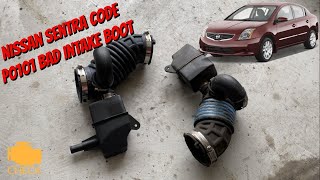
Est. part cost: $10-$20 for cleaner - Intake Air Leaks (Vacuum Leak) 🟡 Medium Probability The accordion-style rubber intake boot between the MAF sensor and the throttle body is a known failure point. It can crack with age and heat, allowing unmetered air to enter the engine and corrupt MAF sensor readings.
How to confirm: Visually inspect the intake hose for cracks, especially in the folds. 🎬 Watch: How to find and fix a cracked intake boot. Perform a smoke test to definitively find the source of any leak.
Typical fix: Replace the cracked intake hose. Tightening loose clamps may also work if the hose is intact.
Est. part cost: $40-$80 for a new intake hose (e.g., OEM Part #16576-ET00A for 2.0L). - Dirty Mass Air Flow (MAF) Sensor 🟡 Medium Probability → Shop Fuel Injection Air Flow Meter Oil and dirt particles from the air filter and crankcase ventilation system can contaminate the sensor's delicate hot wire over time, causing inaccurate readings.
How to confirm: Visually inspect the sensor element for dirt or grime. Monitor live data with a scan tool; voltage should be around 1.0-1.7 volts at idle and increase smoothly with RPM.
Typical fix: Remove the sensor and clean it carefully using only dedicated Mass Air Flow sensor cleaner. Do not touch the internal wires. Let it dry completely before reinstalling.
Est. part cost: $10-$15 for cleaner - Faulty Mass Air Flow (MAF) Sensor ⚪ Low Probability → Shop Fuel Injection Air Flow Meter While less common than a dirty sensor or software issue, the sensor itself can fail electronically. Owners report that using non-OEM/Hitachi sensors often fails to fix the problem or the code returns quickly.
How to confirm: After confirming no vacuum leaks, clean wiring, and correct ECM software, if live data from the sensor is still erratic, unresponsive, or out of spec (e.g., not 1.0-1.7V at idle), 🎬 Watch: Diagnosing a MAF sensor that is out of range. the sensor is likely faulty.
Typical fix: Replace the MAF sensor. It is strongly recommended to use an OEM or Hitachi-branded sensor.
Est. part cost: $70-$250
Rare But Worth Checking
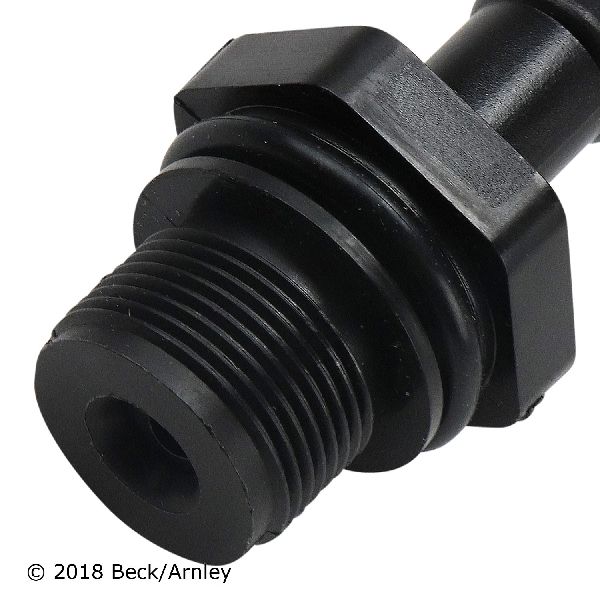
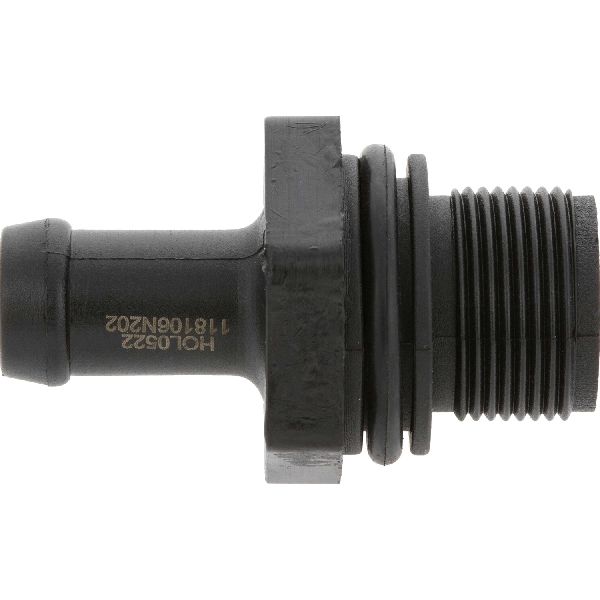
- Faulty PCV Valve: → Shop PCV Valve For 2013-2014 models, Nissan TSB NTB16-027 explicitly advises inspecting the PCV valve. If it is the original orange-colored design, it must be replaced with the updated black version (Part #11810-EA200) as part of the P0101 repair procedure.
- Clogged Catalytic Converter: A restricted exhaust creates backpressure that throws off the airflow readings. This will usually be accompanied by a significant loss of power, a hissing sound, and potentially other codes like P0420.
- Wiring Harness Issue: A poor ground or a short/open in the wiring to the MAF sensor can mimic the symptoms of a failed sensor. One technician fixed a P0101 by soldering a new ground wire from the MAF connector to the engine block.
Diagnosis Steps
- Read the code with an OBD-II scanner and check for any other stored codes like P0171 or P0507.
- Check for applicable TSBs for your specific model year. For 2011-2012, see NTB12-051k. For 2013-2015, see NTB16-027. Note the specific actions required (PCV replacement, throttle cleaning, reprogram).
- Inspect the engine air filter and replace if it is dirty or clogged.
- Carefully inspect the entire intake air duct between the air filter box and the throttle body for any cracks, tears, or loose connections. Pay close attention to the accordion folds.
- Perform a smoke test on the intake system to check for hidden vacuum leaks.
- Remove the intake duct and inspect the throttle body for carbon buildup. If dirty, clean it thoroughly with throttle body cleaner and a lint-free cloth.
- For 2013-2014 models, inspect the PCV valve. If it is orange, replace it with the updated black version.
- Remove the MAF sensor and inspect the sensing element. If dirty, clean it ONLY with MAF sensor cleaner and let it dry completely before reinstalling.
- After any cleaning or part replacement, perform the Idle Air Volume Learn (IAVL) procedure. This is critical and may require a scan tool.
- If the code persists, consult a dealer or qualified shop to check your ECM software version and perform an update if one is available per the TSBs.
- If all other steps fail, test the MAF sensor's wiring for proper power, ground, and signal. If wiring is good, the MAF sensor itself may have failed. Replace with an OEM/Hitachi part.
Parts You'll Likely Need
- Mass Air Flow (MAF) Sensor
(OEM #22680-1MG0A (superseded by others), check VIN. Hitachi MAF0101/MAF0133 are common aftermarket equivalents.)— This sensor is the primary component related to the code. It is often replaced, though cleaning or addressing other issues may be the actual fix. Using OEM or Hitachi is highly recommended.
Trusted brands: Nissan (OEM), Hitachi
OEM price range: $200-$250
Aftermarket price range: $70-$190 - Intake Air Duct Hose
(OEM #16554-3RC2B (for 1.8L MRA8DE))— The rubber hose is a common failure point for vacuum leaks, which directly causes the P0101 code.
Trusted brands: Nissan (OEM), Dorman
OEM price range: $50-$80
Aftermarket price range: $30-$60 - PCV Valve
(OEM #11810-EA200 (Updated Black Version))— Required replacement for 2013-2014 models with the original orange valve, as per TSB NTB16-027d.
Trusted brands: Nissan (OEM), Standard Motor Products (V564)
OEM price range: $15-$30
Aftermarket price range: $10-$20
Related Codes That Often Appear With This One
- P0171 — An intake leak after the MAF sensor allows unmetered air into the engine, causing it to run lean (too much air, not enough fuel), which can trigger a P0171 (System Too Lean) code alongside the P0101.
- P0725 — Mentioned in NHTSA complaint #11192235. Incorrect MAF readings can lead to poor engine performance calculations, which may affect the transmission control module's ability to determine engine speed correctly, especially in CVT models.
- P0507 — A dirty throttle body or vacuum leak can cause the idle speed to be higher than expected, triggering this code along with P0101.
Technical Service Bulletins (TSBs) & Recalls

- P9328_P9343_P934: Mentions ECM calibration errors causing improper storage of P0101, requiring a reprogram.
- NTB16-027: For 2013-2015 Sentra, details a procedure to fix P0101 (with no drivability issues) by inspecting/replacing the PCV valve, cleaning the throttle body, and reprogramming the ECM.
- NTB12-051j: An earlier TSB that applies to 2011-2012 Sentras (among other Nissans) with P0101 and no drivability issues, recommending an ECM reprogram.
Platform-Specific Known Issues
- The TSB is the Authoritative Fix: Many owners chase this code by replacing the MAF sensor multiple times, only to have the light return. Following the specific steps in TSB NTB16-027d or NTB12-051k for your model year is the most reliable path. This often means cleaning the throttle body and getting an ECM reprogram at the dealer, which permanently solves the issue for many.
- The Critical Idle Air Volume Relearn (IAVL): After cleaning the throttle body or replacing it, the idle can become high or erratic. An IAVL procedure is required to teach the ECM the new closed position of the throttle plate. This can be done with a high-end scan tool or a complex 'pedal dance' procedure that involves specific timings of key turns and accelerator pedal presses. Skipping this step will often result in new idle-related problems.
- Orange vs. Black PCV Valve: → Shop PCV Valve On 2013-2014 models, Nissan identified the original orange PCV valve as problematic and a contributor to the conditions that cause P0101. The TSB mandates replacing it with an updated black-colored valve as part of the repair.
Mechanic-Grade Diagnostic Values
- Mass Air Flow (MAF) Sensor Voltage at Idle — expected: 1.0V to 1.7V. Failure: Voltage is outside this range, erratic, or does not increase smoothly with RPM.
- Mass Air Flow (MAF) Sensor Ground Circuit Voltage — expected: Close to 0V. Failure: Voltage significantly above 0.010V with key on, engine running, indicates a bad ground connection.
- Battery Voltage During ECM Reprogramming — expected: Maintained between 12.0V and 15.5V. Failure: Voltage dropping below 12.0V or exceeding 15.5V can cause the ECM reprogramming to fail and may damage the module.
Scan Tool Commands That Help
- Nissan CONSULT-III plus: Re/programming, Configuration — This function is used to update the ECM software to the latest version, which is the primary fix for P0101 when no drivability issues are present, as per Nissan TSBs.
- Nissan CONSULT-III plus or capable aftermarket scanner (e.g., Autel, Launch): Idle Air Volume Learn (IAVL) — This is a mandatory reset procedure after cleaning or replacing the throttle body, or after reprogramming the ECM. It recalibrates the base idle airflow.
- Nissan CONSULT-III plus: Throttle Valve Closed Position / Accelerator Pedal Close Position Learn — These relearn procedures are required after reprogramming the ECM to ensure the system knows the baseline positions of the throttle plate and accelerator pedal.
Wiring & Ground Locations
- MAF Sensor Connector (F31) — On the air intake duct, immediately after the air filter box.. This is the primary connection point for the sensor. Corrosion, damage, or a poor ground on this connector can directly cause a P0101 code.
- MAF Sensor Connector Pinout (B17 Sentra) — On the sensor connector itself.. Pin 1: Yellow (Not Used), Pin 2: Black (12V Power), Pin 3: Green (Sensor Ground), Pin 4: Orange (IAT Signal), Pin 5: Red (MAF Signal). Knowing the pinout is critical for testing power, ground, and signal integrity.
- Engine Ground — Various points on the engine block and cylinder head, connected to the chassis and battery negative terminal.. A faulty engine ground can cause a voltage drop in the MAF sensor's ground circuit, leading to incorrect readings and a P0101 code. One confirmed fix involved running a new ground wire from the MAF connector to the engine block.
Real Owner Repair Stories
- Gabriel Auto Technician YouTube Channel (2013 Nissan Sentra) — Check Engine Light with code P0101.
❌ Tried (didn't work) Initial diagnosis focused on the sensor itself.
✅ What actually fixed it The technician found no ground signal at the MAF sensor connector. The final fix was to solder a new ground wire from the ground pin on the MAF connector directly to a ground point on the engine. - Falcons Garage YouTube Channel (2012 Nissan Sentra 2.0L) — Check Engine Light with code P0101, Mass Air Flow Sensor Out of Range.
❌ Tried (didn't work) A temporary fix with tape on the intake boot was tried months prior but failed again.
✅ What actually fixed it A smoke test revealed a large crack in the accordion-style rubber intake boot between the MAF sensor and the throttle body. Replacing the boot (OEM part mentioned) resolved the code. - Community post on 'Car Problems' forum (2014 Nissan Sentra) — Persistent P0101 code, hesitation, multiple other codes appearing (P0102, U0100, P0122, P0222, P2101, P0643).
❌ Tried (didn't work) Replacing MAF sensor with aftermarket part., Replacing MAF sensor with genuine Nissan part., ECM software update at dealership., Throttle body cleaning and relearn., Spark plug and coil replacement., Wiring inspection by a specialty shop.
✅ What actually fixed it The owner took the car to a second dealership where a master technician found a faulty Engine Room Power Distribution Module (IPDM-ER), which was causing intermittent voltage issues to the related sensors. Replacing the IPDM-ER finally resolved all codes.
"I Checked Everything" — The Actual Cause
- In one documented case, a 2013 Sentra with P0101 had correct MAF voltage readings and no vacuum leaks were mentioned. The root cause was a faulty ground circuit for the MAF sensor itself, which was repaired by adding a new ground wire from the sensor connector to the engine block.
OEM Part Supersession History
Orange-colored PCV Valve (various PNs)→11810-EA200 (Black-colored)— The original orange PCV valve design was prone to issues that could contribute to the P0101 code.
Heads up: Nissan explicitly states in the TSB to replace the orange valve with the black one if found during the P0101 repair procedure.
Model Year Variations Within This Range
- 2013-2014: TSB NTB16-027 requires inspecting the PCV valve and replacing if it's orange, cleaning the throttle body, and reprogramming the ECM.
- 2015-2016: The same TSB requires only cleaning the throttle body and reprogramming the ECM. The PCV valve inspection is not required for these years.
- 2017-2018: The TSB procedure for these years only requires an ECM reprogram (or Idle Air Volume Relearn). Throttle body cleaning and PCV replacement are not listed as required steps.
Helpful Videos
We Have This Part in Stock


The information in this article is provided for general reference and educational purposes only. Vehicle specifications, procedures, and part compatibility can vary by production date, trim level, and region. Always consult your vehicle's factory service manual and verify part numbers before purchasing or performing repairs. Safety-critical components such as airbags, seat belts, and braking systems should be installed by a qualified professional.
- Nissan SENTRA:
- 🧭 Diagnostic Flowchart
- 🎬 Helpful Videos
- 🛍️ Shop This Part
- What's Unique About the 2011-2018 Nissan SENTRA
- Symptoms You May Notice
- Most Likely Causes
- Rare But Worth Checking
- Diagnosis Steps
- Parts You'll Likely Need
- Related Codes That Often Appear With This One
- Technical Service Bulletins (TSBs) & Recalls
- Platform-Specific Known Issues
- Mechanic-Grade Diagnostic Values
- Scan Tool Commands That Help
- Wiring & Ground Locations
- Real Owner Repair Stories
- "I Checked Everything" — The Actual Cause
- OEM Part Supersession History
- Model Year Variations Within This Range
- 🎟️ Get 5% Off