

P0107 on 2012-2017 Mazda CX-5 SKYACTIV-D 2.2L: MAP Sensor Circuit Low Causes and Fixes
This code points to a problem with the No. 2 Manifold Absolute Pressure (MAP) sensor on your CX-5's diesel engine. The most likely causes are a faulty sensor, a damaged wiring connector, or a short in the wiring. Expect to pay $60-$150 for a new sensor, which is a DIY-friendly fix. Crucially, this code disables DPF regeneration, risking a clogged filter and very expensive repairs if not addressed quickly.
- P0107 on this diesel CX-5 refers specifically to MAP Sensor No. 2, located on the intake manifold, OEM part number SH01-18-211.
- The most likely fix is replacing the MAP sensor itself, which is an accessible and relatively inexpensive DIY job.
- Do not ignore this code. The PCM will disable DPF regeneration, which will cause the DPF to clog and lead to a very expensive repair. This is a well-documented, high-risk issue on this specific engine.
- Before replacing the sensor, always check its electrical connector and wiring for visible damage, and verify 5V reference and ground signals with a multimeter.
What's Unique About the 2012-2017 Mazda CX-5
Unlike many gasoline engines, the SKYACTIV-D 2.2L uses two MAP sensors: one at the turbocharger compressor outlet (No. 1) and another on the intake manifold (No. 2). Code P0107 specifically refers to an issue with MAP sensor No. 2. When this code is triggered, the PCM enters a fail-safe mode, which restricts engine torque, inhibits EGR control, and critically, disables the automatic regeneration process for the Diesel Particulate Filter (DPF). Ignoring this code is a common and costly mistake, as it will lead to a clogged DPF, a much more serious and expensive problem notorious on these engines.
Symptoms You May Notice
- Check Engine Light is on
- Noticeable loss of engine power and acceleration (due to torque restriction fail-safe)
- Rough or unstable idle
- Poor fuel economy
- Black smoke from the exhaust
- Engine may be hard to start or stall
- Engine hesitation or misfires
- Replacing the wrong MAP sensor. This engine has two; P0107 is for sensor No. 2, which is on the intake manifold, not the one near the turbocharger.
- Replacing the Mass Airflow (MAF) sensor. The MAF and MAP sensors work together but are different parts with different functions.
- Replacing the DPF Pressure Sensor. This sensor (OEM SH09-18-211 or SH01-182B2) is also on the exhaust system but measures differential pressure across the DPF, not intake manifold pressure. Confusion can arise as part numbers can be similar.
Most Likely Causes
- Faulty MAP Sensor No. 2 🔴 High Probability → Shop Manifold Absolute Pressure Sensor Sensors on diesel engines are exposed to soot and carbon buildup, which can cause them to fail or become contaminated over time. The SKYACTIV-D engine, in particular, is known for issues related to carbon and oil deposits in the intake system, which can foul the sensor.
How to confirm: After confirming wiring is intact, the most definitive test is to replace the sensor. You can also monitor its voltage with a scan tool; if it's stuck below 0.5V (Mazda's threshold is <0.14V) with the engine running, it's likely bad. With the key on, engine off, the MAP reading should be close to the BARO (barometric pressure) reading.
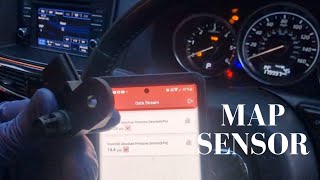
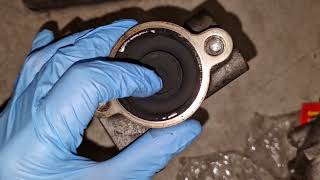
Typical fix: Replace the MAP sensor located on the intake manifold. The OEM part number is SH01-18-211. 🎬 Watch: How to test and replace the MAP sensor
Est. part cost: $60-$180 - Wiring or Connector Issue 🟡 Medium Probability The wiring harness in the engine bay is exposed to heat and vibration, which can lead to frayed wires or loose connections at the sensor's plug. Corrosion on the connector pins is also a common failure point.
How to confirm: Visually inspect the wiring and connector for damage, corrosion, or loose pins. Use a multimeter to check for a 5V reference signal and continuity to the PCM according to the service manual's wiring diagram. A wiggle test on the harness while monitoring live data can reveal intermittent connections.
Typical fix: Repair the damaged section of the wiring harness or replace the connector pigtail.
Est. part cost: $10-$50 - Short to Ground in Circuit ⚪ Low Probability A wire's insulation can rub through against the engine or chassis, causing a short to ground that pulls the signal voltage down to near zero.
How to confirm: This is a specific diagnostic step outlined by Mazda. It requires using a multimeter to test for continuity between the signal wire (at the PCM connector) and a known good ground. There should be no continuity (infinite resistance).
Typical fix: Locate and repair the shorted wire, ensuring it is properly insulated and routed away from sharp edges.
Est. part cost: $0-$20
Rare But Worth Checking
- Intake Manifold Carbon Buildup: The SKYACTIV-D engine is known for significant carbon buildup in the intake manifold. While this may not directly cause a P0107, it can clog the small port for the MAP sensor, leading to inaccurate readings, or contribute to a host of other engine problems that are often seen alongside sensor codes. Cleaning the intake is a common maintenance item on these engines.
- Faulty Powertrain Control Module (PCM): → Shop Engine Control Module (ECM) This is very rare. The PCM should only be considered after all other possibilities, including the sensor and all wiring, have been thoroughly tested and ruled out.
Diagnosis Steps
- Read the code with an OBD-II scanner and confirm P0107 is present. Check for any other codes.
- Visually inspect the MAP sensor No. 2 and its electrical connector. It is located on the top rear of the intake manifold. Look for any signs of damage, carbon/oil fouling, corrosion, or loose connections.
- With the key on and engine off, use a scan tool to observe the live data for MAP sensor No. 2 (PID: MAP). The reading should be close to the barometric pressure (BARO) reading. If it's stuck at a very low value (e.g., under 0.5V), the sensor or circuit is faulty.
- Disconnect the sensor and check the wiring harness connector. Using a multimeter, verify there is a 5-volt reference signal and a good ground connection from the PCM.
- If the 5V reference and ground are present, test the signal wire for a short to ground as per the Mazda diagnostic procedure.
- If the wiring checks out, the MAP sensor itself is the most likely culprit. It can be contaminated or have failed internally.
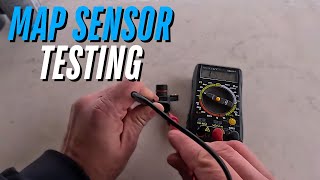
- As a further test, you can apply vacuum with a hand pump to the sensor while monitoring voltage. The voltage should decrease smoothly as vacuum is applied. 🎬 See a demonstration of testing MAP sensors with a multimeter
- After replacing the sensor, clear the code and perform a test drive to ensure the problem is resolved and that the DPF regeneration cycle can now operate.
Parts You'll Likely Need
- Manifold Absolute Pressure Sensor (MAP Sensor No. 2)
(OEM #SH01-18-211)— This sensor is the most common failure point for code P0107. It is responsible for sending the pressure signal to the PCM, and internal failure or contamination will cause a low voltage reading.
Trusted brands: Mazda (OEM), Bosch, Denso, Delphi
OEM price range: $120-$180
Aftermarket price range: $45-$120
Technical Service Bulletins (TSBs) & Recalls
- While no specific TSB for P0107 was found, numerous TSBs exist for related SKYACTIV-D issues. For example, TSB 09-010/18 addresses infotainment system glitches, but highlights how Mazda issues bulletins for various system problems. The general engine problems are more frequently discussed in forums than addressed by specific, public TSBs.
Platform-Specific Known Issues
- The most critical issue specific to the SKYACTIV-D engine is that a P0107 code will inhibit DPF regeneration. If you continue to drive with this fault, the Diesel Particulate Filter will become clogged with soot, which can lead to a much more expensive repair bill to clean or replace the DPF. Forum discussions are filled with owner complaints about DPF, carbon buildup, and general engine reliability on these early models.
- Carbon and oil buildup in the intake manifold is a well-documented problem on this engine. This can foul the MAP sensor, clog its port, and lead to a variety of performance issues. Many owners and independent shops recommend periodic intake cleaning as preventative maintenance. 🎬 Watch: Why carbon buildup causes DPF regeneration to fail
Mechanic-Grade Diagnostic Values
- MAP Sensor No. 2 Connector Voltage (Key On, Engine Off) — expected: Terminal A (Ground): ~0V. Terminal C (5V Reference): ~5V. Terminal D (Signal): ~5V.. Failure: Voltage on Terminal C or D significantly below 5V indicates a wiring or PCM issue. Voltage on Terminal A above 0.1V indicates a bad ground.
- MAP Sensor No. 2 Signal Voltage (Engine Idling) — expected: Approximately 1.0-1.5 volts at idle.. Failure: A voltage reading below 0.5V will trigger the P0107 code.
- Scan Tool Live Data (Key On, Engine Off) — expected: MAP reading should be around 14.5 PSI (atmospheric pressure at sea level).. Failure: A reading significantly different from atmospheric pressure, or one that is stuck low, points to a faulty sensor.
Scan Tool Commands That Help
- FORScan: Reset Learned Values - Exhaust Gas Differential Pressure Sensor — While not directly for the MAP sensor, a faulty MAP sensor can provide incorrect data that prevents DPF-related resets and relearn procedures from working. A mechanic noted that cleaning the MAP sensor is a prerequisite for a successful DPF relearn, indicating a link between the systems.
Wiring & Ground Locations
- MAP Sensor No. 2 Connector (Harness Side) — On top of the intake manifold, at the rear of the engine.. This is the primary connection point for testing. The sensor has a 4-pin plug, but only 3 pins are used for the No. 2 sensor. Pin A is Ground, Pin C is the 5V reference from the PCM, and Pin D is the signal wire to the PCM.
- PCM Connector Pins — At the Powertrain Control Module (PCM).. For end-to-end circuit testing, the MAP sensor signal wire (from sensor pin D) connects to PCM terminal 1CQ. The 5V reference (from sensor pin C) connects to PCM terminal 1CN. This allows for checking continuity and shorts directly at the PCM.
Real Owner Repair Stories
- YouTube channel 'THE FIX' (Mazda 6 with 2.2L Skyactiv-D engine (same engine and sensor as CX-5)) — Engine management light on, code for MAP sensor circuit high (P0108, but diagnosis is identical for P0107 low circuit).
❌ Tried (didn't work) The previous owner had already replaced the MAP sensor with a new, non-genuine (online purchase) sensor, but the fault code remained.
✅ What actually fixed it The technician tested the wiring and found correct 5V reference and ground. He then tested the new non-genuine sensor and found its live data reading was incorrect (36.6 PSI at atmospheric pressure). He borrowed a genuine sensor from a friend's CX-5, which read the correct 14.5 PSI. Replacing the faulty new sensor with a genuine Mazda sensor resolved the issue, suggesting a bad batch or poor quality of the aftermarket part.
OEM Part Supersession History
0261230319 (Bosch)→SH01-18-211 (Mazda)— This appears to be a cross-reference where 0261230319 is the Bosch part number and SH01-18-211 is the corresponding Mazda OEM part number.
Heads up: One source indicates that a batch of aftermarket sensors matching the appearance of the original may be faulty from the manufacturer, providing incorrect readings out of the box.
Diagnostic Flowchart
Related OBD-II Codes
Frequently Asked Questions
Why is my 2012-2017 Mazda CX-5 2.2L diesel losing power with code P0107?
Can I keep driving my CX-5 SKYACTIV-D with a P0107 code?
What is the OEM part number for the MAP sensor on the 2.2L SKYACTIV-D?
Why does the MAP sensor fail so often on this specific Mazda diesel engine?
How can I test if the MAP sensor is bad on my CX-5?
Does TSB 09-010/18 cover the P0107 code on my CX-5?
Are other Mazda models affected by this same P0107 issue?
Helpful Videos

The information in this article is provided for general reference and educational purposes only. Vehicle specifications, procedures, and part compatibility can vary by production date, trim level, and region. Always consult your vehicle's factory service manual and verify part numbers before purchasing or performing repairs. Safety-critical components such as airbags, seat belts, and braking systems should be installed by a qualified professional.
- Mazda CX-5:
- 🧭 Diagnostic Flowchart
- 🎬 Helpful Videos
- What's Unique About the 2012-2017 Mazda CX-5
- Symptoms You May Notice
- Most Likely Causes
- Rare But Worth Checking
- Diagnosis Steps
- Parts You'll Likely Need
- Technical Service Bulletins (TSBs) & Recalls
- Platform-Specific Known Issues
- Mechanic-Grade Diagnostic Values
- Scan Tool Commands That Help
- Wiring & Ground Locations
- Real Owner Repair Stories
- OEM Part Supersession History
- Related OBD-II Codes
- Frequently Asked Questions
- 🎟️ Get 5% Off