

P0116 on 2018-2025 Jeep Wrangler: Engine Coolant Temperature Sensor Performance Fixes
On a 2018-2025 Jeep Wrangler, code P0116 is most often caused by a faulty engine coolant temperature (ECT) sensor or a stuck thermostat. Always check the coolant level first. A new Mopar ECT sensor (p/n 68217702AD for 3.6L) or thermostat is typically under $100 for the part and is a manageable DIY repair for many owners.
- P0116 means your Wrangler's computer thinks the engine temperature reading is illogical.
- The most common fixes are replacing the Engine Coolant Temperature (ECT) sensor or the thermostat.
- Always check your coolant level first, as a low level can cause false readings.
- This is a DIY-friendly repair for those with basic tools, but involves handling engine coolant.
- Using an OEM Mopar sensor is strongly recommended for reliability.
What's Unique About the 2018-2025 Jeep WRANGLER
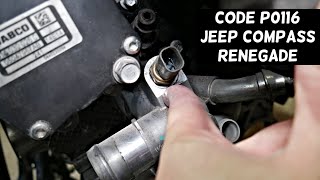
For the Jeep Wrangler JL (2018-2025), the cooling system's sensors are crucial inputs for systems beyond just the temperature gauge, including the engine stop-start feature. A TSB from Jeep (18-044-26) directly links the P0116 code 🎬 Watch: Understanding the P0116 code and how to fix it. to other faults, including one for the stop-start system, indicating an irrational temperature reading can disable other vehicle functions as a precaution. Additionally, some owners have noted that using a block heater can sometimes trigger this code because the PCM sees a warm coolant temperature but a cold intake air temperature on startup, which fails the rationality check. The factory block heater plug on the JL is conveniently located next to the battery. The plastic thermostat housing on the 3.6L Pentastar engine is also a known weak point that can develop hairline cracks, leading to coolant leaks, air in the system, and erratic temperature readings that trigger P0116.
Diagnostic Flowchart
Tap your situation to follow the diagnostic path that matches what you're seeing on this vehicle.
Generation note: The 2018 model year was a transition period for the Wrangler. This guide primarily applies to the 'JL' generation (2018-2025). However, the previous 'JK' generation was also sold in 2018, and while the causes are similar, part numbers and sensor locations may differ slightly. For example, the JK ECT sensor is often accessed through the driver's side wheel well.
Symptoms You May Notice
- Check Engine Light is on
- Temperature gauge behaving erratically (dropping to cold or staying there)
- Cooling fans running constantly at high speed
- Engine stop-start system is disabled
- Reduced fuel economy
- Heater may not blow warm air if the thermostat is stuck open.
- Message on EVIC showing "---" for coolant temperature.
- Replacing the radiator when the issue is a simple sensor or thermostat.
- Replacing the water pump when there are no signs of leaks or bearing failure.
- Replacing the ECT sensor when the thermostat is stuck open, or vice-versa.
Most Likely Causes
- Faulty Engine Coolant Temperature (ECT) Sensor 🔴 High Probability → Shop Engine Coolant Temperature Sensor Sensors can fail over time due to thermal stress. On the 3.6L Pentastar engine, it's a known maintenance item. Aftermarket sensors are often reported to cause issues, so using an OEM Mopar part is highly recommended.
How to confirm: With a scan tool, compare the ECT reading to the IAT reading on a cold engine; they should be within a few degrees of each other. Watch the ECT data as the engine warms up; it should rise smoothly without sudden jumps or dropouts. A failed sensor may also trigger codes P0117 (circuit low) or P0118 (circuit high). You can also test the sensor's resistance with a multimeter; at 68°F (20°C), it should be between 2,000 and 3,000 ohms.
Typical fix: Replace the ECT sensor. On the 3.6L engine, it is located on the thermostat housing, under the intake tube. Replacing it will cause a small amount of coolant loss, but the system may need to be 'burped' of air afterwards.
Est. part cost: $25-$60 - Faulty Thermostat 🔴 High Probability → Shop Integrated Thermostat Housing Assembly Thermostats can fail, most commonly sticking open. This prevents the engine from reaching its proper operating temperature in a timely manner, which the PCM detects as a performance issue.
How to confirm: Monitor the coolant temperature with a scan tool. If the engine takes an excessively long time to warm up or never reaches the normal operating temperature (approx. 195-210°F), the thermostat is likely stuck open. This is often accompanied by code P0128.
Typical fix: Replace the thermostat and housing assembly. This requires draining and refilling some of the engine coolant.
Est. part cost: $80-$150 - Low Coolant Level or Air in the System 🟡 Medium Probability → Shop Engine Coolant / Antifreeze If the coolant level is low, the ECT sensor may be exposed to air instead of coolant, causing erratic readings. Air pockets can be introduced during improper coolant refills. The JL system is designed to be self-bleeding through the reservoir, but it can take several heat/cool cycles to fully purge air. Hairline cracks in the plastic thermostat housing are a common source of slow leaks on the 3.6L engine.
How to confirm: Visually inspect the coolant reservoir (when the engine is cold) to ensure the level is at the 'MAX' line. If the system was recently serviced, it may need to be 'burped' to remove trapped air. Some mechanics use a spill-free funnel kit to make this process easier.
Typical fix: Top off the coolant with the correct type (Mopar 10-year/150,000 Mile OAT coolant) and bleed any air from the system by running the engine with the reservoir cap loose and heater on high, then allowing it to cool and re-checking the level.
Est. part cost: $20-$40 for coolant - Wiring or Connector Issue ⚪ Low Probability The wiring harness to the ECT sensor can be damaged by heat, vibration, or improper servicing. The plastic connector and its red locking tab can become brittle over time.
How to confirm: Visually inspect the connector and wiring going to the ECT sensor for any signs of corrosion, damage, or loose connections. Gently tug on the wires to ensure they are secure in the connector. Check for pushed-out pins inside the connector. A wiggle test on the harness while watching live data can reveal intermittent connections.
Typical fix: Repair the damaged section of wiring or replace the connector pigtail.
Est. part cost: $15-$30 for a pigtail
Rare But Worth Checking
- Block Heater Usage: Using a block heater can cause the PCM's cold-start rationality check to fail. The PCM sees warm coolant but cold intake air, flags the discrepancy, and sets a pending P0116. This is usually a temporary condition that resolves after restarting the engine. This has been documented by owners in cold climates.
- Faulty Powertrain Control Module (PCM): This is extremely rare. In some cases across the Jeep/Chrysler/Dodge lineup, a PCM software update (flash) is required to fix overly sensitive diagnostics for this code, but this is less common than a simple part failure. All other possibilities, especially the sensor, thermostat, and wiring, should be exhaustively ruled out before considering a PCM failure.
Diagnosis Steps
- Check the engine coolant level in the reservoir. It should be at the MAX line when the engine is completely cool. Top off if necessary with the correct Mopar OAT coolant.
- Connect an OBD-II scanner. Check for any other accompanying codes, like P0128, P0117, or P0118.
- With the engine cold (after sitting for several hours), view live data on the scanner. Compare the Engine Coolant Temperature (ECT) and Intake Air Temperature (IAT) readings. They should be within 5-10°F (about 3-6°C) of each other.
- Start the engine and monitor the ECT reading. It should climb steadily to around 195-210°F and stabilize. If it climbs very slowly, never reaches temperature, or fluctuates wildly, suspect the thermostat or sensor.
- Inspect the ECT sensor's electrical connector and nearby wiring for any visible damage, corrosion, or looseness. Ensure the red locking tab is secure.
- If the temperature rises very slowly or never reaches the target range, the thermostat is likely stuck open and should be replaced.
- If the temperature reading is erratic, fails the cold-soak test, or is accompanied by P0117/P0118, the ECT sensor is the most likely culprit and should be replaced.
Parts You'll Likely Need
- Engine Coolant Temperature Sensor
(OEM #68217702AD (for 3.6L Engine))— This sensor is the primary source of the data that the PCM has flagged as irrational. It is a common failure point and relatively inexpensive to replace. For the 3.6L engine, this sensor is often integrated into the thermostat housing assembly.
Trusted brands: Mopar
OEM price range: $30-$60
Aftermarket price range: $15-$40 - Engine Thermostat with Housing
(OEM #5048424AD (for 3.6L Engine))— A thermostat that is stuck open is a frequent cause of this code, as it prevents the engine from warming up at the expected rate. The part for the JL often comes as a complete housing assembly.
Trusted brands: Mopar
OEM price range: $80-$150
Aftermarket price range: $50-$90 - Mopar OAT Coolant
(OEM #68163848AB (concentrate) or 68163849AB (50/50 pre-mixed))— Required to top off or refill the system after replacing the thermostat or sensor. Using the correct OAT (Organic Additive Technology) coolant is critical to prevent cooling system damage.
Trusted brands: Mopar
OEM price range: $25-$40 per gallon
Related Codes That Often Appear With This One
- P0128 — This code for 'Coolant Temperature Below Thermostat Regulating Temperature' often appears with P0116 when the cause is a thermostat stuck open.
- P05BD — As cited in TSB 18-044-26, a fault with the 'Stop-Start Mode Switch' can be logged alongside P0116 because the engine temperature is a critical input for the stop-start system's operation.
- P0117 / P0118 — These codes indicate a circuit low (short) or circuit high (open) condition for the ECT sensor, respectively. They point more directly to a failed sensor or wiring problem, whereas P0116 indicates a performance/rationality problem.
Technical Service Bulletins (TSBs) & Recalls
- 18-044-26: Mentions P0116-00 as a potential code that can be stored along with others related to engine performance and the stop-start system. This TSB is a list of potential codes and does not provide a specific fix for P0116 itself.
Platform-Specific Known Issues
- Technical Service Bulletin #18-044-26 notes that P0116 can be stored in conjunction with other codes, including P05BD-00 related to the stop-start system, indicating a known software link between these components. [⭐ MANUFACTURER TSB — highest authority]
- The cooling system on the 3.6L JL is designed to be self-bleeding via the reservoir, but air pockets introduced from a coolant leak (often from a cracked thermostat housing) or improper service can still cause this code until the air is fully purged.
Mechanic-Grade Diagnostic Values
- ECT Sensor Resistance — expected: 2,000 - 3,000 Ohms (Ω) at 20°C (68°F).. Failure: A reading of open (infinite resistance), short (near zero resistance), or a value significantly outside the expected range for a given temperature indicates a faulty sensor.
- ECT Sensor Resistance (Hot) — expected: 200 - 300 Ohms (Ω) at 90°C (194°F).. Failure: Resistance does not drop into this range when the engine is at full operating temperature.
- ECT Sensor Signal Voltage (Key On, Engine Off, Cold) — expected: ~2.0V to 3.5V, depending on ambient temperature.. Failure: A reading near 5.0V suggests an open circuit or bad ground. A reading near 0V suggests a short to ground.
- ECT Sensor Signal Voltage (Engine at Operating Temp) — expected: ~0.5V to 1.3V.. Failure: Voltage does not decrease smoothly as the engine warms up, or remains high (e.g., over 1.5V) when the gauge shows operating temperature.
- ECT vs. IAT Rationality Check (Cold Soak > 8 hours) — expected: ECT and IAT sensor readings should be within 10°C (18°F) of each other.. Failure: A difference greater than the specified amount will set the fault code.
Wiring & Ground Locations
- K2 (Signal) / K900 (Ground) — These are the wire circuit identifiers for the two wires running between the Powertrain Control Module (PCM) and the ECT sensor connector.. When diagnosing a persistent P0116 after replacing parts, performing a continuity and resistance check on these specific wires can isolate a harness issue from a sensor or PCM issue.
- G904A — Located at the right front corner of the engine compartment.. This is a primary ground point for the engine control system. A loose or corroded connection at G904A can introduce electrical noise and cause erratic readings from the ECT sensor, leading to a P0116 code.
Real Owner Repair Stories
- Reddit user in r/Jeep (2014 Jeep Wrangler JKU (JK model, but with the same 3.6L Pentastar engine and similar plastic thermostat housing design)) — Smelling coolant leak.
✅ What actually fixed it The user identified a crack in the plastic thermostat housing. The part was on backorder from the dealer, suggesting it was a common failure. A temporary fix was made with an epoxy repair kit while awaiting a new housing. This highlights the housing itself as a primary point of failure that leads to coolant loss and subsequent sensor performance codes.
OEM Part Supersession History
68217702AC→68217702AD— Standard part revision by the manufacturer. Reasons can include minor design changes, material improvements, or a change in supplier.
Heads up: The parts are interchangeable. 68217702AD is the current recommended replacement for 68217702AC.
Model Year Variations Within This Range
- 2018-2025: While the 3.6L Pentastar is the most common engine, the 2.0L Turbo engine has a different cooling system layout and part numbers. The diagnostic principles for P0116 remain the same (sensor rationality check), but the physical location of the ECT sensor and thermostat will be different. Always verify parts based on the specific engine, not just the model year.
- 2018-2025: Some owners of 3.6L Wranglers have opted to replace the failure-prone plastic thermostat housing with more durable aftermarket aluminum versions. While not an OEM solution, this is a common preventative upgrade mentioned in forums to avoid future leaks and related codes.
Helpful Videos
We Have This Part in Stock


The information in this article is provided for general reference and educational purposes only. Vehicle specifications, procedures, and part compatibility can vary by production date, trim level, and region. Always consult your vehicle's factory service manual and verify part numbers before purchasing or performing repairs. Safety-critical components such as airbags, seat belts, and braking systems should be installed by a qualified professional.
- Jeep WRANGLER:
- 🧭 Diagnostic Flowchart
- 🎬 Helpful Videos
- 🛍️ Shop This Part
- What's Unique About the 2018-2025 Jeep WRANGLER
- Symptoms You May Notice
- Most Likely Causes
- Rare But Worth Checking
- Diagnosis Steps
- Parts You'll Likely Need
- Related Codes That Often Appear With This One
- Technical Service Bulletins (TSBs) & Recalls
- Platform-Specific Known Issues
- Mechanic-Grade Diagnostic Values
- Wiring & Ground Locations
- Real Owner Repair Stories
- OEM Part Supersession History
- Model Year Variations Within This Range
- 🎟️ Get 5% Off