

P0121 on 2005-2010 Hyundai Sonata: Throttle Position Sensor Causes and Fixes
P0121 on a 2005-2010 Sonata usually points to a failing Throttle Position Sensor (TPS) or a very dirty throttle body. Cleaning the throttle body is a good first step, but often the TPS itself needs replacement. Expect to pay $40-$90 for an aftermarket sensor. On many 2.4L models, the sensor is integrated into the throttle body, requiring a full assembly replacement.
- P0121 on a 2005-2010 Sonata means the throttle position sensor signal is out of range or performing poorly.
- The most likely causes are a faulty Throttle Position Sensor (TPS) or a dirty throttle body.
- For the 3.3L V6, the TPS is usually a separate part; for the 2.4L I4, it's often integrated into the throttle body.
- Start by cleaning the throttle body, as it's inexpensive and may solve the problem.
- Use a scan tool's live data to watch the TPS voltage; a smooth, linear sweep is good, while jumps or drops indicate a bad sensor.
What's Unique About the 2005-2010 Hyundai Sonata
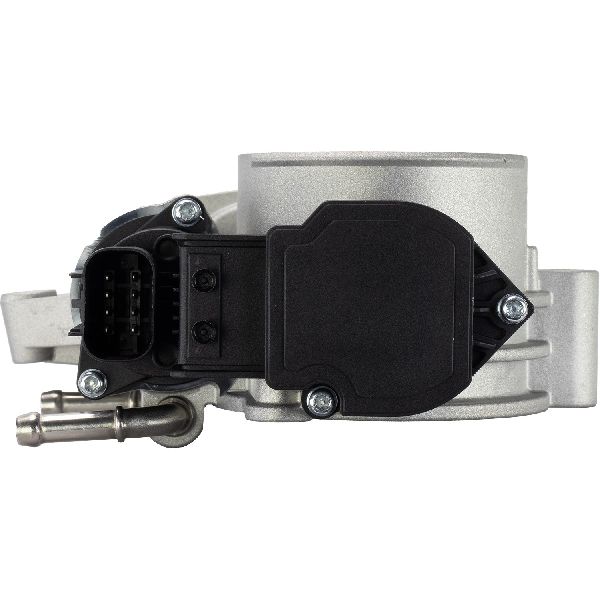
On the 3.3L V6 engine in the fifth-generation (NF) Sonata, the Throttle Position Sensor (TPS) is a separate, replaceable component, making for a potentially cheaper repair. However, on many 2.4L 4-cylinder models of this era, the TPS is integrated into the electronic throttle body and is not sold separately, requiring the replacement of the entire assembly. This is a critical distinction for owners when sourcing parts. The primary issue on these models is often a worn-out sensor or significant carbon buildup inside the throttle body that physically restricts the throttle plate, causing the sensor to report an illogical position. A thorough cleaning of the throttle body can sometimes resolve the issue, but sensor or complete throttle body failure is very common.
Symptoms You May Notice
- Check Engine Light is on
- Poor or hesitant acceleration
- Engine stalling or running rough, especially at idle
- Vehicle enters 'limp mode' (reduced power, limited speed)
- Bucking or jerking during acceleration
- Difficulty or harshness in automatic transmission shifting
- Unstable or fluctuating RPM
- ESC (Electronic Stability Control) light may also illuminate
- Replacing the accelerator pedal sensor. While it also measures driver intent, P0121 specifically points to the sensor on the throttle body, not the pedal, in this vehicle.
- Replacing the entire throttle body assembly on a 3.3L V6 when only the separate, much cheaper sensor is bad.
- Assuming the TPS is separate on a 2.4L I4. On many of these engines, the sensor is integrated, and attempting to source a separate one is futile.
Most Likely Causes
- Faulty Throttle Position Sensor (TPS) or Throttle Body Assembly 🔴 High Probability → Shop Fuel Injection Throttle Body The sensor's internal resistive track wears out over time, creating 'dead spots' or erratic voltage signals. On the 2.4L, the integrated sensor fails, while on the 3.3L, the separate sensor is the weak point.
How to confirm: Use a scan tool to graph the TPS voltage (usually labeled TP1 or similar). As you slowly press the accelerator pedal with the engine off, key on, the voltage should increase smoothly from ~0.5V to ~4.5V. Any sudden jumps, drops, or flat spots indicate a bad sensor. This test confirms the sensor's electronic failure.
Typical fix: For 3.3L V6, replace the standalone Throttle Position Sensor. For most 2.4L I4 models, replace the entire throttle body assembly.
Est. part cost: $40 - $90 (V6 Sensor), $70 - $250 (I4 Throttle Body Assembly) - Dirty Throttle Body 🟡 Medium Probability → Shop Fuel Injection Throttle Body Carbon and oil vapor from the PCV system can build up around the throttle plate and bore, causing it to stick or not close properly, leading to a mismatch between expected and actual position.
How to confirm: Remove the intake air duct from the throttle body and visually inspect for a thick black ring of carbon buildup. Check if the throttle plate moves smoothly by hand (with the engine off).
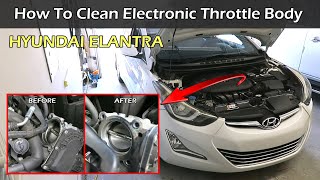
Typical fix: Clean the throttle body thoroughly with a dedicated throttle body cleaner and a soft brush or rag. 🎬 Watch: Step-by-step guide to cleaning your Hyundai throttle body A relearn procedure should be performed afterward.
Est. part cost: $10 - $20 - Damaged Wiring or Connector ⚪ Low Probability Engine vibration and heat can cause wires to fray or the connector pins to become loose or corroded over many years, especially at the connector to the throttle body.
How to confirm: Visually inspect the wiring harness leading to the TPS/throttle body for any signs of cracking, melting, or chafing. Wiggle the connector with the engine running to see if it affects the idle. Check for corrosion on the connector pins.
Typical fix: Repair the damaged section of wire or replace the connector pigtail.
Est. part cost: $15 - $40
Rare But Worth Checking
- Faulty Powertrain Control Module (PCM): This is extremely rare. The PCM should only be considered if all other possibilities, including the sensor, wiring, and throttle body, have been definitively ruled out.
Diagnosis Steps
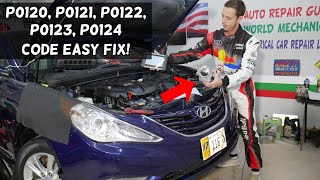
- Connect an OBD-II scanner and confirm the presence of P0121. 🎬 See how to diagnose and fix these common TPS codes Check for any other related codes like P2135, P0122, or P0123.
- Access the live data stream on the scanner. Monitor the 'Throttle Position' or 'TPS Voltage' PIDs.
- With the key on and engine off, slowly press the accelerator pedal to the floor and release it. The voltage should sweep smoothly from its idle value (approx. 0.5V) to its wide-open value (approx. 4.5V) without any glitches or dropouts.
- If the voltage is erratic, the TPS/throttle body assembly is likely faulty.
- If the voltage sweep is smooth, the next step is to inspect the throttle body. Remove the intake ducting connected to it.
- Visually inspect the throttle bore and plate for heavy carbon buildup.
- If dirty, clean it thoroughly using throttle body cleaner and a soft cloth. Do not spray directly into the electronics. Spray onto the cloth and wipe.
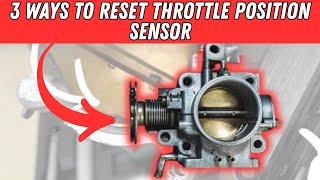
- After cleaning or replacement, perform a throttle relearn procedure. A common method is to turn the ignition to 'ON' (engine off) for 15 seconds, then 'OFF' for 5 seconds, repeating 5 times. Alternatively, disconnecting the battery for 15+ minutes 🎬 Watch: Three quick secrets for a successful TPS reset may reset the ECU.
- If the problem persists, inspect the TPS wiring and connector for damage, corrosion, or loose pins. Perform a 'wiggle test' on the harness while monitoring live data.
- If all other steps fail, replace the appropriate part: the TPS for the 3.3L V6, or the entire throttle body assembly for the 2.4L I4.
Parts You'll Likely Need
- Throttle Position Sensor (TPS)
(OEM #35170-37100)— This sensor is the most common failure point for code P0121 on the 3.3L V6 engine. Its internal components wear out, causing incorrect signals.
Trusted brands: Genuine Hyundai, Standard Motor Products (SMP), Beck/Arnley
OEM price range: $70-$120
Aftermarket price range: $40-$90 - Throttle Body Assembly
(OEM #35100-2G700 (example, verify by VIN))— Required for most 2.4L 4-cylinder models, as the TPS is integrated and not sold separately. Failure of the internal sensor necessitates replacing the whole unit.
Trusted brands: Genuine Hyundai, Cardone (Remanufactured), Dorman
OEM price range: $300-$500
Aftermarket price range: $70-$250 - Throttle Body Cleaner — Required for cleaning carbon buildup from the throttle body, which is a common cause of this code and a necessary step before replacing parts.
Trusted brands: CRC, WD-40
Aftermarket price range: $10-$20
Related Codes That Often Appear With This One
- P0122 — Indicates TPS 'A' Circuit Low Input, often pointing to the same faulty sensor or a wiring short.
- P0123 — Indicates TPS 'A' Circuit High Input, also related to a faulty sensor or wiring issue.
- P2135 — Indicates a correlation error between the two internal circuits (Sensor 'A' and 'B') of the TPS, pointing directly to a failing sensor or throttle body assembly. This code is very commonly seen with P0121.
- P0221 — Indicates a range/performance issue with the 'B' circuit of the TPS, a companion code to P0121 that reinforces the diagnosis of a faulty sensor assembly.
Platform-Specific Known Issues
- Owner Experience: Harsh Shifting and Limp Mode: A 2005 Sonata V6 owner on hyundai-forums.com reported that code P0121 caused the automatic transmission to stop shifting automatically, requiring manual shifting, and produced harsh jerks when selecting gears. This confirms the TPS's critical role in transmission control logic.
- Intermittent Nature of the Fault: Technicians have noted that the P0121 fault on this platform can be highly intermittent, occurring only once every few months, making it difficult to diagnose without advanced tools like an oscilloscope to catch the momentary glitch.
Mechanic-Grade Diagnostic Values
- TPS1 Signal Voltage (KOEO) — expected: Approx. 0.5V at closed throttle, sweeping smoothly to approx. 4.5V at wide-open throttle.. Failure: Voltage is erratic, has spikes or dropouts, or does not move with the throttle plate.
- TPS2 Signal Voltage (KOEO) — expected: Approx. 4.2-4.8V at closed throttle, sweeping smoothly down to approx. 0.2-0.8V at wide-open throttle.. Failure: Voltage is inverse to TPS1. A failure is indicated if it doesn't track smoothly or is stuck.
- TPS Sensor Reference Voltage — expected: Approx. 5V at the sensor harness connector (with sensor disconnected, KOEO).. Failure: Voltage is significantly lower or absent, indicating a wiring or PCM issue, not a sensor fault.
- TPS vs. MAP Sensor Correlation — expected: On a scan tool, the output of the TPS should change in accordance with the MAP sensor output during acceleration and deceleration.. Failure: A mismatch between the expected MAP reading for a given throttle angle can trigger a P0121 rationality fault.
Scan Tool Commands That Help
- Hyundai GDS/GDS-Mobile: Reset Adaptive Values (Throttle) — This is the official dealer tool method for forcing the ECM to relearn the throttle plate's closed, part-throttle, and wide-open positions after cleaning or replacing the throttle body. It is more reliable than manual procedures.
Wiring & Ground Locations
- TPS Connector (3.3L V6) — On the side of the throttle body. It is a 3-pin connector.. This is the primary point for testing the sensor. The pins are for 5V reference, ground, and the signal wire back to the ECM. A poor connection here is a common cause of failure.
- Throttle Body Connector (2.4L I4) — On the electronic throttle body assembly. It is a 6-pin connector.. This connector houses the wiring for both TPS1 and TPS2, as well as the throttle motor. Corrosion or damage here will cause P0121 and related codes.
- ECM/PCM — Typically located under the left side of the dashboard.. All wiring from the throttle position sensor(s) terminates here. It provides the reference voltage and ground, and interprets the return signal.
Real Owner Repair Stories
- YouTube channel 'auto information' (2018 Hyundai Elantra (similar electronic throttle system)) — Check Engine Light on, no throttle response, car would not accelerate.
❌ Tried (didn't work) The video directly diagnosed the issue without showing other failed attempts.
✅ What actually fixed it The vehicle had been in a minor front-end collision. The wiring harness leading to the throttle body was damaged, with several wires cut. Repairing the broken wires in the harness resolved the P0121 code and restored throttle function. - YouTube channel 'Tutos-Cars' (Hyundai Accent (similar electronic throttle system)) — No acceleration, P0121 code present and would not clear with a scan tool.
❌ Tried (didn't work) Attempting to clear the code with a scan tool before addressing the physical problem.
✅ What actually fixed it The throttle body was extremely dirty with carbon buildup, causing the throttle plate to stick open slightly from its rest position. This created a range/performance error. A thorough cleaning of the throttle body resolved the issue and allowed the code to be cleared. - NHTSA ODI #10846204 — An owner reported that after restarting the engine, the acceleration pedal began working again, but the MIL codes stored included P2135, P0221, P2106, P0121, and P2110.
- NHTSA ODI #10576819 (Cross-manufacturer reference: Hyundai Santa Fe) — A report describes the vehicle entering a state where it would only run in third gear, which the owner noted as a significant distraction; the diagnostic codes were P0121 and P0733, relating to the throttle position sensor and a gear ratio mismatch.
OEM Part Supersession History
35170-37100→35170-37100— No supersession. The original part number remains the current valid number for the V6 TPS.35100-25200→35100-25400— Part update or revision for the 2.4L I4 throttle body.
Heads up: Always verify the correct part number by VIN, especially around the 2009 model year refresh.
Model Year Variations Within This Range
- 2009-2010: The 2009 model year marked a facelift for the Sonata, which included an updated 'Theta II' 2.4L 4-cylinder engine. This engine produced more power (175 hp vs 162 hp) than the 2006-2008 version. While the throttle body is still an integrated unit, the specific part number may differ between the pre-facelift and post-facelift 2.4L models.
Diagnostic Flowchart
Other Known Issues on This Vehicle
Issues unrelated to this code that are worth knowing about as an owner of this generation:
- Rear Subframe Corrosion 🔴 High — Common in 'salt belt' states, can occur elsewhere. Affects 2006-2010 models. (Ref: NHTSA Recall 13V354000 (Hyundai Campaign 113).)
- Faulty Stop Lamp Switch 🟠 Medium — Widespread issue affecting many Hyundai models of this era, including the Sonata. (Ref: NHTSA Recall 13V113000 (Hyundai Campaign 110). Can cause brake lights to fail, ESC light to turn on, and issues with push-button start.)
- Airbag Warning Light / OCS Mat Failure 🟠 Medium — A common complaint where the airbag light illuminates due to a faulty Occupant Classification System (OCS) sensor mat in the passenger seat. (Ref: NHTSA Recall 08V161000 (Hyundai Campaign 083) covered this for some models.)
- Front Subframe Corrosion (Earlier Models) 🔴 High — Primarily affects 1999-2004 models but the issue of subframe rust is a known Hyundai problem from this era that can sometimes extend to early NF models. (Ref: NHTSA Recall 09V124000 (Hyundai Campaign 089).)
Used vs. New Parts: Buying Guide for This Vehicle
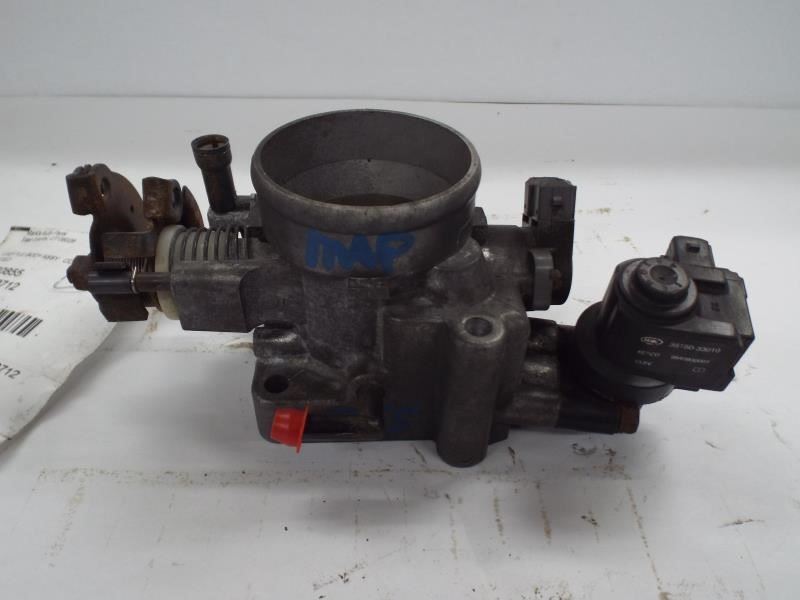
When a used part is the smart pick: For the 2.4L I4 engine, the entire throttle body assembly can be expensive new from the dealer. A used OEM throttle body from a low-mileage, accident-free donor vehicle can be a cost-effective and reliable alternative to a new aftermarket part of questionable quality.
Donor-vehicle mileage cap: roughly under 80000 miles for the part to have meaningful remaining life.
What to inspect on the donor part:
- Check for a clean throttle plate and bore; excessive black carbon suggests a hard life.
- Ensure the electrical connector pins are clean, straight, and free of corrosion.
- Avoid parts from vehicles with signs of a major frontal impact, which could have damaged the wiring or internal electronics.
- If possible, check the donor vehicle's VIN to confirm it's from a compatible year range (pre- or post-2009 facelift).
Aftermarket brands forum-validated for this vehicle:
- Dorman (specifically their OE FIX line, which claims improvements over the original design)
- Standard Motor Products (SMP)
- Hitachi
Brands owners have reported issues with on this vehicle:
- Unbranded, no-name parts from online marketplaces should be treated with caution, as their internal sensor quality can be inconsistent.
Real Owner Stories
Aggregated from forums and TSBs cited above. Mileages and costs reflect what owners reported in those sources.
2005 Hyundai Sonata V6
Symptoms: Check engine light on, automatic transmission will not shift in drive and requires manual shifting. The engine also entered 'limp mode'.
What fixed it: The source suggests checking for a poor electrical connection, though the original poster did not confirm the final repair.
Source hint: hyundai-forums.com - Thread '2005 Hyundai Sonata P0121 Code'
Related OBD-II Codes
Frequently Asked Questions
Is there a difference in how I fix P0121 on the 2.4L vs the 3.3L Sonata?
Can a P0121 code cause my Sonata's transmission to jerk or stop shifting?
My ESC light came on at the same time as the Check Engine Light for P0121. Are they related?
Is there a specific recall for the throttle issues on the 2005-2010 Sonata?
How do I perform the throttle relearn procedure after cleaning the throttle body?
What should the TPS voltage readings be when testing with a scan tool?
Helpful Videos

Used OEM Parts in Stock
New Aftermarket Parts Available


The information in this article is provided for general reference and educational purposes only. Vehicle specifications, procedures, and part compatibility can vary by production date, trim level, and region. Always consult your vehicle's factory service manual and verify part numbers before purchasing or performing repairs. Safety-critical components such as airbags, seat belts, and braking systems should be installed by a qualified professional.
- Hyundai Sonata:
- 🧭 Diagnostic Flowchart
- 🎬 Helpful Videos
- 🛍️ Shop This Part
- What's Unique About the 2005-2010 Hyundai Sonata
- Symptoms You May Notice
- Most Likely Causes
- Rare But Worth Checking
- Diagnosis Steps
- Parts You'll Likely Need
- Related Codes That Often Appear With This One
- Platform-Specific Known Issues
- Mechanic-Grade Diagnostic Values
- Scan Tool Commands That Help
- Wiring & Ground Locations
- Real Owner Repair Stories
- OEM Part Supersession History
- Model Year Variations Within This Range
- Other Known Issues on This Vehicle
- Used vs. New Parts: Buying Guide for This Vehicle
- Real Owner Stories
- 2005 Hyundai Sonata V6
- Related OBD-II Codes
- Frequently Asked Questions
- 🎟️ Get 5% Off