

P0123 on 2010-2015 Hyundai Tucson: Throttle Position Sensor Circuit High Causes and Fixes
On a 2010-2015 Tucson, P0123 almost always means the throttle body has failed. The throttle position sensor (TPS) is built into the throttle body and isn't sold separately. The fix is to replace the entire throttle body assembly, which costs between $200 and $550 for the part. This is a well-documented failure on both the 2.4L and 2.0L engines.
- P0123 on a 2010-2015 Tucson means the throttle position sensor's voltage is too high.
- The sensor is part of the throttle body; you cannot buy it separately. The entire throttle body assembly must be replaced.
- Symptoms are serious and include reduced power ('limp mode'), stalling, and poor acceleration, making the vehicle unsafe for extended driving.
- Before replacing the expensive throttle body, always inspect the wiring and connector for damage, as this can cause the same code.
- After replacement, a throttle 'relearn' procedure is necessary to ensure proper idle and performance.
What's Unique About the 2010-2015 Hyundai Tucson
The 2010-2015 Hyundai Tucson (LM generation) uses an electronic throttle body where the Throttle Position Sensor (TPS) is an integrated, non-serviceable component. Unlike older vehicles where the sensor could be replaced independently, on this Tucson, a P0123 code caused by a faulty sensor requires the replacement of the entire throttle body assembly. This design and failure mode are common across many Hyundai and Kia models from this era that share the Theta II engine platform, such as the Kia Sportage and Hyundai Sonata.
Symptoms You May Notice
- Check Engine Light is on
- Vehicle enters 'limp mode' (reduced engine power and limited RPM, often around 2000 RPM)
- Hesitation or stumbling during acceleration
- Poor, sluggish, or unresponsive acceleration
- Rough or erratic idle
- Engine stalling, especially at low speeds or when coming to a stop
- Hard, late, or erratic automatic transmission shifting
- Replacing only the Accelerator Pedal Position (APP) sensor. While the APP sensor is part of the throttle control system, P0123 specifically points to the sensor at the throttle body ('A' circuit), not the pedal sensor.
- Ignoring a wiring issue and immediately replacing the throttle body. A short in the harness can mimic a failed sensor, leading to a costly misdiagnosis.
Most Likely Causes
- Failed Throttle Body Assembly 🔴 High Probability → Shop Fuel Injection Throttle Body The Throttle Position Sensor (TPS) is integrated into the electronic throttle body and is a common failure point due to internal wear of its electronic components. It cannot be replaced separately.
How to confirm: Using a scan tool, observe the TPS voltage (TPS1 or 'A') with the key on, engine off. If the voltage is stuck high (e.g., above 4.5V) and doesn't change with pedal input, the sensor within the assembly has failed. A healthy sensor should read approx. 0.5V at closed throttle and sweep smoothly to ~4.5V at wide-open throttle.
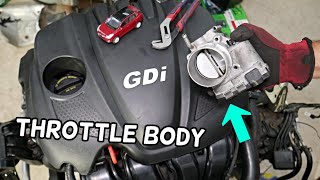
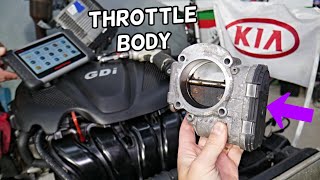
Typical fix: Replace the entire throttle body assembly. 🎬 See this walkthrough for removing and replacing the Tucson throttle body. After replacement, an Electronic Throttle Control (ETC) adaptive value reset must be performed.
Est. part cost: $180-$550 - Wiring Harness Issue (Short to Power or Open Ground) 🟡 Medium Probability Wiring harnesses, especially the section connected to the throttle body, can become damaged from engine vibration, heat, or improper servicing, leading to electrical faults.
How to confirm: Visually inspect the wiring and the 6-pin connector at the throttle body for any signs of damage, corrosion, or loose pins. With the connector unplugged, use a multimeter to check for 5V reference and a good ground on the appropriate pins. Check the signal wire for a short to voltage.
Typical fix: Repair or replace the damaged section of the wiring harness or the connector itself.
Est. part cost: $20-$100
Rare But Worth Checking
- Faulty Powertrain Control Module (PCM): → Shop Engine Control Module (ECM) This is rare, but can happen if the PCM's internal circuit for the TPS fails. All other possibilities, especially a faulty throttle body and wiring, should be exhausted before considering PCM replacement.
- Dirty Throttle Body: → Shop Fuel Injection Throttle Body While a very dirty throttle body can cause erratic behavior and other codes, it is less likely to cause a persistent 'Circuit High' code, which is typically an electrical fault. Cleaning it is good maintenance but unlikely to resolve a true P0123.
Diagnosis Steps
- Connect an OBD-II scanner and confirm the presence of code P0123. Check for any other related codes (e.g., P0122, P0222).
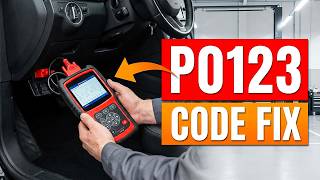
- Using the scanner's live data function, monitor the voltage of "Throttle Position Sens 🎬 Watch: A step-by-step guide to troubleshooting P0123 high input codes.or 1" or "TPS A". With the key on and engine off, the voltage should be stuck high (e.g., 4.75V or more). A healthy sensor should read low (~0.5V) and increase smoothly to about 4.5V as the accelerator pedal is pressed.
- If the voltage is stuck high, turn the ignition off and disconnect the throttle body electrical connector. Inspect the connector and pins for corrosion, damage, or moisture. Ensure a snug fit.
- With the connector still disconnected, turn the key back on (engine off) and re-check the TPS voltage on the scan tool. If it drops to 0V, the problem is very likely the sensor in the throttle body. If the voltage remains high, there is a short to power in the wiring harness.
- To confirm wiring, use a multimeter to check for a 5V reference and a good ground at the connector pins leading to the PCM.
- If wiring is confirmed to be good and the sensor signal is stuck high, the throttle body assembly has failed and must be replaced.
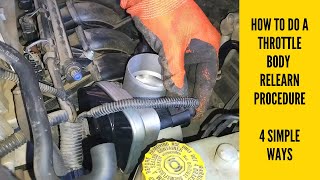
- After replacing the throttle body, perform an ETC (Electronic Throttle Control) relearn procedure. A common manual method is: Turn ignition ON (engine off) for 15 seconds, turn ignition OFF for 15 seconds. Repeat this cycle 2-3 times before starting the engine and letting it idle to stabilize. 🎬 Watch: Four different ways to perform a throttle body relearn procedure.
Parts You'll Likely Need
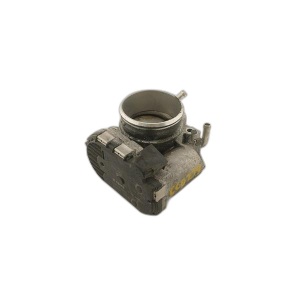
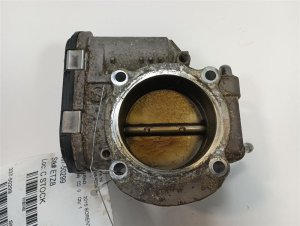
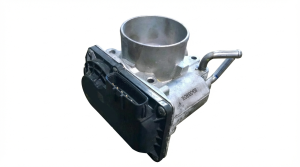
- Throttle Body Assembly
(OEM #35100-2G700 (for 2.4L Engine), 35100-2E000 (for 2.0L Engine))— This is the required fix because the Throttle Position Sensor (TPS) that causes the P0123 code is integrated into this assembly and is not sold separately for the 2010-2015 Tucson.
Trusted brands: Hyundai (OEM), Bosch, Cardone (Remanufactured), Standard Motor Products (SMP)
OEM price range: $450-$550
Aftermarket price range: $180-$350
Related Codes That Often Appear With This One
- P0122 — Indicates TPS 'A' Circuit Low. Seeing both P0122 and P0123 intermittently suggests the sensor is failing erratically or there's a loose connection.
- P0222 / P0223 — These codes relate to the TPS 'B' circuit (TPS2). Since the throttle body has two redundant sensors for safety, a significant internal failure can sometimes affect both circuits, logging faults for both.
- P1326 — This code is for the Knock Sensor Detection System (KSDS). It is not directly related to the throttle body, but is a critical code for this platform. It indicates the system has detected vibrations symptomatic of engine bearing failure and has placed the vehicle in limp mode. The shared symptom of limp mode can cause confusion.
Technical Service Bulletins (TSBs) & Recalls
- TSB 10-FL-018: A general Hyundai TSB that mentions the need for an Electronic Throttle Control (ETC) adaptive value reset after throttle body replacement to ensure proper operation and idle characteristics.
Platform-Specific Known Issues
- A service campaign (TSB #21-01-023H-4, Campaign 966) was issued for some 2010-2015 Tucsons to update the knock sensor software. This was part of a larger program to detect premature engine bearing failure, which triggers code P1326 and also puts the car in limp mode, a shared symptom with a P0123 failure.
Mechanic-Grade Diagnostic Values
- TPS1 Signal Voltage (Fault Trigger) — expected: Signal voltage should not exceed this value.. Failure: Voltage is > 4.75V for more than 0.1 seconds.
- TPS1 Signal Voltage (Key On, Engine Off, Closed Throttle) — expected: 0.29V - 0.71V. Failure: Voltage is stuck high (above 4.5V) or does not rest in this range.
- TPS1 Signal Voltage (Key On, Engine Off, Wide Open Throttle) — expected: 4.43V - 4.86V. Failure: Voltage does not reach this range when the pedal is fully depressed.
- TPS1 Internal Resistance (Sensor Disconnected) — expected: 0.875 kΩ - 1.625 kΩ (at 68°F/20°C). Failure: Resistance is outside this range, or infinite (open circuit).
- TPS Connector Pin 1 (Sensor Power) — expected: ~5.0V (with key on, engine off, connector unplugged). Failure: Voltage is significantly lower or absent, indicating a wiring or PCM issue.
- TPS Connector Pin 5 (Sensor Ground) — expected: < 1 Ohm to chassis ground (near 0V). Failure: High resistance indicates a bad ground connection.
Scan Tool Commands That Help
- Hyundai GDS or advanced aftermarket scanner (e.g., Autel): Active Test: ETC Motor — With the intake boot removed but the throttle body electrically connected, this command forces the throttle plate to open and close. It's used to verify if the throttle motor and internal gears are functioning, or if they are stuck.
- Hyundai GDS: Flight Recorder — For intermittent faults, this function allows the technician to record live data during a test drive. When the fault occurs, the technician can press a trigger to save the data from the preceding minutes, capturing the sensor readings at the exact moment of the failure.
- Hyundai GDS or advanced aftermarket scanner: Throttle Body Adaptation / Reset Adaptive Values — This function must be used after replacing the throttle body to reset the learned values for the throttle plate's closed position, ensuring a stable idle. While a manual relearn often works, this is the official and most reliable method.
Wiring & Ground Locations
- ECM/PCM Ground Pins (2.4L Engine) — On Connector B of the main engine computer (ECM/PCM), pins 1, 2, and 4 are the primary grounds.. A high-resistance or open ground on these specific pins can cause erratic behavior and internal calculation errors in the ECM, potentially leading to false sensor codes like P0123.
- Throttle Body Connector (C28) — The 6-pin electrical connector plugged directly into the electronic throttle body assembly.. This is the primary connection point for the TPS. Pin 1 is the 5V power supply, Pin 5 is the sensor ground, and other pins are for the signal and motor control. Checking for voltage and ground at these specific pins is a key diagnostic step.
Real Owner Repair Stories
- Go-Parts / hyundai-forums.com (2011-2014 Hyundai Sonata 2.0L Theta II T-GDI (platform mate)) — Limp mode, high voltage reading on TPS Signal 1, P0123 code stored.
❌ Tried (didn't work) Initial diagnosis pointed towards a sensor failure.
✅ What actually fixed it The final repair was the replacement of the entire electronic throttle body assembly, followed by a manual relearn procedure (cycling the ignition ON/OFF several times). - NHTSA ODI #11445835 (Hyundai Veloster cross-reference) — An owner reported that even after a mechanic replaced the throttle body, codes P0222 and P0123 persisted, noting that the throttle position pedal part was not a regular item carried by auto parts stores.
- NHTSA ODI #11292479 (Hyundai Azera cross-reference) — A report describes a persistent problem where new codes including P0122, P0222, and P0123 appeared after grounding issues were addressed; the vehicle was eventually limped to a shop where a MAP sensor was also investigated.
Diagnostic Flowchart
Other Known Issues on This Vehicle
Issues unrelated to this code that are worth knowing about as an owner of this generation:
- Theta II Engine Failure 🔴 High — Widespread across multiple model years. Subject of recalls, class-action lawsuits, and a lifetime warranty extension for connecting rod bearing failure. Can occur at various mileages, often starting with a knocking noise. (Ref: NHTSA Campaign 20V543, Hyundai Service Campaign 953, TSB 19-01-006H (KSDS Update))
- Excessive Oil Consumption 🟠 Medium — Common issue tied to the Theta II engine's piston rings and cylinder walls, often preceding more catastrophic engine failure. Owners report needing to add oil between changes.
- Faulty Brake Light Switch 🟡 Low — Very common. A faulty switch can prevent the vehicle from shifting out of Park, cause the ESC light to illuminate, and disable cruise control. (Ref: Hyundai Recall 110 (NHTSA ID: 13V113000))
- ABS Module Fire Risk 🔴 High — A defect in the Anti-Lock Brake System (ABS) module's circuit board can cause an electrical short, potentially leading to an engine compartment fire, even when the vehicle is off. (Ref: Hyundai Recall 194 (NHTSA ID: 20V543000))
Used vs. New Parts: Buying Guide for This Vehicle
When a used part is the smart pick: Given that a new OEM throttle body can be expensive (over $450), a used OEM part from a reputable salvage yard is a sensible, cost-effective alternative, often costing between $50 and $150.
Donor-vehicle mileage cap: roughly under 80000 miles for the part to have meaningful remaining life.
What to inspect on the donor part:
- Verify the OEM part number on the used part matches the one required for your specific engine (2.0L vs 2.4L).
- Inspect the electrical connector for any cracked plastic, corrosion on the pins, or signs of moisture intrusion.
- Ensure the throttle body housing is not cracked or physically damaged from the donor vehicle's removal or accident.
- Look at the throttle plate; while some carbon is normal, avoid units that are excessively coated in thick, black buildup, as it may indicate other engine issues on the donor car.
Aftermarket brands forum-validated for this vehicle:
- Bosch
- Standard Motor Products (SMP)
- Cardone (Remanufactured)
- Duralast
- Hitachi
Real Owner Stories
Aggregated from forums and TSBs cited above. Mileages and costs reflect what owners reported in those sources.
2011 Hyundai Tucson
Symptoms: The vehicle was stalling and entering limp mode with the Check Engine Light on.
What fixed it: Replacement of the throttle body assembly.
Source hint: Hyundai-Forums: 2011 Tucson Stalling, P0123, P0222
2011-2014 Hyundai Sonata 2.4L Theta II
Symptoms: Owners reported P0123 and P0122 codes leading to limp mode.
What fixed it: Replacement of the throttle body assembly (part no. 35100-2G700).
Source hint: 2011-2014 Hyundai Sonata (YF) with 2.4L Theta II Engine platform mate description
Related OBD-II Codes
Frequently Asked Questions
Can I just replace the sensor on my 2010-2015 Hyundai Tucson throttle body?
My Tucson is stuck at 2000 RPM and won't accelerate. Is this related to P0123?
Is there a specific TSB for the throttle body on my Tucson?
Does the knock sensor software update (Campaign 966) have anything to do with P0123?
What is the correct replacement part number for a Hyundai Sonata with the same engine issue?
How do I perform the throttle relearn procedure after a repair?
Helpful Videos
We Have This Part in Stock

The information in this article is provided for general reference and educational purposes only. Vehicle specifications, procedures, and part compatibility can vary by production date, trim level, and region. Always consult your vehicle's factory service manual and verify part numbers before purchasing or performing repairs. Safety-critical components such as airbags, seat belts, and braking systems should be installed by a qualified professional.
- Hyundai Tucson:
- 🧭 Diagnostic Flowchart
- 🎬 Helpful Videos
- 🛍️ Shop This Part
- What's Unique About the 2010-2015 Hyundai Tucson
- Symptoms You May Notice
- Most Likely Causes
- Rare But Worth Checking
- Diagnosis Steps
- Parts You'll Likely Need
- Related Codes That Often Appear With This One
- Technical Service Bulletins (TSBs) & Recalls
- Platform-Specific Known Issues
- Mechanic-Grade Diagnostic Values
- Scan Tool Commands That Help
- Wiring & Ground Locations
- Real Owner Repair Stories
- Other Known Issues on This Vehicle
- Used vs. New Parts: Buying Guide for This Vehicle
- Real Owner Stories
- 2011 Hyundai Tucson
- 2011-2014 Hyundai Sonata 2.4L Theta II
- Related OBD-II Codes
- Frequently Asked Questions
- 🎟️ Get 5% Off