

P0126 on 2011-2015 Kia Optima 2.4L: Insufficient Coolant Temperature Causes and Fixes
On a 2011-2015 Kia Optima with the 2.4L GDI engine, the P0126 code is almost always caused by a faulty thermostat that is stuck open. The most effective repair is to replace the entire thermostat and housing assembly. Expect to pay around $20-$70 for the part, with a DIY difficulty of 2/5.
- The most likely cause for a P0126 code on your 2011-2015 Optima 2.4L is a thermostat that has failed in the stuck-open position.
- Symptoms to watch for include a slow-to-warm-up engine, a temperature gauge that reads low, and poor performance from your cabin heater.
- The recommended repair is to replace the entire thermostat and housing assembly, not just the thermostat itself.
- Before buying parts, always check your coolant level first, as a low level can also cause this code.
- This is a DIY-friendly repair for those with basic tools, but it's crucial to properly bleed the air from the cooling system after the repair to prevent overheating.
What's Unique About the 2011-2015 Kia Optima
The 2011-2015 Kia Optima uses the 2.4L Theta II GDI engine, which it shares with its corporate cousin, the Hyundai Sonata. On this specific engine platform, a thermostat that fails in the 'stuck open' position is a very common and well-documented issue that directly leads to the P0126 code. While a faulty sensor is possible, the thermostat itself is the primary weak point and the cause in the vast majority of cases for this vehicle. It's also critical for owners to distinguish this minor cooling system fault from the severe engine failure issues (related to code P1326 and recalls) that also plague this engine.
Symptoms You May Notice
- Check Engine Light is on
- Engine takes a very long time to warm up to normal operating temperature
- Temperature gauge on the dashboard stays low or drops during highway driving
- Poor or no heat from the cabin heater, especially when idling
- Noticeable decrease in fuel economy
- Smell of unburnt fuel from the exhaust
- Replacing the oxygen sensors
- Replacing the water pump when there are no signs of leaking or overheating
Most Likely Causes
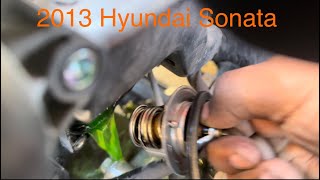
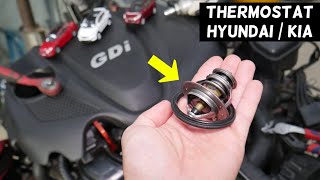
- Thermostat Stuck Open 🔴 High Probability → Shop Integrated Thermostat Housing Assembly The thermostat is a known high-failure item on the Theta II 2.4L GDI engine. The internal mechanism wears out, causing it to fail in the open position as a failsafe against overheating. 🎬 See how a stuck-open thermostat triggers these codes This is a well-documented issue across many Hyundai and Kia models using this engine.
How to confirm: Monitor the engine temperature gauge. If it's slow to rise, never reaches the middle, or drops at cruising speeds, the thermostat is likely stuck open. You can also feel the upper radiator hose shortly after a cold start; if it gets warm gradually right away instead of remaining cool for 5-10 minutes and then getting hot suddenly, coolant is flowing when it shouldn't be.
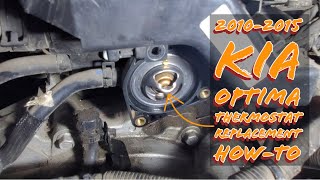
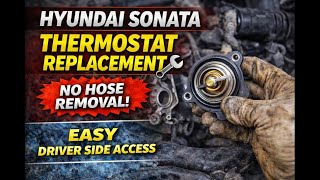
Typical fix: Replace the thermostat and the housing as a complete assembly. It's also recommended to replace the coolant at the same time, using the correct Hyundai/Kia-specific green or blue coolant and properly bleeding the system of air. 🎬 Watch: Step-by-step thermostat and coolant replacement guide
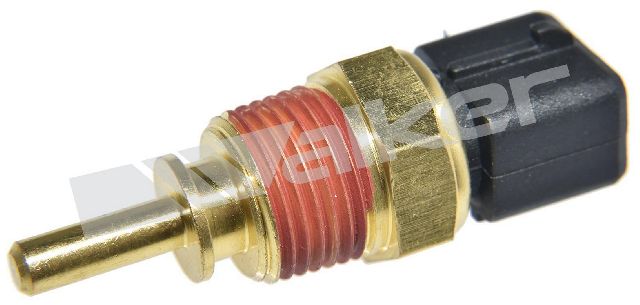
Est. part cost: $20-$70 - Faulty Engine Coolant Temperature (ECT) Sensor ⚪ Low Probability → Shop Engine Coolant Temperature Sensor
How to confirm: Use an OBD-II scanner with live data to monitor the ECT sensor reading. On a cold engine, the ECT reading should be very close to the Intake Air Temperature (IAT) reading. If the reading is erratic, doesn't change as the engine warms up, or shows an illogical value (e.g., -40°F on a warm day), the sensor is likely bad. You can also test the sensor's resistance with a multimeter and compare it to the manufacturer's specifications for a given temperature.
Typical fix: Replace the Engine Coolant Temperature (ECT) sensor. On this engine, it is located on the thermostat housing.
Est. part cost: $20-$60 - Low Engine Coolant Level ⚪ Low Probability
How to confirm: Visually inspect the coolant reservoir and the radiator (when the engine is cold) to ensure the coolant is at the proper level. If it's low, an air pocket may be causing an incorrect sensor reading or preventing the system from heating up properly. A low level indicates a leak in the system that must be found and repaired.
Typical fix: Top off the coolant and find and repair the source of the leak (e.g., hoses, radiator, water pump).
Est. part cost: $15-$30 for coolant
Rare But Worth Checking
- Cooling Fan Running Constantly: → Shop Engine Cooling Fan Blade If the electric radiator fan is stuck on and runs continuously, even when the engine is cold, it can prevent the engine from reaching operating temperature. This is usually caused by a faulty fan relay or a short in the wiring.
- Internal PCM Fault: In very rare cases, the Powertrain Control Module (PCM) can misinterpret the data from the ECT sensor, causing it to set the P0126 code. This should only be considered after all other possibilities have been exhaustively ruled out.
Diagnosis Steps
- Check the engine coolant level in the reservoir and radiator (only when the engine is completely cool). Top off if necessary.
- Using an OBD-II scanner, check for any other accompanying trouble codes. Codes related to the ECT sensor circuit (P0117, P0118) would point towards a sensor issue.
- Start the car from cold and monitor the temperature gauge. Observe if it rises very slowly or fails to reach the normal operating position (typically halfway).
- While the engine is warming up, carefully feel the upper radiator hose. It should remain cool for several minutes. If it starts to get warm almost immediately and gradually, the thermostat is stuck open, allowing coolant to circulate prematurely.
- If the thermostat appears to be working correctly, use an OBD-II scanner to view live data from the Engine Coolant Temperature (ECT) sensor. Compare the ECT reading to the Intake Air Temperature (IAT) sensor on a completely cold engine; they should be within a few degrees of each other.
- Ensure the ECT reading climbs steadily and logically as the engine warms up. An erratic or unchanging reading points to a sensor or wiring issue.
- If the ECT sensor reading is illogical or doesn't change, inspect the sensor's wiring and connector for damage or corrosion before condemning the sensor itself.
- Confirm that the radiator fan is not running constantly from the moment the car is started.
Parts You'll Likely Need
- Thermostat and Housing Assembly
(OEM #25600-2G500)— This is the most common cause of code P0126 on this engine. The thermostat fails in the open position. Replacing the entire assembly is recommended as the plastic housing can become brittle.
Trusted brands: Genuine Kia/Hyundai, Gates, Dorman, Beck/Arnley
OEM price range: $40-$70
Aftermarket price range: $20-$50 - Engine Coolant Temperature Sensor
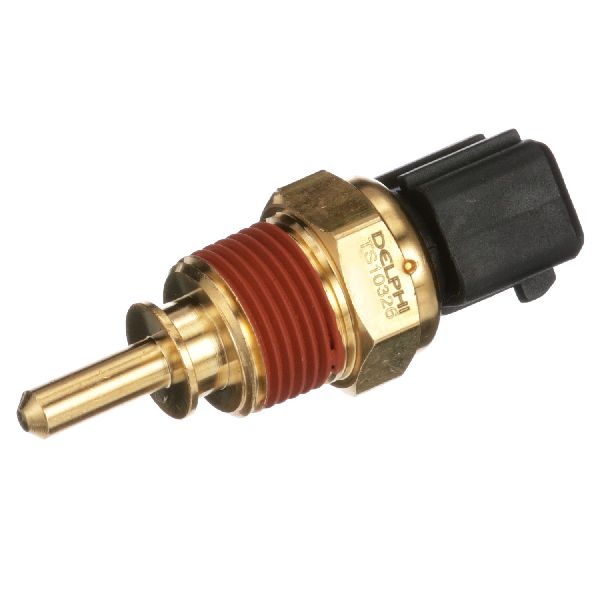
(OEM #39220-38030)— If the thermostat is confirmed to be working correctly, a faulty ECT sensor giving incorrect readings to the computer is the next most likely cause. This part number supersedes the older 39220-38020.
Trusted brands: Genuine Kia/Hyundai, NTK, Delphi, Standard Motor Products
OEM price range: $30-$60
Aftermarket price range: $20-$40
Related Codes That Often Appear With This One
- P0128 — P0128 (Coolant Temperature Below Thermostat Regulating Temperature) is a very similar code that is often triggered by the exact same cause: a thermostat stuck open. It's common to see either P0126 or P0128, or sometimes both, for this issue.
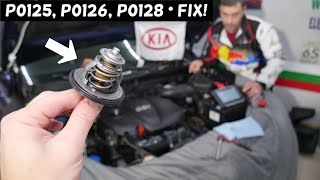
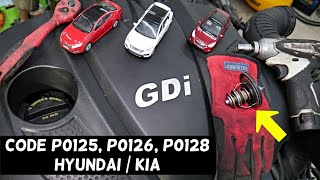
- P0125 — P0125 (Insufficient Coolant Temperature for Closed Loop Fuel Control) can also appear alongside P0126, as the engine must reach a certain temperature to enter 'closed loop' mode for optimal fuel management. All three codes often point to a faulty thermostat. 🎬 Watch: Diagnosing codes P0125, P0126, and P0128
Mechanic-Grade Diagnostic Values
- Engine Coolant Temperature (ECT) Sensor Resistance — expected: 20°C (68°F): ~2.0-3.0 kΩ; 50°C (122°F): ~750-950 Ω; 90°C (194°F): ~225-300 Ω.. Failure: A resistance reading that is infinite (open circuit), near zero (shorted), or does not match the expected value for a given temperature indicates a faulty sensor.
- ECT Sensor Signal Wire Voltage (Key On, Engine Off) — expected: The PCM supplies a 5V reference. The signal wire should read a high voltage when the engine is cold (e.g., ~3.0-4.0V) and decrease as the engine warms up to operating temperature (e.g., ~0.5-1.0V).. Failure: Voltage that is stuck high, stuck low, or does not change smoothly as the engine warms up points to a sensor or wiring issue.
Wiring & Ground Locations
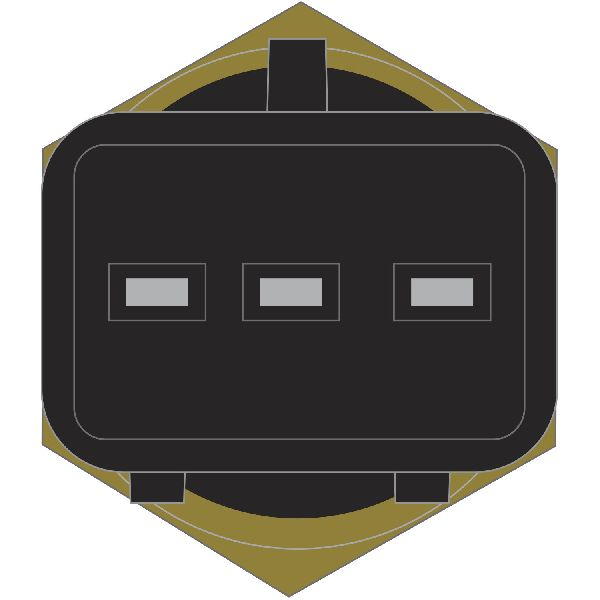
- ECT Sensor Connector — Located on the thermostat housing on the driver's side of the engine.. Corrosion, damage, or a loose connection at this 2-pin connector can mimic a failed sensor, causing erratic readings and triggering P0126 or related codes like P0117/P0118.
- Engine Ground Strap Assembly — Main ground strap connecting the engine block to the chassis. Part number 91860-2T011 is listed for 2011-2013 models. Another part number for 2012-2013 US-built models is 91860-4C010.. A poor or corroded engine ground can cause incorrect or floating voltage readings from various sensors, including the ECT sensor, potentially leading to false trouble codes.
OEM Part Supersession History
39220-38020, 39230-26700→39220-38030— Standard part revision and consolidation by the manufacturer.
Heads up: The newer part number (39220-38030) is the correct replacement for the older numbers and should be used for repairs.25600-2G400→25600-2G500— The updated G500 version uses a more durable, reinforced fiber-infused ABS plastic instead of the standard polypropylene of the G400, making it more resistant to warping and cracking from heat cycles.
Diagnostic Flowchart
Other Known Issues on This Vehicle
Issues unrelated to this code that are worth knowing about as an owner of this generation:
- Catastrophic Engine Failure (Connecting Rod Bearing Wear) 🔴 High — Widespread across 2011-2015 models. Can occur at any mileage, often under 100,000 miles. Caused by manufacturing debris blocking oil passages. (Ref: NHTSA Campaign 17V224000 (Kia Recall SC147). A class-action lawsuit resulted in a lifetime warranty extension for the engine short block for affected vehicles that received a required Knock Sensor Detection System (KSDS) software update.)
- Intake Valve Carbon Buildup 🟠 Medium — Very common on GDI engines, as fuel is not sprayed over the intake valves to clean them. Symptoms like misfiring and rough idle typically appear between 60,000 and 100,000 miles.
- Worn Steering Coupler (MDPS) 🟡 Low — Extremely common. Owners report a distinct 'clicking' or 'ticking' noise from the steering column when turning the wheel, especially when stationary. Usually appears after 50,000 miles. The flexible coupler (Part # 56315-2K000-FFF) disintegrates. (Ref: TSB CHA-064)
- Engine Compartment Fire Risk 🔴 High — Affects a wide range of Hyundai/Kia vehicles with Theta II engines. Can be caused by fuel leaks or oil leaks related to the primary engine defect. (Ref: Multiple recalls, including NHTSA 20V750000, address various fire risks.)
Used vs. New Parts: Buying Guide for This Vehicle
When a used part is the smart pick: For this specific repair, using new parts is strongly recommended. The primary failure components (thermostat, ECT sensor) are low-cost wear items. The risk of a used part failing shortly after installation outweighs the minimal cost savings. A used thermostat housing could be considered if it's in excellent physical condition with no signs of cracking or warping, but it should be fitted with a new thermostat and sensor.
Donor-vehicle mileage cap: roughly under 50000 miles for the part to have meaningful remaining life.
What to inspect on the donor part:
- For a thermostat housing: check for any hairline cracks, especially around bolt holes and hose connections.
- Ensure all mating surfaces are flat and not warped.
- Verify the donor vehicle did not have signs of overheating or coolant leaks.
OEM-only on this vehicle (don't cheap out):
- While not strictly 'OEM-only', using a genuine Kia/Hyundai thermostat assembly is often recommended for the best fit and longevity.
Aftermarket brands forum-validated for this vehicle:
- Thermostats: Gates, Beck/Arnley, Motorad.
- ECT Sensors: NTK, Delphi, Standard Motor Products (SMP).
Brands owners have reported issues with on this vehicle:
- Unbranded, 'white-box' thermostats and sensors from online marketplaces should be avoided due to a higher risk of premature failure.
Real Owner Stories
Aggregated from forums and TSBs cited above. Mileages and costs reflect what owners reported in those sources.
2017 Kia Optima 2.4L
Symptoms: Check engine light on with code P0128.
What fixed it: The owner had the thermostat housing replaced, and the mechanic also recommended replacing all coolant hoses.
Source hint: Reddit r/kia
2011-2014 Hyundai Sonata 2.4L GDI
Symptoms: P0126/P0128 codes on the shared platform.
What fixed it: Replacing the thermostat, which is the primary cause for these codes on the shared 2.4L platform.
Source hint: Go-Parts.com
2013-2018 Hyundai Santa Fe Sport 2.4L GDI
Symptoms: High frequency of P0126 and P0128 codes.
What fixed it: Replacement of the entire thermostat housing assembly.
Source hint: Platform mate data for 2.4L GDI engine
Related OBD-II Codes
Frequently Asked Questions
Is there a recall for the engine issues on my 2011-2015 Kia Optima 2.4L GDI?
My 2011-2015 Optima has a clicking noise in the steering wheel; is this related to the P0126 code?
Why is the thermostat a high-failure item on the Theta II 2.4L GDI engine?
Where is the Engine Coolant Temperature (ECT) sensor located on the 2.4L Optima?
What type of coolant should I use when replacing my Optima's thermostat?
Can I just replace the thermostat, or do I need the whole housing?
Helpful Videos

We Have This Part in Stock


The information in this article is provided for general reference and educational purposes only. Vehicle specifications, procedures, and part compatibility can vary by production date, trim level, and region. Always consult your vehicle's factory service manual and verify part numbers before purchasing or performing repairs. Safety-critical components such as airbags, seat belts, and braking systems should be installed by a qualified professional.
- Kia Optima:
- 🧭 Diagnostic Flowchart
- 🎬 Helpful Videos
- 🛍️ Shop This Part
- What's Unique About the 2011-2015 Kia Optima
- Symptoms You May Notice
- Most Likely Causes
- Rare But Worth Checking
- Diagnosis Steps
- Parts You'll Likely Need
- Related Codes That Often Appear With This One
- Mechanic-Grade Diagnostic Values
- Wiring & Ground Locations
- OEM Part Supersession History
- Other Known Issues on This Vehicle
- Used vs. New Parts: Buying Guide for This Vehicle
- Real Owner Stories
- 2017 Kia Optima 2.4L
- 2011-2014 Hyundai Sonata 2.4L GDI
- 2013-2018 Hyundai Santa Fe Sport 2.4L GDI
- Related OBD-II Codes
- Frequently Asked Questions
- 🎟️ Get 5% Off