

Pontiac G6 P0128 Code (2005-2010): Causes and Fixes for Coolant Temperature Issues
On a 2005-2010 Pontiac G6, the P0128 code almost always means the engine thermostat is stuck open and needs to be replaced. This is a common and relatively inexpensive DIY repair, with the part costing between $20 and $50. The thermostat is designed to open at 180°F (82°C).
- P0128 on a 2005-2010 Pontiac G6 almost always points to a bad thermostat stuck open.
- Symptoms include a low-reading or inoperative temperature gauge, poor heater performance, and disabled A/C.
- It is a relatively simple and inexpensive DIY repair for those with basic mechanical skills, though access is tighter on V6 models.
- Always check the coolant level first, as a low level can also cause this code.
- While driving is possible, it's best to fix the issue to avoid poor fuel economy, higher emissions, and lack of A/C.
What's Unique About the 2005-2010 Pontiac G6
For the Pontiac G6 and its platform mates (like the Chevy Malibu and Saturn Aura), the P0128 code is a very frequent issue, and the cause is almost universally a failed thermostat that is stuck in the open position. While a faulty coolant temperature sensor can theoretically cause this code, it's a much less common culprit on this specific vehicle. A unique symptom on many GM vehicles with this code is that the ECM will disable the A/C compressor and command the temperature gauge on the dash to read zero or cold, which can be misleading. The thermostat's location and replacement procedure vary slightly depending on whether the G6 is equipped with the 2.4L 4-cylinder, 3.5L V6, or the 3.9L V6 engine, but the underlying problem and solution are consistent across all powertrains.
Symptoms You May Notice
- Check Engine Light is on
- Engine temperature gauge reads lower than normal or doesn't move from the 'cold' position.
- It takes a long time for the engine to warm up.
- Heater may not blow as hot as it should, especially in cold weather.
- A/C may not work correctly as the system can be disabled by this code.
- Cooling fans may run continuously, even when the engine is cold.
- A decrease in fuel economy.
- Replacing the coolant temperature sensor when the thermostat is the actual problem. On the Pontiac G6, a P0128 code is most often caused by the thermostat. Owners often replace the sensor first due to its lower cost, only to find the problem persists until the thermostat is replaced.
Most Likely Causes
- Stuck-Open Thermostat 🔴 High Probability → Shop Integrated Thermostat Housing Assembly The thermostat is a common failure item on these vehicles due to age and wear. The internal wax motor fails, or the spring mechanism weakens, causing it to remain partially or fully open.
How to confirm: After starting the car from cold, feel the upper radiator hose. If it starts to get warm within the first few minutes, the thermostat is likely stuck open, allowing coolant to circulate to the radiator prematurely. A properly functioning thermostat would keep the hose cool until the engine reaches operating temperature (around 180°F).
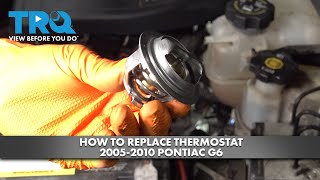
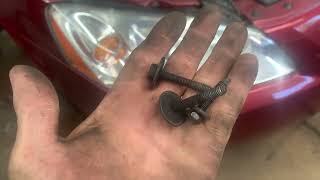
Typical fix: Replace the engine thermostat and gasket. 🎬 Watch: This step-by-step walkthrough shows you how to replace the thermostat. It's also a good time to inspect the coolant and top it off or replace it if necessary. For the 3.5L V6, some owners recommend removing the passenger headlight assembly for easier access to the thermostat housing.
Est. part cost: $20-$50 - Low Engine Coolant 🟡 Medium Probability
How to confirm: Visually inspect the coolant level in the overflow reservoir when the engine is cool. If it is below the 'cold' fill line, the level is low. Also, check for any visible coolant leaks from hoses, the radiator, or the water pump.
Typical fix: Top off the coolant to the correct level with a 50/50 mix of Dex-Cool compatible antifreeze and distilled water. Monitor the level for any drops, which would indicate a leak that needs to be repaired.
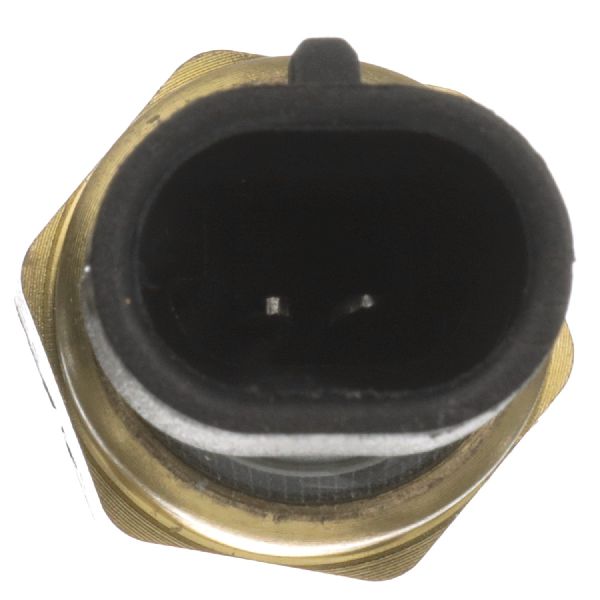
Est. part cost: $15-$30 for a gallon of coolant - Faulty Engine Coolant Temperature (ECT) Sensor ⚪ Low Probability → Shop Engine Coolant Temperature Sensor While less common, the ECT sensor can fail and send incorrect readings to the ECM. On some models, a faulty ECT can also cause the cooling fans to run constantly, which prevents the engine from warming up properly.
How to confirm: A faulty ECT sensor may cause erratic temperature gauge readings or other related trouble codes. A scan tool can be used to monitor the coolant temperature reading from the sensor to see if it is behaving erratically or providing an illogical reading (e.g., reading -40°F on a warm day).
Typical fix: Replace the engine coolant temperature sensor. 🎬 See how to diagnose and replace the sensor on a 3.9L V6. On the 3.9L V6, the sensor is fairly accessible.
Est. part cost: $15-$40
Rare But Worth Checking
- Cooling Fans Stuck On: → Shop Engine Cooling Fan Blade If the cooling fans are running continuously from a cold start, it can prevent the engine from reaching operating temperature. This could be caused by a faulty fan relay or a bad coolant temperature sensor sending an incorrect signal.
- ECM Software Calibration: In some cases, particularly for 2006 models, GM issued a technical service bulletin (TSB) indicating that the P0128 diagnostic parameters were too sensitive and could cause a false code. The fix is to have a dealer reprogram the ECM with an updated calibration. This should be considered after verifying the mechanical parts are functioning correctly.
Diagnosis Steps
- Check the engine coolant level in the reservoir when the engine is completely cool. Top it off with the correct Dex-Cool compatible coolant if it's low.
- With a cold engine, start the car and feel the upper radiator hose. If it warms up quickly (within 2-3 minutes), the thermostat is stuck open and needs replacement.
- If the temperature gauge is behaving erratically or you suspect the sensor, use an OBD-II scan tool to monitor the live data from the Engine Coolant Temperature (ECT) sensor. The temperature should rise steadily as the engine warms up. A reading that is stuck, jumps around, or is illogical (e.g., negative values) points to a bad sensor.
- Check if the cooling fans are running all the time, even when the engine is cold and the A/C is off. If so, investigate the fan control circuit, which could be a faulty relay or ECT sensor.
- If all mechanical components check out, consider the possibility of an ECM calibration issue, especially on 2006 models, and consult a dealer about potential software updates.
- Based on the findings, replace the faulty component, which is most commonly the thermostat.
Parts You'll Likely Need
- Engine Coolant Thermostat
(OEM #12622410 (ACDelco 131-158) for 2.4L)— This is the most common cause of a P0128 code on the Pontiac G6, as they are prone to getting stuck in the open position. The OEM specified temperature is 180°F (82°C).
Trusted brands: ACDelco, Stant, Murray
OEM price range: $30-$60
Aftermarket price range: $20-$40 - Engine Coolant Temperature Sensor
(OEM #12608814)— While less common than the thermostat, a faulty ECT sensor can also trigger a P0128 code by sending incorrect temperature readings to the ECM. This is a more likely cause if the temperature gauge behavior is erratic or if cooling fans run constantly from a cold start.
Trusted brands: ACDelco, Delphi
OEM price range: $25-$50
Aftermarket price range: $15-$30 - Dex-Cool Engine Coolant — You will lose some coolant when replacing the thermostat or ECT sensor, so it's necessary to have some on hand to top off the system. Use a 50/50 mix with distilled water.
Trusted brands: ACDelco, Prestone
OEM price range: $20-$30 per gallon
Aftermarket price range: $15-$25 per gallon
Technical Service Bulletins (TSBs) & Recalls
- A GM TSB from 2007 suggests that for some 2006 models with P0128, the issue may be an overly sensitive ECM diagnostic, and the recommended fix is reprogramming the ECM, not replacing parts. Other TSBs like 20-NA-109 and 22-NA-054 exist for newer GM vehicles with similar logic errors, but the 2007 bulletin is most relevant.
Platform-Specific Known Issues
- Thermostat Location Varies by Engine: → Shop Integrated Thermostat Housing Assembly The difficulty of the thermostat replacement varies by engine. On the 2.4L 4-cylinder, it is relatively accessible. On the 3.5L V6, it is located under the throttle body and can be difficult to reach; some owners find that removing the passenger-side headlight assembly provides better access. On the 3.9L V6, it is located on the side of the engine block.
- Misleading Dashboard Behavior: A common GM-specific reaction to code P0128 is for the ECM to disable the temperature gauge (making it read cold) and turn off the A/C system, sometimes displaying a message like 'A/C Off Due to High Engine Temp' even though the code means the engine is too cool. This is a default fail-safe mode.
- Bleeding the Cooling System: After replacing the thermostat, it's crucial to properly bleed the air from the cooling system. The 3.5L V6 has a 7mm bleed screw on the thermostat housing that must be opened during filling until a steady stream of coolant emerges. The 3.9L V6 may not have a bleeder screw, requiring the system to be filled via the expansion tank and burped by running the engine with the cap loose.
Mechanic-Grade Diagnostic Values
- ECT Sensor Resistance (disconnected) — expected: Approx. 2,200 - 3,000 Ω at 20°C (68°F); Approx. 250 - 350 Ω at 80°C (176°F).. Failure: Readings that are infinite (open circuit), zero (short circuit), or do not decrease smoothly as the sensor is heated.
- ECT Sensor Signal Voltage (Key On, Engine Off, sensor connected) — expected: Approx. 3.0V - 3.5V on a cold engine (~20°C/68°F). Voltage should decrease steadily as the engine warms, reaching approx. 1.0V - 1.3V at operating temperature (~80°C/176°F).. Failure: Voltage that is stuck at 5V (open signal circuit or bad ground), 0V (short to ground), or does not change with temperature.
- ECT Sensor Reference Voltage (Key On, connector unplugged) — expected: 5.0V on the reference wire from the ECM.. Failure: No voltage or low voltage indicates a problem with the ECM or the wiring between the ECM and the sensor.
Scan Tool Commands That Help
- Tech2 / GDS2 or equivalent bidirectional scanner: Cooling Fan Control (Low/High Speed) — Use this command to verify the integrity of the cooling fan circuit (relays, wiring, and fan motors). If you can command the fans on and off with the scanner, but they do not operate correctly based on engine temperature, it strongly suggests the problem is with the thermostat or ECT sensor, not the fan circuit itself.
Wiring & Ground Locations
- ECT Sensor Location (3.5L V6) — Mounted in the rear cylinder head, below the coolant reservoir.. Knowing the physical location is required for testing and replacement. An air pocket trapped here due to improper bleeding can cause incorrect readings.
- ECT Sensor Location (2.4L I4) — Located on the right rear of the engine.. Physical location required for testing and replacement.
- ECT Sensor Location (3.9L V6) — Located below the throttle actuator control module.. Physical location required for testing and replacement.
- Engine Ground (V6) — Check the ground wire at the back of the engine, above the transmission.. A poor ground for the ECT sensor circuit can cause intermittent or incorrect readings, leading to P0128 or other temperature-related symptoms without the sensor itself being faulty.
- G105 (3.6L V6) — On the left rear side of the engine compartment, on an engine-to-transmission stud, below the upper coolant hose.. This is a primary engine ground. While specific to the 3.6L, it illustrates the importance of checking major engine grounds which provide the return path for sensors like the ECT.
Real Owner Repair Stories
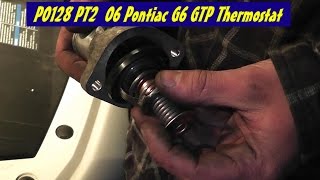
- YouTube user 'Keeping Kevin Repair and Restoration' (2006 Pontiac G6 GTP 3.9L V6 (single thermostat model)) — P0128 code was present, and the cooling fans were running constantly on high, even from a cold start.
❌ Tried (didn't work) The owner diagnosed the issue as a two-part problem. Instead of immediately replacing the thermostat, they focused on why the fans were on.
✅ What actually fixed it The root cause was a faulty Engine Coolant Temperature (ECT) sensor. The bad sensor was incorrectly telling the ECM the engine was overheating, which commanded the fans to run constantly. The constant fan operation prevented the engine from warming up properly, which in turn triggered the P0128 code. Replacing the ECT sensor fixed both the fan issue and the P0128 code. - Car Talk Community Forum (Unknown vehicle, but common GM issue) — P0128 code returned shortly after having a mechanic replace the thermostat.
❌ Tried (didn't work) Replacing the thermostat.
✅ What actually fixed it The issue was not resolved in the thread, but the expert advice given was to verify the mechanic used the correct temperature-rated thermostat and properly bled all air from the cooling system. An air pocket at the sensor or a thermostat that opens too early (wrong part) will cause the code to return. - 2CarPros Forum user (2008 Pontiac G6) — Fan runs constantly and temp gauge quit working, then would work intermittently.
❌ Tried (didn't work) Replacing the coolant temp sensor initially seemed to work, but the problem returned intermittently.
✅ What actually fixed it The suggested fix from a mechanic on the forum was to check the ground wire at the back of the engine above the transmission, indicating a likely wiring or ground issue rather than a faulty component.
"I Checked Everything" — The Actual Cause
- For code P0128, the equivalent of a 'smoke test clean' scenario is when the thermostat and ECT sensor have both been replaced, yet the code persists. In this situation, the root cause is often not a component failure but either a procedural error or a software issue. The most common missed causes are: 1) Air pockets remaining in the cooling system due to improper bleeding, which causes the ECT sensor to read air temperature instead of coolant temperature. 2) Installation of an aftermarket thermostat with the wrong temperature rating (e.g., a 160°F thermostat instead of the specified 180°F). 3) On 2006 models specifically, an overly sensitive ECM diagnostic threshold, which requires a software update from a dealer as per a GM TSB, not a parts replacement.
When the Usual Fixes Don't Work
- While the vast majority of P0128 codes on the Pontiac G6 are fixed by replacing the thermostat, a significant counter-narrative involves the Engine Coolant Temperature (ECT) sensor causing the problem indirectly. In a documented case on a 3.9L G6, a faulty ECT sensor was sending an erroneous 'overheat' signal to the computer from a cold start. This caused the cooling fans to run constantly at high speed. The hyperactive fans acted as an excessive cooling source, preventing the engine from ever reaching its 180°F target operating temperature within the time allotted by the ECM, which then logged the P0128 code. The owner correctly diagnosed that the fans running on a cold engine was the primary fault, replaced the ECT sensor that controls them, and the P0128 code was resolved as a secondary effect. This highlights a scenario where replacing the thermostat would not have fixed the issue.
OEM Part Supersession History
90537453, 55350941, 21018811, 12615097→12622410 (for 2.4L engine)— Part has been revised and updated by the manufacturer over time for improved reliability or manufacturing efficiency.
Heads up: The newest part number (12622410) is the correct replacement for all prior versions for the 2.4L engine. Using an old stock part is not recommended.
Model Year Variations Within This Range
- 2006: GM issued a Technical Service Bulletin (TSB 07-06-02-001 / PIP5685) for some 2006 models indicating the diagnostic criteria for setting a P0128 were too sensitive, leading to false codes. The official fix is to have a dealer reprogram the Engine Control Module (ECM) with an updated calibration, not to replace the thermostat or sensor.
- 3.9L V6 models: Early 3.9L V6 engines in the G6 used a single thermostat design. Later versions of this engine family (potentially outside the G6 range but good to be aware of) switched to a dual-thermostat setup. It is critical to identify which version is in the vehicle before ordering parts. The vehicles in this 2005-2010 range are expected to be the single thermostat design.
Diagnostic Flowchart
Real Owner Stories
Aggregated from forums and TSBs cited above. Mileages and costs reflect what owners reported in those sources.
2010 Pontiac G6
Symptoms: Intermittently won't reach operating temperature, temperature needle stays at the bottom. Heat works fine.
What fixed it: The community consensus was to replace the thermostat, as an intermittently stuck open thermostat is the most likely cause.
Source hint: Reddit r/MechanicAdvice Thread: 'Periodic p0128 code on a 2010 pontiac g6.'
2008 Pontiac G6 GT
Symptoms: Triggered a P0128 code and initially suspected the ECT sensor was at fault.
What fixed it: Replacing the thermostat.
Source hint: CarAudio.com Forum: 'Pontiac G6 P0128 code'
Related OBD-II Codes
Frequently Asked Questions
Why does my 2005-2010 Pontiac G6 display 'A/C Off Due to High Engine Temp' 🎬 Watch this video to see why your temperature gauge might stop working. when I have a P0128 code for the engine being too cold?
Is there a software update or TSB for the P0128 code on my Pontiac G6?
How hard is it to replace the thermostat on the 3.5L V6 Pontiac G6?
Do I need to bleed the cooling system after replacing the thermostat on my G6?
My cooling fans are running constantly on my G6 even when the engine is cold. Is this related to P0128?
Helpful Videos
We Have This Part in Stock


The information in this article is provided for general reference and educational purposes only. Vehicle specifications, procedures, and part compatibility can vary by production date, trim level, and region. Always consult your vehicle's factory service manual and verify part numbers before purchasing or performing repairs. Safety-critical components such as airbags, seat belts, and braking systems should be installed by a qualified professional.
- Pontiac G6:
- 🧭 Diagnostic Flowchart
- 🎬 Helpful Videos
- 🛍️ Shop This Part
- What's Unique About the 2005-2010 Pontiac G6
- Symptoms You May Notice
- Most Likely Causes
- Rare But Worth Checking
- Diagnosis Steps
- Parts You'll Likely Need
- Technical Service Bulletins (TSBs) & Recalls
- Platform-Specific Known Issues
- Mechanic-Grade Diagnostic Values
- Scan Tool Commands That Help
- Wiring & Ground Locations
- Real Owner Repair Stories
- "I Checked Everything" — The Actual Cause
- When the Usual Fixes Don't Work
- OEM Part Supersession History
- Model Year Variations Within This Range
- Real Owner Stories
- 2010 Pontiac G6
- 2008 Pontiac G6 GT
- Related OBD-II Codes
- Frequently Asked Questions
- 🎟️ Get 5% Off