

P0136 on 2013-2018 Toyota RAV4 2.5L: O2 Sensor Circuit Causes and Fixes
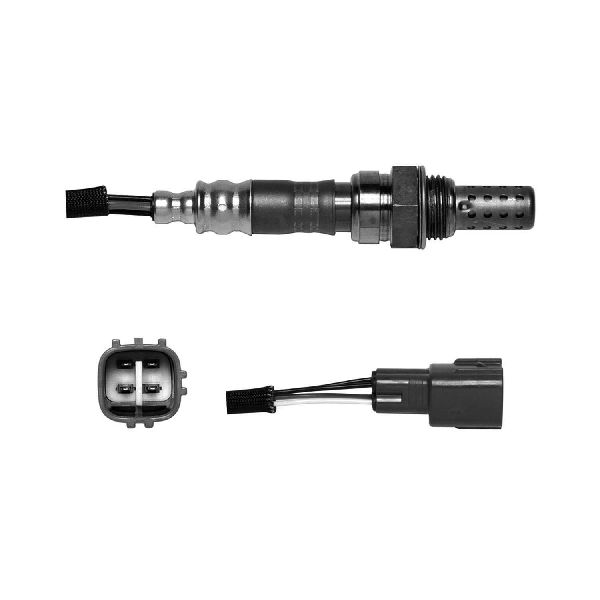
On a 2013-2018 RAV4, code P0136 almost always points to a failed downstream oxygen sensor (Bank 1, Sensor 2). Replacing this sensor is the most common fix. Expect to pay $70-$100 for an aftermarket Denso sensor (Part No. 234-4509) or around $130-$180 for a genuine Toyota part (Part No. 89465-0R040). It's a straightforward DIY job for most home mechanics, requiring a 22mm or 7/8" wrench.
- P0136 on your RAV4 points to the downstream oxygen sensor (after the catalytic converter).
- The most likely cause is simply a failed sensor. Replacing it usually solves the problem.
- Always inspect the wiring for damage before buying parts. A damaged wire can mimic a failed sensor.
- Use a genuine Toyota (part # 89465-0R040) or an OEM-supplier (Denso, part # 234-4509) sensor for best results.
- This is a manageable DIY repair with a special 22mm (7/8") O2 sensor socket or wrench, saving you on labor costs.
What's Unique About the 2013-2018 Toyota RAV4
For the 2013-2018 (XA40 generation) RAV4 with the 2AR-FE engine, the P0136 code is a very common and straightforward issue. There are no widespread, unique platform-specific problems that make this code more complex than on other vehicles. The issue is almost always a worn-out downstream oxygen sensor. Unlike some other vehicle models where wiring harness heat damage is a frequent culprit, for this RAV4 generation, the sensor itself is the primary point of failure.
Symptoms You May Notice
- Check Engine Light is on
- Failure to pass an emissions test
- Potentially decreased fuel efficiency
- In rare cases, a rough or hesitant idle
- Replacing the upstream Air/Fuel Ratio sensor (Sensor 1) instead of the downstream Oxygen Sensor (Sensor 2). They are different parts in different locations.
- Replacing the catalytic converter. While a bad converter can affect the O2 sensor reading, the P0136 code specifically points to a fault 🎬 Watch: A breakdown of P0136 causes and common fixes in the sensor's circuit, not converter efficiency (which would typically set a P0420 code).
Most Likely Causes
- Failed Downstream Oxygen Sensor (Bank 1, Sensor 2) 🔴 High Probability → Shop Oxygen Sensor Oxygen sensors are wear-and-tear items that degrade over time due to constant exposure to hot exhaust gases. After 80,000-100,000 miles, failure is common and expected.
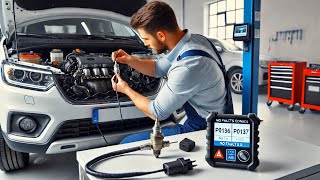
How to confirm: Use a scan tool to monitor the live data for the B1S2 sensor. A healthy downstream sensor should show a relatively steady voltage. If the voltage is stuck, flat-lined at 0V, or fluctuating wildly like an upstream sensor, it has failed. You can also test the sensor's internal heater circuit continuity with a multimeter; an open circuit indicates failure. Many owners report success by simply replacing the sensor as the primary diagnostic step 🎬 See how to diagnose low voltage circuit codes due to the high failure rate.
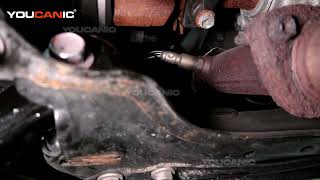
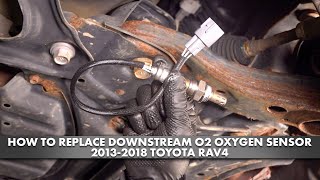
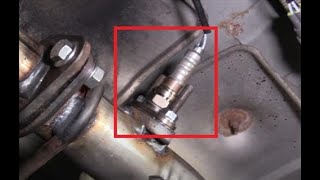
Typical fix: Replace the Bank 1, Sensor 2 oxygen sensor. A 22mm or 7/8" wrench is required. Applying penetrating oil before removal can help if it's rusted. Use a small amount of anti-seize compound on the threads of the new sensor, avoiding the sensor tip. 🎬 Watch: Step-by-step downstream oxygen sensor replacement walkthrough Be sure to use the correct OEM or high-quality aftermarket part (like Denso).
Est. part cost: $70-$180 - Damaged Wiring or Connector 🟡 Medium Probability The sensor wiring runs under the vehicle and is exposed to road debris, moisture, and heat, which can cause wires to break, fray, or corrode over time. The connector is located behind the passenger-side front wheel well liner on some models, requiring tire removal for access.
How to confirm: Visually inspect the entire wiring harness from the O2 sensor to the main loom. Look for any signs of melting, chafing, corrosion in the connector pins, or breaks. Perform a voltage and ground check at the sensor connector with a multimeter to ensure the circuit is intact.
Typical fix: Repair the damaged section of the wiring harness or clean/replace the connector.
Est. part cost: $5-$50 - Exhaust Leak ⚪ Low Probability Rust can cause leaks at gasket flanges or in the exhaust pipe itself, especially in regions where road salt is used. A leak before the sensor can introduce oxygen and cause incorrect readings.
How to confirm: Listen for a ticking or hissing sound from the exhaust system, which may be more noticeable on a cold start. Visually inspect the exhaust pipes and flanges for black soot marks, which indicate a leak. A shop can perform a smoke test to pinpoint the leak.
Typical fix: Replace the leaking gasket or repair the damaged section of the exhaust pipe using exhaust putty or by welding.
Est. part cost: $10-$100
Rare But Worth Checking
- Faulty Engine Control Module (ECM): This is extremely rare. Before condemning the ECM, all other possibilities, especially the sensor and its wiring, must be exhaustively ruled out by a qualified technician.
Diagnosis Steps
- Connect an OBD-II scanner and confirm P0136 is present. Check for other codes, especially P0137 or P0138.
- Using the scanner's live data function, observe the voltage from 'O2S B1S2' (Bank 1, Sensor 2). A healthy downstream sensor on a warm, running engine should show a relatively stable voltage, typically between 0.5V and 0.8V. If the voltage is stuck near 0V, 0.9V, or is fluctuating rapidly like an upstream sensor, the sensor is likely bad.
- Perform a thorough visual inspection. Raise the vehicle safely. Inspect the downstream O2 sensor's wiring harness and connector for any signs of melting, chafing, corrosion, or physical damage. The connector is often located behind the passenger front wheel well liner.
- If the wiring looks good and the live data is abnormal, the sensor is the most likely culprit. Proceed with replacement.
- If you suspect a wiring issue, disconnect the sensor and use a multimeter to check for proper voltage and ground on the vehicle-side of the connector (with the key on, engine off). You should also check the integrity of the heater circuit fuse ('A/F Heater').
- If the sensor and wiring are confirmed to be good, check for any exhaust leaks between the catalytic converter and the downstream O2 sensor.
- After any repair, clear the codes with the scanner and perform a drive cycle to ensure the fix was successful and the Check Engine Light does not return.
Parts You'll Likely Need
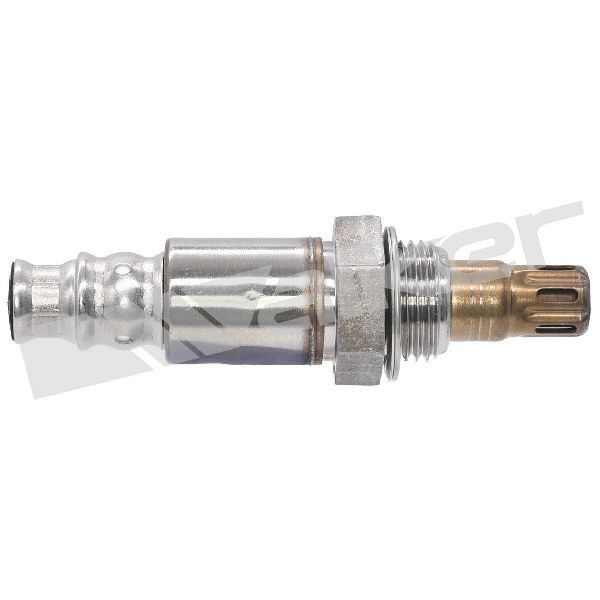
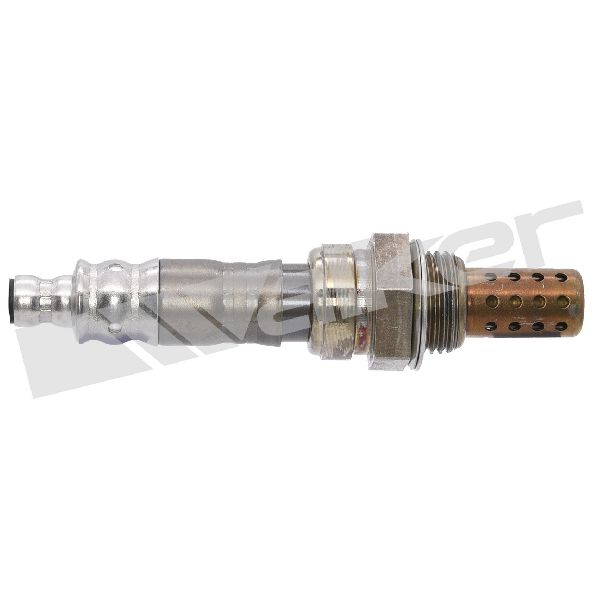
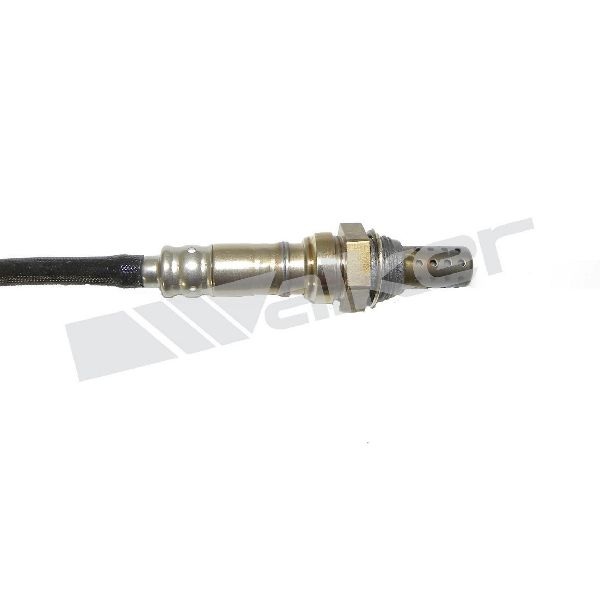
- Downstream Oxygen Sensor (Bank 1, Sensor 2)
(OEM #89465-0R040)— This is the most common cause of code P0136. It is a standard wear item that fails over time.
Trusted brands: Toyota (Genuine), Denso (OEM Supplier) - Part #234-4509
OEM price range: $130-$180
Aftermarket price range: $70-$120
Related Codes That Often Appear With This One
- P0137 — P0137 (O2 Sensor Circuit Low Voltage) is very commonly seen with P0136. Both codes point to a problem with the same sensor, and P0137 often indicates the specific failure mode (low voltage or an open circuit) that triggered the general P0136 malfunction code.
- P0138 — P0138 (O2 Sensor Circuit High Voltage) can also accompany P0136, pointing to a short in the sensor or wiring causing a constantly rich reading.
Technical Service Bulletins (TSBs) & Recalls
- T-SB-0078-16: While not for P0136, this TSB is highly relevant for 2013-2015 RAV4 owners as it addresses a common torque converter shudder issue by reprogramming the ECM and/or replacing the torque converter.
- T-SB-0010-20 / T-SB-0022-20: These bulletins address common complaints of a musty odor from the HVAC system and recommend cleaning procedures and the use of a charcoal cabin air filter.
Mechanic-Grade Diagnostic Values
- Downstream O2 Sensor (HO2S) Heater Circuit Resistance — expected: While a specific value for the 2AR-FE is not published in general manuals, typical Toyota heated oxygen sensors have a resistance between 11 and 16 Ω at room temperature. Some sources indicate a wider range of 10-40 Ω is acceptable depending on the specific sensor design.. Failure: A reading of infinity (open circuit) or near zero (short circuit) indicates a failed heater element.
- Downstream O2 Sensor (HO2S) Signal Voltage — expected: On a fully warmed-up engine at steady cruise, the voltage should be relatively stable, typically between 0.5V and 0.8V.. Failure: A voltage that is stuck low (near 0V), stuck high (near 1.0V), or fluctuating rapidly similar to an upstream A/F sensor indicates a failure.
- Mode $06 - TID $02, CID $08 — expected: This test ID monitors the maximum oxygen sensor output voltage.. Failure: If the measured value exceeds the malfunction criteria stored in the ECM, it can contribute to setting code P0136.
- Mode $06 - TID $02, CID $07 — expected: This test ID monitors the minimum oxygen sensor output voltage.. Failure: If the measured value is below the malfunction criteria, it can contribute to setting code P0136.
Scan Tool Commands That Help
- Toyota Techstream: Active Test: 'A/F Control' — This function allows a technician to force the engine's air-fuel ratio to be rich or lean. While observing the B1S2 live data, a healthy downstream sensor's voltage should respond by rising when forced rich and falling when forced lean. A slow or non-responsive sensor during this test confirms it is faulty.
Wiring & Ground Locations
- ECM Terminals OX1B and E2 — At the Engine Control Module (ECM).. According to wiring diagrams, the signal from the downstream oxygen sensor (B1S2) is sent to terminal OX1B of the ECM. The sensor ground is terminal E2. Checking for continuity and voltage at these specific pins can rule out a wiring problem between the sensor and the ECM.
Real Owner Repair Stories
- Reddit user in r/MechanicAdvice (2010 Toyota RAV4 (Similar platform and issue)) — Check Engine Light with codes P0136 & P0138.
❌ Tried (didn't work) Replaced the downstream O2 sensor with an Autozone (non-OEM, non-Denso) part. The codes returned within 100 miles.
✅ What actually fixed it The user then replaced the aftermarket sensor with a genuine Toyota (Denso) sensor, but the codes still returned, indicating a likely underlying wiring or ECM issue that was not resolved in the thread. This highlights the importance of using high-quality parts but also completing the full diagnostic circuit check if a new sensor doesn't solve the problem. - NHTSA ODI #11377970 — An owner of a similar Toyota model reported persistent P0136 Bank 1 Sensor 2 error codes even after mechanics switched the downstream O2 sensor.
- NHTSA ODI #10194123 — A Toyota owner noted a dealer diagnostic report showing a P0136 oxygen sensor malfunction, where the dealer advised the sensor should be replaced to resolve the check engine light.
OEM Part Supersession History
89465-42230→89465-0R040— Standard part number update/revision by Toyota.
Heads up: The new part number 89465-0R040 is the correct and direct replacement for 89465-42230. There are no known incompatibility issues.
Model Year Variations Within This Range
- 2016-2018: The RAV4 received a facelift for the 2016 model year which included revised exterior styling, interior updates, and new features. However, the 2.5L 2AR-FE engine and its associated emissions/exhaust components, including the downstream oxygen sensor, remained unchanged. Therefore, the diagnosis and repair for P0136 are identical across the entire 2013-2018 range.
Diagnostic Flowchart
Other Known Issues on This Vehicle
Issues unrelated to this code that are worth knowing about as an owner of this generation:
- Torque Converter Shudder 🔴 High — Common on 2013-2015 models, typically between 25-50 mph under light throttle. Feels like driving over rumble strips. (Ref: Toyota issued a warranty extension (program ZH1) and TSBs (e.g., T-SB-0078-16) to address this by replacing the torque converter and/or reprogramming the ECM.)
- Musty or Moldy HVAC Odor 🟡 Low — A very common complaint across many Toyota models of this era. Odor is most noticeable at A/C startup. (Ref: Toyota issued TSBs like T-SB-0010-20 and T-SB-0022-20, which acknowledge the issue is from microbe growth on the evaporator and suggest maintenance procedures like using a refresher kit and replacing the cabin filter with a charcoal version.)
- Oil Seeping from Timing Cover / Valve Cover 🟠 Medium — Can occur at higher mileage (e.g., 150k+ miles). Not usually a catastrophic leak but can be an expensive repair if addressed.
- Water Pump Leaks 🟠 Medium — Failures can occur every 50,000-75,000 miles, leading to coolant loss.
Used vs. New Parts: Buying Guide for This Vehicle
When a used part is the smart pick: For this repair, buying a used oxygen sensor is strongly discouraged. O2 sensors are wear-and-tear items with a finite lifespan. A used sensor from a salvage yard has unknown remaining life and may fail shortly after installation, wasting time and money.
Donor-vehicle mileage cap: roughly under 20000 miles for the part to have meaningful remaining life.
What to inspect on the donor part:
- If forced to consider used, only select a sensor from a very low-mileage wreck (under 20k miles).
- Inspect the sensor tip for heavy carbon buildup, white deposits (coolant), or oily residue (oil burning), all of which indicate it came from a poorly running engine.
- Ensure the wiring and connector are completely intact with no cuts, melting, or corrosion.
OEM-only on this vehicle (don't cheap out):
- While not strictly 'OEM-only', using either a genuine Toyota sensor or the OEM-supplier (Denso) is highly recommended. Other aftermarket brands have a higher reported failure rate on Toyota vehicles, sometimes not working correctly right out of the box.
Aftermarket brands forum-validated for this vehicle:
- Denso (Part #234-4509) is the original equipment manufacturer for Toyota and is considered the best alternative to buying the part from a Toyota dealer.
Brands owners have reported issues with on this vehicle:
- Generic, unbranded, or 'white-box' sensors from online marketplaces or discount auto parts stores should be avoided. Forum discussions frequently mention issues with these parts failing to resolve codes or failing prematurely.
Real Owner Stories
Aggregated from forums and TSBs cited above. Mileages and costs reflect what owners reported in those sources.
2013 Toyota RAV4 2.5L — 167000 miles
Symptoms: Torque converter shudder and oil seeping from the timing cover.
What fixed it: The user discussed these as major platform issues alongside general maintenance; for P0136 specifically, forum consensus for this generation points to replacing the downstream O2 sensor.
Source hint: Reddit r/rav4club - '2013 Toyota RAV4 – Torque Converter Shudder + Oil Seeping'
Toyota Owner Report — NHTSA ODI #11377970
Symptoms: Persistent P0136 Bank 1 Sensor 2 error code.
What fixed it: The owner reported that they "KEEP GETTING A P0136 BANK 1 SENSOR 2 ERROR CODE" and took the vehicle to several mechanics who switched the downstream O2 sensor, though the code persisted, suggesting further electrical diagnosis was needed.
Toyota Owner Report — NHTSA ODI #10194123
Symptoms: Check engine light with a failure code of P0136.
What fixed it: A dealer diagnostic report confirmed the oxygen sensor malfunction, and the dealer advised that the sensor should be replaced at a cost of $230.00.
Related OBD-II Codes
Frequently Asked Questions
Where is the Bank 1, Sensor 2 connector located on my 2013-2018 RAV4?
Should I use a genuine Toyota oxygen sensor or an aftermarket one like Denso?
Does TSB-0078-16 address my P0136 check engine light?
My RAV4 has over 100,000 miles; is it common for the downstream sensor to fail now?
Can a leak in my exhaust system cause the P0136 code?
Is there a specific fuse I should check for the oxygen sensor circuit?
Helpful Videos
We Have This Part in Stock

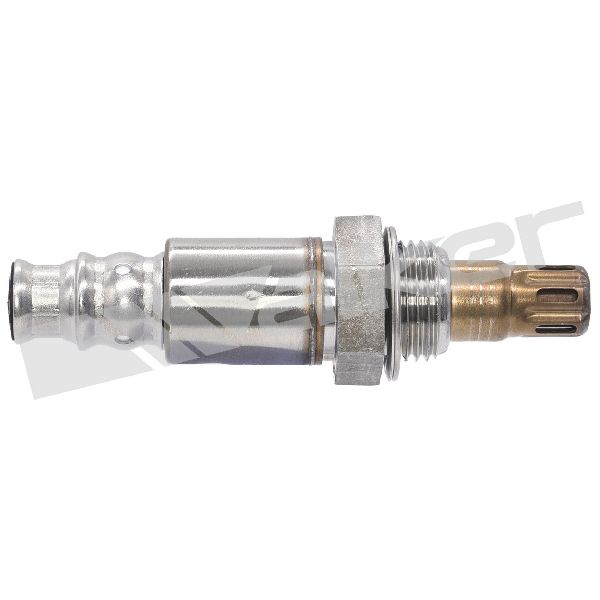

The information in this article is provided for general reference and educational purposes only. Vehicle specifications, procedures, and part compatibility can vary by production date, trim level, and region. Always consult your vehicle's factory service manual and verify part numbers before purchasing or performing repairs. Safety-critical components such as airbags, seat belts, and braking systems should be installed by a qualified professional.
- Toyota RAV4:
- 🧭 Diagnostic Flowchart
- 🎬 Helpful Videos
- 🛍️ Shop This Part
- What's Unique About the 2013-2018 Toyota RAV4
- Symptoms You May Notice
- Most Likely Causes
- Rare But Worth Checking
- Diagnosis Steps
- Parts You'll Likely Need
- Related Codes That Often Appear With This One
- Technical Service Bulletins (TSBs) & Recalls
- Mechanic-Grade Diagnostic Values
- Scan Tool Commands That Help
- Wiring & Ground Locations
- Real Owner Repair Stories
- OEM Part Supersession History
- Model Year Variations Within This Range
- Other Known Issues on This Vehicle
- Used vs. New Parts: Buying Guide for This Vehicle
- Real Owner Stories
- 2013 Toyota RAV4 2.5L — 167000 miles
- Toyota Owner Report — NHTSA ODI #11377970
- Toyota Owner Report — NHTSA ODI #10194123
- Related OBD-II Codes
- Frequently Asked Questions
- 🎟️ Get 5% Off