

P0175 on 2003-2010 Porsche Cayenne: Causes and Fixes for Rich Fuel Mixture (Bank 2)
On a 2003-2010 Porsche Cayenne, code P0175 (System Too Rich, Bank 2) is most often caused by a failing front (pre-catalyst) oxygen sensor on the driver's side or a leaking fuel injector on that same bank. A faulty MAF sensor is also possible, but less likely when only one bank is affected.
- P0175 means your Cayenne's engine is running too rich on the driver's side (Bank 2).
- Since the code is only for one bank, the most likely cause is a bad front O2 sensor or a leaking fuel injector on that side.
- Use an OBD-II scanner to watch live data for the Bank 2 fuel trims and O2 sensor voltage; this is the fastest way to start diagnosing the problem.
- Do not immediately replace the MAF sensor, as it typically affects both engine banks.
- Driving for an extended period with this code can damage your expensive catalytic converters.
What's Unique About the 2003-2010 Porsche Cayenne
The Bosch Motronic engine management system in the first-generation Cayenne is highly sensitive to inputs from its sensors. While Mass Airflow (MAF) sensors are a very common failure point on these M48 V8 engines, they typically cause rich codes on *both* banks (P0172 and P0175). A P0175 code by itself strongly suggests the problem is isolated to Bank 2, shifting suspicion towards components that only serve that side of the engine, such as its specific oxygen sensor or one of its fuel injectors. A major distinction exists between the 955 (4.5L Port Fuel Injection) and 957 (4.8L Direct Fuel Injection) models, which significantly alters the fuel system components and potential causes.
Generation note: This guide covers the first-generation Porsche Cayenne, which includes the 955 (2003-2006) with the 4.5L V8 and the facelifted 957 (2008-2010) with the 4.8L V8. While the causes are generally the same, specific part numbers for sensors, injectors, and other components will differ between these models. A critical difference is the fuel system: 955 models use Port Fuel Injection (PFI), while 957 models use Direct Fuel Injection (DFI), which adds a high-pressure fuel pump (HPFP) and different pressure specifications. Always verify parts against your vehicle's VIN.
Symptoms You May Notice
- Noticeably worse fuel economy.
- Strong smell of gasoline from the exhaust.
- Rough or unstable idle.
- Hesitation or stumbling during acceleration.
- Black smoke from the exhaust pipe in severe cases.
- Illuminated Check Engine Light.
- Engine misfires, which may feel like a shudder or skip.
- Fuel dilution of engine oil (can be detected by a gasoline smell on the dipstick).
- Replacing the MAF sensor immediately when only one bank has a rich code. While a possibility, a bank-specific issue like an O2 sensor or injector is more probable.
- Replacing the rear (post-catalyst) O2 sensor instead of the front (pre-catalyst) one. The front sensor (Sensor 1) is the primary input for fuel trim adjustments.
Most Likely Causes
- Failing Front Oxygen (O2) Sensor (Bank 2, Sensor 1) 🔴 High Probability → Shop Oxygen Sensor O2 sensors have a finite lifespan and can become lazy or biased with age, sending incorrect 'rich' signals to the ECM even when the mixture is normal.
How to confirm: Use an OBD-II scanner to monitor the live data for the Bank 2, Sensor 1 voltage. It should fluctuate rapidly between approximately 0.1V and 0.9V. If it is stuck high (above 0.8V) or is very slow to respond compared to the Bank 1 sensor, it is likely faulty.
Typical fix: Replace the Bank 2 (driver's side) front (pre-catalyst) oxygen sensor. It is recommended to use an OEM-quality brand like Bosch or NTK. Many technicians recommend replacing both front O2 sensors at the same time, as the other is likely of similar age and condition.
Est. part cost: $80-$150 - Leaking Fuel Injector(s) (Bank 2) 🟡 Medium Probability → Shop Fuel Injector Injectors can fail mechanically or develop internal leaks over time, dripping excess fuel into one or more cylinders, which is a direct cause of a bank-specific rich condition.
How to confirm: After the engine has been off for a while, check fuel rail pressure to see if it holds or drops, which could indicate a leak. Another method is to remove the spark plugs on Bank 2 (cylinders 5-8) and inspect them; a plug that is black and sooty compared to the others points to the cylinder with the leaking injector. Hard starting after the car sits for a while can also be a symptom of a flooded cylinder from a leaky injector.
Typical fix: Replace the faulty fuel injector(s) on Bank 2. It is often recommended to replace all four injectors on that bank at the same time for balanced fueling.
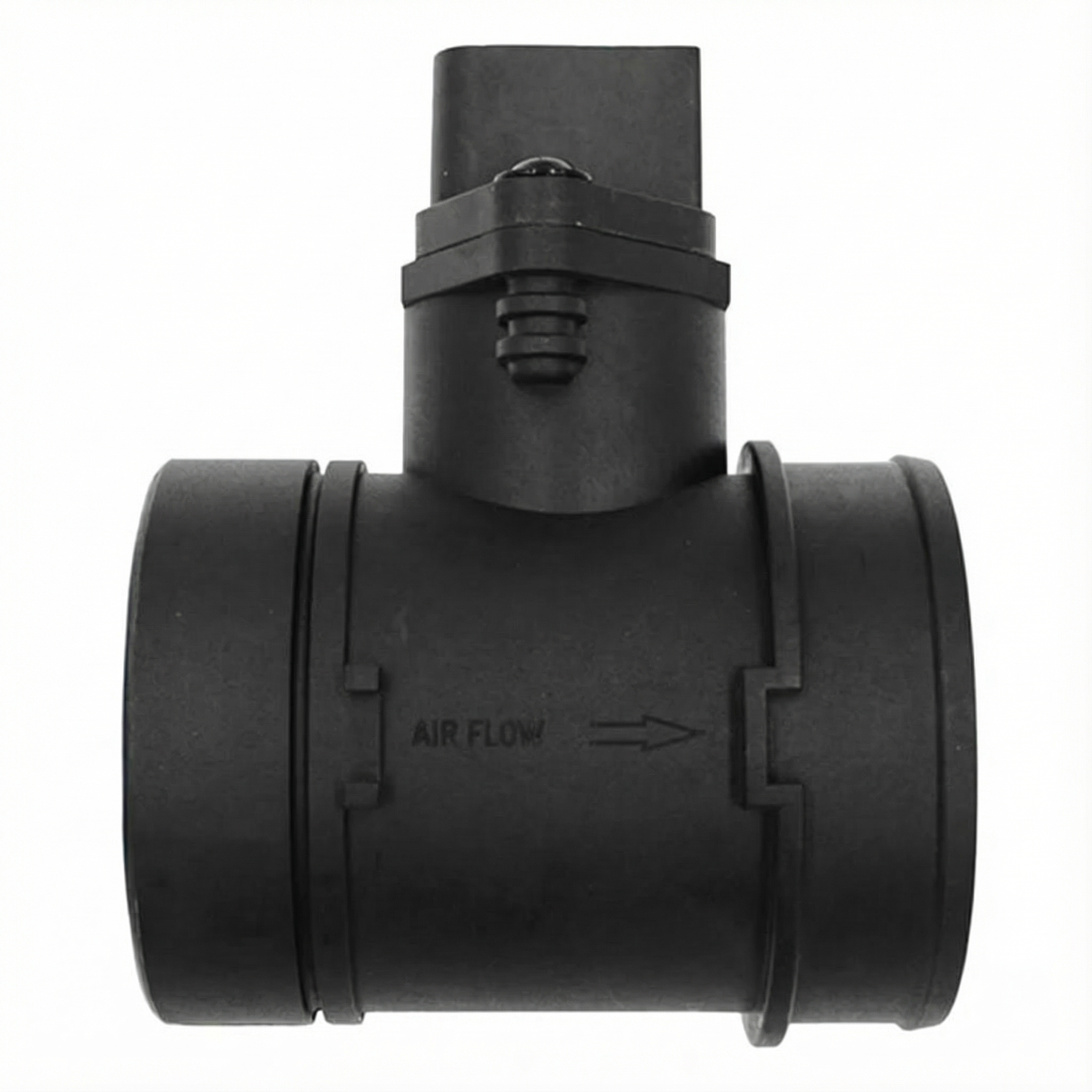
Est. part cost: $70-$120 per injector - Faulty Mass Airflow (MAF) Sensor ⚪ Low Probability → Shop Fuel Injection Air Flow Meter The MAF sensor element can become contaminated with oil or dirt, causing it to inaccurately measure the air entering the engine. This is a very common failure on Cayennes.
How to confirm: While typically causing codes on both banks (P0172 & P0175), a skewed MAF can sometimes affect one bank more than the other initially. Monitor MAF readings (g/s) at idle and with increasing RPMs to check for smooth, plausible values. You can try cleaning the sensor with dedicated MAF cleaner first, but replacement is often necessary.
Typical fix: Clean the MAF sensor with a dedicated electronic parts cleaner. If the problem persists, replace the MAF sensor, preferably with a Bosch unit.
Est. part cost: $150-$250 - High Fuel Pressure ⚪ Low Probability A failing fuel pressure regulator can cause system-wide high pressure, forcing too much fuel through the injectors. The 955 models have the regulator integrated with the fuel filter in the tank.
How to confirm: Connect a fuel pressure gauge to the fuel rail's service port. Check the pressure at idle and compare it to the manufacturer's specification (typically around 58 PSI or 4 Bar for 955 models). If it is too high, the regulator is the likely cause. For 957 models, this is more complex due to the two-stage fuel system (see Model Year Variations).
Typical fix: Replace the fuel pressure regulator. On 955 models, this is part of the in-tank fuel filter assembly. On 957 models, pressure is controlled by a fuel pump control module based on sensor readings, and a high-pressure pump adds a second layer of complexity.
Est. part cost: $100-$200
Rare But Worth Checking
- EVAP Purge Valve Stuck Open: → Shop Vapor Canister If the evaporative emissions purge valve sticks open, it can allow unmetered fuel vapors into the intake manifold at the wrong time, potentially causing a rich condition. This would usually be accompanied by EVAP system codes like P0441, P0442 or P0455.
- Faulty Engine Coolant Temperature (ECT) Sensor: If the ECT sensor incorrectly tells the ECM that the engine is cold, the computer will command a richer fuel mixture, similar to a cold start. This can trigger a rich code if the sensor is faulty or if the thermostat is stuck open, preventing the engine from reaching proper operating temperature.
- Corroded Engine Harness Ground Splice: On the related 4.8L Panamera, a known issue involves moisture causing corrosion at a key engine harness ground splice. This can lead to erratic sensor readings and has been known to cause fuel mixture codes, including P0175. While not a common Cayenne issue, it's a possibility for hard-to-diagnose cases.
Diagnosis Steps
- Connect an OBD-II scanner and confirm P0175 is the only fuel trim code. Check freeze frame data to see the engine conditions (RPM, load, temp) when the code was set.
- Observe live data. Look at the Short-Term Fuel Trim (STFT) and Long-Term Fuel Trim (LTFT) for both Bank 1 and Bank 2. For P0175, you will see significant negative values on Bank 2 (e.g., -15% to -30%) as the ECM tries to remove fuel. Compare to Bank 1, which should be near 0%.
- Test the Bank 2 Oxygen Sensor (Sensor 1). Graph the voltage of the front O2 sensors for both banks. Bank 2's sensor should switch rapidly like Bank 1's. If it's slow, stuck, or biased high, it needs replacement.
- Inspect for Leaking Injectors on Bank 2. If the O2 sensor appears to be working correctly, investigate the fuel injectors on the driver's side. Check fuel pressure hold after shutdown or inspect the spark plugs on Bank 2 for signs of richness (black, sooty deposits).
- Check for Fuel Dilution. Carefully remove the oil filler cap or dipstick and smell for a strong odor of raw gasoline. This indicates a severe rich condition, likely from a leaking injector, that is contaminating the engine oil and requires immediate attention.
- Check Fuel Pressure. If injectors and O2 sensors seem fine, test the fuel pressure to rule out a faulty regulator causing a system-wide issue that is only just triggering a code on one bank. Verify the correct pressure based on your model year (955 vs 957).
- Inspect the MAF Sensor. As a final check, inspect and clean the MAF sensor, as a dirty sensor can cause a variety of fuel trim issues, though it's less likely for a single-bank code.
Parts You'll Likely Need
- Front Oxygen Sensor (Bank 2, Sensor 1)
(OEM #95560612811 (4.5L V8) / 95760612801 (4.8L V8). Verify with VIN.)— This is the primary sensor that measures the air/fuel ratio for Bank 2 and is a common failure item leading to rich codes.
Trusted brands: Bosch, NTK
OEM price range: $150-$200
Aftermarket price range: $80-$130 - Fuel Injector
(OEM #94860513001 (4.5L V8) / 94811012824 (4.8L V8 N/A). Verify with VIN.)— A leaking injector is a direct cause of a rich condition on a specific bank.
Trusted brands: Bosch
OEM price range: $150-$200
Aftermarket price range: $70-$120 - Mass Airflow (MAF) Sensor
(OEM #95560612331)— Though less likely for a single-bank code, a contaminated MAF is a very common Cayenne issue that can cause incorrect fuel mixture calculations.
Trusted brands: Bosch
OEM price range: $250-$350
Aftermarket price range: $150-$250
Related Codes That Often Appear With This One
- P0172 — System Too Rich (Bank 1). If both P0172 and P0175 are present, it strongly points to a common cause affecting both banks, such as the MAF sensor or a fuel pressure issue.
- P0300, P0305, P0306, P0307, P0308 — Misfire codes for Bank 2 cylinders (5, 6, 7, 8). An overly rich mixture can foul spark plugs and cause incomplete combustion, leading to misfires on the affected bank.
- P0441, P0455 — EVAP system codes. If the purge valve is stuck open and causing the rich condition, it will often be accompanied by codes indicating an EVAP system leak or incorrect purge flow.
Technical Service Bulletins (TSBs) & Recalls
- Porsche TSB WC05 (related to Panamera 4.8L): While not directly for the Cayenne, this TSB for the platform-mate Panamera identifies a faulty engine harness ground splice that can become corroded, leading to a wide array of sensor faults, including fuel mixture codes P0171-P0175. This is a valuable data point for a rare but possible cause.
Mechanic-Grade Diagnostic Values
- Fuel Pressure (955 / 4.5L PFI models) — expected: ~58 psi (4 bar). Failure: Significantly higher pressure indicates a faulty in-tank fuel pressure regulator.
- Low-Side Fuel Pressure (957 / 4.8L DFI models) — expected: ~80-87 psi (5.5-6 bar) at idle. Failure: Low pressure here points to a failing in-tank low-pressure fuel pump, not the HPFP.
- High-Side Fuel Pressure (957 / 4.8L DFI models) — expected: Varies from ~580 psi (40 bar) at idle to ~1740 psi (120 bar) under load.. Failure: While failure of the High Pressure Fuel Pump (HPFP) or sensor more commonly causes lean codes (P0171/P0174) or specific pressure codes (P1023, P1026), erratic readings could contribute to fuel trim issues.
- Long Term Fuel Trim (LTFT) for Bank 2 — expected: Within +/- 5% of zero.. Failure: A consistent, large negative value (e.g., -15% to -30%) confirms the ECM is trying to remove a large amount of fuel to correct a rich condition on Bank 2.
Scan Tool Commands That Help
- Porsche PIWIS Tester (Dealer-level): Guided Fault Finding & Actuations — For complex diagnoses, the PIWIS can run specific test plans for fuel mixture faults. It allows for bidirectional control to individually activate components like specific fuel injectors, the EVAP purge valve, or O2 sensor heater circuits to isolate a fault without replacing parts.
Wiring & Ground Locations
- Main Engine Ground Strap — There are two primary ground straps. One is located in the engine bay, connecting the engine block to the passenger side (right side) strut tower. Another is located underneath the engine.. A corroded or loose ground strap can create high resistance, causing erratic voltage signals from critical sensors like O2 sensors and the MAF sensor, leading the ECU to make incorrect fuel calculations.
- Oxygen Sensor Electrical Connectors — Mounted on the firewall in the engine compartment. Bank 2 (driver's side) connectors are on the right side of the engine bay when viewing from the front.. These must be disconnected before removing the sensors to avoid twisting and damaging the wiring. The connectors are physically keyed differently for upstream and downstream sensors, preventing incorrect installation.
- Engine Bay Fuse Box (E-Box) — Located in the plenum area at the left rear of the engine compartment (driver's side).. This box contains fuses and relays for engine management components, including the O2 sensor heaters (Fuses F3 & F4 in the engine compartment fuse box are often cited for O2 heater circuits). A blown fuse for the Bank 2 O2 sensor heater (e.g., P0155) can cause the sensor to respond slowly, leading to incorrect fuel trim and a P0175 code.
Model Year Variations Within This Range
- 2003-2006 (955 models): These models use a 4.5L V8 with Port Fuel Injection (PFI). The fuel system is simpler, with in-tank pumps supplying fuel to the rail at approximately 58 psi (4 bar). Diagnosis for P0175 on these models should focus on bank-specific components like the O2 sensor and injectors, or a system-wide issue like the MAF or fuel pressure regulator (part of the in-tank filter assembly).
- 2008-2010 (957 models): These models use a 4.8L V8 with Direct Fuel Injection (DFI). This system is more complex, featuring two fuel pressure stages: a low-pressure system (~80 psi) from the in-tank pumps, and a high-pressure system regulated by an engine-driven High-Pressure Fuel Pump (HPFP) that generates up to 1740 psi. While a failing HPFP typically causes lean codes or low-pressure warnings, any fault within the high-pressure sensor or pump could potentially contribute to fueling inaccuracies. The causes are more complex than on the 955.
Diagnostic Flowchart
Real Owner Stories
Aggregated from forums and TSBs cited above. Mileages and costs reflect what owners reported in those sources.
2007 Porsche Cayenne 4.8L V8 — 190000 miles
Symptoms: Vehicle jerked at idle speed and blew blue smoke from both exhaust tailpipes when starting. Threw codes P1373, P0175, and P1377. Upon inspection, the cylinder 5 spark plug was very oily while all others were dry.
What fixed it: The final repair was not specified in the initial post, but the owner successfully isolated the issue to cylinder 5 after finding a heavily oiled spark plug, pointing toward a localized injector or mechanical fault.
Source hint: PFF Porsche Community
2005 Porsche (Model unspecified)
Symptoms: Experienced a recurring P0175 code and questioned if the MAF sensor was to blame.
What fixed it: Community feedback confirmed that a faulty MAF usually triggers codes on both banks, leading the owner to redirect their diagnosis toward Bank 2 specific components like the O2 sensor and leaking injectors.
Source hint: 6SpeedOnline - 'P0175 OBDII Trouble Code' (2005)
2012 Porsche (Model unspecified)
Symptoms: Owner experienced recurring P0172 and P0175 Check Engine Lights simultaneously.
What fixed it: The presence of both Bank 1 and Bank 2 rich codes led the owner to suspect the MAF sensor, reinforcing the common diagnostic pattern that dual-bank faults are usually air-metering issues.
Source hint: RennTech.org - 'Recurring P0172 and P0175 CELs' (2012)
Related OBD-II Codes
Frequently Asked Questions
Does Porsche TSB WC05 apply to my Cayenne?
How can I tell if a leaking fuel injector is causing the P0175 code on my 4.5L or 4.8L V8?
Should I replace both front O2 sensors on my Cayenne if only Bank 2 is throwing the code?
Can a dirty MAF sensor cause a rich condition on just Bank 2?
Where is the fuel pressure regulator located on the 2003-2010 Cayenne?
I smell gasoline on my Cayenne's oil dipstick. Is this related to the P0175 code?
Used OEM Parts in Stock
New Aftermarket Parts Available


The information in this article is provided for general reference and educational purposes only. Vehicle specifications, procedures, and part compatibility can vary by production date, trim level, and region. Always consult your vehicle's factory service manual and verify part numbers before purchasing or performing repairs. Safety-critical components such as airbags, seat belts, and braking systems should be installed by a qualified professional.
- Porsche Cayenne:
- 🧭 Diagnostic Flowchart
- 🛍️ Shop This Part
- What's Unique About the 2003-2010 Porsche Cayenne
- Symptoms You May Notice
- Most Likely Causes
- Rare But Worth Checking
- Diagnosis Steps
- Parts You'll Likely Need
- Related Codes That Often Appear With This One
- Technical Service Bulletins (TSBs) & Recalls
- Mechanic-Grade Diagnostic Values
- Scan Tool Commands That Help
- Wiring & Ground Locations
- Model Year Variations Within This Range
- Real Owner Stories
- 2007 Porsche Cayenne 4.8L V8 — 190000 miles
- 2005 Porsche (Model unspecified)
- 2012 Porsche (Model unspecified)
- Related OBD-II Codes
- Frequently Asked Questions
- 🎟️ Get 5% Off