

P0175 on 2007-2017 Toyota Camry 3.5L V6: System Too Rich Bank 2 Causes and Fixes
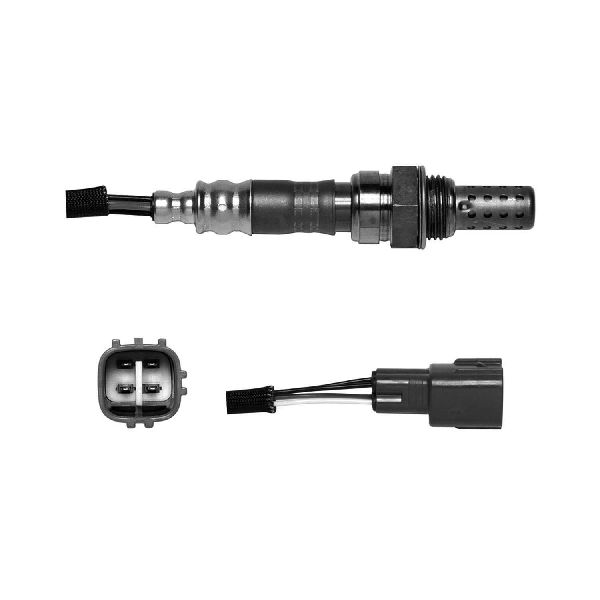
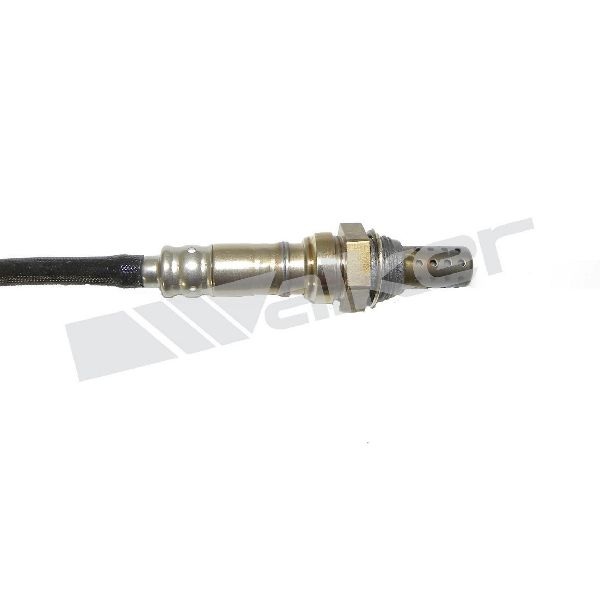
Code P0175 on a V6 Camry means the engine is running too rich on Bank 2 (the cylinder bank near the radiator). The most common causes are a faulty Air/Fuel Ratio (A/F) sensor or a leaking fuel injector. Expect to pay $150-$250 for an OEM Denso A/F sensor, part number 89467-06070 or the equivalent Denso aftermarket part 234-9056.
- P0175 means Bank 2 (front bank) is running rich.
- The most likely cause is a failing Air/Fuel Ratio sensor (Bank 2, Sensor 1), which is the upstream sensor on the front exhaust manifold.
- Before replacing parts, use a scan tool to watch fuel trims and sensor data to confirm the diagnosis.
- A leaking fuel injector is the second most likely cause and can be diagnosed with a fuel pressure test.
- Driving with this code can ruin your expensive catalytic converter over time, so it's best to address it promptly.
What's Unique About the 2007-2017 Toyota Camry
The Toyota 2GR-FE engine is known for its reliability, but like any modern engine, it relies on precise sensor readings. For this P0175 code, issues are most frequently traced back to the upstream Air/Fuel (A/F) ratio sensors, which are a more advanced and sensitive type of oxygen sensor. While a dirty MAF sensor can be a cause, it often triggers codes for both banks (P0172 and P0175). A single bank code like P0175 points more specifically to a component isolated to that bank, such as the A/F sensor or a fuel injector on that bank.
Generation note: This guide covers the Toyota Camry XV40 (2007-2011) and XV50 (2012-2017) generations, both of which used the 2GR-FE 3.5L V6 engine. The causes and diagnostic procedures for code P0175 are consistent across these generations.
Symptoms You May Notice
- Check Engine Light is on
- Decreased fuel economy
- Rough or unstable idle
- Strong smell of gasoline from the exhaust
- Black smoke or soot from the tailpipe
- Engine hesitation or lack of power during acceleration
- Difficulty starting the vehicle (Startability Malfunction)
- Replacing the downstream (Sensor 2) oxygen sensor. The downstream sensor's primary role is to monitor catalytic converter efficiency, not to control the primary air-fuel mixture. The P0175 code is based on readings from the upstream (Sensor 1) A/F sensor.
Most Likely Causes
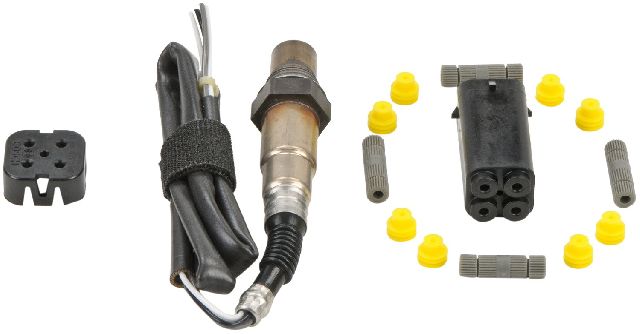
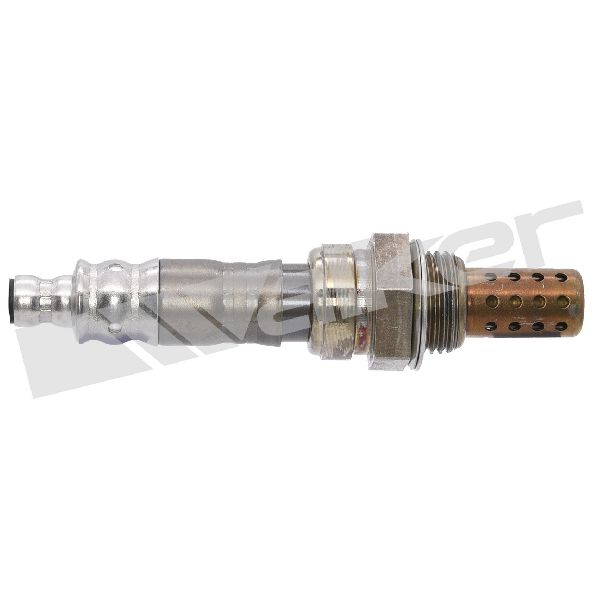
- Faulty Air/Fuel Ratio Sensor (Bank 2, Sensor 1) 🔴 High Probability → Shop Oxygen Sensor A/F sensors are sensitive components that wear out over time, typically after 100,000+ miles. They can become 'lazy' or biased, sending inaccurate readings that trick the ECM into creating a rich mixture.
How to confirm: Use an OBD-II scanner to monitor the live data for the Bank 2, Sensor 1 A/F sensor voltage or current. A healthy sensor will show rapid fluctuations. A lazy or faulty sensor will have a slow, steady, or non-responsive signal. Comparing its reading to the Bank 1 sensor under the same conditions is a very effective diagnostic method. A faulty sensor will often read lean, causing the ECM to add fuel and create a rich condition reflected by negative fuel trims.
Typical fix: Replace the Bank 2, Sensor 1 Air/Fuel Ratio sensor. This sensor is located on the front exhaust manifold, which is easily accessible from the front of the engine bay.
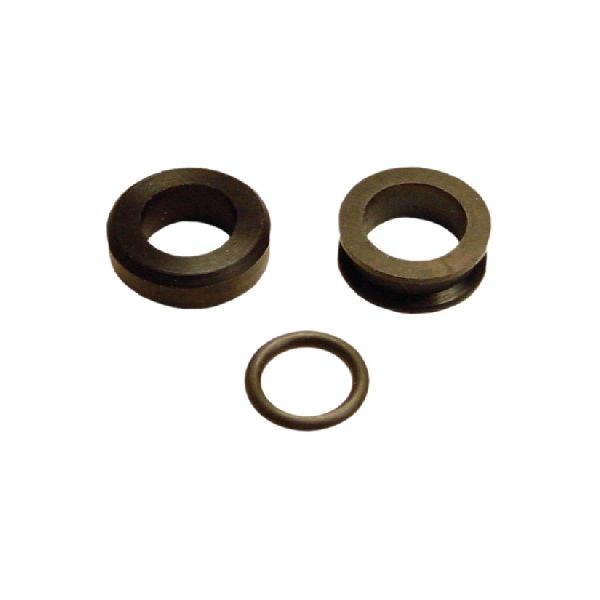
Est. part cost: $150-$250 - Leaking Fuel Injector(s) on Bank 2 🟡 Medium Probability → Shop Fuel Injector Injectors can develop internal leaks over time, dripping un-commanded fuel into the cylinders. This is less common than A/F sensor failure but is a significant possibility, especially on higher mileage vehicles.
How to confirm: Perform a fuel pressure leak-down test. After pressurizing the fuel rail, turn the engine off and watch the pressure gauge. If the pressure drops quickly, it may indicate a leaking injector. Another method is to remove the spark plugs from Bank 2 (cylinders 2, 4, 6) and inspect them; a plug from a cylinder with a leaking injector will be black, sooty, and may smell of raw fuel.
Typical fix: Replace the leaking fuel injector(s). It is often recommended to replace all three injectors on Bank 2 as a set to ensure balanced fuel delivery and prevent future failures of the other original injectors.
Est. part cost: $70-$150 per injector - Dirty or Faulty Mass Airflow (MAF) Sensor ⚪ Low Probability → Shop Fuel Injection Air Flow Meter If the MAF sensor is dirty (often from an over-oiled aftermarket air filter), it can under-report the amount of air entering the engine, causing the ECM to inject too much fuel system-wide.
How to confirm: A dirty MAF sensor will usually set codes for both banks (P0172 and P0175). Inspect the sensor element for dirt or debris. You can try cleaning it with a dedicated MAF sensor cleaner spray. If cleaning doesn't work, monitor the MAF reading on a scan tool to see if it's within the expected range for the given RPM.
Typical fix: Clean the MAF sensor with a specialized cleaner. If cleaning does not resolve the issue, the sensor must be replaced.
Est. part cost: $10 for cleaner, $80-$150 for a new sensor
Rare But Worth Checking
- High Fuel Pressure: A faulty fuel pressure regulator or a restriction in the fuel return line can cause system-wide high fuel pressure, forcing too much fuel through the injectors. This would typically affect both banks, but it's worth checking with a fuel pressure gauge if other causes are ruled out.
- Faulty Engine Coolant Temperature (ECT) Sensor: If the ECT sensor is stuck reading a very cold temperature, the ECM will enrich the fuel mixture, assuming the engine is in a cold-start state. This can be checked by comparing the ECT reading on a scan tool to the actual engine temperature after warmup.
Diagnosis Steps
- Connect an OBD-II scanner and confirm the P0175 code is present. Check for any other codes, especially P0172.
- View live data on the scanner. Focus on the Short-Term Fuel Trim (STFT) and Long-Term Fuel Trim (LTFT) for both Bank 1 and Bank 2. For P0175, you will see highly negative numbers for Bank 2 (e.g., -15% or lower) as the ECM tries to remove fuel.
- Compare the live data from the Bank 1 A/F sensor and the Bank 2 A/F sensor. If the Bank 2 sensor's readings are sluggish, stuck, or significantly different from Bank 1's under similar conditions, it is likely faulty.
- If the A/F sensor appears to be working, inspect the Mass Airflow (MAF) sensor. Check for dirt on the sensing wire. If dirty, clean it with dedicated MAF sensor cleaner.
- Perform a fuel pressure test. Connect a fuel pressure gauge to the fuel rail and verify the pressure is within the manufacturer's specifications (typically 44-50 psi for the 2GR-FE).
- Check for leaking fuel injectors on Bank 2. Perform a fuel pressure leak-down test or remove the spark plugs on Bank 2 (front bank) to look for signs of a rich condition (black, sooty deposits).
- Inspect the air intake system for any blockages and check the engine air filter to ensure it's not severely clogged.
- Check the Engine Coolant Temperature (ECT) sensor reading on your scan tool to ensure it is providing a plausible temperature reading after the engine has warmed up (typically 180-210°F).
Parts You'll Likely Need
- Air/Fuel Ratio Sensor (Bank 2, Sensor 1)
(OEM #89467-06070)— This is the primary sensor that measures the air-fuel mixture for Bank 2. It is the most common failure point for a single-bank rich code like P0175.
Trusted brands: Denso (OEM), Denso (Aftermarket, P/N 234-9056)
OEM price range: $180-$250
Aftermarket price range: $100-$160 - Fuel Injector
(OEM #23250-31050)— A leaking fuel injector will directly cause a rich condition in one or more cylinders of Bank 2.
Trusted brands: Denso, Aisan
OEM price range: $120-$180
Aftermarket price range: $50-$100 - Mass Airflow Sensor
(OEM #22204-31020)— A less common cause for a single-bank code, but a dirty or failing MAF sensor can cause rich conditions. It's more likely if P0172 is also present.
Trusted brands: Denso (OEM)
OEM price range: $120-$180
Aftermarket price range: $70-$120
Related Codes That Often Appear With This One
- P0172 — System Too Rich (Bank 1). If both P0172 and P0175 are present, it points to a problem common to both engine banks, such as a faulty MAF sensor, a fuel pressure issue, or a stuck open thermostat.
- P1604 — Startability Malfunction. As noted in manufacturer service bulletins such as TSB Bulletin #T-SB-0166-19, this code may appear alongside P0175 when a rich condition affects the engine's ability to start.
Technical Service Bulletins (TSBs) & Recalls
- T-SB-0034-14 / T-SB-0312-17: Pertains to torque converter shudder on 2012-2014 models, a common platform issue but unrelated to P0175.
- LSC 90K (Expired): A Limited Service Campaign to replace the problematic rubber/metal VVT-i oil line on early 2GR-FE engines.
- TSB Bulletin #T-SB-0166-19 / T-SB-0166-19_Rev: While specifically referencing the Tundra, these manufacturer bulletins note that a P0175 condition may be accompanied by negative fuel trims and a P1604 startability malfunction code.
Platform-Specific Known Issues
- Check VVT-i Oil Line Status: While not a direct cause of P0175, early 2GR-FE engines (approx. 2007-2010) had a faulty VVT-i oil line with a rubber section that can rupture, causing catastrophic oil loss. A massive oil leak could potentially foul sensors or cause other issues. It is prudent for any owner of an early model to visually inspect the oil line for Bank 1 (rear bank) and ensure it has been replaced with the updated all-metal version (P/N 15772-31030).
Mechanic-Grade Diagnostic Values
- Fuel Pressure at Idle — expected: 304 to 343 kPa (44 to 50 psi). Failure: Pressure significantly above 50 psi could indicate a faulty regulator, causing a rich condition. Pressure below 44 psi is not a cause for a rich code.
- Fuel Pressure Leak-Down — expected: Pressure should remain at 147 kPa (21 psi) or more for at least 5 minutes after the engine is stopped.. Failure: A rapid drop in pressure after the engine is off points to a leak in the system, most likely a leaking fuel injector or a faulty fuel pressure regulator.
- Fuel Injector Resistance — expected: 11.6 to 12.4 Ω at 20°C (68°F). Failure: Resistance outside this range indicates a faulty injector coil. While this test checks the electrical side, it does not confirm or rule out a mechanical leak.
- Air/Fuel Ratio Sensor Heater Resistance — expected: 1.8 to 3.4 Ω at 20°C (68°F) between terminals HA1A and +B.. Failure: Resistance outside this range indicates a failed heater element, which will cause the sensor to respond slowly and can lead to incorrect fuel trim adjustments.
- Air/Fuel Ratio Sensor Voltage (Key On, Engine Off) — expected: 3.0V on one signal wire (A1A-), 3.3V on the other (A1A+), when measured to ground.. Failure: Incorrect or missing reference voltage indicates a wiring problem or a fault in the Engine Control Module (ECM).
- Long Term Fuel Trim (LTFT) — expected: Ideally between -10% and +10%. Normal range is generally considered -20% to +20%.. Failure: For P0175, the LTFT for Bank 2 will be highly negative (e.g., -20% or more) as the ECM tries to remove fuel to compensate for the rich condition. Manufacturer TSB Bulletin #T-SB-0166-19 confirms that Techstream data analysis often reveals these negative fuel trims in rich-running conditions.
Scan Tool Commands That Help
- Toyota Techstream: Active Test: Control the Injection Mode — This test allows a technician to switch between port and direct injection (on later FKS engines) to isolate fueling issues. However, a TSB notes that on 2GR-FKS engines, improperly using this test can itself cause P0172/P0175 codes to be set. It may be necessary to reset fuel trim learning values after using this test.
- Toyota Techstream: Active Test: Fuel Pump Speed Control — Allows for testing the fuel pump's response to commands from the ECU. This can help diagnose if a fuel pressure issue is related to the pump or the pressure regulator.
- Toyota Techstream: Active Test: A/F Control — This function allows the technician to manually alter the fuel mixture (e.g., command +12% or -12% fuel) and observe the A/F and O2 sensor responses. This is a powerful way to confirm if the sensors are responding correctly to known changes in the air/fuel mixture.
Wiring & Ground Locations
- Engine Harness Grounds — The 2GR-FE engine harness has primary ground points on the cylinder heads. One is on the front head (Bank 2) underneath the throttle body area, and another is on the rear head (Bank 1) near the valve cover.. A poor ground connection for the engine harness can introduce electrical noise and voltage offsets, potentially causing inaccurate readings from the A/F sensors, ECT sensor, and MAF sensor, leading to incorrect fuel calculations.
- ECM A/F Sensor Pins (Bank 2) — At the ECM connector C55: Pin 120 (A2A+), Pin 119 (A2A-).. These are the specific pins at the main engine computer for the Bank 2 A/F sensor. A technician can test for continuity and voltage directly at these pins to rule out wiring harness breaks or shorts between the sensor and the ECM.
- Starter/Transmission Ground — A large ground cable runs from the top of the transmission bell housing to a point on the chassis near the driver-side motor mount.. While primarily for the starter, all engine grounds are critical. A loose or corroded main ground can cause a variety of unpredictable electrical issues, including faulty sensor readings, as the engine block itself is part of the ground path.
Real Owner Repair Stories
- ToyotaNation Forum (2007 Camry V6) — P0172 and P0175 codes (rich on both banks)
❌ Tried (didn't work) Cleaning the MAF sensor
✅ What actually fixed it The owner replaced both upstream Air/Fuel ratio sensors (Bank 1 and Bank 2), which resolved both rich codes simultaneously.
Model Year Variations Within This Range
- 2007-2011 (XV40) vs 2012-2017 (XV50): While both generations use the 2GR-FE engine, there can be minor differences in ECU calibration and wiring harness routing. However, for the P0175 code, the primary components (A/F sensors, injectors, MAF) and diagnostic procedures are functionally identical. A direct engine swap between these generations is not recommended without significant work due to differences in ECU programming and motor mount brackets.
Diagnostic Flowchart
Other Known Issues on This Vehicle
Issues unrelated to this code that are worth knowing about as an owner of this generation:
- VVT-i Oil Line Rupture 🔴 High — Affects earlier models (approx. 2007-2010) that came with a rubber/metal composite oil line for the rear bank's VVT-i actuator. The rubber portion can degrade and burst, causing rapid and catastrophic oil loss. (Ref: Toyota issued a Limited Service Campaign (LSC) which expired in 2013, to replace the original line with an all-metal part (P/N 15772-31030). Many vehicles may still have the old part.)
- Torque Converter Shudder (XV50) 🟠 Medium — Common on 2012-2014 models with the U760E 6-speed automatic transmission, typically appearing between 80,000-120,000 miles. It manifests as a vibration or 'rumble strip' feeling under light acceleration between 25-50 mph. (Ref: T-SB-0034-14 (superseded by T-SB-0312-17) addresses this by recommending replacing the torque converter and reprogramming the ECM. A fluid flush is sometimes attempted first.)
- Water Pump Failure 🟠 Medium — The water pump is a known failure point across the 2GR-FE engine family, often occurring after 100,000 miles. Leaks can be slow and hard to spot as they may drip into the engine valley before reaching the ground.
- Timing Chain Cover Oil Leak 🟡 Low — Some earlier 2GR-FE engines can develop oil leaks from the front timing chain cover sealant. It's typically a slow seep rather than a major leak but can be costly to repair due to the labor involved.
- Moonroof Drain Hose Leak (XV40) 🟡 Low — On earlier models (up to 2011), the moonroof drain hoses can become disconnected, causing water to leak into the headliner and footwells. (Ref: T-SB-0037-11 describes a procedure to add retainer clamps to the drain hoses to prevent this.)
Used vs. New Parts: Buying Guide for This Vehicle
When a used part is the smart pick: Used parts are generally not recommended for fixing a P0175 code, as the common causes are wear-and-tear items. A used fuel rail could be a cost-effective replacement if the original is damaged, but the injectors themselves should be new or professionally remanufactured. Structural components like engine covers or brackets are fine to source from a junkyard.
Donor-vehicle mileage cap: roughly under 80000 miles for the part to have meaningful remaining life.
What to inspect on the donor part:
- For any used part, check for obvious signs of damage, corrosion, or oil leaks from the donor vehicle.
- If considering used injectors, ask for them to be flow-tested and cleaned before purchase.
- Never buy used sensors like A/F or O2 sensors; their remaining lifespan is unknown and they are the most common failure point.
OEM-only on this vehicle (don't cheap out):
- Air/Fuel Ratio Sensor: While Denso is the OEM and their aftermarket version (234-9056) is identical, avoid other brands. The ECM is calibrated specifically for the Denso sensor's response curve, and off-brand sensors are a very common cause of persistent or new codes.
Aftermarket brands forum-validated for this vehicle:
- Denso (for A/F sensors, injectors, and MAF sensor)
- Aisan (OEM supplier for some fuel system components)
Brands owners have reported issues with on this vehicle:
- Unknown or generic 'white box' brands for any electronic sensor, especially A/F and MAF sensors. The cost savings are not worth the high probability of incorrect readings, poor performance, and the need to do the job twice.
Real Owner Stories
Aggregated from forums and TSBs cited above. Mileages and costs reflect what owners reported in those sources.
2007 Toyota Camry 3.5L V6 — ~120000 miles
Symptoms: Check Engine Light on with codes P0175 and P0172. Attempted to clean the MAF sensor but the issue persisted.
What fixed it: Replacing both upstream A/F sensors.
Source hint: ToyotaNation Forum - Thread: 'P0175 and P0172 on 2007 Camry V6'
2007 Toyota Camry 3.5L V6 — ~105000 miles
Symptoms: P0175 code present on the front bank of the engine.
What fixed it: Replacing the Bank 2 (front) A/F sensor.
Source hint: ToyotaNation Forum - Thread: '2007 Camry V6 P0175'
2007-2018 Lexus ES 350 (2GR-FE) — ~130000 miles
Symptoms: Vehicle running rich with both P0172 and P0175 codes triggered simultaneously.
What fixed it: Replacing the MAF sensor.
Source hint: ClubLexus Forum - Thread: 'P0172 and P0175 on my ES350'
Related OBD-II Codes
Frequently Asked Questions
Does the TSB for torque converter shudder (T-SB-0034-14) explain why my 2012 Camry has a P0175 code?
I have a 2008 Camry V6; is there a specific engine component I should inspect for safety while diagnosing P0175?
Where is the Bank 2, Sensor 1 A/F sensor located on my 3.5L V6 Camry?
Can I just clean the sensor to fix P0175 on my Camry?
Why is my Camry's ECM adding fuel if the code says the system is rich?
Is the VVT-i oil line replacement still covered for my 2009 Camry?
Helpful Videos
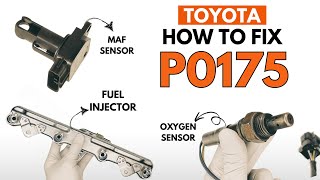

![How to Fix TOYOTA P0175 Engine Code in 3 Minutes [2 DIY Methods / Only $8.99]](https://img.youtube.com/vi/wX3se9lWBPo/mqdefault.jpg)
Used OEM Parts in Stock
New Aftermarket Parts Available


The information in this article is provided for general reference and educational purposes only. Vehicle specifications, procedures, and part compatibility can vary by production date, trim level, and region. Always consult your vehicle's factory service manual and verify part numbers before purchasing or performing repairs. Safety-critical components such as airbags, seat belts, and braking systems should be installed by a qualified professional.
- Toyota Camry:
- 🧭 Diagnostic Flowchart
- 🎬 Helpful Videos
- 🛍️ Shop This Part
- What's Unique About the 2007-2017 Toyota Camry
- Symptoms You May Notice
- Most Likely Causes
- Rare But Worth Checking
- Diagnosis Steps
- Parts You'll Likely Need
- Related Codes That Often Appear With This One
- Technical Service Bulletins (TSBs) & Recalls
- Platform-Specific Known Issues
- Mechanic-Grade Diagnostic Values
- Scan Tool Commands That Help
- Wiring & Ground Locations
- Real Owner Repair Stories
- Model Year Variations Within This Range
- Other Known Issues on This Vehicle
- Used vs. New Parts: Buying Guide for This Vehicle
- Real Owner Stories
- 2007 Toyota Camry 3.5L V6 — ~120000 miles
- 2007 Toyota Camry 3.5L V6 — ~105000 miles
- 2007-2018 Lexus ES 350 (2GR-FE) — ~130000 miles
- Related OBD-II Codes
- Frequently Asked Questions
- 🎟️ Get 5% Off