

P0192 on 2017-2024 Mazda CX-5 2.5L: High-Pressure Fuel Pump Failure Guide
On a 2017-2024 Mazda CX-5 with the 2.5L SKYACTIV-G engine, the P0192 code almost always indicates a failing high-pressure fuel pump (HPFP), not the fuel rail pressure sensor. This is a common issue for this platform, leading to severe drivability problems. Expect a repair cost of $800 to $1,800 at a shop.
- P0192 on a 2017-2024 CX-5 almost always means the high-pressure fuel pump (HPFP) has failed.
- Do not replace the fuel rail pressure sensor first; it is rarely the cause of the problem.
- Confirm the diagnosis by checking live fuel rail pressure with a scan tool. If the pressure is stuck low (around 60-70 PSI) and doesn't increase when you rev the engine, the HPFP is bad.
- This repair is complex due to the high-pressure fuel system and is best left to a professional.
- Always replace the single-use high-pressure fuel pipe when replacing the pump to prevent dangerous leaks.
What's Unique About the 2017-2024 Mazda CX-5
Mazda's SKYACTIV-G direct injection engines have a known weakness with the high-pressure fuel pump (HPFP), which is driven by the camshaft. While the code P0192 points to the sensor circuit, extensive owner and mechanic experience shows the pump itself is the culprit in the vast majority of cases. This issue was prevalent enough on earlier models that Mazda issued Technical Service Bulletin (TSB) 01-010/14, which identified that a manufacturing error in the HPFP's internal parts prevented it from generating the target fuel pressure. Though the TSB doesn't officially cover all 2017+ models, the failure pattern continues, making the HPFP the primary suspect whenever a P0192 code appears.
Generation note: The 2017-2024 Mazda CX-5 covers the second generation (KF). The high-pressure fuel pump issue is a known problem for this entire generation with the SKYACTIV-G 2.5L engine.
Symptoms You May Notice
- Check Engine Light is on
- Engine is hard to start or requires long cranking
- Stalling, especially under acceleration or at idle
- Severe lack of power and sluggish acceleration
- Inability to rev the engine past a certain RPM (e.g., 2000 RPM), with the tachometer needle bouncing
- Rough or unstable idle
- Engine misfires
- Replacing the Fuel Rail Pressure Sensor. Mechanics and owners unfamiliar with this specific Mazda issue may replace the sensor based on the code's definition, but this will not fix the underlying problem of a failed high-pressure fuel pump.
Most Likely Causes
- Failing High-Pressure Fuel Pump (HPFP) 🔴 High Probability → Shop Fuel Pump This is a well-documented weak point on SKYACTIV-G engines. The internal components of the pump can wear out, preventing it from generating the required high pressure. TSB 01-010/14 cited a manufacturing error as the cause for earlier models.
How to confirm: Use an OBD-II scan tool to monitor live fuel rail pressure data. With the engine running, the pressure should be several hundred PSI at idle and increase to over 2,000 PSI under load. If the pressure is stuck at a low value (typically 60-70 PSI, as reported by owners) and does not increase with RPM, the HPFP has failed.
Typical fix: Replace the high-pressure fuel pump, the pump's gasket/seal, and the single-use high-pressure fuel line that connects the pump to the fuel rail.
Est. part cost: $400-$800
Rare But Worth Checking
- Faulty Fuel Rail Pressure Sensor: → Shop Fuel Pressure Sensor While the code directly names the sensor, it is very rarely the actual cause of the problem on this vehicle. One forum user replaced the sensor first with no change in symptoms before correctly identifying the HPFP as the culprit. It should only be considered after the high-pressure fuel pump has been confirmed to be working correctly.
- Wiring Harness or Connector Issue: Damage to the wiring or a poor connection at the fuel rail pressure sensor or high-pressure fuel pump could cause this code. A visual inspection for chafed wires or corroded pins is a good preliminary step.
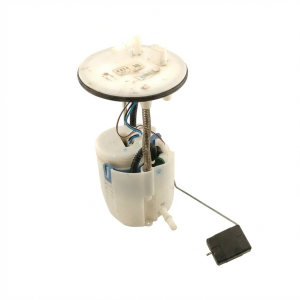
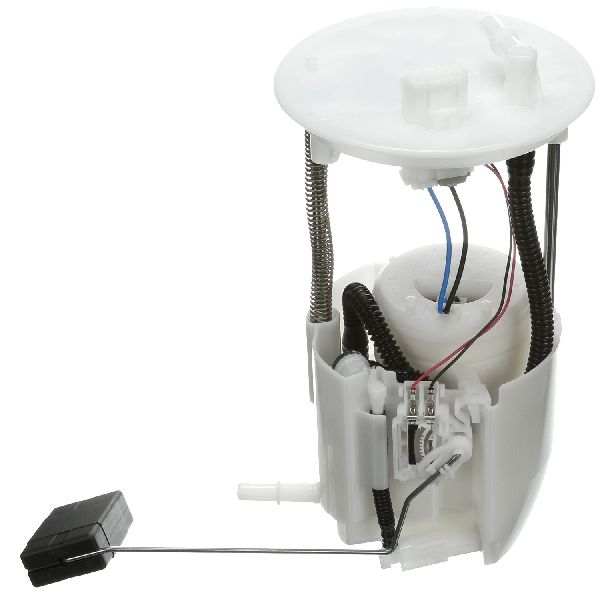
- Failing In-Tank Low-Pressure Fuel Pump: → Shop Fuel Pump A failing low-pressure pump can starve the high-pressure pump of fuel, leading to low rail pressure. However, this is much less common than the HPFP failing on its own. One owner reported symptoms that only appeared when the fuel tank was below 1/4 full, suggesting a low-pressure pump issue.
Diagnosis Steps
- Connect an OBD-II scanner and confirm the presence of the P0192 code. Check for any other related fuel system codes like P0087, P0191, or P0171.
- Access the live data stream on the scanner and monitor the "Fuel Rail Pressure" (FRP) PID.
- Start the engine. At idle, observe the fuel rail pressure. A healthy system will show several hundred PSI (e.g., ~300+ PSI).
- If the pressure is very low (e.g., 60-70 PSI), this indicates the high-pressure pump is not working and you are only seeing pressure from the in-tank (low-pressure) pump.
- Carefully increase the engine RPM while monitoring the fuel pressure. The pressure should rise significantly, often into the thousands of PSI. If it remains low and does not respond to engine speed, this strongly confirms a failed HPFP.
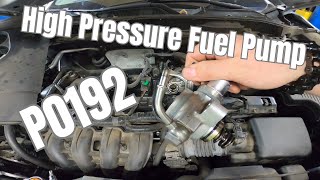
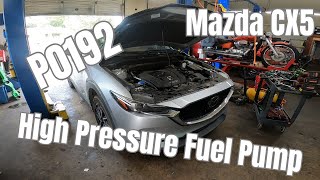
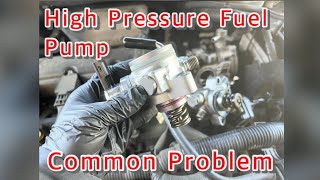
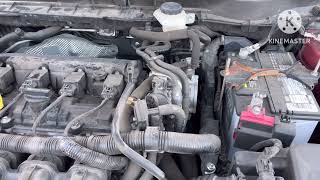
- If the fuel pressure readings are erratic or seem incorrect, perform a visual inspection of the wiring and connector for the fuel rail pressure sensor and the high-pressure fuel pump. 🎬 Watch: Step-by-step diagnostic guide for code P0192
- Before replacing any parts, relieve the fuel system pressure. This can be done by removing the fuel pump fuse or relay and running the engine until it stalls.
Parts You'll Likely Need
- High-Pressure Fuel Pump
(OEM #PE19-20-3F0 (supersedes PE18-20-3F0, PE01-20-3F0B, etc.))— This is the most common failure point for the P0192 code on the SKYACTIV-G 2.5L engine.
Trusted brands: Mazda (OEM), Bosch, Standard Motor Products (GDP510)
OEM price range: $600-$900
Aftermarket price range: $400-$700 - High-Pressure Fuel Pipe
(OEM #PE01-13-49Y)— This is considered a single-use, 'torque-to-yield' part by the manufacturer and should be replaced anytime it is removed to ensure a proper seal in the high-pressure system.
Trusted brands: Mazda (OEM)
OEM price range: $50-$80
Related Codes That Often Appear With This One
- P0087 — Stands for "Fuel Rail/System Pressure - Too Low." It often appears alongside P0192 because both codes indicate that the fuel pressure is below the commanded level, which is a direct result of the HPFP failing.
- P0191 — Stands for "Fuel Rail Pressure Sensor Circuit Range/Performance." This is another code that points to an issue with the fuel pressure reading not matching the expected value, again typically caused by a failing HPFP. TSB 01-010/14 explicitly covers both P0191 and P0192.
- P0171 — Stands for "System Too Lean (Bank 1)." This can accompany a fuel pressure code because the lack of fuel pressure prevents the injectors from delivering the correct amount of fuel, leading to a lean air/fuel mixture.
Technical Service Bulletins (TSBs) & Recalls
- 01-010/14: While for earlier models (2013-2014 CX-5), this TSB addresses the Check Engine Light on with DTC P0191 or P0192, identifying the cause as a faulty high-pressure fuel pump due to a manufacturing error and instructing technicians to replace it.
Platform-Specific Known Issues
- Real-World Repair Cost: A 2017 CX-5 owner in Ontario, Canada reported being quoted C$1,063 for the OEM HPFP part and C$525 for 3.5 hours of labor, for a total pre-tax cost of C$1,588. After a diagnostic fee, the final bill was C$1,700. This provides a concrete example of a dealership repair cost.
Mechanic-Grade Diagnostic Values
- Low-Pressure Fuel System (In-tank pump output) — expected: 55-71 PSI. Failure: Pressure below this range indicates a failing in-tank pump, which will starve the HPFP.
- High-Pressure Fuel System at Idle (Live Data) — expected: ~400-435 PSI (approx. 3.0 MPa). Failure: Pressure is stuck at the low-pressure pump's output (~60-70 PSI) and does not rise from there.
- High-Pressure Fuel System Under Load (Live Data) — expected: Up to ~3,000 PSI. Failure: Pressure fails to rise significantly from idle when revving or driving under load.
- Fuel Rail Pressure Sensor Signal Voltage (Key On, Engine Off) — expected: ~0.5V. Failure: Voltage is stuck high (near 5V) or low (near 0V).
- Fuel Rail Pressure Sensor Signal Voltage (Engine Idling) — expected: ~1.3V - 1.7V. Failure: Voltage is erratic or does not correspond to the expected ~435 PSI idle pressure.
- Fuel Rail Pressure Sensor Reference Voltage (at connector) — expected: Steady 5.0V. Failure: Voltage is significantly lower or higher, indicating a PCM or wiring issue.
- Fuel Rail Pressure Sensor Ground Circuit (at connector) — expected: Less than 500mV (0.5V). Failure: Higher voltage indicates a poor ground connection, which can skew sensor readings.
Wiring & Ground Locations
- Fuel Rail Pressure Sensor Connector — Located on the end of the high-pressure fuel rail on the engine.. This is the primary connection point for the sensor. It should be inspected for corrosion, damage, or loose pins, which can cause the P0192 circuit code.
- Engine Wiring Harness — Runs across the top and sides of the engine, connecting components to the PCM.. Mazda has been noted to use soy-based wiring insulation, which can attract rodents. A visual inspection for chew marks along the harness path is a worthwhile check if wiring issues are suspected.
Real Owner Repair Stories
- Reddit user r/mazda (2016 Mazda CX-5, 101,000 miles) — Sudden loss of power, rough idle then stalling, P0192 code. Live data showed fuel rail pressure stuck at 62-68 PSI.
❌ Tried (didn't work) Initial diagnosis was uncertain between sensor and pump.
✅ What actually fixed it Replaced the high-pressure fuel pump with a used unit from a low-mileage donor engine. This resolved all issues, with idle pressure returning to ~400 PSI and ~3000 PSI at wide-open throttle. - Mazdas247 Forum User (2016 Mazda CX-5 Grand Touring 2.5L) — P0192 and P0171 codes, engine would not accelerate past 2000 RPM. Live data showed fuel rail pressure at 69 PSI at idle.
❌ Tried (didn't work) Replaced the MAF sensor which cleared P0171 but not P0192.
✅ What actually fixed it Replaced the high-pressure fuel pump with a Standard Ignition GDP510. This cleared the P0192 code and restored normal operation, with idle pressure returning to around 300 PSI. - Mazda Forum User (cited in Go-Parts article) (2015 Mazda CX-5 2.5L) — P0192 code, stalling at idle, no power on acceleration.
❌ Tried (didn't work) Replaced the entire fuel rail with a new sensor.
✅ What actually fixed it The high-pressure fuel pump was the actual cause. After replacing the HPFP, all symptoms were resolved. - Reddit user r/mazda (2016 Mazda 6 Touring, 91,000 miles) — P0192 code, trouble with cold starts (sputtering and cutting off), limp mode with significant loss of power.
❌ Tried (didn't work) An independent shop diagnosed a bad fuel rail., A second mechanic could not source the sensor separately from the rail.
✅ What actually fixed it The Mazda dealership diagnosed and replaced the high-pressure fuel pump, which was covered under California's PZEV emissions warranty (15 years/150,000 miles). This fixed all symptoms. - NHTSA ODI #11518617 — An owner reported that while the dealer could not reproduce the problem, a P0192 code was stored in the ECU, leading to the replacement of the high-pressure fuel pump.
- NHTSA ODI #11534098 — A vehicle was diagnosed by an independent mechanic with a P0192 code and a faulty fuel pump. The owner noted the vehicle operated as designed after adding fuel.
Documented NHTSA Reports
- NHTSA ODI #11522704 — An owner reported a sudden loss of power while on the highway. The check engine light illuminated, and the vehicle entered a reduced power mode due to low fuel pressure, throwing a P0192 code.
- NHTSA ODI #11619748 — A deeper diagnostic at a dealership revealed a P0192 code after an owner experienced issues with a small amount of gas left in the tank.
OEM Part Supersession History
PE01-20-3F0B (and subsequent C, D, E, F revisions), PE18-20-3F0, PE18-20-3F0A→PE19-20-3F0— Likely internal improvements to address the known reliability issues.
Heads up: The latest part number, PE19-20-3F0, is the correct replacement for all previous versions for this application.
Model Year Variations Within This Range
- 2018-2024: For the 2018 model year, Mazda added cylinder deactivation to the naturally aspirated 2.5L SKYACTIV-G engine. The 2017 model does not have this feature. While not directly related to the P0192 fuel pump issue, some owners prefer the 2017 model to avoid potential complexities associated with cylinder deactivation.
- 2019-2024: Starting in 2019, a 2.5L turbocharged engine option was added to the CX-5 lineup. While it also uses a high-pressure direct injection system, some components may differ from the naturally aspirated version.
Diagnostic Flowchart
Other Known Issues on This Vehicle
Issues unrelated to this code that are worth knowing about as an owner of this generation:
- Infotainment 'Ghost Touch' and Malfunctions 🟠 Medium — Very common on 2017-2020 models. The screen may register phantom touches, change settings, or become unresponsive. (Ref: Mazda issued a warranty extension under Customer Service Program (CSP13) to address this.)
- Intake Valve Carbon Buildup 🟠 Medium — A known issue for all direct-injection engines. Becomes a potential problem after 60,000-80,000 miles, especially with frequent short trips. Can lead to misfires or a P0171 lean code.
- Cylinder Deactivation Malfunction 🔴 High — Affects 2018-2019 models. A software issue could cause the intake valve rocker arm to dislodge, leading to misfires, loss of power, or engine stall. (Ref: Recall issued for approximately 262,000 vehicles to update the powertrain control module software.)
- Premature Brake Wear 🟡 Low — Some owners report needing to replace brake pads and rotors earlier than expected, particularly the rear brakes.
Used vs. New Parts: Buying Guide for This Vehicle
When a used part is the smart pick: For the High-Pressure Fuel Pump (HPFP). Given the high cost of a new OEM pump ($600+), a verified low-mileage used pump from a reputable salvage yard can be a cost-effective alternative. One owner reported successfully fixing their vehicle with a pump from a donor engine.
Donor-vehicle mileage cap: roughly under 70000 miles for the part to have meaningful remaining life.
What to inspect on the donor part:
- Verify the donor vehicle's mileage.
- Inspect the part for any physical damage, heavy corrosion, or leaking.
- Ensure it comes from a vehicle that was not in a major front-end collision.
- Purchase from a seller with a warranty or return policy.
OEM-only on this vehicle (don't cheap out):
- High-Pressure Fuel Pipe. This is a one-time-use, torque-to-yield part and must be replaced with a new OEM part whenever the HPFP is serviced to prevent dangerous high-pressure leaks.
Aftermarket brands forum-validated for this vehicle:
- Standard Motor Products (specifically part GDP510, cited in a successful repair).
- Bosch (often the original equipment manufacturer for these types of components).
Real Owner Stories
Aggregated from forums and TSBs cited above. Mileages and costs reflect what owners reported in those sources.
2017 CX-5 Touring — 54000 miles
Symptoms: Felt the car crank while on the highway, could not accelerate more, and the engine light turned on. Also mentioned having difficulty in accelerating even after clearing the code.
What fixed it: The dealership confirmed the fuel pump was failing and replaced it under an extended powertrain warranty.
Source hint: Reddit (r/CX5) - Thread: '2017 CX-5 Touring with 54k miles - P0192 fuel pump issue?' (2022)
2017 Mazda CX-5 — ~60894 miles
Symptoms: The engine was hard to start and sluggish under load, though it could hold an idle. Live data showed fuel rail pressure was stuck exactly at 62 psi and would not move when revving.
What fixed it: Replacement of the high pressure fuel pump.
Source hint: Reddit (r/CX5) - Thread: 'Hey everyone, I'm chasing a P0192 (Fuel Rail Pressure Sensor Circuit Low) on my wife's 2017 Mazda CX-5.'
2017 Mazda CX-5 — ~60894 miles
Symptoms: Owner reported a failed HPFP and provided a detailed cost breakdown from a Mazda dealership.
What fixed it: High Pressure Fuel Pump replacement.
Cost: $1,200-$1,300
Source hint: Mazda Forum - Thread: '2017 Mazda CX5 - Error Code P0192 - High Pressure Fuel Pump replacement' (Oct 23, 2023)
2016 Mazda CX-5 — ~85000 miles
Symptoms: Fuel rail pressure was stuck at 69 PSI at idle and only reached 136 PSI when accelerating. Normal operation requires ~300 PSI at idle.
What fixed it: Replacing the HPFP (Standard Ignition GDP510) resolved the code and restored normal operation.
Source hint: Mazdas247 - Thread: 'High pressure fuel pump or pressure sensor issue? 2017 CX-5' (Jun 19, 2024)
Related OBD-II Codes
Frequently Asked Questions
Does TSB 01-010/14 apply to my 2017-2024 Mazda CX-5?
My 2017 CX-5 is stalling and showing P0192; is this covered under warranty?
What fuel pressure should I see on my scan tool for a healthy SKYACTIV-G 2.5L?
Can I just replace the fuel rail pressure sensor to fix P0192?
Are there other common issues on the 2017-2024 CX-5 I should watch for while fixing this?
Is there a specific part I must replace along with the high-pressure fuel pump?
Helpful Videos
Used OEM Parts in Stock
New Aftermarket Parts Available

The information in this article is provided for general reference and educational purposes only. Vehicle specifications, procedures, and part compatibility can vary by production date, trim level, and region. Always consult your vehicle's factory service manual and verify part numbers before purchasing or performing repairs. Safety-critical components such as airbags, seat belts, and braking systems should be installed by a qualified professional.
- Mazda CX-5:
- 🧭 Diagnostic Flowchart
- 🎬 Helpful Videos
- 🛍️ Shop This Part
- What's Unique About the 2017-2024 Mazda CX-5
- Symptoms You May Notice
- Most Likely Causes
- Rare But Worth Checking
- Diagnosis Steps
- Parts You'll Likely Need
- Related Codes That Often Appear With This One
- Technical Service Bulletins (TSBs) & Recalls
- Platform-Specific Known Issues
- Mechanic-Grade Diagnostic Values
- Wiring & Ground Locations
- Real Owner Repair Stories
- Documented NHTSA Reports
- OEM Part Supersession History
- Model Year Variations Within This Range
- Other Known Issues on This Vehicle
- Used vs. New Parts: Buying Guide for This Vehicle
- Real Owner Stories
- 2017 CX-5 Touring — 54000 miles
- 2017 Mazda CX-5 — ~60894 miles
- 2017 Mazda CX-5 — ~60894 miles
- 2016 Mazda CX-5 — ~85000 miles
- Related OBD-II Codes
- Frequently Asked Questions
- 🎟️ Get 5% Off