

P0217 on 2011-2024 Dodge Durango 3.6L: Engine Overheat Causes and Fixes
P0217 means your Durango's engine is dangerously overheating. Stop driving immediately. The most common causes are a failed thermostat, a bad water pump, or a coolant leak from the oil filter/cooler housing. Expect repair costs from $200 to over $1,000 depending on the failed part.
- P0217 is a critical code meaning your engine is overheating. Stop driving immediately to prevent severe damage.
- The most likely causes on a 3.6L Durango are a failed thermostat, a bad water pump, or a leaking oil cooler housing.
- Do not assume the problem is a simple sensor; P0217 almost always indicates a genuine and dangerous overheating condition.
- Diagnosis should involve checking coolant level, fan operation, and performing a pressure test to find the root cause.
- After any cooling system repair, it is absolutely essential to properly bleed the air out of the system to ensure it functions correctly.
What's Unique About the 2011-2024 Dodge Durango
The 3.6L Pentastar V6, while generally reliable, is known for specific cooling system weaknesses that can lead to a P0217 code. The plastic thermostat housing and the oil filter/cooler housing assembly are common failure points, prone to cracking and leaking over time due to heat exposure and material degradation. Additionally, water pump failures are a known issue, sometimes with the impeller separating from the shaft internally on earlier models (2011-2013), causing an overheat with no visible leak. While overheating can happen to any engine, on the Durango, these specific components are often the first place to look for the cause of the problem.
Generation note: The 2011-2024 Dodge Durango is part of the third generation (WD). While the core engine and cooling system design are similar across these years, earlier models (approx. 2011-2013) were more susceptible to a left cylinder head issue that could cause overheating in severe cases. Later models have seen TSBs related to correctly diagnosing coolant leaks, suggesting a focus on ensuring parts like the water pump aren't replaced unnecessarily when the thermostat housing is the real culprit. The oil cooler housing has also been through several part revisions to improve durability.
Symptoms You May Notice
- Temperature gauge reading in the red or 'HOT'
- Check Engine Light or a dedicated engine temperature warning light is on
- Reduced engine power or 'limp mode' activation
- Steam coming from under the hood
- A sweet smell of coolant around the vehicle
- Audible chimes or warnings from the dashboard
- Coolant boiling in the overflow reservoir
- Replacing the Engine Coolant Temperature (ECT) sensor first. While a faulty sensor can cause incorrect readings, P0217 is usually triggered by a genuine overheat condition, not a false sensor reading. A bad sensor is more likely to set codes like P0117 or P0118.
- Replacing the water pump when the leak is actually from the thermostat housing or oil cooler housing. Coolant can travel down the front of the engine or drip from the bellhousing, making it appear as if the pump or rear main seal is leaking.
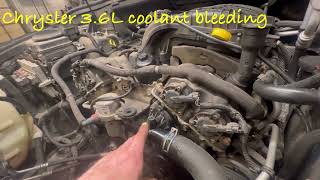
- Refilling coolant without bleeding the system. Air pockets trapped in the system, especially near the thermostat, will cause immediate and repeated overheating. The bleeder screw on the thermostat housing must be used.
Most Likely Causes
- Failed Engine Coolant Thermostat 🔴 High Probability → Shop Integrated Thermostat Housing Assembly The thermostat assembly on the Pentastar engine is made of plastic and is a very common failure item. It can stick closed, preventing coolant from circulating to the radiator. The plastic can become brittle and crack over time.
How to confirm: After the engine has warmed up, feel the upper and lower radiator hoses. If the upper hose is hot and the lower hose is cool or lukewarm, the thermostat is likely stuck closed. A scan tool can also monitor ECT sensor data to see if the temperature rises but never stabilizes, indicating a lack of circulation.
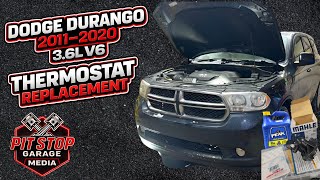
Typical fix: Replace the entire thermostat and housing assembly. 🎬 Watch: Step-by-step thermostat replacement for the 3.6L V6 engine. It is highly recommended to use an OEM Mopar part, as it often includes a new ECT sensor. The system must be properly bled of air after replacement using the bleeder screw on the housing.
Est. part cost: $50-$110 - Failing Water Pump 🔴 High Probability → Shop Engine Water Pump Water pump failures are a documented common problem on the 3.6L Pentastar engine, leading to loss of coolant circulation. Early models were known for internal plastic impeller failure, while later models more commonly suffer from bearing or seal failure.
How to confirm: Listen for a whining or grinding noise from the front passenger side of the engine that changes with RPM. Check for coolant leaks from the pump's weep hole. A cooling system pressure test can confirm a leak. If there is no leak but the engine overheats, the impeller may have failed internally.
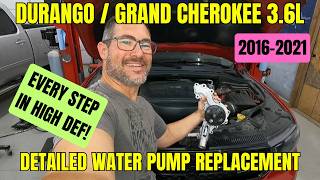
Typical fix: Replace the water pump and serpentine belt. 🎬 See every step of the water pump replacement process here. It's wise to inspect the thermostat at the same time. The cooling system must be refilled with the correct Mopar OAT coolant (MS-12106) and bled of air.
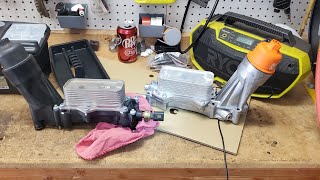
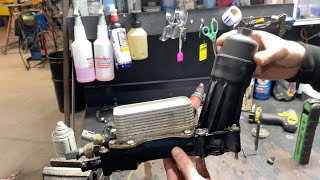
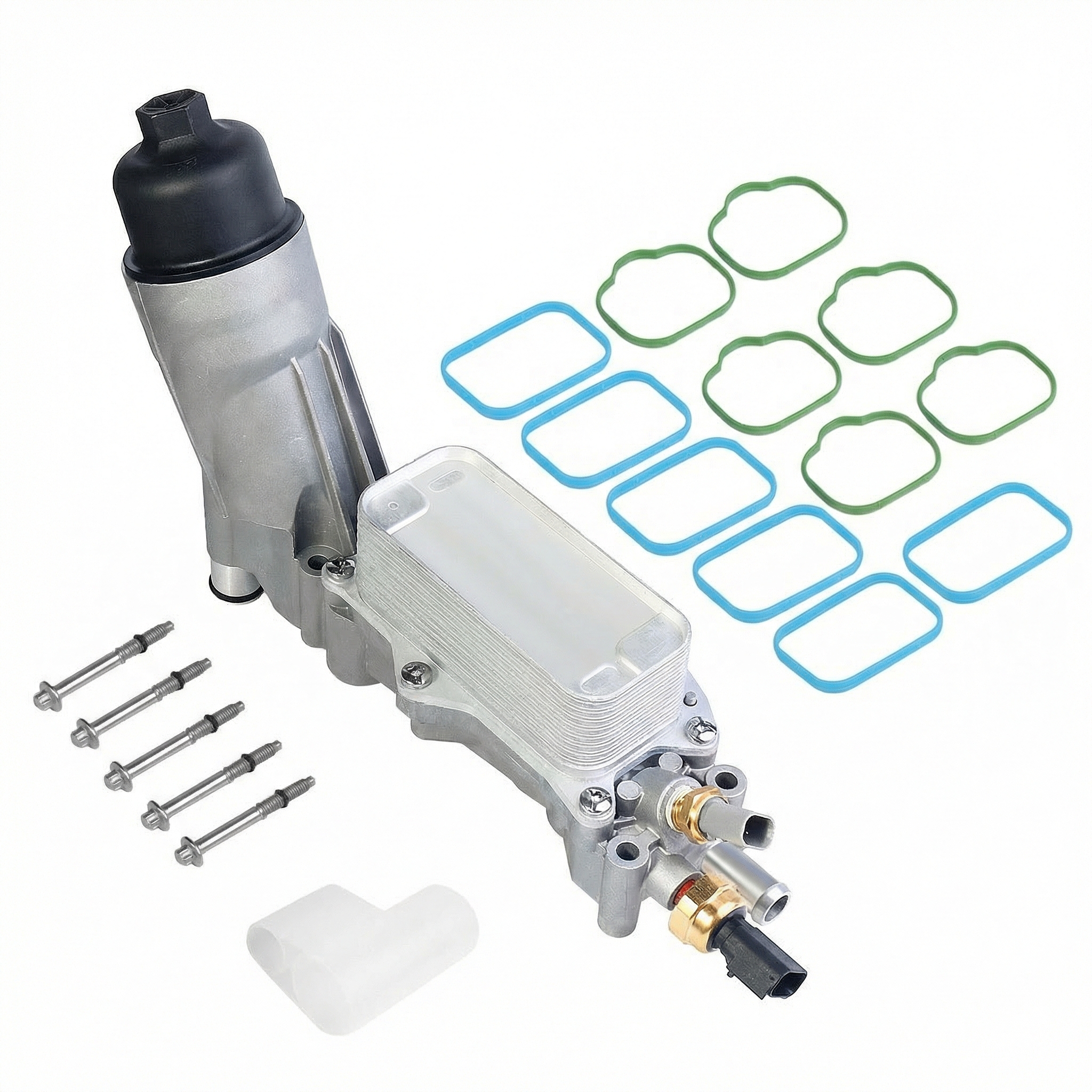
Est. part cost: $100-$250 - Leaking Oil Filter / Cooler Housing 🟡 Medium Probability This plastic housing, located in the valley of the engine, is notorious for becoming brittle and cracking, causing significant coolant and/or oil leaks. A major coolant leak will quickly lead to overheating and can trigger a P0217 code. This part has been redesigned multiple times to improve durability.
How to confirm: Look for coolant (pink/purple) or oil pooling in the engine valley, underneath the intake manifold. A cooling system pressure test will make the leak more apparent. The leak often runs down the back of the engine and drips off the transmission bell housing, sometimes being misdiagnosed as a rear main seal leak.
Typical fix: Replace the entire oil filter/cooler housing assembly. This is a labor-intensive job as the upper and lower intake manifolds must be removed. Some owners opt for an aftermarket aluminum housing for better durability. 🎬 Watch: How to replace the oil housing and cooler assembly.
Est. part cost: $150-$300 - Malfunctioning Electric Cooling Fan 🟡 Medium Probability → Shop Engine Cooling Fan Blade
How to confirm: With the engine getting hot (or by turning on the A/C), verify if the cooling fan assembly is running. If not, check the fan fuses and relays in the underhood fuse box (TIPM). For a 2012 model, a 40A fuse in the PDC is for the fan. If fuses are good, test for power at the fan connector with a multimeter.
Typical fix: If fuses and relays are good but the fan has power and doesn't run, the fan motor/assembly needs to be replaced. If the relay is suspect, it can be swapped with a known good relay (like the horn relay) for testing.
Est. part cost: $200-$450 - Low Engine Coolant Level ⚪ Low Probability
How to confirm: Visually check the coolant level in the overflow reservoir when the engine is cold. If it's low, there is a leak somewhere in the system that must be found and repaired. Do not assume it's a minor issue.
Typical fix: Perform a cooling system pressure test to locate the leak. Common leak sources include the radiator, hoses, thermostat housing, water pump, or oil cooler housing. Repair the leak and refill/bleed the system with the correct OAT coolant.
Est. part cost: $10-$500+
Rare But Worth Checking
- Blown Head Gasket or Cracked Cylinder Head: While rare, this is a catastrophic failure. Early (2011-2013) Pentastar engines had a known cylinder head issue that could lead to misfires and, in severe cases, overheating. A 'block test' (combustion leak test) can detect exhaust gases in the coolant, which confirms a head gasket failure. This is a very expensive repair.
- Clogged Radiator: → Shop Radiator Internal blockages from sludge (often from mixing incorrect coolant types) or external blockages from debris can restrict coolant and airflow, reducing cooling efficiency. This is more common on high-mileage vehicles or those with poorly maintained cooling systems.
Diagnosis Steps
- DO NOT open the radiator cap when the engine is hot.
- Visually inspect the coolant level in the overflow tank (when cold). If low, a leak is present.
- Check for obvious signs of coolant leaks on the ground under the vehicle.
- With the engine running and A/C on, verify the electric cooling fan is operating. If not, check fuses and relays.
- If the fan works and coolant is full, let the engine warm up. Carefully feel the upper and lower radiator hoses. If the upper is hot and the lower is cool, the thermostat is likely stuck closed.
- If you hear a grinding/whining noise from the passenger side of the engine, suspect the water pump.
- If the above steps are inconclusive, perform a cooling system pressure test to identify any hidden leaks. Pay close attention to the thermostat housing, water pump, and the valley of the engine for the oil cooler housing.
- If no external leaks are found and the thermostat is confirmed to be opening, perform a combustion leak test ('block test') to check for a failed head gasket.
- After any repair, properly bleed all air from the cooling system using the bleeder screw on the thermostat housing to prevent air pockets and future
Parts You'll Likely Need
- Engine Coolant Thermostat Housing Assembly
(OEM #5184651AJ)— This is one of the most common failure points causing overheating on the 3.6L Pentastar. It is often the cause of a P0217 and is best replaced as a complete assembly. This part number supersedes several previous versions (5184651AF, AG, AH, AI). - Engine Oil Cooler / Filter Housing Assembly
(OEM #68105583AF (example, part number varies by year))— A notorious source of both oil and coolant leaks that can lead to overheating. If coolant is found in the engine valley, this part has likely failed. - Water Pump
(OEM #68667064AA (example, part number varies by year))— A common failure item that stops coolant circulation, causing a rapid overheat. Often replaced alongside the thermostat. - Mopar OAT Coolant (10 Year/150,000 Mile)
(OEM #68163848AB (concentrate), 68163849AB (50/50 pre-mixed))— The correct coolant must be used. Mixing coolant types can cause gelling and clog the radiator and heater core.
Related Codes That Often Appear With This One
- P0480 — This code indicates a fault in the cooling fan control circuit. Seeing it with P0217 strongly points to a malfunctioning cooling fan as the cause of the overheat.
- P0128 — This code means 'Coolant Temperature Below Thermostat Regulating Temperature.' It's extremely common on this engine and indicates a thermostat stuck open. Seeing a history of this code before a P0217 event could suggest an intermittently failing thermostat that has now failed by sticking closed.
- P2181 — This code for 'Cooling System Performance' indicates that the engine is not reaching operating temperature correctly. It often points to a faulty thermostat or ECT sensor and can be a precursor to a more severe P0217 event if the thermostat fails completely.
Technical Service Bulletins (TSBs) & Recalls
- TSB 07-003-14: This TSB, later superseded by Customer Satisfaction Notification (CSN) P49, addresses cooling system issues on 2011-2013 models but does not provide public-facing repair details.
- TSB 18-034-14: While for code P0520, this TSB acknowledges the high failure rate of sensors located in the hot engine valley, which is relevant context for parts in that area.
Platform-Specific Known Issues
- Oil Cooler Housing Leaks Misdiagnosed: A significant coolant or oil leak from the oil cooler housing in the engine valley often drips down the back of the engine over the transmission bell housing. This is frequently misdiagnosed by shops as a leaking rear main seal, leading to an expensive and incorrect repair.
- Internal Water Pump Failure: → Shop Engine Water Pump On earlier Pentastar models (approx. 2011-2013), it's possible for the water pump's plastic impeller to separate from the metal shaft. This causes a complete loss of coolant circulation and a severe overheat (P0217) without any visible external coolant leak, making it difficult to diagnose without checking for coolant flow.
Mechanic-Grade Diagnostic Values
- Engine Coolant Temperature (ECT) Sensor Resistance — expected: Approximately 2200-2800 Ohms at 68°F (20°C) and 270-380 Ohms at 176°F (80°C).. Failure: An infinite reading (open circuit) or near-zero reading (short circuit) indicates a failed sensor.
- ECT Sensor Signal Voltage (Key On, Engine Off, Cold) — expected: Approximately 2.0V to 3.0V at 68°F (20°C).. Failure: A reading of 0V suggests a short to ground, while a constant 5.0V indicates an open circuit in the sensor or wiring.
- Cooling Fan Connector Voltage — expected: Approximately 12V at the power and ground pins when the fan is commanded on (e.g., by turning on the A/C).. Failure: No voltage at the main power wire indicates a problem with the fuse, relay, or TIPM. Voltage present but the fan not running points to a failed fan motor.
Scan Tool Commands That Help
- wiTECH (or equivalent professional scan tool): Radiator Fan Control / Actuator Test — This bidirectional command allows a technician to manually turn the cooling fan on at low and high speeds, bypassing the temperature sensors. It is the definitive way to test if the fan motor, relays, and wiring are functional. If the fan runs with the scan tool but not when the engine gets hot, the problem is likely the ECT sensor or PCM logic.
Wiring & Ground Locations
- G906A — At the right front of the engine compartment.. This is a primary chassis and engine ground. A poor connection here can cause erratic behavior in the PCM and cooling fan module, leading to intermittent fan operation or incorrect sensor readings.
- G905A — On the lower right side of the engine compartment, sometimes near the battery or in the driver's side footwell area.. This is a key ground point for the PCM and various sensor circuits. A corroded or loose G905A can cause a floating ground, leading to incorrect ECT sensor readings and potentially triggering false overheat codes or preventing the fan from activating correctly.
- ECT Sensor Connector — On the thermostat housing assembly, located in the valley at the front of the engine.. This is the primary connection point for testing the ECT sensor's resistance and voltage. Corrosion or a damaged pin in this connector can cause an open or shorted circuit, leading to incorrect temperature readings sent to the PCM.
- Cooling Fan Module Connector — On the radiator cooling fan assembly, typically at the right rear of the radiator.. This connector contains the main power, ground, and control signal wires for the fan. Testing for voltage and ground at this connector is the final step before condemning a failed fan motor.
Real Owner Repair Stories
- Reddit user in r/MechanicAdvice (2014 Jeep Grand Cherokee 3.6L (shared platform)) — Engine running hot (temperature gauge at 75%) with fan kicking on high after aggressive driving.
❌ Tried (didn't work) Replaced oil filter housing, Replaced radiator, Replaced thermostat, Performed a coolant flush
✅ What actually fixed it The final suspected part, though not explicitly confirmed as the fix in the thread, was the water pump, as it was the only major cooling component not yet replaced after the overheating persisted.
OEM Part Supersession History
68105583AA (and subsequent revisions AB, AC, AD, AE, AF, AG, AH, AI)→68596317AB (latest known Mopar P/N)— The original plastic oil filter/cooler housings were extremely prone to cracking and warping from heat, causing major oil and coolant leaks. The numerous revisions represent attempts by Mopar to improve the plastic composition and gasket design.
Heads up: A significant design change occurred for the 2014 model year. While a 2014+ housing can be retrofitted to a 2011-2013 engine, you MUST use the 2014+ style oil filter (e.g., Mopar MO-349) for all future oil changes.
Model Year Variations Within This Range
- 2011-2013: These earlier models use a different oil filter housing and oil filter cartridge design than 2014+ models. They were also more susceptible to the left cylinder head failure and potential issues with casting sand contamination in the cooling system.
- 2014+: Features a redesigned, slightly taller oil filter/cooler housing assembly that uses a different oil filter. While the housing is considered an upgrade and can be retrofitted to earlier models, the correct (2014+) filter must be used thereafter.
Diagnostic Flowchart
Other Known Issues on This Vehicle
Issues unrelated to this code that are worth knowing about as an owner of this generation:
- Rocker Arm / Lifter Failure ('Pentastar Tick') 🔴 High — Common across all years, particularly noted in 2011-2016 models. Often presents as a distinct ticking noise from the upper engine, which can lead to misfires and camshaft damage. (Ref: Subject of multiple class-action lawsuits.)
- Cracked Oil Filter / Cooler Housing 🔴 High — Extremely common, often between 60,000 and 120,000 miles. The plastic housing cracks, causing major oil and/or coolant leaks into the engine valley.
- Totally Integrated Power Module (TIPM) Failure 🔴 High — Most prevalent on 2011-2013 models. Can cause a wide range of bizarre electrical issues, including no-starts, stalling, fuel pump staying on, and accessories acting erratically. (Ref: Subject of recalls and class-action lawsuits for some models/years.)
- Left Cylinder Head Failure (2011-2013) 🔴 High — Affected early production Pentastar engines, causing misfires (commonly P0302, P0304, P0306) and requiring cylinder head replacement. (Ref: Covered under an extended warranty (X56) by Chrysler for 10 years/150,000 miles.)
- MAP Sensor Failure 🟡 Low — Very common failure item causing code P0106, rough idle, and poor fuel economy. Oil contamination from the PCV system often fouls the sensor.
Used vs. New Parts: Buying Guide for This Vehicle
When a used part is the smart pick: A used cooling fan assembly from a reputable salvage yard can be a cost-effective option, provided it's from a lower-mileage, accident-free vehicle. Other major components like the radiator can also be considered if they pass a pressure test and show no signs of corrosion or sludge.
Donor-vehicle mileage cap: roughly under 80000 miles for the part to have meaningful remaining life.
What to inspect on the donor part:
- For a cooling fan, check for any cracks in the shroud or damage to the fan blades. Spin the blades by hand to ensure the motor isn't seized.
- For a radiator, inspect the fins for excessive damage or corrosion. Look inside the inlet/outlet ports for signs of heavy scale, sludge, or oily residue.
- Verify the donor vehicle's mileage and check its history for front-end collisions.
OEM-only on this vehicle (don't cheap out):
- Engine Coolant Temperature (ECT) Sensor: The Pentastar PCM can be sensitive to voltage variations from aftermarket sensors, potentially causing incorrect readings. An OEM Mopar sensor (P/N 5149077AB) is the safest bet.
- Thermostat: Given the critical role and high failure rate, an OEM Mopar thermostat and housing assembly is strongly recommended to ensure the correct opening temperature and longevity.
Aftermarket brands forum-validated for this vehicle:
- Oil Filter/Cooler Housing: Dorman (P/N 926-959) offers a popular all-aluminum upgrade that eliminates the cracking issue of the OEM plastic part. Many owners and shops consider this a permanent fix.
- Water Pump: Gates and ACDelco are reputable aftermarket brands for water pumps. Some specialty brands like RIPP Modifications offer heavy-duty versions for higher performance applications.
Brands owners have reported issues with on this vehicle:
- Unnamed/"White Box" Oil Cooler Housings: Be wary of cheap, unbranded aluminum oil cooler housings found on sites like Amazon or eBay. Forum users have reported poor casting quality, rough gasket surfaces, and premature seal failure.
- Cheap Plastic Replacement Parts: Avoid the lowest-cost plastic replacement thermostat housings and oil cooler assemblies, as they are likely to fail again quickly due to inferior materials.
Real Owner Stories
Aggregated from forums and TSBs cited above. Mileages and costs reflect what owners reported in those sources.
2011 Dodge Durango 3.6L V6
Symptoms: The vehicle overheated due to a ruptured oil cooler housing. The owner continued to drive it while hot.
What fixed it: Because the vehicle was driven while overheating, the repair required head gasket work (confirmed with a block tester) in addition to replacing the oil cooler housing.
Source hint: YouTube - Busted Oil Cooler caused Dodge Durango to Over Heat
2011-2024 Dodge Durango 3.6L V6 — 108000 miles
Symptoms: Repeat failure of the oil filter/cooler housing; the second unit lasted 108,000 miles before leaking again.
What fixed it: Replacement of the oil filter/cooler housing assembly; some users in the discussion suggest upgrading to an aluminum version.
Source hint: BobIsTheOilGuy - Durango oil filter/cooler housing leaking again :-(
Related OBD-II Codes
Frequently Asked Questions
Is there a TSB for cooling system issues on my 2011-2013 Dodge Durango?
Why is my Durango leaking coolant from the back of the engine near the transmission?
Should I use a specific type of coolant for my 3.6L Pentastar engine?
Can I replace just the thermostat, or do I need the whole housing?
My 2012 Durango is overheating but I don't see any leaks. What could it be?
Is there an upgrade for the plastic oil cooler housing that keeps failing?
Helpful Videos
Used OEM Parts in Stock

New Aftermarket Parts Available


The information in this article is provided for general reference and educational purposes only. Vehicle specifications, procedures, and part compatibility can vary by production date, trim level, and region. Always consult your vehicle's factory service manual and verify part numbers before purchasing or performing repairs. Safety-critical components such as airbags, seat belts, and braking systems should be installed by a qualified professional.
- Dodge Durango:
- 🧭 Diagnostic Flowchart
- 🎬 Helpful Videos
- 🛍️ Shop This Part
- What's Unique About the 2011-2024 Dodge Durango
- Symptoms You May Notice
- Most Likely Causes
- Rare But Worth Checking
- Diagnosis Steps
- Parts You'll Likely Need
- Related Codes That Often Appear With This One
- Technical Service Bulletins (TSBs) & Recalls
- Platform-Specific Known Issues
- Mechanic-Grade Diagnostic Values
- Scan Tool Commands That Help
- Wiring & Ground Locations
- Real Owner Repair Stories
- OEM Part Supersession History
- Model Year Variations Within This Range
- Other Known Issues on This Vehicle
- Used vs. New Parts: Buying Guide for This Vehicle
- Real Owner Stories
- 2011 Dodge Durango 3.6L V6
- 2011-2024 Dodge Durango 3.6L V6 — 108000 miles
- Related OBD-II Codes
- Frequently Asked Questions
- 🎟️ Get 5% Off