

P0222 on 2005-2013 Chevrolet Corvette: Throttle Position Sensor Causes and Fixes
On a C6 Corvette, code P0222 almost always points to a wiring issue at the throttle body or a failed throttle body assembly. This triggers 'Reduced Engine Power' mode. Check the connector and harness first before replacing the throttle body.
- P0222 on a C6 Corvette means the computer is seeing a critically low voltage from the secondary throttle position sensor.
- This will immediately put the car into 'Reduced Engine Power' mode, making it unsafe to drive normally.
- Before buying parts, ALWAYS inspect the wiring harness and connector at the throttle body first. A loose connection or chafed wire is a very common cause.
- If the wiring is good, the next step is to replace the entire throttle body assembly, as the sensor is not sold separately.
- Ensure your battery is healthy and connections are tight, as low system voltage can cause this fault.
What's Unique About the 2005-2013 Chevrolet Corvette
The 2005-2013 C6 Corvette's electronic throttle control system is generally reliable, but sensitive to electrical issues. The most common trigger for P0222 isn't necessarily a 'bad part' but often a poor connection or chafed wire in the harness leading to the throttle body. Wires can break internally within the first 1 to 4 inches of the throttle body connector due to engine vibration and heat cycles. Because the TPS sensors are integrated into the throttle body and not sold separately, a sensor failure requires replacing the entire unit. Owners often find this code appears intermittently at first, sometimes triggered by bumps in the road, which points strongly to a wiring fault rather than a completely failed component.
Symptoms You May Notice
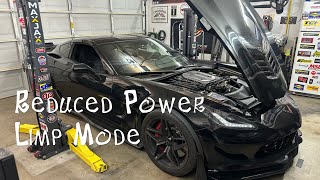
- "Reduced Engine Power" message on the driver information center 🎬 Watch: How to fix a Corvette in reduced power limp mode(DIC)
- Check Engine Light is illuminated
- "Service Active Handling" or "Service Traction Control" messages may also appear
- Drastic loss of power and acceleration (limp mode)
- Poor or non-responsive throttle
- Rough or unstable idle
- Hesitation or stumbling on acceleration
- Replacing the accelerator pedal assembly. While the pedal has its own sensors (APP sensors), P0222 specifically points to the 'B' circuit of the Throttle Position Sensor (TPS) on the throttle body. While pedal failure can cause similar symptoms, it usually sets different codes (e.g., P2138).
Most Likely Causes
- Throttle Body Wiring Harness or Connector Issue 🔴 High Probability → Shop Fuel Injection Throttle Body The engine harness can rub against brackets or become brittle from heat cycles, leading to chafed wires. More commonly, the wires break internally near the connector from vibration, or the connector pins suffer from fretting corrosion, causing an intermittent low voltage signal. This is a known issue across many GM platforms from this era.
How to confirm: With the key on, engine off, gently wiggle the wiring harness at the back of the throttle body connector. If this triggers the code, causes a change in sensor voltage on a scan tool, or makes the engine stumble, you've found the problem area. Visually inspect the harness for any signs of damage. A more thorough test involves checking for broken wires inside the insulation by gently tugging on each individual wire at the connector. Check the connector for corrosion or backed-out pins.
Typical fix: Repair the damaged section of wire. If the connector is the issue, clean the pins with electrical contact cleaner and apply a small amount of dielectric grease before reconnecting. In severe cases or for recurring issues, replacing the connector pigtail is the recommended fix. 🎬 See: How to replace automotive pigtails and repair broken wiring
Est. part cost: $15-$60 - Faulty Throttle Body Assembly 🟡 Medium Probability → Shop Fuel Injection Throttle Body The Throttle Position Sensor (TPS) is an electronic component with a finite lifespan. It is integrated into the throttle body and cannot be replaced separately on the C6 Corvette. Heat and vibration eventually cause the internal carbon tracks or electronic components to wear out or fail.
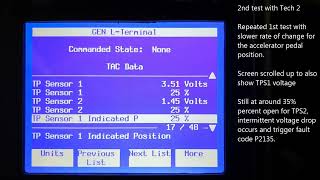
How to confirm: After exhaustively ruling out wiring issues, use a scan tool with live data to graph the voltage of TPS Sensor 1 and TPS Sensor 2. As you slowly open the throttle (engine off, key on), both sensor voltages should change smoothly. If Sensor 2's voltage is stuck low (near 0V), drops out intermittently, or does not move in a smooth curve, the throttle body is faulty.
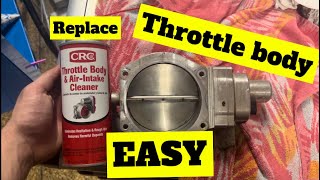
Typical fix: Replace the entire throttle body assembly. 🎬 Watch: Easy step-by-step Corvette throttle body replacement walkthrough A 'throttle relearn' procedure is required after installation, which can often be done without a scan tool by following a specific sequence of key cycles and idling.
Est. part cost: $150-$450 - Weak Battery or Poor Ground Connection ⚪ Low Probability The C6 Corvette is known for being sensitive to low voltage. A weak battery can cause a cascade of seemingly unrelated error codes, including those related to the throttle system. The main ground connection under the battery tray is a common point of corrosion that can cause widespread electrical gremlins.
How to confirm: Test the battery's voltage and health at an auto parts store. Ensure battery terminals are clean and tight. Inspect the main engine and chassis ground straps for corrosion or looseness, paying special attention to the ground point located under the battery.
Typical fix: Replace the battery if it fails a load test. Disassemble, clean, and secure ground connections, especially the one under the battery.
Est. part cost: $150-$250
Rare But Worth Checking
- Faulty Powertrain Control Module (PCM): → Shop Engine Control Module (ECM) This is extremely rare. The PCM is the last component to suspect. All other possibilities, especially wiring, must be exhaustively ruled out before considering PCM replacement. A diagnostic specialist should confirm this diagnosis as it requires expensive replacement and programming.
Diagnosis Steps
- Read all stored fault codes with an OBD-II scanner. Note any other codes that are present, especially P0122 or P2135.
- Check battery voltage and have the battery load tested. Ensure terminals are clean and tight.
- Inspect and clean the main engine ground straps, particularly the G103/G104 grounds often located under the battery tray.
- Visually inspect the wiring harness leading to the throttle body. Look for any signs of chafing, melting, or physical damage.
- Disconnect the throttle body connector. Inspect for corrosion, moisture, or bent/backed-out pins. Clean with electrical contact cleaner and apply dielectric grease.
- Perform a 'wiggle test' on the harness near the throttle body connector with the key on, engine off, while observing TPS voltage on a scan tool. Gently pull on each wire to check for internal breaks.
- If you have a scan tool with live data, monitor the voltage for TPS1 and TPS2. Confirm that TPS2 is reading abnormally low (<0.25V). The signal wire for TPS2 is typically a Light-Blue/Black wire going to the ECM.
- If the wiring and connector appear perfect, the throttle body assembly is the most likely cause. Replace the throttle body, ensuring you use the correct part for your model year range (Silver vs. Gold blade).
- After replacement, perform the throttle relearn procedure as specified for your vehicle. This typically involves a series of key-on, key-off, and idle periods.
- If the problem persists after replacing the throttle body and verifying the wiring, the issue may be with the PCM, which requires professional diagnosis.
Parts You'll Likely Need
- Throttle Body Assembly
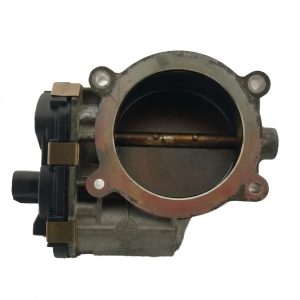
(OEM #19420707 (supersedes 12605109 for 2009-2013 LS3/LS7/LS9 'Gold Blade') OR 12570790 (for 2005-2008 LS2/LS7 'Silver Blade'))— The Throttle Position Sensor (TPS) that causes this code is integrated into the throttle body. If the sensor itself has failed, the entire assembly must be replaced. Part numbers differ by model year.
Trusted brands: ACDelco, Standard Motor Products (SMP), Dorman
OEM price range: $250-$450
Aftermarket price range: $150-$250 - Throttle Body Connector Pigtail
(OEM #ACDelco PT2628 (check application))— If the connector itself is damaged or corroded, or if wires are broken right at the connector, replacing the pigtail is the proper repair. This is a very common failure point.
Trusted brands: ACDelco, Dorman, Standard Motor Products (SMP) S2061 or 756AW29
OEM price range: $30-$50
Aftermarket price range: $15-$30
Related Codes That Often Appear With This One
- P0122 — This is 'Throttle Position Sensor 'A' Circuit Low'. If both P0122 and P0222 appear, it strongly suggests a problem common to both sensors, like a lost 5-volt reference or ground wire in the main harness or connector.
- P2135 — This code means 'Throttle/Pedal Position Sensor/Switch 'A'/'B' Voltage Correlation'. It sets when the ECM sees a disagreement between the two TPS sensors. A failing Sensor 'B' (causing P0222) will often trigger P2135 as well. Many GM service bulletins address P2135 by pointing to wiring issues near the throttle body connector.
Technical Service Bulletins (TSBs) & Recalls
- PIP3089B: Addresses SES Light and Reduced Engine Power with codes like P2135, P0120, P0220. It advises technicians to inspect for poor terminal crimps or broken wires within 1-4 inches of the throttle body connector.
Mechanic-Grade Diagnostic Values
- TPS Sensor 2 (TPS2) Signal Voltage — expected: A smooth sweep from approximately 4.5V at closed throttle to 0.5V at wide-open throttle (Note: TPS2 is often inverse to TPS1).. Failure: Voltage is stuck below 0.25V for more than one second, which sets the P0222 code.
- TPS Sensor 1 (TPS1) Signal Voltage — expected: A smooth sweep from approximately 0.5V at closed throttle to 4.5V at wide-open throttle.. Failure: While not directly for P0222, an erratic or non-responsive TPS1 signal would set other codes (like P0122) and points to a general throttle body or wiring issue.
- 5-Volt Reference Voltage at Throttle Body Connector — expected: A steady 5 volts with the key on, engine off.. Failure: Voltage significantly below 5V indicates a wiring problem or a fault in the ECM's 5V reference circuit.
Scan Tool Commands That Help
- Tech2 / GDS2: Throttle Position Sensor Live Data Graphing — This is the primary method to visually confirm if TPS Sensor 2's voltage is dropping out, sticking, or not sweeping smoothly as the throttle is manually opened and closed (with engine off). It's more effective than a multimeter for catching intermittent glitches.
- Tech2 / GDS2: Idle Learn / Throttle Learn Reset — After replacing the throttle body, a scan tool can force the ECM to immediately relearn the new sensor's closed-throttle position. While a manual relearn procedure exists, using the scan tool function is faster and more reliable.
Wiring & Ground Locations
- Throttle Body Connector (X120) — Directly on the electronic throttle body, top of the engine's intake manifold.. This is the most common point of failure. The pins can corrode, and wires can break internally within a few inches of the connector due to engine vibration and heat.
- TPS2 Signal Wire — Light Blue/Black wire running from the throttle body connector to pin 3 of the X2 connector at the ECM.. This specific wire carries the voltage signal for TPS Sensor 2. A short to ground on this wire will directly cause a P0222 code.
- G104 Ground — On the frame rail next to the battery.. This is a major chassis and PCM ground point. Corrosion or looseness here can cause a variety of electrical issues, including erratic sensor readings for the throttle control system.
- G103 Ground — On the left front of the engine, sometimes described as below the brake booster on C5/C6 platforms.. This is a primary engine ground. While less commonly the direct cause for P0222 than G104 or the connector itself, a poor connection here can contribute to electrical noise and unstable sensor grounds.
Real Owner Repair Stories
- CorvetteForum user (2008 Corvette Z06) — Reduced Engine Power, Service Traction Control, shaking at 1100 RPM, no throttle response, codes P0122 and P0222.
❌ Tried (didn't work) Initial visual inspection of wiring and connections seemed okay., Replaced the accelerator pedal sensor three years prior for a different issue.
✅ What actually fixed it The user suspected the pigtail connector based on another member's advice. The final fix was replacing the throttle body connector pigtail. The reasoning was that engine vibration and thin gauge wires lead to connection wear or internal breaks that aren't always visible. - CorvetteForum user 'Machaux' (2008 C6 Base with a supercharger) — Intermittent P0222 code, previously had P2135 which was resolved by replacing the gas pedal.
❌ Tried (didn't work) Replacing the accelerator pedal assembly (fixed P2135 but P0222 remained)., Inspecting wiring and connectors for obvious damage or debris.
✅ What actually fixed it After ruling out wiring and the pedal, the final resolution was replacing the entire throttle body assembly.
OEM Part Supersession History
12605109→19420707— Standard part number update by GM.
Heads up: This is the 'Gold Blade' throttle body for 2009+ models with the E38 PCM. It is not compatible with 2005-2008 'Silver Blade' systems as it opens in the opposite direction.Multiple (e.g., 88986255, 13580112)→ACDelco PT2628— Consolidation of pigtail connector part numbers.
Heads up: PT2628 is the widely accepted 8-pin connector for this application, but it's always critical to verify the connector keying and pin layout against the old part before splicing.
Model Year Variations Within This Range
- 2005-2008: Uses the 'Silver Blade' throttle body (GM P/N 12570790) designed to work with the E40 and earlier PCMs.
- 2009-2013: Uses the 'Gold Blade' throttle body (GM P/N 19420707) designed for the E38 PCM. The throttle blade opens in the opposite direction of the earlier silver blade version, making them electronically incompatible.
Diagnostic Flowchart
Other Known Issues on This Vehicle
Issues unrelated to this code that are worth knowing about as an owner of this generation:
- Harmonic Balancer Wobble / Failure 🔴 High — Common across all C6 models, especially early 2005 models. The rubber bonding delaminates, causing the outer ring to wobble, which can damage the steering rack or oil pump. (Ref: TSB 05-06-01-001A (for early 2005 models with a loose bolt), but the delamination issue can affect all years.)
- Fuel Sending Unit Failure 🟠 Medium — Very common. Sulfur in fuel contaminates the sensor contacts, causing the fuel gauge to read empty or inaccurately, often after a fill-up. Triggers code P2068. (Ref: GM released updated sending units, but the problem can still occur. Using Top Tier gasoline or Techron additive is a common preventative measure.)
- LS7 Valve Guide Wear (Z06 & 427 Models) 🔴 High — A significant concern for all 7.0L LS7 engines. Excessive wear between the valve stem and guide can lead to catastrophic engine failure if a valve head breaks off. (Ref: TSB #13-06-01-001A acknowledges the issue but doesn't mandate a recall. Owners often perform a 'wiggle test' or have cylinder heads rebuilt with aftermarket components as a preventative measure.)
- Removable Roof Panel Adhesive Failure 🔴 High — Common on 2005-2007 coupes. The factory adhesive fails, causing the roof panel to make noise, leak, or, in worst cases, detach from the car at speed. (Ref: Recall 090230 (NHTSA 09V432000) was issued to replace the entire roof panel with a new design.)
- Service Active Handling System (Steering Position Sensor) 🟠 Medium — Prevalent on 2005-2006 models. The steering wheel position sensor connector can become loose, causing the car to mistakenly apply a brake and trigger a service message. (Ref: A recall was issued to install a clip on the connector to prevent it from coming loose.)
Used vs. New Parts: Buying Guide for This Vehicle
When a used part is the smart pick: A used OEM throttle body can be a cost-effective choice if the wiring and connector have been definitively ruled out as the cause of P0222. Given the high cost of a new OEM unit, a used part from a reputable salvage yard is a reasonable option.
Donor-vehicle mileage cap: roughly under 80000 miles for the part to have meaningful remaining life.
What to inspect on the donor part:
- Ensure it is the correct part for your year range ('Silver Blade' for 2005-2008, 'Gold Blade' for 2009-2013).
- Inspect the connector pins for any signs of corrosion, bending, or damage.
- Check the throttle blade for cleanliness and ensure it moves freely without binding (though it will be stiff against the motor).
- Ask for the donor vehicle's mileage if possible; lower is always better.
- Look for signs of modification, like porting or polishing, which might be undesirable for a stock replacement.
OEM-only on this vehicle (don't cheap out):
- While aftermarket throttle bodies exist, sticking with a new or used OEM ACDelco unit is the safest bet for guaranteed compatibility and avoiding tuning issues, especially on an otherwise stock vehicle.
Aftermarket brands forum-validated for this vehicle:
- Soler Performance (for ported/performance-oriented options)
- Katech (for ported/performance-oriented options)
Brands owners have reported issues with on this vehicle:
- Unbranded, low-cost throttle bodies from online marketplaces can have calibration issues or premature electronic failure. It's generally advised to avoid them unless validated by extensive community feedback.
Real Owner Stories
Aggregated from forums and TSBs cited above. Mileages and costs reflect what owners reported in those sources.
2005-2013 Chevrolet Corvette V8
Symptoms: Intermittent P0222 code where the TPS2 voltage was reading less than 0.25V for over a second.
What fixed it: Identified a short to ground in the light-blue/black wire or a connector issue at the throttle body.
Source hint: CorvetteForum.com - 'P0222 where to start?'
2005-2013 Chevrolet Corvette V8
Symptoms: Reduced Engine Power message and SES light; inspection found poor terminal crimps near the throttle body.
What fixed it: Repaired broken wires/terminals within 1-4 inches of the throttle body connector as per technical guidance.
Source hint: TSB PIP3089B
Related OBD-II Codes
Frequently Asked Questions
My C6 Corvette is displaying 'Reduced Engine Power' and 'Service Active Handling' simultaneously. Are these related to P0222?
Does TSB PIP3089B apply to my Corvette's throttle issues?
Can I just replace the Throttle Position Sensor (TPS) on my LS3 engine?
I heard there are different throttle bodies for the C6. Which one do I need for a P0222 fix?
Could a bad battery cause a P0222 code on a 2005-2013 Corvette?
Is there a specific wire I should check for the P0222 'Circuit Low' condition?
Helpful Videos

Used OEM Parts in Stock
New Aftermarket Parts Available




The information in this article is provided for general reference and educational purposes only. Vehicle specifications, procedures, and part compatibility can vary by production date, trim level, and region. Always consult your vehicle's factory service manual and verify part numbers before purchasing or performing repairs. Safety-critical components such as airbags, seat belts, and braking systems should be installed by a qualified professional.
- Chevrolet Corvette:
- 🧭 Diagnostic Flowchart
- 🎬 Helpful Videos
- 🛍️ Shop This Part
- What's Unique About the 2005-2013 Chevrolet Corvette
- Symptoms You May Notice
- Most Likely Causes
- Rare But Worth Checking
- Diagnosis Steps
- Parts You'll Likely Need
- Related Codes That Often Appear With This One
- Technical Service Bulletins (TSBs) & Recalls
- Mechanic-Grade Diagnostic Values
- Scan Tool Commands That Help
- Wiring & Ground Locations
- Real Owner Repair Stories
- OEM Part Supersession History
- Model Year Variations Within This Range
- Other Known Issues on This Vehicle
- Used vs. New Parts: Buying Guide for This Vehicle
- Real Owner Stories
- 2005-2013 Chevrolet Corvette V8
- 2005-2013 Chevrolet Corvette V8
- Related OBD-II Codes
- Frequently Asked Questions
- 🎟️ Get 5% Off