

P0238 on 2015-2020 Jeep Renegade: Turbo Boost Sensor 'A' Circuit High Causes and Fixes
On a 2015-2020 Jeep Renegade, code P0238 most often means the Turbocharger Boost Pressure Sensor (also called a MAP or T-MAP sensor) has failed. This sensor sends a voltage signal to the computer that is higher than the expected range (often over 4.8 volts for more than a couple of seconds), triggering limp mode. It's a straightforward replacement, with the part costing between $40 and $85.
- P0238 on your Renegade almost always points to a problem with the boost pressure sensor or its wiring, not the turbo itself.
- Symptoms are serious and include a major loss of power (limp mode), making the vehicle difficult to drive.
- The most likely fix is replacing the Turbo/Manifold Absolute Pressure (T-MAP) sensor, which is an affordable and accessible part for a DIY repair on the 1.4L engine.
- Before replacing parts, check the sensor's connector and wiring for any obvious damage, and perform a 'wiggle test'.
- In some cases, a software update from a Jeep dealer may be required, as noted in a manufacturer TSB for a related fault.
What's Unique About the 2015-2020 Jeep RENEGADE
For the Jeep Renegade, this code applies to the turbocharged engines (1.4L gasoline and 2.0L diesel). The 1.4L MultiAir Turbo engine, shared with the Fiat 500 and Dodge Dart, has multiple pressure sensors, so correct identification is key. While the general meaning is the same, manufacturer Technical Service Bulletins (TSBs) point to different nuances. TSB #08-089-14 specifically calls out P0238 on the 2.0L Diesel during hard acceleration. 🎬 See how this common sensor fault affects the 2.0L diesel engine. Another TSB, #18-017-20, describes a related fault as a "Signal Calculation Failure," suggesting that some cases may be caused by a software issue requiring a PCM update rather than a part failure.
Diagnostic Flowchart
Tap your situation to follow the diagnostic path that matches what you're seeing on this vehicle.
Symptoms You May Notice
- Check Engine Light is on
- Significant loss of engine power (Limp Mode)
- Poor or hesitant acceleration
- Erratic engine idle (as noted in TSB #18-017-20)
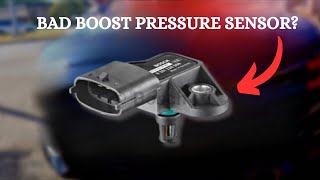
- Black smoke from exhaust (in some cases, indicating a rich fuel mixture) 🎬 Watch: Top 8 symptoms of a failing boost pressure sensor.
- Replacing the turbocharger. This code is almost always electrical (sensor/wiring) and not a mechanical failure of the turbo itself. Replacing the turbo would be an expensive and unnecessary repair for P0238.
Most Likely Causes
- Faulty Turbo Boost Pressure Sensor (T-MAP Sensor) 🔴 High Probability The sensor is exposed to constant changes in heat and pressure within the intake manifold, leading to eventual electronic failure. On some Fiat platform-mates, owners report the sensor getting heavily caked with soot and oil residue, which can cause failure.
How to confirm: With the key on and engine off, use a scan tool to view the live data for the boost pressure sensor. If the reading is abnormally high (e.g., much higher than atmospheric pressure, or stuck at a high voltage like 4.8V+), the sensor is likely faulty. On the 1.4L engine, the sensor is easily accessible on the front of the intake manifold.
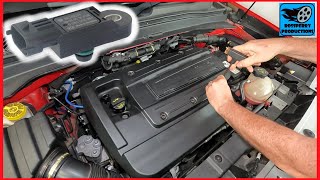
Typical fix: Replace the boost pressure sensor. It is typically mounted on the intake manifold or a charge pipe, secured by a single screw (often a T20 or Phillips head). 🎬 Watch: Step-by-step MAP sensor replacement on the 1.4L MultiAir engine. Cleaning is sometimes attempted but replacement is the most reliable fix.
Est. part cost: $40-$85 - Wiring or Connector Issue 🟡 Medium Probability Engine vibrations and heat can cause wires to chafe, break, or corrode over time. The connector's locking tab can become brittle and fail, leading to a poor connection. Pigtail repair kits are available for this specific issue.
How to confirm: Visually inspect the wiring harness and connector going to the boost pressure sensor for any signs of damage, corrosion, or loose pins. With the engine running, gently wiggle the harness near the sensor; if the idle changes, a bad connection is likely. With the sensor unplugged (Key On, Engine Off), use a multimeter to check for a 5-volt reference signal and a good ground at the connector.
Typical fix: Repair the damaged section of the wiring harness or replace the connector pigtail.
Est. part cost: $15-$50 - PCM Software Update Needed ⚪ Low Probability TSB #18-017-20 mentions a "Positive Boost Pressure Governor Deviation Low Pressure Signal Calculation Failure" for a similar code, indicating that the PCM's software may be misinterpreting the sensor data under certain conditions, causing an erratic idle.
How to confirm: A Jeep dealership or a qualified shop with access to OEM software (like wiTECH) can check if your vehicle's VIN has a pending software update related to this TSB or other powertrain enhancements.
Typical fix: Update or 'reflash' the Powertrain Control Module with the latest software version.
Est. part cost: $0-$200
Rare But Worth Checking
- Faulty Powertrain Control Module (PCM): This is very uncommon. Before condemning the PCM, all other possibilities, especially the sensor, wiring, and software, must be thoroughly ruled out.
Diagnosis Steps
- Read the code using an OBD-II scanner and note any other codes present, such as P0236 or P0237, which point strongly to the boost sensor circuit.
- Visually inspect the boost pressure sensor's wiring and connector for visible damage, corrosion, or loose connections. Perform a 'wiggle test' on the harness with the engine running to check for changes in idle.
- Using a scan tool with the Key On, Engine Off (KOEO), observe the live data from the boost pressure sensor. The reading should be close to atmospheric pressure. A reading that is excessively high (e.g., a voltage stuck above 4.5V) points to a faulty sensor or a short in the signal wire.
- Disconnect the sensor. The voltage reading on the scan tool should drop to near zero. If it remains high, there is a short-to-power in the signal wire that needs to be traced and repaired.
- If the voltage drops when disconnected, test the sensor's circuit. Using a digital multimeter, verify you have a 5-volt reference and a good ground at the connector with the key on.
- If the sensor and wiring test good, check with a dealer for any available PCM software updates, referencing TSB #18-017-20.
- If all other steps fail to find a wiring or software issue, the sensor is the most likely culprit. Replace the boost pressure (T-MAP) sensor.
Parts You'll Likely Need
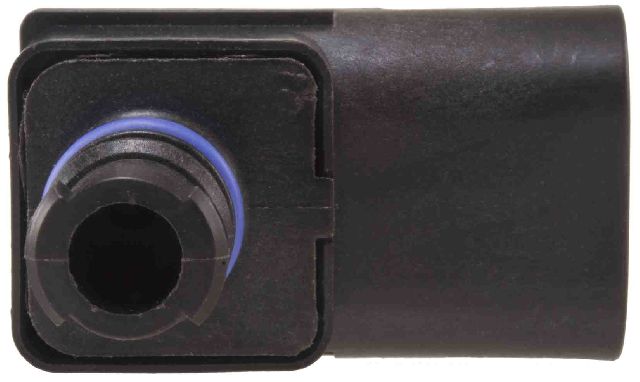
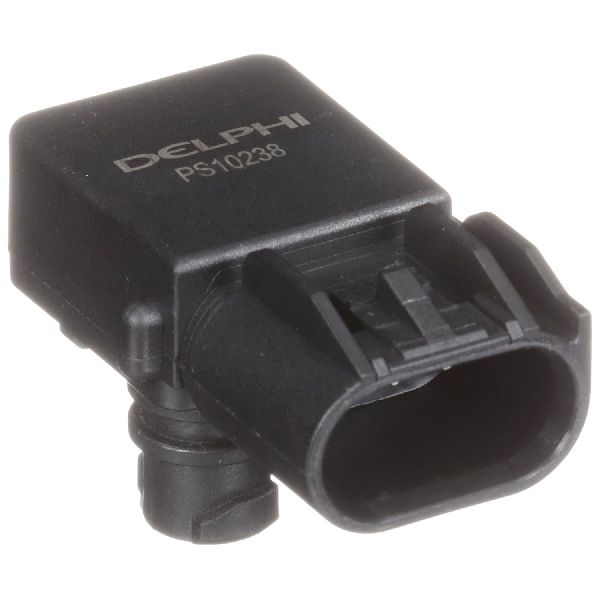
- Turbocharger Boost Pressure Sensor (T-MAP Sensor)
(OEM #68199324AB (supersedes 68199324AA, 5149091AA, 5033310AC))— This sensor is the most common failure point for code P0238, as it is responsible for sending the voltage signal that the PCM is reading as too high. Part number 68199324AB is listed for many Mopar vehicles, including those with 2.4L engines, but is often cross-referenced for the 1.4L turbo as well. Always verify fitment with your VIN.
Trusted brands: Mopar, Bosch, Standard Motor Products, NGK/NTK
OEM price range: $60-$90
Aftermarket price range: $40-$75
Related Codes That Often Appear With This One
- P0236 (Turbocharger/Supercharger Boost Sensor 'A' Circuit Range/Performance)
- P0237 (Turbocharger/Supercharger Boost Sensor 'A' Circuit Low)
Technical Service Bulletins (TSBs) & Recalls
- 18-017-20: Mentions a "Positive Boost Pressure Governor Deviation Low Pressure Signal Calculation Failure" which is closely related to P0238 and may require a PCM reflash.
- 08-089-14: Specifically calls out P0238 "Turbo boost Pressure Sensor Circuit High" on the 2.0L Diesel engine during WOT acceleration.
Platform-Specific Known Issues
- TSB #18-017-20 indicates that on some models, a similar code (P0238-00) can be triggered by a software calculation failure within the PCM, causing symptoms like an erratic idle.
- TSB #08-089-14 notes that on the 2.0L Diesel engine, P0238 can appear during wide-open throttle (WOT) acceleration.
- The 1.4L MultiAir Turbo engine has at least two pressure sensors in the intake tract. P0238 refers to the sensor 'A', which is typically the one on the intake manifold itself, post-intercooler.
Mechanic-Grade Diagnostic Values
- T-MAP Sensor Signal Wire Voltage (Key On, Engine Off) — expected: ~4.5V (at atmospheric pressure). Failure: Voltage is stuck high (above 4.5V) regardless of pressure, or does not drop when vacuum is applied. A P0238 is set when voltage is greater than ~3.9-4.5V for more than 5 seconds.
- T-MAP Sensor Signal Wire Voltage (Engine at Idle) — expected: 1.1V - 1.8V (high vacuum). Failure: Voltage is significantly higher than 1.8V at idle, indicating the sensor is not reading engine vacuum correctly.
- T-MAP Sensor Reference Wire Voltage (Key On, Engine Off) — expected: 5.0V. Failure: Voltage is significantly lower or higher than 5.0V, indicating a problem with the PCM or wiring, not the sensor itself.
- T-MAP Sensor Ground Wire Voltage (Key On, Engine Off) — expected: Less than 0.1V (100 millivolts). Failure: Voltage is higher than 0.1V, indicating a poor ground connection which can cause incorrect sensor readings.
- Scan Tool Boost Pressure Voltage (Key On, from a service manual) — expected: 1.12V - 1.36V. Failure: If the voltage is outside this range with the key on, the manual suggests replacing the Turbocharger Boost Pressure Sensor.
Scan Tool Commands That Help
- wiTECH (or equivalent professional scanner): Boost Pressure Sensor Calibration Check — Use this function with the ignition on to compare the Boost Pressure sensor reading (in hpa and volts) against the atmospheric pressure sensor. The values should be nearly identical. If they are not, or if the voltage is outside the specified range (e.g., 1.12-1.36V), it points to a faulty sensor.
Wiring & Ground Locations
- T-MAP Sensor Connector (1.4L Turbo) — On the front of the intake manifold, after the charge pipe from the intercooler.. This is the primary connector to test for 5V reference, ground, and the signal wire voltage that triggers P0238. A generic 3-pin MAP sensor pinout is often: Pin A - Ground, Pin B - Signal, Pin C - 5V Supply. This must be verified for the specific vehicle.
- Main Engine/Battery Ground — The main negative battery cable connects to a grounding point on the vehicle's chassis/frame near the battery.. A poor main ground can cause floating voltages and erratic behavior in multiple sensors, including the T-MAP. While not a direct cause, intermittent electrical issues and codes can sometimes be traced back to a corroded or loose main ground strap.
Real Owner Repair Stories
- Sonic Owners Forum (Chevrolet Sonic 1.4T (shares similar engine architecture)) — Intermittent P0238 code, especially during a pull in a high gear. Loss of boost and limp mode.
❌ Tried (didn't work) Clearing the code (it would return under load).
✅ What actually fixed it The user did not post a final fix, but another user in a similar thread suggested the issue was related to the tune's 'base duty cycle' for the wastegate being set too high, causing an over-boost condition that the sensor correctly reported before triggering the code. This points to a potential tuning issue in modified vehicles, rather than a hardware fault.
OEM Part Supersession History
5033310AC, 5149091AA, 68199324AA→68199324AB— Standard part revision and consolidation by the manufacturer.
Heads up: Part 68199324AB is listed for a very wide range of Mopar vehicles, including the 2.4L MultiAir engine. While it is often cross-referenced for the 1.4L Turbo, it is critical to verify the correct part number using the vehicle's VIN before purchasing, as there may be calibration differences.
Helpful Videos
![Compass Diesel PERDENDO POTÊNCIA: O defeito simples que assusta! [Falha P0238-00]](https://img.youtube.com/vi/0bMKs13JYXs/mqdefault.jpg)
Used OEM Parts in Stock
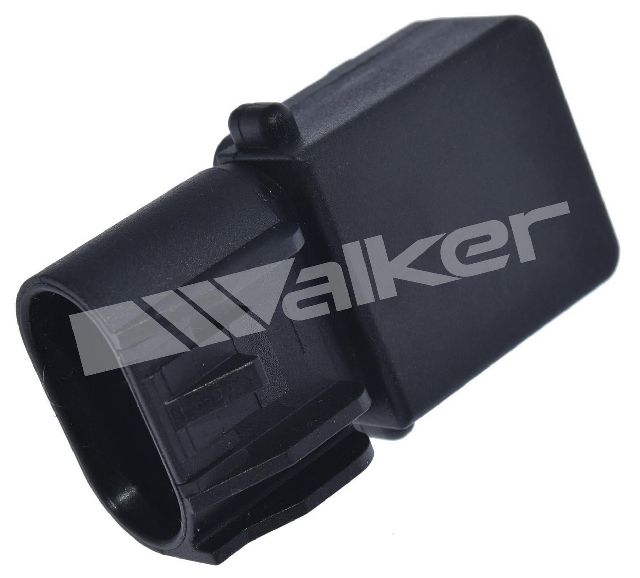
New Aftermarket Parts Available


The information in this article is provided for general reference and educational purposes only. Vehicle specifications, procedures, and part compatibility can vary by production date, trim level, and region. Always consult your vehicle's factory service manual and verify part numbers before purchasing or performing repairs. Safety-critical components such as airbags, seat belts, and braking systems should be installed by a qualified professional.
- Jeep RENEGADE:
- 🧭 Diagnostic Flowchart
- 🎬 Helpful Videos
- 🛍️ Shop This Part
- What's Unique About the 2015-2020 Jeep RENEGADE
- Symptoms You May Notice
- Most Likely Causes
- Rare But Worth Checking
- Diagnosis Steps
- Parts You'll Likely Need
- Related Codes That Often Appear With This One
- Technical Service Bulletins (TSBs) & Recalls
- Platform-Specific Known Issues
- Mechanic-Grade Diagnostic Values
- Scan Tool Commands That Help
- Wiring & Ground Locations
- Real Owner Repair Stories
- OEM Part Supersession History
- 🎟️ Get 5% Off