

P0400 on 2005-2011 Saab 9-3 1.9L TiD: EGR Flow Malfunction Causes and Fixes
On the Saab 9-3 1.9L TiD (Z19DTH engine), code P0400 is overwhelmingly caused by a sticking or completely seized EGR valve due to heavy carbon soot buildup. The most reliable fix is replacing the EGR valve (Pierburg is OEM) and thoroughly cleaning the intake manifold passages. Simply cleaning the valve is often a temporary fix. Expect to pay $150-$300 for a quality aftermarket valve.
- P0400 on your Saab 9-3 1.9L TiD almost certainly means your EGR valve is clogged with carbon and needs attention.
- The most effective fix is to replace the EGR valve and its gasket. Simply cleaning the old valve may only provide a temporary solution.
- While you have the EGR system apart, inspect the intake manifold port for heavy carbon buildup. If it's clogged, the manifold should be removed and cleaned.
- This is a manageable DIY job for someone with mechanical experience, with a difficulty of about 3 out of 5.
- Do not replace the MAF sensor; it is doing its job by detecting the lack of EGR flow.
What's Unique About the 2005-2011 Saab 9-3
The 1.9L TiD engine, also known as the Z19DTH, is a Fiat/GM engine known for producing significant amounts of soot, making the EGR system highly susceptible to clogging. Unlike some generic P0400 definitions that can point to electrical issues, on this Saab platform, the cause is overwhelmingly mechanical: the EGR valve itself gets physically stuck with carbon, preventing it from opening and closing correctly. Many owners and mechanics on forums report that simply cleaning the valve is only a temporary solution that may last a few weeks to a few months due to the high rate of soot accumulation. Replacement is the recommended long-term repair.
Symptoms You May Notice
- Check Engine Light illuminated
- Reduced engine power or hesitation, especially during acceleration
- Rough or unstable idle
- Vehicle may enter 'Limp Home Mode'
- Increased black smoke from the exhaust
- Failed emissions test
- Stuttering or 'hiccup' at steady, low-to-mid RPMs (around 1500-2000 RPM).
- Poor fuel economy
- Replacing the Mass Airflow (MAF) sensor. The MAF sensor is used to detect the fault, but it is not the cause of it. The P0400 code is set because the MAF reading *doesn't* change as expected, which points to a lack of EGR flow, not a faulty MAF.
Most Likely Causes
- Sticking or Seized EGR Valve 🔴 High Probability → Shop Exhaust Gas Recirculation (EGR) Valve The Z19DTH diesel engine produces a large amount of soot, which builds up on the EGR valve's pintle and seat, causing it to jam. This is a widely documented failure on this engine across all brands that use it.
How to confirm: Remove the EGR valve and visually inspect it for heavy carbon buildup and check if the internal plunger moves freely. A capable diagnostic scan tool can also be used to command the valve open; if it doesn't respond or the engine's MAF readings don't change, the valve is likely stuck or clogged.
Typical fix: Replace the EGR valve and its gasket. While cleaning is possible, owner experiences show it is often a short-term fix. Replacement with a new unit from a quality brand like Pierburg (OEM), Hella, or Wahler is the most reliable long-term solution. Torque specs for the bolts are critical and range from 10-25 Nm.
Est. part cost: $150-$300 - Clogged EGR Passages or Intake Manifold 🟡 Medium Probability The same soot that clogs the EGR valve also accumulates in the intake manifold and the passages leading to it, restricting airflow even if the EGR valve itself is functional. Videos show these passages can be almost completely blocked.
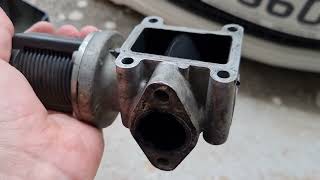
How to confirm: After removing the EGR valve, inspect the port on the intake manifold. If it is heavily caked with carbon, the entire manifold is likely restricted. This is often visible as a solid black mass of carbon completely obscuring the port.
Typical fix: Remove the intake manifold and physically clean out the carbon deposits using degreasers, brushes, and sometimes a pressure washer. This is often done at the same time as EGR valve replacement to ensure a complete repair. New intake manifold gaskets are required.
Est. part cost: $20-$40 (for gaskets and cleaning supplies) - Faulty EGR Solenoid/Actuator ⚪ Low Probability The electronic actuator on the EGR valve can fail, but it is much less common than mechanical seizure from carbon. The actuator is almost always integrated with the valve.
How to confirm: With the valve connected but removed from the engine, use a scan tool to command it open and closed. Visually confirm if the valve stem moves. If there is no movement but you can confirm voltage is being sent to the actuator, the actuator is faulty.
Typical fix: The actuator is integrated with the EGR valve, so the entire assembly must be replaced.
Est. part cost: $150-$300
Rare But Worth Checking
- Air Leak in Intake System: A significant air leak (e.g., a split intercooler hose) between the turbocharger and the intake manifold can cause the ECM to disable the EGR system as a precaution, which may log a P0400 code.
- Dirty MAP Sensor: The Manifold Absolute Pressure (MAP) sensor, located on the intake manifold, can get coated in soot and oil, leading to inaccurate readings that can confuse the ECM's EGR calculations. It's rarely the root cause but is often cleaned during an EGR service as a 'while you're in there' task.
Diagnosis Steps
- Read the fault codes with an OBD-II scanner to confirm P0400 is present. Check for other codes like P1109 which would point to related swirl flap issues.
- Using a capable scan tool, monitor the live data for EGR commanded position vs. actual position (if available) and the Mass Airflow (MAF) sensor reading.
- Command the EGR valve to open (e.g., to 50%) while the engine is idling. You should see the MAF reading drop significantly and the engine may stumble or run rough. If there is no change, the EGR flow is blocked.
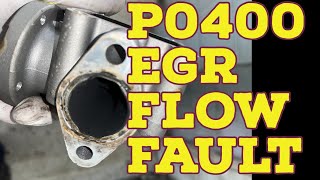
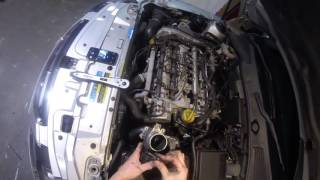
- Turn off the engine and allow it to cool. Locate and remove the EGR valve. It is typically held on by a few 10mm and 13mm bolts and is located on the front of the engine. 🎬 See this step-by-step guide for removing and cleaning the valve.
- Visually inspect the valve and the intake manifold port for heavy carbon buildup. The port on the manifold is often completely blocked.
- Test the mechanical action of the valve. If it is seized and does not move, it has failed. Even if it moves, heavy internal buildup can still block flow.
- If the valve appears clean and moves freely, the blockage is almost certainly further downstream in the intake manifold itself, which will require removal for a thorough cleaning.
- If you suspect an electrical issue, check the wiring harness for damage. Use a multimeter to verify power and ground at the EGR connector while commanding it with a scan tool. 🎬 Watch: How to diagnose EGR faults using a scan tool and multimeter.
Parts You'll Likely Need
- EGR Valve
(OEM #55215031 / 93181981)— This is the component that almost always fails by sticking or seizing due to carbon buildup, directly causing the P0400 code.
Trusted brands: Pierburg (OEM supplier), Wahler, Hella, Delphi
OEM price range: $250-$350
Aftermarket price range: $150-$250 - EGR Valve Gasket
(OEM #Included with new valve)— A new gasket is required to ensure a proper seal when replacing the EGR valve. Quality replacement valves typically include new gaskets.
Trusted brands: Elring, Victor Reinz
OEM price range: $5-$15
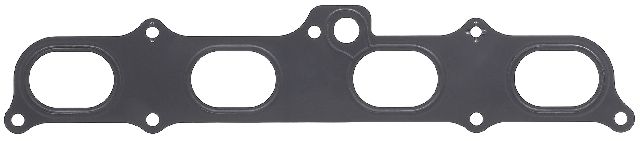
Aftermarket price range: $3-$10 - Intake Manifold Gasket
(OEM #93177341)— This is required if the intake manifold is removed for cleaning, which is a common and highly recommended secondary step to fix the root cause of carbon buildup.
Trusted brands: Elring, Victor Reinz
OEM price range: $20-$40
Aftermarket price range: $15-$30
Related Codes That Often Appear With This One
- P1109 - Swirl Valve Actuator Malfunction. This is often seen alongside P0400 because the same carbon buildup that clogs the EGR also causes the intake manifold's swirl flaps to stick or fail.
Platform-Specific Known Issues
- The swirl flaps inside the intake manifold on the Z19DTH engine are also prone to failure due to carbon buildup. The plastic bushings on the actuating rod wear out, causing the rod to detach from the flaps. When servicing the EGR system and cleaning the intake, it is critical to inspect the condition of the swirl flap mechanism. 🎬 Watch: How to clean the MAP sensor and check swirl flaps. A failed flap can break off and cause serious engine damage. Many owners opt to install a swirl flap delete kit for a permanent solution.
- There are two different EGR valve designs for this engine, which differ by the angle of the exhaust port. It is critical to visually compare the old part to the new one before purchasing to ensure compatibility.
Mechanic-Grade Diagnostic Values
- EGR Valve Internal Resistance (Cold) — expected: 19.9 - 23.4 Ohms. Failure: A reading outside this range indicates a faulty internal coil in the EGR solenoid.
- EGR Valve Connector Voltage (Key On, Engine Off) — expected: 12V (Battery Voltage). Failure: No voltage indicates a wiring issue, blown fuse, or problem with the main relay.
Hidden / Shadow Codes Worth Checking
- P0400-01, P0400-02, P0400-04: These sub-codes point to general EGR flow malfunctions, often mechanical (stuck valve). (see via Saab Tech2 or equivalent professional diagnostic tool.)
- P0400-54: Indicates a fault in the female connector of the Engine Control Unit (ECU), such as corrosion or poor pin contact. (see via Saab Tech2 or equivalent professional diagnostic tool.)
- P0400-5A: Suggests an air leak between the turbocharger and the intake manifold (e.g., split intercooler hose), which causes the ECU to disable the EGR valve. (see via Saab Tech2 or equivalent professional diagnostic tool.)
- P0400-5B: Suggests an air leak between the Mass Airflow (MAF) meter and the turbocharger, which can trigger limp-home mode. (see via Saab Tech2 or equivalent professional diagnostic tool.)
Scan Tool Commands That Help
- Saab Tech2 / Thinkcar: EGR Actuator Test / EGR Valve Actuation Test — This is a critical bidirectional test to diagnose a suspected stuck EGR valve. With the valve removed but still connected electrically, this function commands the valve to open and close. You can visually confirm if the pintle is moving. If the command is sent but the valve doesn't move, it is seized or the internal motor has failed.
Wiring & Ground Locations
- G2 — On the side of the left-hand structural member in the engine bay, near the headlamp and connector bracket.. This is a primary battery and chassis ground point in the engine bay. A poor connection here can cause a variety of electrical issues, including erratic sensor readings and problems with actuators like the EGR valve.
- G7 (EDC16 ECU) — On the starter motor lower retaining bolt for diesel models with the EDC16 engine management system.. This is a specific ground point for the engine control module. A faulty ground here can directly impact the ECU's ability to control the EGR valve and correctly interpret sensor data, potentially leading to a P0400 code even with a functional valve.
- G25 — A main ground cable runs from the battery directly to the gearbox or the left-hand engine mounting.. This is the main engine ground. Corrosion or a loose connection here can affect all engine-mounted sensors and actuators, including the EGR system.
- EGR Valve Connector — A 5-pin round electrical connector on the top of the EGR valve actuator.. This is where voltage and command signals are sent to the valve. Technicians test for 12V power and check for signal changes here during bidirectional tests. Corrosion or damaged pins in this connector can cause a P0400 code.
Real Owner Repair Stories
- Reddit user in r/saab (2011 Saab 9-3 TTID) — Check engine light with P0400/P0404 codes.
❌ Tried (didn't work) Removed and thoroughly cleaned the original EGR valve with oven cleaner., Replaced the cleaned EGR valve with a brand new one.
✅ What actually fixed it The user's problem persisted even after replacing the valve twice. The final solution recommended by another user was a DPF (Diesel Particulate Filter) and EGR delete with a corresponding ECU remap, which prevents the issue from recurring. This suggests the root cause was related to excessive soot production clogging the DPF and overwhelming the EGR system.
When the Usual Fixes Don't Work
- While cleaning the EGR valve is widely reported as a temporary fix, some owners have had success by being extremely thorough. This involves not only cleaning the valve's pintle and seat but also removing the electronic solenoid, cleaning the spring and plunger mechanism underneath, and scraping carbon from the engine-side port. However, even with this level of cleaning, if the root cause of excessive soot (e.g., short-trip driving, other engine issues) is not addressed, the code is likely to return. In some cases, even a brand new EGR valve will not solve the P0400 code if the intake manifold passages are severely restricted with carbon, or if there is an underlying issue like a cracked EGR cooler pipe or a boost leak tricking the ECU.
OEM Part Supersession History
55204250, 93181981→55215031— Part revision and consolidation by the manufacturer (GM/Fiat).
Heads up: The most critical variation is not a supersession, but the distinction between the 16-valve (Z19DTH) and 8-valve (Z19DT) engines. The Z19DTH uses part numbers like 55215031. The 8-valve Z19DT uses different part numbers (e.g., 93189082, 55215032). The valves are not interchangeable.
Model Year Variations Within This Range
- 2005-2011: The primary variation is the engine version. The 1.9L TiD was available as an 8-valve 120bhp (Z19DT) and a 16-valve 150bhp (Z19DTH). While both suffer from P0400 due to carbon, their EGR valves are physically different and are not interchangeable. The Z19DTH is more common and is the primary focus of this article.
Diagnostic Flowchart
Other Known Issues on This Vehicle
Issues unrelated to this code that are worth knowing about as an owner of this generation:
- Intake Manifold Swirl Flap Failure 🔴 High — Very common, especially on vehicles over 60,000 miles. The connecting rod often falls off, or the flaps themselves can break and enter the engine.
- Premature Water Pump Failure 🔴 High — Known to fail before the recommended timing belt interval, often around 60,000 miles. Failure can cause the timing belt to snap, leading to catastrophic engine damage. (Ref: Specialists recommend changing the timing belt and water pump every 60k miles or 4 years, whichever is sooner, which is earlier than the official Saab interval.)
- Dual-Mass Flywheel (DMF) Failure 🔴 High — Common on manual transmission models, typically after 60,000-100,000 miles. Symptoms include rattling at idle and vibration through the clutch pedal.
- Alternator Failure 🟠 Medium — Alternators are a known weak point and can fail without much warning, often requiring replacement.
- Broken Front Coil Springs 🟠 Medium — A common issue on many modern cars, but frequently reported on the 9-3. Springs can snap, usually at the bottom coil, especially in areas with poor road conditions or heavy salt use.
Used vs. New Parts: Buying Guide for This Vehicle
When a used part is the smart pick: Buying a used EGR valve for the Z19DTH engine is strongly discouraged. The primary failure mode is internal clogging and seizure from carbon soot, which is a function of age and mileage. A used part from a donor vehicle is highly likely to have significant internal buildup and a very limited remaining service life.
Donor-vehicle mileage cap: roughly under 25000 miles for the part to have meaningful remaining life.
What to inspect on the donor part:
- If considering used, it should only be from a very low-mileage, documented wreck.
- Visually inspect the pintle and port for any signs of soot; ideally, it should look almost new.
- Manually actuate the plunger (if possible) to ensure it moves smoothly without any sticking or grinding.
Aftermarket brands forum-validated for this vehicle:
- Pierburg (OEM supplier for this part)
- Wahler
- Hella
- Delphi
Brands owners have reported issues with on this vehicle:
- Generic, unbranded 'eBay special' valves are reported by owners to have a very short lifespan, sometimes failing within months.
Real Owner Stories
Aggregated from forums and TSBs cited above. Mileages and costs reflect what owners reported in those sources.
2005-2011 Saab 9-3 1.9 TiD
Symptoms: The car had a noticeable 'stagger' or hesitation when driving between 1,500 and 2,000 RPM.
What fixed it: The issue was traced to a failing EGR and swirl flap system, requiring service of both components.
Source hint: pistonheads.com - A thread titled 'Saab 1.9 diesel engine problem' (10-Sep-2013)
2005-2011 Saab 9-3 1.9 TiD
Symptoms: The Check Engine Light came on for code P0400, and the engine had reduced power.
What fixed it: The problem was resolved by replacing the faulty EGR valve, as cleaning it was found to be only a temporary fix.
Source hint: saabcentral.com - Numerous threads corroborate that P0400 on the 1.9 TiD is almost exclusively an EGR valve issue
2005-2011 Saab 9-3 1.9 TiD (Z19DTH)
Symptoms: The car threw both a P0400 code for the EGR and a P1109 code for the swirl flaps.
What fixed it: The root cause was carbon buildup affecting both systems. The fix involved addressing the EGR valve and repairing the swirl flap mechanism, which had failed due to the same soot.
Source hint: saabtechtalk.com - Thread 'Z19DTH Swirl actuator flap rod question' (01-Feb-2014)
Related OBD-II Codes
Frequently Asked Questions
I'm getting code P0400 on my 1.9 TiD. Should I just clean the EGR valve or replace it?
When I replace the EGR valve, is there anything else I should inspect at the same time?
I'm buying a replacement EGR valve for my Saab 9-3. Are all 1.9 TiD valves the same?
My car is stuttering between 1500-2000 RPM but the Check Engine Light isn't on. Could this be an early sign of EGR failure?
My scanner shows both P0400 and P1109. Are these codes related?
Does this P0400 information also apply to my Vauxhall/Opel 1.9 CDTi?
Helpful Videos
We Have This Part in Stock



The information in this article is provided for general reference and educational purposes only. Vehicle specifications, procedures, and part compatibility can vary by production date, trim level, and region. Always consult your vehicle's factory service manual and verify part numbers before purchasing or performing repairs. Safety-critical components such as airbags, seat belts, and braking systems should be installed by a qualified professional.
- Saab 9-3:
- 🧭 Diagnostic Flowchart
- 🎬 Helpful Videos
- 🛍️ Shop This Part
- What's Unique About the 2005-2011 Saab 9-3
- Symptoms You May Notice
- Most Likely Causes
- Rare But Worth Checking
- Diagnosis Steps
- Parts You'll Likely Need
- Related Codes That Often Appear With This One
- Platform-Specific Known Issues
- Mechanic-Grade Diagnostic Values
- Hidden / Shadow Codes Worth Checking
- Scan Tool Commands That Help
- Wiring & Ground Locations
- Real Owner Repair Stories
- When the Usual Fixes Don't Work
- OEM Part Supersession History
- Model Year Variations Within This Range
- Other Known Issues on This Vehicle
- Used vs. New Parts: Buying Guide for This Vehicle
- Real Owner Stories
- 2005-2011 Saab 9-3 1.9 TiD
- 2005-2011 Saab 9-3 1.9 TiD
- 2005-2011 Saab 9-3 1.9 TiD (Z19DTH)
- Related OBD-II Codes
- Frequently Asked Questions
- 🎟️ Get 5% Off