

P0401 on 2005-2007 Ford Freestyle 3.0L: EGR Flow Insufficient Causes and Fixes
The P0401 code on a 2005-2007 Ford Freestyle most often points to a faulty DPFE sensor, clogged EGR passages in the intake manifold, or a bad EGR valve. The DPFE sensor (Part No. F77Z-9J460-AB) is a notorious failure point on Fords of this era. Before replacing the more difficult EGR valve, check the DPFE sensor voltage and inspect its hoses. Expect to spend $30-$80 for a new DPFE sensor or $70-$150 for an EGR valve for a DIY fix.
- P0401 on your Ford Freestyle means the EGR system isn't flowing enough exhaust gas.
- Before buying an expensive EGR valve, test the DPFE sensor. It's the most likely cause, cheaper, and easier to replace.
- Check the small hoses connected to the DPFE sensor for cracks or holes.
- If the sensor and hoses are good, your next step is to check for clogged EGR passages in the intake manifold, which is a common issue.
- If you must replace the EGR valve, be prepared for a difficult job due to its location on the back of the engine.
What's Unique About the 2005-2007 Ford Freestyle
On this 3.0L Duratec engine, like many Fords of its era, the P0401 code is very frequently caused by the failure of a specific part called the DPFE (Differential Pressure Feedback EGR) sensor. This sensor measures EGR flow and is a known weak point. While the EGR valve itself can fail or its passages can clog with carbon, the DPFE sensor and its associated hoses should be one of the first things you inspect. For the 2005-2006 models, the Manifold Absolute Pressure (MAP) sensor is integrated into the EGR valve assembly, which can complicate diagnosis and increases the cost of the part.
Symptoms You May Notice
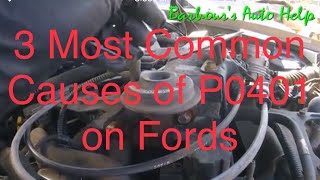
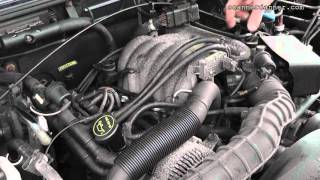
🎬 Watch: A breakdown of the three most common P0401 causes.- Check Engine Light is on
- Engine knocking or pinging, especially under load or acceleration
- Rough idle or stalling, particularly if the valve is stuck open
- Reduced power and acceleration
- Failure to pass an emissions inspection
- Replacing the EGR valve when the actual problem is a much cheaper and easier to replace DPFE sensor.
- Replacing sensors without first checking for simple mechanical issues like clogged passages or cracked hoses.
- Mistaking symptoms of a major vacuum leak from failed intake manifold gaskets for a faulty EGR system. In some cases, mechanics have even misdiagnosed this as a transmission problem.
Most Likely Causes
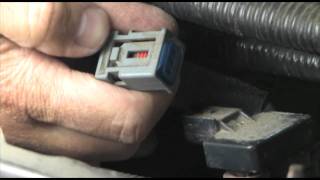
- Faulty DPFE (Differential Pressure Feedback EGR) Sensor 🔴 High Probability The DPFE sensor is a common failure point on many Ford engines from this period. It is exposed to heat and pressure fluctuations that can cause its internal electronics to drift out of specification, providing incorrect voltage readings to the PCM. 🎬 See how to diagnose and repair a faulty DPFE sensor.
How to confirm: With the key on and engine off, use a multimeter to back-probe the sensor's signal wire (often a brown/light green wire). The voltage should be between 0.5V and 1.2V. A reading significantly higher (e.g., 1.9V or more) or lower indicates a bad sensor.
Typical fix: Replace the DPFE sensor and the two small rubber hoses connecting it to the EGR tube. This is a simple repair, usually taking less than 30 minutes.
Est. part cost: $30-$80 - Clogged EGR Passages 🟡 Medium Probability Over time, carbon from the exhaust gas can build up and restrict or completely block the small passages inside the intake manifold where the EGR gas enters. This is the second most common cause after the DPFE sensor.
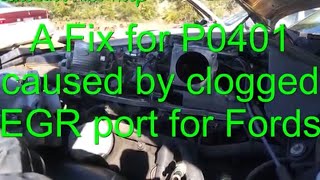
How to confirm: With the engine idling, apply 10-15 in-Hg of vacuum to the EGR valve with a hand pump. The engine should stumble or stall. If there is no change in idle, the passages are likely clogged. Visually inspecting the ports, often by removing the throttle body, can also confirm blockage. The port is visible directly behind the throttle body opening.
Typical fix: Remove the throttle body and/or EGR valve to gain access to the passages. Use picks, brushes, and carburetor cleaner to manually remove the carbon buildup. It is recommended to do this with the intake air inlet removed to prevent debris from falling into the engine.
Est. part cost: $5-$15 for cleaner and gaskets - Failed EGR Valve 🟡 Medium Probability → Shop Exhaust Gas Recirculation (EGR) Valve
How to confirm: Perform the same vacuum test as for clogged passages. If the engine idle does not change, but you have confirmed the passages are clear, the EGR valve itself is likely stuck closed or has a ruptured diaphragm. For the 2005-2006 models, the MAP sensor is integrated into the EGR valve, which can also fail and necessitate replacement of the whole unit.
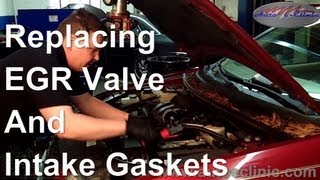
Typical fix: Replace the EGR valve and its gasket. Due to difficult access on the Freestyle (located on the back of the engine near the firewall), this can be a time-consuming and difficult job, often requiring removal of the upper intake manifold. 🎬 Watch this walkthrough for replacing the EGR valve and gaskets.
Est. part cost: $70-$150 - Cracked or Clogged DPFE Hoses ⚪ Low Probability
How to confirm: Visually inspect the two small high-temperature silicone hoses that connect the DPFE sensor to the EGR tube. Look for cracks, holes, brittleness, or melting caused by exhaust heat. Ensure they are not clogged with carbon.
Typical fix: Replace the hoses. It is highly recommended to do this whenever the DPFE sensor is replaced, as they are inexpensive and prone to failure.
Est. part cost: $10-$25
Rare But Worth Checking
- Faulty EGR Vacuum Regulator (EVR) Solenoid: This solenoid controls the vacuum supply to the EGR valve. If it fails, it won't command the valve to open, resulting in insufficient flow. It can be tested for proper operation with a multimeter and vacuum gauge.
- Leaking or Disconnected Vacuum Lines: Any vacuum line supplying the EGR system (specifically the EVR solenoid) could be cracked or disconnected, preventing the EGR valve from opening. A visual inspection and vacuum gauge check are needed.
Diagnosis Steps
- Scan the vehicle for any other trouble codes to see if they provide additional clues.
- Visually inspect all vacuum lines connected to the EGR valve and EVR solenoid for cracks, breaks, or disconnections.
- Inspect the two small hoses running to the DPFE sensor for cracks, melting, or blockages.
- Test the DPFE sensor. With the key on, engine off, back-probe the signal wire (Brown/Light Green). Voltage should be between 0.5V and 1.2V. If it's out of this range, the sensor is likely bad.
- Test the EGR valve's mechanical function. At idle, use a hand vacuum pump to apply 10-15 in-Hg of vacuum to the EGR valve's port. The engine should run rough or stall. If it does, the valve and passages are likely clear. If it doesn't, proceed to the next step.
- If the engine idle doesn't change during the vacuum test, remove the throttle body and visually inspect the EGR passages in the intake manifold for carbon blockage. Clean them thoroughly if clogged.
- If passages are clear but the vacuum test failed, the EGR valve itself is faulty and should be replaced. Be aware that on 2005-2006 models, this assembly also contains the MAP sensor.
Parts You'll Likely Need
- DPFE Sensor
(OEM #F77Z-9J460-AB)— This is the most common failure point for a P0401 code on this platform due to its design and operating environment. It is also sold under the service part number DPFE15.
Trusted brands: Motorcraft, Standard Motor Products
OEM price range: $60-$90
Aftermarket price range: $30-$60 - EGR Valve
(OEM #5F9Z-9D475-BA)— The valve can get stuck closed from carbon buildup or mechanical failure. On 2005-2006 models, it also integrates the MAP sensor. This part number replaces the previous version 5F9Z-9D475-AA.
Trusted brands: Motorcraft, Standard Motor Products
OEM price range: $110-$180
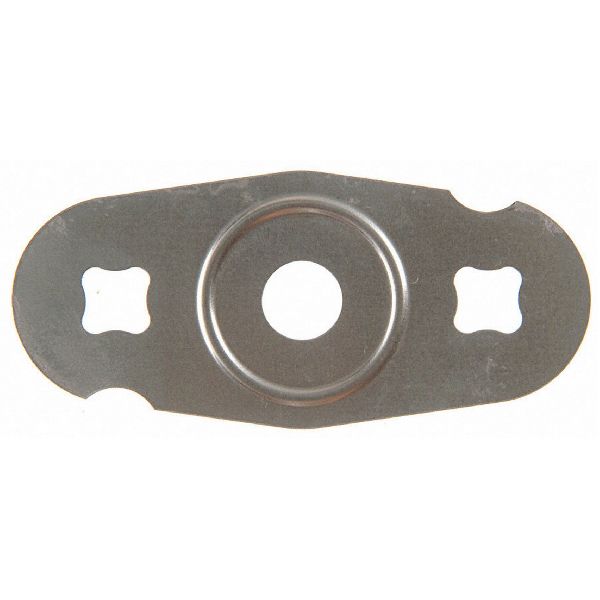
Aftermarket price range: $70-$120 - EGR Valve Gasket — A new gasket is required whenever the EGR valve is removed for cleaning or replacement to prevent leaks. It is often included with a new valve.
Trusted brands: Fel-Pro, Motorcraft
OEM price range: $5-$10
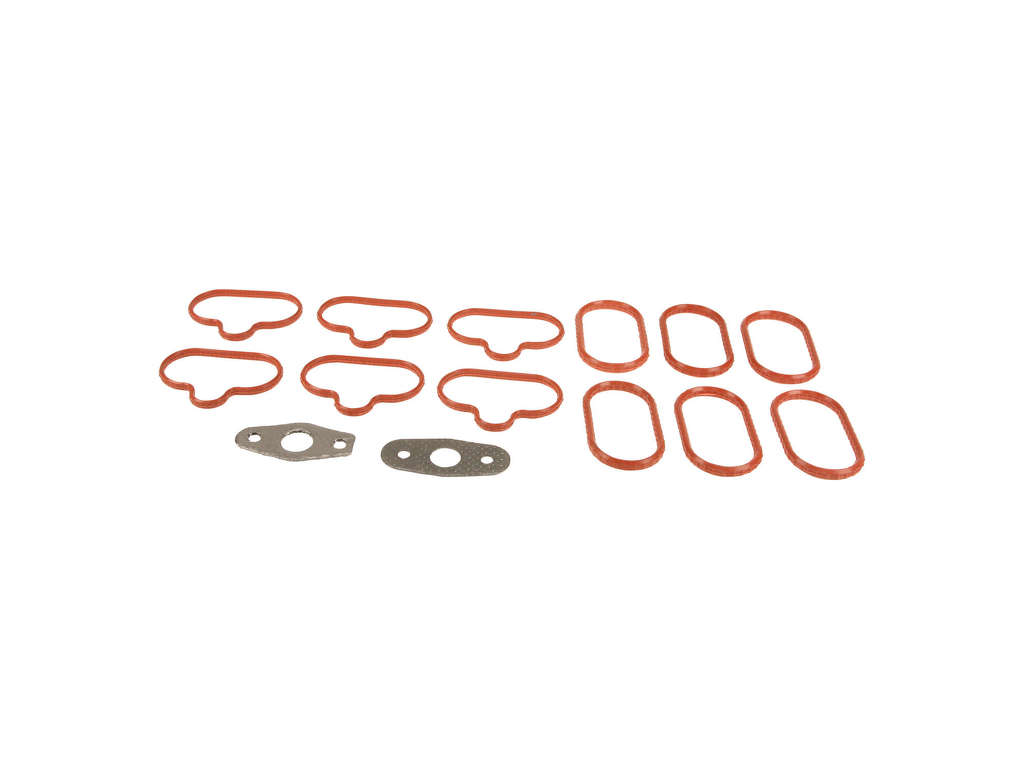
Aftermarket price range: $3-$8 - Upper and Lower Intake Manifold Gaskets — If the EGR valve needs replacement, it is often necessary to remove the upper intake manifold for access. It is highly recommended to replace the upper and lower intake gaskets at this time to prevent future vacuum leaks, which are a known issue on this engine.
Trusted brands: Fel-Pro, Motorcraft
OEM price range: $40-$70
Aftermarket price range: $20-$40
Related Codes That Often Appear With This One
- P0402 — Excessive EGR Flow. Seeing both P0401 and P0402 can strongly indicate a faulty DPFE sensor that is providing erratic readings to the computer.
- P0171, P0174 — System Too Lean (Bank 1 and Bank 2). While not directly related, a significant vacuum leak in the intake manifold gaskets, which can be disturbed during a difficult EGR valve replacement, can cause these codes. A YouTube video by 'Auto E Clinic' documents a case where these codes were present alongside EGR issues.
Technical Service Bulletins (TSBs) & Recalls
- While no specific TSB for P0401 on the Freestyle was found, TSBs for other Ford models with similar EGR systems often point to DPFE sensor failure or the need for a PCM reflash after component replacement.
- A TSB for the related Ford Five Hundred with the same engine notes that lean codes P0171/P0174 could be caused by dried and shriveled intake manifold gaskets, a repair often performed alongside EGR valve replacement.
- Manufacturer Bulletin #TSB 19-2343 notes that for some Ford vehicles, an illuminated MIL with DTC P0401 or P0402 may be due to various strategies within the powertrain control module (PCM) software.
- Manufacturer Bulletin #21M04 describes a condition where customers may experience an illuminated malfunction indicator light due to the EGR cooler becoming partially or completely plugged, resulting in DTC P0401.
- Manufacturer Bulletin #SSM 48345 indicates that P0401 can sometimes be associated with an EGR cooler that is leaking coolant into the engine intake and exhaust systems, which may also cause over-temperature warnings or white smoke.
- Manufacturer Bulletin #TSB 24-2263 highlights that P0401 may occur alongside cooling system symptoms such as internal or external leaks and engine over-temperature.
Platform-Specific Known Issues
- Accessing the EGR valve on the 3.0L V6 in the Freestyle is notoriously difficult, as it is located on the back of the engine against the firewall. Many owners and mechanics find it easier to remove the upper intake manifold to gain access, despite the extra time. A video from 'Auto E Clinic' on YouTube shows this exact process, highlighting that rusted bolts on the EGR pipe often make removal without taking off the intake impossible.
- The intake manifold gaskets on the 3.0L Duratec are a known weak point and can cause vacuum leaks leading to lean codes (P0171, P0174). Since replacing the EGR valve may require removing the intake, it is considered best practice to replace these gaskets simultaneously.
Mechanic-Grade Diagnostic Values
- EGR Vacuum Regulator (EVR) Solenoid Coil Resistance — expected: 26 to 40 Ohms. Failure: A reading of infinity (open circuit) or near zero (short circuit).
- DPFE Sensor Voltage (EGR valve manually opened) — expected: Rises to approx. 4.0V - 4.9V. Failure: Voltage does not rise significantly from the baseline KOEO reading when vacuum is applied to the EGR valve.
- EVR Solenoid Connector Voltage (Key On, Engine Off) — expected: Both wires will show approx. 12V.. Failure: This is an integrity check. With the solenoid plugged in, one wire is a 12V feed and the other shows 12V as it waits for the PCM to provide a ground. If you unplug the solenoid, the feed wire will still show 12V while the control wire will drop to 0V. This confirms the wiring to the solenoid is intact.
Scan Tool Commands That Help
- Ford IDS or equivalent professional scanner: EGR/EVR Duty Cycle Command — After cleaning passages or replacing a valve, you can command the EGR solenoid (EVR) to open by percentage. This allows you to watch the DPFE sensor voltage on the live data screen to confirm the entire system is responding correctly without a full drive cycle.
- Ford IDS or equivalent professional scanner: EGR Valve Initialization / Reset — Some modern systems require a reset procedure after replacing an electronic EGR valve to teach the PCM the new valve's closed and open positions. While less common on this specific vacuum-actuated system, it's a function to look for in the scanner's special functions menu after a repair.
Wiring & Ground Locations
- PCM Location — Right rear of the engine compartment, near the firewall.. This is the location of the Powertrain Control Module (PCM), which controls the EGR system and is where all sensor signals and actuator commands originate.
- G101 — Right front of the engine compartment.. This is a primary engine ground. A poor connection at G101 can cause erratic behavior and incorrect readings from various engine sensors, including the DPFE sensor.
- G102 — Right rear of the engine compartment.. Another engine compartment ground point. Verifying that major grounds are clean and tight is a crucial step in diagnosing any electronic fault code.
- EVR Solenoid Control Wire — In the harness connector for the EGR Vacuum Regulator solenoid.. This wire, often brown with a pink tracer, is what the PCM pulses with a ground signal to open the EGR valve. A technician can manually apply a ground to this wire to bypass the PCM and test the solenoid's function directly.
OEM Part Supersession History
5F9Z-9D475-AA→5F9Z-9D475-BA— Standard part revision, likely for improved durability or manufacturing process.
Model Year Variations Within This Range
- 2005-2006: On these model years, the Manifold Absolute Pressure (MAP) sensor is explicitly noted as being integrated into the EGR valve assembly. While the same replacement part number (5F9Z-9D475-BA) is listed for all 2005-2007 models, this integration is a key diagnostic and cost factor for the earlier years in the range.
Diagnostic Flowchart
Other Known Issues on This Vehicle
Issues unrelated to this code that are worth knowing about as an owner of this generation:
- Continuously Variable Transmission (CVT) Failure 🔴 High — A widely reported issue. Failures can occur at various mileages, sometimes as low as 40,000 miles. Symptoms include lurching, loss of acceleration, and high RPMs with no movement. (Ref: Multiple TSBs exist, including TSB #06114 for CVT noise diagnosis. Repair often involves costly replacement as many shops cannot service the unit.)
- Internal Water Pump Failure 🔴 High — The water pump is internal and driven by the timing chain. When it fails, it can leak coolant directly into the engine oil, leading to catastrophic engine failure if not caught immediately.
- Premature Rear Brake Wear 🟡 Low — Many owners of 2005-2006 models reported abnormally fast wear of rear brake pads and rotors, sometimes requiring replacement twice before 75,000 miles.
- Throttle Body Malfunctions 🟠 Medium → Shop Fuel Injection Throttle Body — Can cause sudden uncontrolled acceleration or a 'wrench' light with poor throttle response. TSB #CSP-12N03 addresses momentary idle surges due to throttle body deposits. (Ref: TSB #CSP-12N03, TSB #SSM 46085)
- Binding Transmission Shifter 🟡 Low — Common across 2005-2007 models, the shifter becomes hard to move from Park due to a binding slider in the shifter bezel. (Ref: TSB #0718 addresses bezel replacement to fix the issue.)
Used vs. New Parts: Buying Guide for This Vehicle
When a used part is the smart pick: Used parts are generally not recommended for the key electronic components in this system (DPFE sensor, EGR valve). However, sourcing a used intake manifold from a low-mileage donor vehicle to clean its EGR passages offline can be a time-saving strategy compared to cleaning the passages on the vehicle.
Donor-vehicle mileage cap: roughly under 100000 miles for the part to have meaningful remaining life.
What to inspect on the donor part:
- Check electrical connectors for green or white corrosion.
- Inspect rubber hoses for pliability; avoid any that are hard or brittle.
- Look for excessive rust on the EGR valve body or mounting bolts, as it indicates a hard life in a salt-belt region.
OEM-only on this vehicle (don't cheap out):
- DPFE Sensor: Due to the high failure rate and sensitivity of this part, using an OEM Motorcraft sensor (F77Z-9J460-AB / DPFE15) is strongly advised to avoid repeat failures.
Aftermarket brands forum-validated for this vehicle:
- Standard Motor Products (SMP)
- Duralast
Real Owner Stories
Aggregated from forums and TSBs cited above. Mileages and costs reflect what owners reported in those sources.
2005 Mercury Montego 3.0L V6 Duratec
Symptoms: Vehicle throwing a P0401 code; owner was unsure whether to replace the EGR valve or the DPFE sensor first due to commonality of both issues.
What fixed it: Diagnostic approach suggested checking the DPFE sensor and EGR valve signals to confirm the failure point before part replacement.
Source hint: Reddit r/MechanicAdvice thread titled '2005 Mercury Montego (Ford Five Hundred) Throwing p0401 code'
2005 Ford Freestyle 3.0L V6 Duratec
Symptoms: Complex EGR-related failure requiring multiple repairs including the catalytic converter and intake manifold.
What fixed it: The owner faced a high-difficulty repair (rated 8-10/10) involving the removal of the intake manifold and dealing with rusty bolts.
Cost: $3000-$3000
Source hint: Reddit r/AskMechanics thread titled 'Is replacing a catalytic converter, intake manifold, and EGR valve on a Ford Freestyle doable?'
2005 Ford Five Hundred 3.0L V6 Duratec
Symptoms: P0401 code present; diagnostic live data used to confirm the failure.
What fixed it: The EGR valve assembly was confirmed as the point of failure after checking electrical signals.
Source hint: YouTube video 'Ford Five Hundred 2005 ( P0401 code diagnose )'
Related OBD-II Codes
Frequently Asked Questions
Is it true that I have to remove the intake manifold just to get to the EGR valve on my 3.0L Freestyle?
Should I replace my intake manifold gaskets while fixing the P0401 code?
How can I tell if my 2005-2006 Freestyle needs a new MAP sensor or a new EGR valve?
What is the most common 'quick fix' for a P0401 on this specific Ford V6?
Can I just clean the EGR passages instead of buying new parts?
Helpful Videos
We Have This Part in Stock


The information in this article is provided for general reference and educational purposes only. Vehicle specifications, procedures, and part compatibility can vary by production date, trim level, and region. Always consult your vehicle's factory service manual and verify part numbers before purchasing or performing repairs. Safety-critical components such as airbags, seat belts, and braking systems should be installed by a qualified professional.
- Ford Freestyle:
- 🧭 Diagnostic Flowchart
- 🎬 Helpful Videos
- 🛍️ Shop This Part
- What's Unique About the 2005-2007 Ford Freestyle
- Symptoms You May Notice
- Most Likely Causes
- Rare But Worth Checking
- Diagnosis Steps
- Parts You'll Likely Need
- Related Codes That Often Appear With This One
- Technical Service Bulletins (TSBs) & Recalls
- Platform-Specific Known Issues
- Mechanic-Grade Diagnostic Values
- Scan Tool Commands That Help
- Wiring & Ground Locations
- OEM Part Supersession History
- Model Year Variations Within This Range
- Other Known Issues on This Vehicle
- Used vs. New Parts: Buying Guide for This Vehicle
- Real Owner Stories
- 2005 Mercury Montego 3.0L V6 Duratec
- 2005 Ford Freestyle 3.0L V6 Duratec
- 2005 Ford Five Hundred 3.0L V6 Duratec
- Related OBD-II Codes
- Frequently Asked Questions
- 🎟️ Get 5% Off