

P0401 on 2007-2012 Mazda CX-7 2.3L Turbo: EGR Flow Insufficient Causes and Fixes
On the 2007-2012 Mazda CX-7 with the 2.3L Turbo engine, code P0401 is almost always caused by heavy carbon buildup clogging the EGR valve and its passages. The fix is to remove and thoroughly clean the valve and intake ports, or replace the EGR valve if it's damaged or the internal motor has failed. This is a very common issue for this direct-injection engine.
- P0401 on your CX-7 is almost certainly due to carbon buildup clogging the EGR system.
- The most effective fix is to remove the EGR valve and thoroughly clean both the valve and the intake manifold passages.
- This is a manageable DIY job (Difficulty 3/5) but requires removing the intercooler and battery for access.
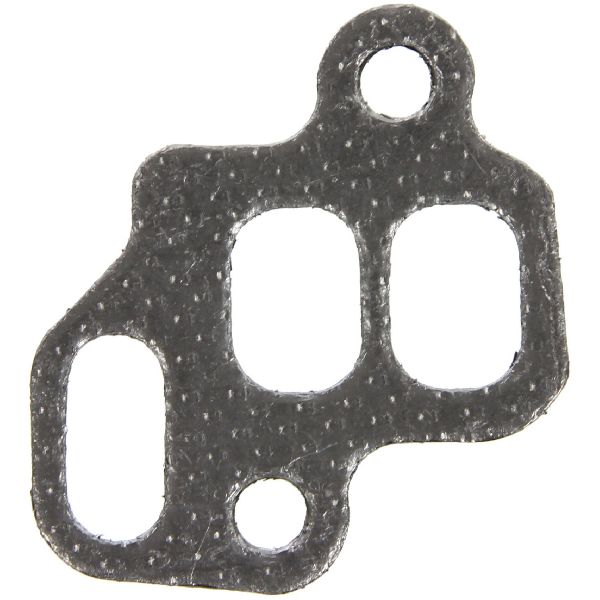
- Always replace the EGR valve gasket (Part #L3K9-13-ZE5) when reinstalling the valve to prevent leaks.
- If cleaning doesn't solve the problem, the EGR valve itself has likely failed electronically and needs to be replaced (Part #L3K9-20-300B).
What's Unique About the 2007-2012 Mazda CX-7
The MZR 2.3L DISI (Direct Injection Spark Ignition) Turbo engine in the CX-7 is a direct-injection design. This technology is inherently prone to heavy carbon buildup in the intake and EGR systems. Because fuel is injected directly into the cylinder instead of washing over the intake ports, there's no gasoline to help clean away oil vapors and exhaust soot. This soot, combined with oil vapor from the PCV system, bakes onto the hot surfaces of the EGR valve and its passages, leading to the exact kind of blockage that triggers a P0401 code. This is a very common and well-documented issue for this specific engine, shared with its platform mates.
Symptoms You May Notice
- Check Engine Light is on
- Rough or uneven idle
- Engine hesitation or sluggish acceleration
- Engine knocking or pinging sound during acceleration
- Failed emissions test
- Slightly reduced fuel economy
- Replacing the EGR valve without cleaning the clogged passages in the intake manifold. The code will return because flow is still insufficient.
Most Likely Causes
- Clogged EGR Valve 🔴 High Probability → Shop Exhaust Gas Recirculation (EGR) Valve The MZR 2.3L DISI Turbo engine produces significant carbon/soot, which easily clogs the small plunger and passages inside the EGR valve, causing it to stick closed. This is the most frequent point of failure.
How to confirm: Remove the EGR valve and visually inspect it for heavy carbon deposits that prevent the internal plunger from moving freely. When removed, you can often feel the plunger is seized or gritty in its movement.
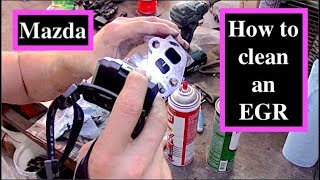
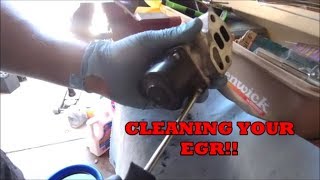
Typical fix: Thoroughly clean the valve with carburetor or brake parts cleaner, scraping out all carbon until the plunger moves smoothly. 🎬 See how to deep clean the valve and internal plunger. If cleaning doesn't work or the code returns, the valve's internal motor has likely failed and the entire valve must be replaced.
Est. part cost: $150-$350 for a new valve - Clogged EGR Passages in Intake Manifold 🔴 High Probability → Shop Engine Intake Manifold The same carbon that clogs the valve also builds up in the port where the exhaust gas enters the intake manifold. Even a clean EGR valve cannot flow gas if its destination port is blocked. This is a critical and often-missed step.
How to confirm: When the EGR valve is removed, inspect the corresponding port on the intake manifold. It will likely be restricted with thick, hard carbon deposits. A mirror and flashlight may be needed to see the extent of the blockage.
Typical fix: Carefully scrape and clean the carbon out of the intake manifold port using picks, brushes, and chemical cleaners. Use rags to prevent debris from falling into the engine. This should be done any time the EGR valve is cleaned or replaced.
Est. part cost: $0 (requires cleaning supplies) - Failed EGR Valve (Electronic) 🟡 Medium Probability → Shop Exhaust Gas Recirculation (EGR) Valve The constant struggle to move a carbon-stuck valve can burn out the internal electric motor. Sometimes the electronics fail on their own without severe clogging, which can also trigger a P0403 circuit code.
How to confirm: Use a capable bidirectional scan tool to command the EGR valve to open and close while monitoring engine RPMs or MAP sensor data. If the valve clicks but there is no change in engine operation (and passages are confirmed clean), the valve is likely faulty. You may also hear a faint click from the valve when activated.
Typical fix: Replace the EGR valve. Cleaning will not fix an electronic failure.
Est. part cost: $150-$350
Rare But Worth Checking
- Cracked or Clogged EGR Tube:
- Faulty MAP Sensor: → Shop Manifold Absolute Pressure Sensor
Diagnosis Steps
- Confirm the P0401 code is present using an OBD-II scanner.
- For access, disconnect the negative battery terminal. Remove the top-mount intercooler, the battery, and the battery tray. A rag should be placed in the turbo opening to prevent debris from entering.
- Locate the EGR valve. It is mounted to the intake manifold, connected by a metal tube from the exhaust side.
- Disconnect the electrical connector and the two coolant hoses attached to the EGR valve. Be prepared to catch a small amount of coolant (about a quart).
- Remove the two bolts holding the EGR valve to the intake manifold and remove the valve.
- Visually inspect the valve and the port on the intake manifold for heavy carbon buildup. This is the most likely cause.
- If clogged, thoroughly clean the EGR valve's plunger and passages using brake/carb cleaner and small brushes until it moves freely. Also, carefully clean the carbon from the intake manifold port, blocking the opening with a rag to prevent debris from falling inside. Some owners report success using dental picks and coat hangers to break up deposits.
- If the valve appears clean or cleaning does not resolve the issue, test the valve's motor using a bidirectional scanner to command it open and closed. If it fails to respond, it needs replacement.
- Install the cleaned or new EGR valve using a new gasket. The old metal gasket should not be reused.
- Reassemble all components in the reverse order of removal.
- Top off any lost coolant.
- Reconnect the battery, clear the code with the scanner, and perform a test drive that includes varied speeds and loads to allow the PCM to verify the repair.
Parts You'll Likely Need
- EGR Valve
(OEM #L3K9-20-300B)— This is the component that gets clogged with carbon or fails electronically, directly causing the P0401 code. While cleaning often works, replacement is the definitive fix. The part number L3K9-20-300B supersedes previous versions L3K9-20-300 and L3K9-20-300A.
Trusted brands: Mazda (OEM), Standard Motor Products, Dorman
OEM price range: $250-$350
Aftermarket price range: $150-$250 - EGR Valve Gasket
(OEM #L3K9-13-ZE5)— A new gasket is required to ensure a proper seal between the EGR valve and the intake manifold, preventing vacuum or exhaust leaks after the repair.
Trusted brands: Mazda (OEM), Fel-Pro, Mahle
OEM price range: $15-$25
Aftermarket price range: $5-$15
Related Codes That Often Appear With This One
- P0403 — P0403 indicates an electrical circuit failure in the EGR valve. A valve that is mechanically stuck with carbon (P0401) can strain the motor and eventually cause it to fail electrically, triggering P0403.
- P0300-P0304 — Misfire codes can sometimes occur alongside P0401. While a stuck-closed EGR valve is more common for P0401, an intermittently sticking valve can disrupt the air/fuel mixture and cause misfires.
Technical Service Bulletins (TSBs) & Recalls
- SA-072/17 (for 2016-18 CX-9): While for a different model, this service alert instructs dealers to inspect for carbon deposits and replace the EGR valve if found when a P0401 is present, corroborating the common failure mode across Mazda vehicles.
- Bulletin #SA-072-17: This manufacturer bulletin notes that if a customer complains of a Check Engine Light with DTC P0401 stored in memory, technicians should follow a specific repair procedure.
- Bulletin #01-017-18-3518: A manufacturer service bulletin for the CX-9 notes that customers may experience a check engine light with DTC P0401:00 (EGR flow insufficient) stored in memory without any drivability issues.
- SSP-86: A warranty extension program for 2007-2009 CX-7s regarding heavy white smoke from the exhaust, caused by oil leaking from the turbocharger. While not directly related to P0401, it highlights the oil and heat issues of the engine that contribute to carbon and sludge.
Platform-Specific Known Issues
- The MZR 2.3L DISI Turbo engine is widely known in owner communities for causing P0401 due to its direct-injection design leading to rapid and severe carbon buildup in the EGR system.
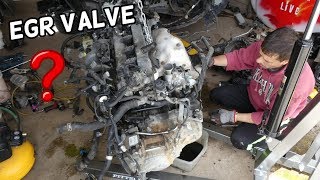
- Access to the EGR valve is considered difficult by many DIYers, requiring the removal of the top-mount intercooler, battery, and battery tray. 🎬 Watch: How to access and remove the EGR valve.
Mechanic-Grade Diagnostic Values
- Mass Air Flow (MAF) at idle — expected: Approximately 12-14 g/s with EGR valve closed.. Failure: If commanding the EGR valve open with a scan tool does not cause this value to drop significantly, it indicates a flow restriction.
- Mass Air Flow (MAF) with EGR commanded open — expected: Should drop to approximately 5-6 g/s when the EGR valve is commanded 80% open on a healthy, clean system.. Failure: A smaller drop or no drop in MAF reading indicates insufficient EGR flow, confirming the P0401 condition. 🎬 Watch: A complete walkthrough of the P0401 diagnostic and fix.
- EGR Valve Motor Bench Test — expected: When terminals 1 and 5 are connected to a 9-volt battery, the internal pintle/plunger should move up and down.. Failure: If the pintle does not move, the valve's internal motor is faulty and the valve must be replaced.
Scan Tool Commands That Help
- Autel, FORScan, or similar bidirectional scanner: Active Test: 'EGR exhaust gas recirculation valve stepping motor position' — Use this test to verify if the EGR valve's electronic motor is functional. You can command the valve to open in steps (e.g., 10%, 20%, up to 80%) and listen for a click or watch for a corresponding change in engine RPM or MAF sensor readings on live data. If the valve clicks and engine parameters change, the valve motor is likely good and the problem is a physical blockage. If it does not click or parameters do not change, the valve has failed electronically.
Wiring & Ground Locations
- G2 — Left rear corner of the engine compartment.. This is a primary ground point for the engine control system, including the PCM which controls the EGR valve. A poor connection here can cause erratic behavior of multiple sensors and actuators.
- G10 — Under the left side of the dash, near the kick panel.. This is an interior ground point that can affect the Body Control Module (BCM) and other systems that communicate with the PCM. While less likely to be the direct cause, it's a key location in the vehicle's grounding scheme.
- EGR Valve Connector — On the EGR valve itself, located at the top rear of the engine.. The wires to this 6-pin connector can become brittle from heat and break, causing a P0403 (circuit code) but can also be related to a P0401 if the valve isn't receiving the command to open. Schematics are available showing the wire colors for repair.
- PCM (Powertrain Control Module) — Left rear corner of the engine compartment.. This is the computer that commands the EGR valve and monitors for the P0401 condition. Knowing its location is critical for tracing wiring from the EGR valve connector.
Real Owner Repair Stories
- NHTSA ODI #10490942 — An owner reported the engine light came on and the vehicle was diagnosed with code P0401, EGR valve failure. With under 40,000 miles, the owner noted the repair cost was $718 for diagnosis, parts, and labor.
- mazdaspeedforums.org user 'Raider' (2007 Mazdaspeed3 (same engine/EGR system)) — P0401 CEL at 51,000 miles.
❌ Tried (didn't work) The user had the code return a couple of years after an initial cleaning.
✅ What actually fixed it For a persistent issue, the user found that using a full bottle of Chevron Techron Complete Fuel System Cleaner in a tank of gas caused the light to go off after about 200 miles. They continued this annually as a preventative measure and the code did not return. This suggests it may work for minor-to-moderate clogging. - YouTube channel 'Big Joes Chop Chop' (2008 Mazda CX-7) — Persistent P0401 error code.
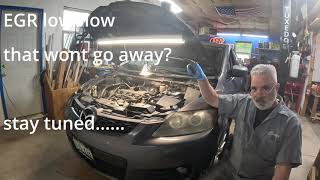
❌ Tried (didn't work) Cleaning the original EGR valve., Replacing the EGR valve with a new one., Cleaning the EGR pipe.
✅ What actually fixed it The problem was finally solved by thoroughly cleaning the EGR passages inside the intake manifold itself, which were still completely blocked even after replacing all other components. This is the most common reason for the code to return after a repair.
"I Checked Everything" — The Actual Cause
- A smoke test is not a relevant diagnostic procedure for a P0401 code. This code indicates 'insufficient flow,' which is caused by a blockage, not a leak that a smoke test is designed to find. All successful diagnostic paths for this code on this vehicle involve finding and clearing a carbon blockage in the EGR valve, EGR pipe, or intake manifold passages.
OEM Part Supersession History
L3K9-20-300, L3K9-20-300A, L3K9-20-300A9U→L3K9-20-300B— Standard part revision by the manufacturer to improve reliability or address issues in earlier designs.
Heads up: The L3K9-20-300B is the correct and current part for all 2007-2012 CX-7 2.3L Turbo models and is fully compatible.
Model Year Variations Within This Range
- 2007-2009 vs 2010-2012: There is a significant difference in the estimated professional repair cost for an EGR valve replacement. RepairPal estimates a range of $651-$982 for 2007-2009 models, but only $298-$430 for 2010-2012 models. This is despite using the same part number, and may reflect changes in dealer pricing, labor time guides, or initial part availability over the years.
Diagnostic Flowchart
Other Known Issues on This Vehicle
Issues unrelated to this code that are worth knowing about as an owner of this generation:
- Timing Chain Stretch & VVT Actuator Failure 🔴 High — Common, especially on earlier models (pre-2010). Often presents as a rattling/ticking noise on cold starts that lasts for a few seconds. Can occur from 60,000 miles onward. (Ref: Mazda issued a warranty extension (SSP 87) and TSB 01-012/12 for this issue, covering vehicles for 7 years or 70,000 miles.)
- Turbocharger Failure ('Smoking Turbo Syndrome') 🔴 High — Very common. Caused by oil starvation from a clogged banjo bolt filter screen or oil coking from heat. Symptoms include heavy blue/white smoke from the exhaust, especially after idling. (Ref: Mazda issued a warranty extension (SSP-86) for some model years to address this.)
- High-Pressure Fuel Pump (HPFP) Failure 🟠 Medium — Can fail, leading to fuel mixing with engine oil (raising oil level on dipstick), hard starting, and loss of power.
- Engine Oil Sludge Buildup 🟠 Medium — The engine runs hot and is prone to oil sludge, especially with extended oil change intervals. This contributes to turbo failure and VVT issues.
- Air Conditioning Compressor Failure 🟡 Low — A frequently reported failure point, leading to a loss of A/C.
Used vs. New Parts: Buying Guide for This Vehicle
When a used part is the smart pick: It is strongly recommended NOT to buy a used EGR valve for this repair. The primary failure mode is internal carbon clogging from normal engine operation. A used part from a donor vehicle will have accumulated an unknown amount of carbon and is likely to fail soon, if it doesn't already have the same P0401-causing restriction.
What to inspect on the donor part:
- Not applicable for the EGR valve itself. If sourcing other hardware like the EGR tube or mounting bolts, inspect for heavy rust, cracks, or stripped threads.
OEM-only on this vehicle (don't cheap out):
- EGR Valve: While aftermarket options exist, the OEM Mazda valve (L3K9-20-300B) is the most reliable choice to ensure compatibility and longevity. Many forum users and technicians default to OEM for critical electronic emissions components to avoid repeat work.
Aftermarket brands forum-validated for this vehicle:
- Standard Motor Products (SMP)
- Dorman (often a last resort, but widely available)
Brands owners have reported issues with on this vehicle:
- Unbranded, no-name parts from online marketplaces should be avoided. The electronic stepper motor and position sensor inside the valve must meet precise specifications, and cheap alternatives are a common cause of immediate or premature failure.
Real Owner Stories
Aggregated from forums and TSBs cited above. Mileages and costs reflect what owners reported in those sources.
2007 Mazda CX-7 Sport MZR 2.3L DISI Turbo — 150000 miles
Symptoms: Check Engine Light (CEL) on for about 8 months with codes P0301 and P0401.
What fixed it: Installation of a new EGR valve with a new gasket, along with new spark plugs, fuel injectors for cylinders 2 and 4, and coils for cylinders 1, 2, and 4.
Source hint: Mazdas247 forum post by an owner of a 2007 Mazda CX-7 Sport
2007-2012 Mazda CX-7 MZR 2.3L DISI Turbo
Symptoms: P0401 CEL Code; carbon buildup in the EGR system.
What fixed it: Thoroughly cleaning the EGR valve's plunger and passages using brake/carb cleaner and brushes, followed by annual use of Chevron Techron fuel system cleaner to prevent recurrence.
Source hint: mazdaspeedforums.org thread titled 'How to Clean your EGR Valve on your Mazdaspeed 3/6 or CX-7 to fix the P0401 CEL Code'
Related OBD-II Codes
Frequently Asked Questions
Does the SSP-86 warranty extension for the 2007-2009 CX-7 cover my P0401 code?
Is it true that I have to remove the battery just to get to the EGR valve on my CX-7?
Can I just clean the EGR valve, or do I need to buy a new one for $150-$350?
Why does my CX-7 keep throwing P0401 even after I installed a brand new EGR valve?
Is the P0401 issue on my CX-7 the same as the one on the Mazdaspeed3?
Does TSB SA-072/17 apply to my 2007-2012 CX-7?
Helpful Videos
We Have This Part in Stock




The information in this article is provided for general reference and educational purposes only. Vehicle specifications, procedures, and part compatibility can vary by production date, trim level, and region. Always consult your vehicle's factory service manual and verify part numbers before purchasing or performing repairs. Safety-critical components such as airbags, seat belts, and braking systems should be installed by a qualified professional.
- Mazda CX-7:
- 🧭 Diagnostic Flowchart
- 🎬 Helpful Videos
- 🛍️ Shop This Part
- What's Unique About the 2007-2012 Mazda CX-7
- Symptoms You May Notice
- Most Likely Causes
- Rare But Worth Checking
- Diagnosis Steps
- Parts You'll Likely Need
- Related Codes That Often Appear With This One
- Technical Service Bulletins (TSBs) & Recalls
- Platform-Specific Known Issues
- Mechanic-Grade Diagnostic Values
- Scan Tool Commands That Help
- Wiring & Ground Locations
- Real Owner Repair Stories
- "I Checked Everything" — The Actual Cause
- OEM Part Supersession History
- Model Year Variations Within This Range
- Other Known Issues on This Vehicle
- Used vs. New Parts: Buying Guide for This Vehicle
- Real Owner Stories
- 2007 Mazda CX-7 Sport MZR 2.3L DISI Turbo — 150000 miles
- 2007-2012 Mazda CX-7 MZR 2.3L DISI Turbo
- Related OBD-II Codes
- Frequently Asked Questions
- 🎟️ Get 5% Off