

P0420 on 2011-2018 Ram 1500 5.7L Hemi: Causes for Catalyst Efficiency Code
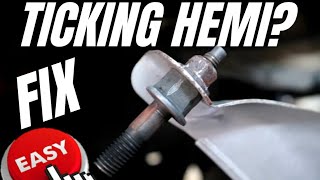
On a 2011-2018 Ram 1500 with the 5.7L Hemi, P0420 is very often caused by an exhaust manifold leak from broken bolts, a well-known issue for this engine. Before replacing the expensive catalytic converter, thoroughly inspect for exhaust leaks and test the O2 sensors. This issue is so prevalent that it's often referred to as the 'Hemi Tick'.
- For a P0420 code on a 2011-2018 Ram 1500 5.7L, your first suspect should always be an exhaust manifold leak from broken bolts.
- Listen for a 'ticking' noise when the engine is cold as a key symptom of the most common cause.
- Do not replace the expensive catalytic converter until you have definitively ruled out exhaust leaks and a faulty downstream O2 sensor.
- If you have other codes, especially for engine misfires (P030x), you must diagnose and fix those first to prevent damaging a new catalytic converter.
What's Unique About the 2011-2018 Ram 1500
For the 2011-2018 Ram 1500 with the 5.7L Hemi, P0420 is frequently linked to a specific, well-documented engine flaw: broken exhaust manifold bolts. These bolts, particularly the rearmost ones, are prone to snapping after repeated heat cycles, causing an exhaust leak often identified by a distinct ticking noise on cold starts, known as the 'Hemi tick'. This leak introduces unmetered oxygen into the exhaust stream before the O2 sensors, which can trick the sensors into sending false data to the PCM. This leads to a P0420 code even when the catalytic converter itself is still functional. Because this issue is so common, it should be the first suspect during diagnosis. Many owners on forums report that fixing the manifold leak resolves the P0420 code.
Symptoms You May Notice
- Check Engine Light is on
- A ticking noise from the engine bay, especially when cold (indicative of an exhaust manifold leak)
- Reduced fuel economy
- Possible lack of engine power or acceleration
- Rotten egg smell from the exhaust, indicating a failing catalytic converter.
- Strong exhaust odor inside the cabin if the leak is significant.
- Immediately replacing the catalytic converter without first checking for exhaust manifold leaks. Due to the high frequency of broken manifold bolts on the 5.7L Hemi, this is the most common misdiagnosis that leads to wasted money.
- Replacing the O2 sensor without confirming it is faulty. While O2 sensors can fail, an exhaust leak is a more probable cause for the incorrect readings on this platform.
Most Likely Causes
- Cracked Exhaust Manifold / Broken Bolts 🔴 High Probability → Shop Exhaust Manifold The 5.7L Hemi's cast iron exhaust manifolds and steel bolts expand and contract at different rates, causing the rearmost bolts to break over time. This is a widely documented issue known as the 'Hemi Tick'. The constant stress eventually fatigues and snaps the bolts.
How to confirm: Perform a cold start and listen for a ticking noise from the passenger side of the engine bay that may quiet down as the engine warms up. Visually inspect the exhaust manifold for broken bolt heads (especially the one closest to the firewall) and look for black soot trails indicating a leak. A mechanic can also use a smoke machine to pinpoint the leak.
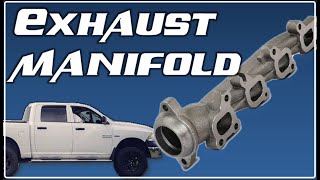
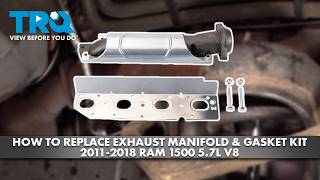
Typical fix: Replace the exhaust manifold, gasket, and all mounting bolts. Many owners opt for upgraded aftermarket manifolds (e.g., BD Diesel) or stronger bolts/studs to prevent a recurrence. Some owners have the warped original manifolds milled flat and reinstall them 🎬 See a full walkthrough on replacing the manifold and gasket. with new gaskets and bolts.
Est. part cost: $150-$550 - Failing Catalytic Converter 🔴 High Probability → Shop Catalytic Converter Converters can fail from normal aging (over 100,000-150,000 miles), or be damaged prematurely by unburnt fuel from engine misfires or contamination from oil/coolant leaks. The intense heat from unburnt fuel can melt the internal substrate.
How to confirm: After ruling out exhaust leaks and O2 sensor issues, use a scan tool to graph O2 sensor data. A healthy converter shows a steady downstream O2 sensor voltage, while a failing one will have the downstream sensor voltage fluctuating similarly to the upstream sensor. An infrared thermometer can also be used; the outlet should be significantly hotter than the inlet on a working converter. A rattling noise from the exhaust can also indicate a broken converter substrate.
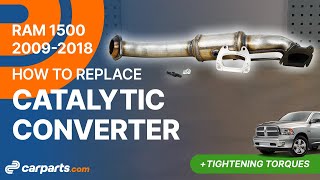
Typical fix: Replace the Bank 1 catalytic converter assembly. Aftermarket brands like Walker are a common, more affordable alternative to OEM. 🎬 Watch how to replace the catalytic converter on your Ram.
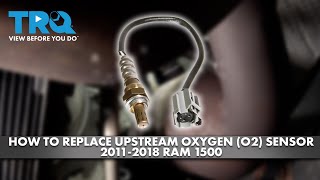
Est. part cost: $600-$1800 - Faulty Downstream Oxygen (O2) Sensor 🟡 Medium Probability → Shop Oxygen Sensor O2 sensors are wear-and-tear items that become less accurate over time. They can get 'lazy' or contaminated, sending incorrect data to the PCM that mimics a bad converter. Sometimes, replacing a faulty O2 sensor can cause a P0420 to appear if the old sensor was too 'lazy' to detect a pre-existing converter issue.
How to confirm: The best way is to view live data on a scan tool. The downstream (Bank 1, Sensor 2) sensor's voltage should be relatively stable around 0.5-0.8V on a warm engine at steady RPM. If it's stuck high, low, or fluctuates wildly like the upstream sensor, it may be faulty. Swapping the Bank 1 and Bank 2 downstream sensors and seeing if the code changes to P0430 (for Bank 2) is another effective diagnostic step.
Typical fix: Replace the Bank 1, Sensor 2 (downstream) oxygen sensor. Common replacement brands include Mopar, NTK/NGK, Denso, and Bosch.
Est. part cost: $50-$130 - Engine Misfires or Fuel System Issues ⚪ Low Probability The 5.7L Hemi uses 16 spark plugs, increasing the chance of a worn plug causing incomplete combustion. A known issue with camshaft/lifter failure on some Hemi engines can also cause persistent misfires that dump unburned fuel into the exhaust, destroying the converter.
How to confirm: Check for other stored trouble codes, especially misfire codes (P0300, P0301, etc.). If misfire codes are present, diagnose the cause (spark plugs, ignition coils, fuel injectors, or internal engine issues) before addressing the P0420.
Typical fix: Perform a full tune-up (spark plugs, coils). Address any specific cylinder misfires. In severe cases, this could point to internal engine work related to the camshaft and lifters.
Est. part cost: $100-$500+
Rare But Worth Checking
- PCM Software Update Required:
- O2 Sensor Spacers / 'Cheaters': → Shop Oxygen Sensor
Diagnosis Steps
- Check for other diagnostic trouble codes (DTCs). Misfire (P030x), fuel system, or lean codes (P2096) must be addressed first, as they can cause a P0420.
- Perform a cold start and listen carefully for a 'ticking' sound from the passenger side engine bay. This is a classic sign of an exhaust manifold leak on a 5.7L Hemi.
- Visually inspect the Bank 1 (passenger side) exhaust manifold for signs of leaks, such as black soot trails or broken bolt heads, paying close attention to the bolt nearest the firewall.
- If no leaks are apparent, use a scan tool to observe the live data for the upstream (B1S1) and downstream (B1S2) oxygen sensors. The B1S1 sensor should fluctuate rapidly, while the B1S2 sensor should remain relatively stable and flat. If B1S2 mimics B1S1, the converter is likely not working or an exhaust leak is present.
- Test the downstream O2 sensor. You can swap the downstream sensors from Bank 1 and Bank 2. Clear the codes and drive. If the code changes to P0430 (Bank 2), the sensor is faulty.
- Check for Technical Service Bulletins (TSBs) related to P0420 or PCM updates for your specific model year. A software update at a dealership may be the required fix.
- If exhaust leaks, O2 sensors, and software have been ruled out, the catalytic converter is the most likely culprit.
Parts You'll Likely Need
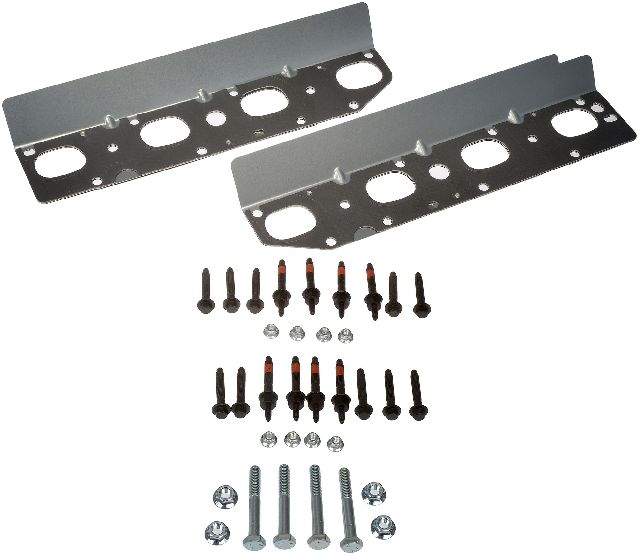
- Exhaust Manifold Kit (Bank 1 / Passenger Side)
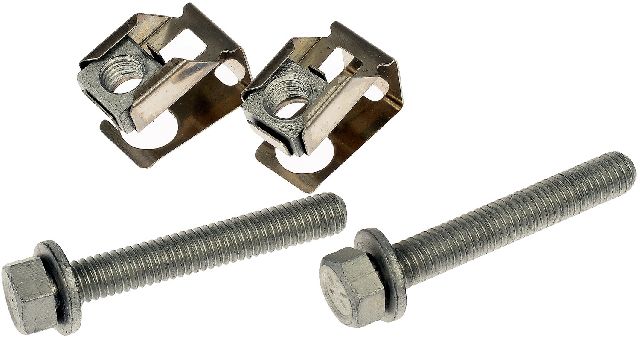
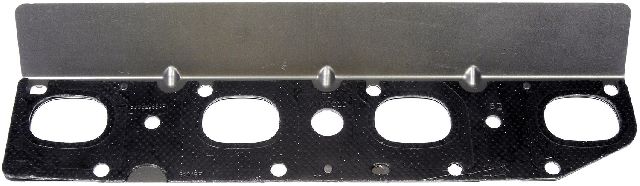
(OEM #68591585AA)— This is the most common point of failure leading to a P0420 code on this specific engine due to broken bolts causing an exhaust leak. Repair often involves new bolts (e.g., Mopar 06507746AA, 6510140AA) and a gasket.
Trusted brands: Mopar, Dorman, BD Diesel
OEM price range: $200-$350
Aftermarket price range: $150-$400
Related Codes That Often Appear With This One
- P0430 — This is the identical code for Bank 2 (driver's side). If both appear together, it could point to a systemic issue like a fuel delivery problem, the need for a PCM software update, or that both exhaust manifolds have leaking bolts.
- P0300-P0308 — These are cylinder misfire codes. An engine misfire allows unburnt fuel to enter the exhaust, which can overheat and damage the catalytic converter, leading to a P0420 code.
- P2096 — This code indicates a lean condition on Bank 1, post-catalyst. It is often caused by the same exhaust manifold leaks that can also trigger P0420, as the leak introduces extra oxygen that the downstream sensor detects.
Technical Service Bulletins (TSBs) & Recalls
- While no specific TSB for P0420 on the 2011-2018 Ram 1500 was found, related TSBs for other vehicles with similar engine platforms (like Jeep Grand Cherokee) and for similar codes (like P2096 on the Ram) suggest that PCM software updates can be a potential fix for overly sensitive emissions monitoring. TSBs for other manufacturers facing P0420 often involve a PCM reflash to adjust catalyst monitoring sensitivity.
Platform-Specific Known Issues
- The 5.7L Hemi engine is notorious for breaking exhaust manifold bolts, particularly the rear-most bolts that thread into the aluminum cylinder heads. This causes a pre-catalyst exhaust leak that is a very common root cause for code P0420 on these trucks.
- Some Hemi engines can suffer from camshaft and lifter failure, which will cause persistent misfires (P030x codes) that can quickly destroy a catalytic converter by sending unburnt fuel into the exhaust.
Mechanic-Grade Diagnostic Values
- Upstream O2 Sensor (B1S1) Voltage — expected: Rapidly fluctuating between ~0.1V and ~0.9V at operating temperature.. Failure: Slow or no fluctuation, or voltage is stuck.
- Downstream O2 Sensor (B1S2) Voltage — expected: Relatively stable voltage, typically between 0.5V and 0.8V at a steady RPM.. Failure: Voltage fluctuates rapidly, mirroring the upstream sensor, or is stuck very low (near 0V).
- Long-Term Fuel Trim (LTFT) — expected: Within +/- 5% at idle.. Failure: High positive or negative fuel trims (e.g., >10%) can indicate an underlying issue like a vacuum leak or fuel delivery problem that could damage the converter.
- Mode $06 Catalyst Monitor Test (Bank 1) — expected: The measured value from the scan tool should be within the MIN/MAX range specified by the PCM.. Failure: The test result is marked as 'FAIL' or the measured value is outside the specified threshold, indicating the catalyst is borderline or failing even if the code is intermittent.
- Fuel Pressure (5.7L Hemi) — expected: Approximately 57-58 PSI.. Failure: Low fuel pressure can cause a lean condition, while high pressure can cause a rich condition, both of which can lead to P0420.
Scan Tool Commands That Help
- Generic OBD-II Scanner / wiTECH: Clear DTCs / Reset Emissions Monitors — After a repair, such as replacing an O2 sensor or fixing an exhaust leak, the DTCs must be cleared. This action also resets the readiness monitors. A specific 'drive cycle' must then be completed to allow the catalyst monitor to run its self-test and confirm the fix.
- wiTECH (Dealer Tool): HO2S Heater Learn Procedure — Some service documents specify running this procedure after replacing a heated oxygen sensor to ensure the PCM correctly calibrates for the new sensor's heater element.
Wiring & Ground Locations
- Engine Ground Strap — On some model years, a key ground strap fastens to the back of the passenger side cylinder head and connects to the PCM bracket or chassis.. A corroded or broken engine ground strap can cause erratic behavior and incorrect readings from engine sensors, including the oxygen sensors, leading to false trouble codes. One owner found this strap had rotted off and fallen underneath the truck.
- Bank 1 Sensor 2 Connector — The downstream (post-cat) O2 sensor for Bank 1 is located on the passenger side of the vehicle, in the exhaust pipe after the catalytic converter. The connector is typically found on the transmission or nearby frame rail.. This is the primary sensor used to trigger the P0420 code. The wiring and connector are exposed to road debris and heat, and should be inspected for damage, melting, or corrosion which could cause faulty readings.
Real Owner Repair Stories
- RamForum.com user (2007 Ram 1500 5.7L with 181k miles) — Intermittent P0420 code for about a year. B1S1 voltage seemed a bit high and B1S2 varied more than the other bank.
❌ Tried (didn't work) Spark plug change, Fuel system cleaner, Resetting ECM
✅ What actually fixed it The user identified an exhaust manifold leak on Bank 1 and suspected it was the cause. Another user confirmed that starting with the manifold leak is the correct diagnostic step, as the extra air can skew O2 sensor readings and trigger the code. - Reddit r/DodgeRam user (2003 Ram 1500 4.7L) — P0420 code returned after repair.
❌ Tried (didn't work) Replaced exhaust manifolds, Had catalytic converter 'checked' by a shop
✅ What actually fixed it The issue was unresolved in the thread, but a key piece of advice was given: on a 20-year-old vehicle, even if a catalytic converter 'looks' okay, its internal materials are likely degraded and no longer efficient, especially if it's original. The average lifespan is about 10 years.
"I Checked Everything" — The Actual Cause
- A common scenario is a hairline crack in the exhaust manifold that only opens up and leaks significantly when the engine is cold. As the manifold heats up and the metal expands, the crack can seal itself. This can lead to a smoke test on a warm engine passing, while the leak is still present on cold starts, causing the 'Hemi tick' and triggering the P0420 code.
When the Usual Fixes Don't Work
- While an exhaust manifold leak is the most common cause, there are many documented cases where the P0420 code persisted even after fixing leaks and replacing O2 sensors. In one such case, a user on a Pontiac forum (with a similar OBD-II system) replaced the catalytic converter, both O2 sensors, and an intake manifold gasket, but the P0420 code remained. The final solution was to install two spark plug non-foulers as a spacer for the downstream O2 sensor, which pulled the sensor out of the direct exhaust stream and resolved the code, allowing the car to pass an emissions test. This indicates that in some cases, a new (potentially aftermarket) catalytic converter may still not be efficient enough to satisfy the PCM's monitoring, requiring a 'trick' to solve the code.
OEM Part Supersession History
Unknown→68591585AA— Likely a design revision to improve durability or material composition.
Heads up: Part number 68591585AA is listed for the right (passenger) side exhaust manifold kit for a wide range of years, including 2013-2024, indicating it has superseded previous numbers for this generation.
Model Year Variations Within This Range
- 2013-2018: A significant refresh occurred for the 2013 model year. While the 5.7L Hemi block and heads remained largely the same, the engine received a power bump to 395 hp. The 8-speed automatic transmission was introduced, and electric power steering was added. The front grille and fog lights also changed. While these changes don't directly alter the root cause of P0420 (manifold leaks), the introduction of the 8-speed transmission changed the vehicle's operating RPMs, and software calibrations for the PCM would be different from the earlier 2011-2012 models.
Diagnostic Flowchart
Real Owner Stories
Aggregated from forums and TSBs cited above. Mileages and costs reflect what owners reported in those sources.
Ram 1500 5.7L Hemi
Symptoms: Triggered a P0420 code. Owner was unsure whether to replace the O2 sensor or catalytic converter.
What fixed it: Other forum members immediately advised checking for the common exhaust manifold leak as the primary cause before suspecting the O2 sensor or catalytic converter.
Source hint: RamForum.com thread titled 'P0420 code problem'
Ram 1500 5.7L Hemi
Symptoms: Experienced the 'Hemi tick' caused by broken exhaust manifold bolts.
What fixed it: Replaced the exhaust manifold bolts. Owners noted dealership prices were higher, while independent shops were cheaper.
Cost: $700-$1600
Source hint: Reddit r/ram_trucks thread titled 'Quoted 1,600 to repair my exhaust manifold bolts... Is this a good price?'
Ram 1500 5.7L Hemi
Symptoms: Broken exhaust manifold bolts requiring replacement.
What fixed it: Milled the original warped manifolds flat and reinstalled them, as they are less likely to warp again after being heat-cycled. Other users opted for the BD Diesel aftermarket kit.
Source hint: Reddit r/ram_trucks thread titled 'Is manifold bolt replacement worth it?'
Ram 1500 5.7L Hemi
Symptoms: Exhaust manifold leak from broken studs.
What fixed it: Paid an independent shop to replace both manifolds, gaskets, and bolts using Dorman parts.
Cost: $950-$950
Source hint: RamForum.com thread titled 'Cost to Replace Exhaust Manifold Studs, Gaskets and Mill Manifold'
Related OBD-II Codes
Frequently Asked Questions
Is the 'Hemi Tick' related to the P0420 code on my Ram 1500?
Should I replace the O2 sensor or the catalytic converter first?
Are there any TSBs or PCM updates for the P0420 code on the 2011-2018 Ram 1500?
What is the best replacement exhaust manifold to prevent the bolts from breaking again?
Can camshaft or lifter failure cause a P0420 code on my 5.7L Hemi?
How much does it cost to fix the broken exhaust manifold bolts on a Ram 1500?
Helpful Videos
We Have This Part in Stock




The information in this article is provided for general reference and educational purposes only. Vehicle specifications, procedures, and part compatibility can vary by production date, trim level, and region. Always consult your vehicle's factory service manual and verify part numbers before purchasing or performing repairs. Safety-critical components such as airbags, seat belts, and braking systems should be installed by a qualified professional.
- Ram 1500:
- 🧭 Diagnostic Flowchart
- 🎬 Helpful Videos
- 🛍️ Shop This Part
- What's Unique About the 2011-2018 Ram 1500
- Symptoms You May Notice
- Most Likely Causes
- Rare But Worth Checking
- Diagnosis Steps
- Parts You'll Likely Need
- Related Codes That Often Appear With This One
- Technical Service Bulletins (TSBs) & Recalls
- Platform-Specific Known Issues
- Mechanic-Grade Diagnostic Values
- Scan Tool Commands That Help
- Wiring & Ground Locations
- Real Owner Repair Stories
- "I Checked Everything" — The Actual Cause
- When the Usual Fixes Don't Work
- OEM Part Supersession History
- Model Year Variations Within This Range
- Real Owner Stories
- Ram 1500 5.7L Hemi
- Ram 1500 5.7L Hemi
- Ram 1500 5.7L Hemi
- Ram 1500 5.7L Hemi
- Related OBD-II Codes
- Frequently Asked Questions
- 🎟️ Get 5% Off