

P0440 on 2020-2024 Ford Explorer 2.3L: EVAP System Malfunction Causes and Fixes
P0440 on a 2020-2024 Ford Explorer indicates a general fault in the EVAP emissions system. Before replacing any parts, clean the capless fuel filler neck. The most likely culprits are a faulty canister purge valve or a known wiring issue at connector C1198 on the driver's side frame.
- P0440 is a general EVAP system fault; it does not specify a leak size.
- Always start diagnosis by cleaning the capless fuel filler neck thoroughly.
- Before replacing parts, inspect the wiring at connector C1198 on the driver's side frame, a known weak point on this vehicle.
- The most likely failed part is the canister purge valve, which can cause a rough idle or hard starting after refueling.
- Do not immediately assume a major repair is needed; the fix is often simple and inexpensive.
What's Unique About the 2020-2024 Ford Explorer
While P0440 is a generic code, the 2020-2024 Explorer with the 2.3L engine has well-documented EVAP system weak points. Ford's own Technical Service Bulletin (TSB) SSM 51247 directly links a host of EVAP codes (P0455, P0456, P0496, etc.) to a single problematic wiring harness connector: C1198. This connector is located on the driver's side lower frame rail, where it is exposed to moisture, leading to corrosion and poor pin connections. This corrosion disrupts the crucial 5-volt reference (VREF) signals shared by multiple EVAP sensors, making an electrical fault just as likely, if not more so, than a physical component leak.
Symptoms You May Notice
- Check Engine Light is illuminated
- A faint smell of fuel, particularly around the outside of the vehicle
- Potentially hard starting after refueling (a classic symptom of a stuck-open purge valve)
- Remote start feature may be disabled by the system until the fault is cleared
- Message on dash such as 'Check Fuel Fill Inlet'
- Replacing the canister purge valve without first checking the C1198 wiring connector or cleaning the capless fuel filler neck. TSB SSM 50306 specifically notes that the purge valve is often misdiagnosed when the fault is elsewhere.
Most Likely Causes
- Debris in Capless Fuel Filler Neck 🔴 High Probability → Shop Fuel Filler Neck The capless system is convenient but the spring-loaded flap's seal can easily be compromised by dirt, dust, or corrosion, preventing it from closing properly and causing the system to fail its pressure test.
How to confirm: Visually inspect the metal flap and the seal inside the fuel filler neck for any debris or damage. Use the white plastic funnel that came with the vehicle to cycle the flap and check its movement.
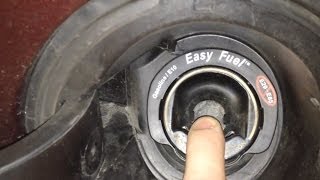
Typical fix: Clean the fuel filler neck opening thoroughly with a clean rag and a small amount of solvent or silicone spray. Cycle the internal flap multiple times with the vehicle's funnel to work in the lubricant and ensure it moves freely and seals correctly. 🎬 Watch: How to properly clean and maintain your capless filler.
Est. part cost: $0 - Wiring Harness Issue at Connector C1198 🟡 Medium Probability Ford TSB SSM 51247 specifically identifies this connector as a common failure point for 2.3L models due to its location on the lower driver's side frame, which exposes it to road spray and salt. Corrosion on the pins disrupts signals for multiple EVAP components.
How to confirm: Locate connector C1198 on the driver's side lower frame area, often underneath the brake lines near the electric brake booster (EBB). Disconnect the battery, then the connector, and inspect the pins and wiring for any signs of green or white corrosion, water intrusion, or loose-fitting terminals.
Typical fix: Clean the connector terminals with electrical contact cleaner. If corrosion is severe or pins are damaged, the connector pigtail (Motorcraft WPT-1198) may need to be spliced into the harness. This is a DIY job for those comfortable with wiring repair.
Est. part cost: $15-$50 - Faulty EVAP Canister Purge Valve 🟡 Medium Probability → Shop Vapor Canister This valve, located on the engine, controls the flow of stored fuel vapors to the engine. It's a common failure item on many modern vehicles, often getting stuck open.
How to confirm: Remove the valve from the engine. With no power applied, it should be closed. Try to blow through it; if air passes, the valve has failed and is stuck open. A hard start immediately after refueling is another strong indicator.
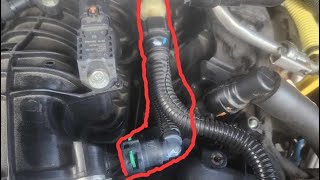
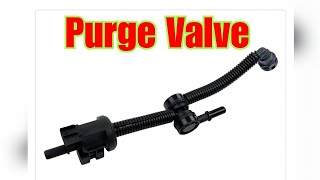
Typical fix: Replace the canister purge valve. On the 2.3L EcoBoost, it is located on the engine and is relatively easy to access and replace, often requiring just an 8mm socket. 🎬 See this walkthrough for replacing the purge valve yourself.
Est. part cost: $40-$80 - Faulty EVAP Vent Solenoid ⚪ Low Probability → Shop Vapor Canister This solenoid, located near the charcoal canister under the vehicle, is responsible for letting fresh air into the system for testing. It can fail, but it is less common than the purge valve for a general P0440 fault.
How to confirm: This is more difficult to confirm without a capable scan tool to command the valve open and closed. A common symptom of a stuck-closed vent solenoid is the gas pump nozzle clicking off repeatedly during refueling.
Typical fix: Replace the vent solenoid, which is typically attached to the charcoal canister under the rear of the vehicle.
Est. part cost: $50-$100
Rare But Worth Checking
- Cracked or Disconnected EVAP Hose: While a physical leak in a hose can cause P0440, it's less common than component or electrical failure on this platform. A visual inspection of lines around the engine bay and near the fuel tank is worthwhile, but a definitive diagnosis often requires a smoke test.
- Leaking Charcoal Canister: → Shop Vapor Canister The canister itself can develop cracks or become saturated with fuel if the tank is consistently overfilled. This is an expensive part, so it should be the last item to suspect after all other causes are ruled out.
Diagnosis Steps
- Read the code with an OBD-II scanner to confirm P0440 and check for any other related codes, especially those listed in TSB SSM 51247 (P0455, P0456, P0496, P04F0).
- Thoroughly inspect and clean the capless fuel filler neck using the vehicle's supplied funnel and a clean rag with silicone spray or similar lubricant. Ensure the internal flap seals correctly.
- Clear the codes and drive the vehicle for a few days to see if the code returns. If it does not, the issue was likely debris in the filler neck.
- If the code returns, locate and inspect wiring connector C1198 on the driver's side lower frame rail for any signs of corrosion or damage, per TSB SSM 51247. Clean and secure the connection or repair as needed.
- If the connector is clean, locate and inspect the EVAP canister purge valve on the engine. Remove it and test if it holds a vacuum (i.e., you cannot blow through it). If air passes, replace it.
- Visually inspect all accessible EVAP hoses in the engine bay and near the fuel tank for obvious cracks, disconnections, or damage.
- If the cause is still not found, the next step is a professional smoke test to find the source of the leak, which could be a faulty vent solenoid, 🎬 Watch: A mechanic explains common causes and fixes for P0440. a cracked charcoal canister, or a hard-to-see hose leak.
Parts You'll Likely Need
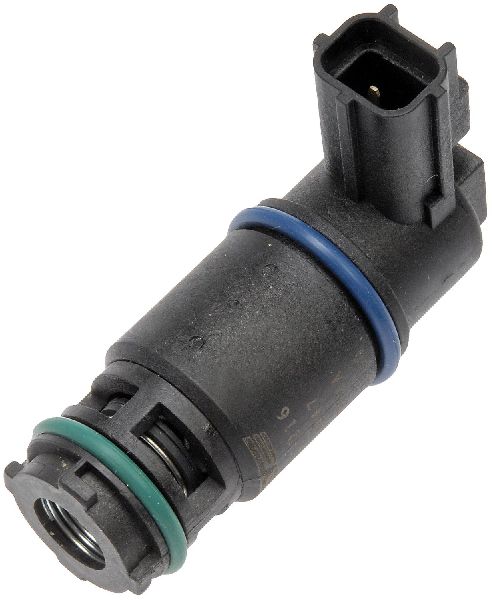
- Vapor Canister Purge Valve/Solenoid
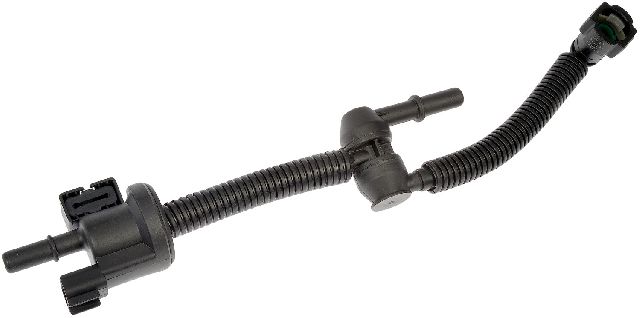
(OEM #L1MZ-9G271-B (Valve Only) or FB5Z-9G271-A (Valve with Hose Assembly))— This is a common failure point that can get stuck open. Part number may vary; L1MZ-9G271-B is the valve itself, while FB5Z-9G271-A is often sold as a kit with attached hoses. Verify which is needed for your specific repair.
Trusted brands: Motorcraft, Bosch, Dorman
OEM price range: $60-$90
Aftermarket price range: $30-$60 - Wiring Harness Connector Pigtail (for C1198)
(OEM #WPT-1198)— If the C1198 connector on the frame rail is corroded beyond cleaning, this pigtail is required to be spliced in to restore proper connection to the EVAP system components.
Trusted brands: Motorcraft
OEM price range: $25-$50
Aftermarket price range: $15-$30 - Capless Fuel Filler Funnel — Required to properly clean and test the seal on the capless fuel filler neck, which is a very common cause of EVAP codes. This part should have come with the vehicle.
Trusted brands: Motorcraft
OEM price range: $5-$15
Aftermarket price range: $5-$10
Related Codes That Often Appear With This One
- P0455 — Indicates a large EVAP leak. If seen with P0440, it strongly points to a major leak source like a stuck-open purge valve or a problem with the capless filler neck seal. It is also listed in TSB SSM 51247 as a code caused by the C1198 connector issue.
- P0456 — Indicates a very small EVAP leak. If seen with P0440, it could point to a failing purge valve or a small crack in a hose. It is also listed in TSB SSM 51247.
- P0496 — Indicates incorrect purge flow. This code, along with P0440, strongly suggests a problem with the canister purge valve or its control circuit. It is also listed in TSB SSM 51247.
- P04F0 — EVAP System Leak Detected (Incorrect Purge Flow). This is another primary code listed in TSB SSM 51247 that points directly to inspecting the C1198 connector.
Technical Service Bulletins (TSBs) & Recalls
- SSM 51247 / 50348: Point to wiring issues at connector C1198 on the driver's side frame as a cause for multiple EVAP codes on 2.3L models.
- SSM 50306: Warns against misdiagnosing the canister purge valve when other faults are more likely.
- TSB 21-2446: Points to loose or partially connected EVAP vapor lines as a cause for codes P04F0 and P144C on 2020-2022 models.
Platform-Specific Known Issues
- A known issue documented in Ford TSB SSM 51247 for the 2020-2022 Explorer 2.3L is a wiring fault at connector C1198 on the driver's side frame, which can cause various EVAP codes including P0440, P0455, P0456, and P0496.
- TSB SSM 50306 warns technicians that the canister purge valve is frequently misdiagnosed and replaced when the actual fault lies elsewhere in the system, such as the C1198 connector or a dirty fuel filler neck.
Mechanic-Grade Diagnostic Values
- Voltage Reference (VREF) at EVAP sensors fed by C1198 — expected: 5.0 Volts (Key On, Engine Off). Failure: A voltage reading significantly lower than 5.0V points to high resistance or a short, likely within connector C1198.
- Fuel Tank Pressure (FTP) Sensor Signal Voltage — expected: ~2.5 - 2.7 Volts (Key On, Engine Off, at atmospheric pressure). Failure: A reading near 0V or 5V indicates an open or shorted circuit. A static value that doesn't change when vacuum is applied also indicates a fault.
- EVAP Canister Purge Valve Coil Resistance — expected: 14-30 Ohms. Failure: A reading outside this range, or an open circuit (infinite resistance), indicates a failed coil in the valve.
Hidden / Shadow Codes Worth Checking
- N/A (Functional Test): While there are no specific 'shadow codes,' the Ford dealer-level scanner (IDS) or advanced tools like ForScan can run a comprehensive 'EVAP System Leak Test.' This automated test commands the vent and purge valves and monitors the FTP sensor to check for leaks, blockages, and correct component response, providing a pass/fail result that is more definitive than just reading generic codes. (see via Ford IDS, ForScan)
Scan Tool Commands That Help
- Ford IDS / ForScan: EVAP System Leak Test — This is the primary factory-level diagnostic test. It should be used to verify the integrity of the entire system after a repair (like cleaning the fuel filler neck) or to confirm if a leak is actually present when a code is intermittent.
- Ford IDS / ForScan: Manual Control of Purge/Vent Valves — Allows a technician to manually command the purge valve and vent solenoid on and off while observing the FTP sensor voltage or fuel trims. This is used to isolate a specific component that is suspected of sticking open or closed (e.g., commanding the purge valve closed and seeing if fuel trims normalize).
Wiring & Ground Locations
- Connector C1198 — On the driver's side lower frame rail, located underneath the brake lines near the electric brake booster (EBB).. This is the primary weak point identified in TSB SSM 51247. It carries three separate 5V reference (VREF) wires for various EVAP sensors. Corrosion here disrupts these signals, causing the PCM to set multiple EVAP codes even if no physical leak exists.
- Ground G104 — Main ground point, often on the frame rail or engine block (exact location requires a specific wiring diagram).. A corroded or loose main ground can cause erratic sensor readings across multiple systems, mimicking component failure. It's a worthwhile secondary check if C1198 appears clean.
- Fuse F2 (Underhood) — In the underhood fuse box, also known as the Battery Junction Box.. This fuse provides power to the EVAP Canister Purge Valve. If blown, the valve cannot operate, which could lead to a P0440 fault.
Real Owner Repair Stories
- Synthesized from multiple forum discussions (Explorer ST Forum, Reddit) (2020-2022 Ford Explorer 2.3L EcoBoost) — Persistent Check Engine Light for P0440, sometimes accompanied by P0455 or P0496. Occasionally reported hard starting after refueling.
❌ Tried (didn't work) Replacing the gas cap (or cleaning the capless filler neck multiple times)., Replacing the EVAP canister purge valve on the engine.
✅ What actually fixed it After the initial part swaps failed, the code returned. The final fix was locating connector C1198 on the driver's side frame rail as described in TSB SSM 51247. The connector was found to have visible green corrosion on the pins. The fix involved disconnecting the battery, thoroughly cleaning the male and female pins with electrical contact cleaner, applying dielectric grease, and ensuring a secure connection. In some cases, the connector was damaged beyond repair and had to be replaced with a pigtail (Motorcraft WPT-1198).
"I Checked Everything" — The Actual Cause
- It is common for the 2020-2022 Explorer to pass a smoke test, indicating no physical leaks, yet still have a persistent P0440 or related EVAP code. The actual cause is frequently electrical: corrosion or poor pin fitment in connector C1198 disrupts the signal from the Fuel Tank Pressure (FTP) sensor. The PCM misinterprets this faulty electrical signal as a system leak, even though the EVAP system is physically sealed.
OEM Part Supersession History
4U2Z-14S411-LC→WPT-1198— WPT-1198 is the service part number for the pigtail kit which includes the connector (formerly 4U2Z-14S411-LC), butt splices, and heat shrink tubing.FB5Z-9G271-A→L1MZ-9G271-B— Part number clarification. FB5Z-9G271-A is for the previous generation (2016-2019) Explorer. The correct part for the 2020-2024 Explorer is L1MZ-9G271-B (valve only).
Heads up: FB5Z-9G271-A is a valve and hose assembly for the prior generation and is not the correct part for the 2020+ models, despite some aftermarket listings.
Model Year Variations Within This Range
- 2020-2022: Ford TSBs SSM 51247 and 21-2446, which address the most common non-obvious causes (C1198 connector fault and loose EVAP lines), specifically name the 2020-2022 model years. While the issues may also occur on 2023-2024 models due to similar designs, they are officially documented for the earlier years of this generation.
Diagnostic Flowchart
Other Known Issues on This Vehicle
Issues unrelated to this code that are worth knowing about as an owner of this generation:
- Rear Axle Bolt Fracture 🔴 High — Common enough to trigger multiple recalls (e.g., NHTSA 22V-255, 23V-332) affecting over 238,000 vehicles from 2020-2022. The bolt can fracture, leading to a grinding noise, loss of motive power, and potential rollaway if the parking brake is not engaged. (Ref: Recalls NHTSA 22V-255, 23V-332; TSB SSM 50471)
- 10R60 Transmission Harsh Shifting & Shudder 🟠 Medium — Widespread owner complaints across 2020-2024 models, often described as jerky or delayed shifts, and a 'rumble-strip' shudder at steady speeds. Issues can sometimes be improved with software updates (PCM relearn/break-in TSBs) but may require internal repairs. (Ref: Multiple TSBs exist for software updates and clutch relearn procedures.)
- Rearview Camera Failure 🟠 Medium — Extremely common, affecting hundreds of thousands of 2020-2024 Explorers and platform mates. Results in a blue or black screen instead of a camera image. Multiple recalls have been issued, but owners report recurring issues. (Ref: Recalls NHTSA 23V-022, 23V-342, 24V-123)
- Rodent Damage to Soy-Based Wiring 🟡 Low — An industry-wide issue, but noted by Explorer owners. The soy-based coating used on wiring harnesses can attract rodents, who chew the wires and cause difficult-to-diagnose electrical failures. Not a defect, but a vulnerability for vehicles parked outdoors.
Used vs. New Parts: Buying Guide for This Vehicle
When a used part is the smart pick: For this specific repair, used parts are generally not recommended due to the primary causes being electronic or seal-related. However, a simple plastic component like an EVAP hose or the fuel filler neck assembly could be sourced from a low-mileage, non-corroded (non-salt-belt) donor vehicle if a significant cost saving is realized.
Donor-vehicle mileage cap: roughly under 40000 miles for the part to have meaningful remaining life.
What to inspect on the donor part:
- For a fuel filler neck, inspect the internal flap for smooth operation and the integrity of the rubber seal.
- For any wiring harness or connector, check for zero signs of green/white corrosion, no brittle insulation, and ensure all locking tabs are intact.
- Avoid parts from vehicles in regions that use heavy road salt.
OEM-only on this vehicle (don't cheap out):
- Wiring Harness Connector Pigtail (WPT-1198): Given the critical nature of this connector, using the OEM Motorcraft pigtail is strongly advised to ensure proper pin material and fitment.
Aftermarket brands forum-validated for this vehicle:
- Bosch (for Canister Purge Valve)
- Dorman (for Canister Purge Valve and Vent Solenoid)
Brands owners have reported issues with on this vehicle:
- No-name, unbranded electronic sensors or valves from online marketplaces should be avoided, as their internal components and calibration may not meet OEM specifications, leading to persistent codes.
Real Owner Stories
Aggregated from forums and TSBs cited above. Mileages and costs reflect what owners reported in those sources.
2020 Ford Explorer 2.3L EcoBoost
Symptoms: EVAP code triggered by debris in the capless filler neck preventing the flap from sealing correctly.
What fixed it: Cleaned the fuel filler neck opening with a clean rag and lubricant, then cycled the internal flap multiple times with the vehicle's funnel to work in the lubricant and ensure a correct seal.
Cost: $0
Source hint: BobIsTheOilGuy.com - Thread: 'Quick & Easy "Fix" for "Capless Fuel Systems"'
Related OBD-II Codes
Frequently Asked Questions
My 2021 Explorer 2.3L has a P0440 and the dash says 'Check Fuel Fill Inlet.' Is there a TSB for this?
I'm getting a P0440 code; could this be why my remote start stopped working?
Is it true that the canister purge valve is often misdiagnosed on the 2.3L EcoBoost?
How can I fix the 'Check Fuel Fill Inlet' message without buying parts?
Where is connector C1198 located on the 2020-2024 Explorer 2.3L?
What part do I need if the wiring at connector C1198 is corroded?
Helpful Videos
Used OEM Parts in Stock

New Aftermarket Parts Available


The information in this article is provided for general reference and educational purposes only. Vehicle specifications, procedures, and part compatibility can vary by production date, trim level, and region. Always consult your vehicle's factory service manual and verify part numbers before purchasing or performing repairs. Safety-critical components such as airbags, seat belts, and braking systems should be installed by a qualified professional.
- Ford Explorer:
- 🧭 Diagnostic Flowchart
- 🎬 Helpful Videos
- 🛍️ Shop This Part
- What's Unique About the 2020-2024 Ford Explorer
- Symptoms You May Notice
- Most Likely Causes
- Rare But Worth Checking
- Diagnosis Steps
- Parts You'll Likely Need
- Related Codes That Often Appear With This One
- Technical Service Bulletins (TSBs) & Recalls
- Platform-Specific Known Issues
- Mechanic-Grade Diagnostic Values
- Hidden / Shadow Codes Worth Checking
- Scan Tool Commands That Help
- Wiring & Ground Locations
- Real Owner Repair Stories
- "I Checked Everything" — The Actual Cause
- OEM Part Supersession History
- Model Year Variations Within This Range
- Other Known Issues on This Vehicle
- Used vs. New Parts: Buying Guide for This Vehicle
- Real Owner Stories
- 2020 Ford Explorer 2.3L EcoBoost
- Related OBD-II Codes
- Frequently Asked Questions
- 🎟️ Get 5% Off