

P0441 on 2009-2014 Acura TSX: EVAP Incorrect Purge Flow Causes and Fixes
On a 2009-2014 Acura TSX, code P0441 is almost always caused by a faulty EVAP canister purge valve. This is a common failure point for Honda and Acura vehicles. Replacing the valve is a simple DIY job that costs around $30-$60 for an aftermarket part and can be done in under 30 minutes. The part number is 36162-RRA-A01 for the 2.4L 4-cylinder and 36162-RDV-J01 for the 3.5L V6.
- P0441 on your TSX almost always means you need a new EVAP purge valve.
- Before buying parts, always check that your gas cap is tight and its seal is not cracked.
- The purge valve for the 2.4L engine is part number 36162-RRA-A01; for the 3.5L V6 it is 36162-RDV-J01.
- This is a very simple and inexpensive DIY repair that requires basic tools and can be completed in less than 30 minutes.
What's Unique About the 2009-2014 Acura TSX
While no specific service bulletin for the P0441 code targets the 2009-2014 TSX directly, Acura has issued TSBs (like 23-035 for the MDX and RDX) for other models due to sticking purge control solenoid valves. This indicates a known pattern of this component failing across the manufacturer's lineup due to internal spring variations causing uneven wear. For the second-generation TSX, this makes the purge valve the primary suspect by a wide margin, more so than on other car brands where the cause could be a wider range of possibilities.
Symptoms You May Notice
- Check Engine Light is on.
- Slightly rough idle, especially after refueling (if the valve is stuck open).
- A faint fuel smell (rare).
- In some Acura models, an "Emissions System Problem" message may appear on the dashboard information display.
- Replacing the charcoal canister when it is not clogged. The canister is durable and usually only fails if saturated with liquid fuel from overfilling the tank.
- Replacing the fuel tank pressure sensor without checking for other related codes. The purge valve is a much more likely failure point for an isolated P0441.
- Confusing the purge valve (in the engine bay) with the vent valve (near the charcoal canister at the rear of the car).
Most Likely Causes
- Faulty EVAP Canister Purge Valve/Solenoid 🔴 High Probability → Shop Vapor Canister This is a very common failure point across the Honda/Acura lineup of this era, with some models having service bulletins for sticking internal valve springs. The part is subjected to constant fuel vapor flow and engine vacuum cycles, leading to eventual failure.
How to confirm: Locate the valve in the engine bay, typically mounted to the intake manifold. With the engine off, disconnect the hoses. Try to blow through it; it should be closed and block air. If air passes, it's stuck open. You can also use a scan tool to command it open or apply 12V to its connector; it should click and allow air to pass. If it doesn't, it's stuck closed.
Typical fix: Replace the purge valve solenoid. This is a simple repair involving one or two bolts and two hose clamps.
Est. part cost: $25-$70 - Loose or Faulty Gas Cap 🟡 Medium Probability → Shop Fuel Tank Cap
How to confirm: Ensure the gas cap is tightened until it clicks at least once. Inspect the rubber O-ring seal on the cap for cracks, stiffness, or damage. A faulty seal can cause various EVAP codes, though P0441 is specifically for flow, not a general leak.
Typical fix: Tighten or replace the gas cap. Using an OEM cap is highly recommended for proper sealing. After replacing, the code may need to be cleared with a scanner.
Est. part cost: $20-$40 - Cracked or Disconnected EVAP Hose ⚪ Low Probability Rubber hoses in the engine bay can become brittle and crack with age and exposure to heat.
How to confirm: Visually inspect the vacuum hoses connected to and surrounding the purge valve for any obvious cracks, loose fittings, or disconnections. A smoke test is the professional method for finding small, hard-to-see leaks.
Typical fix: Replace the damaged section of hose.
Est. part cost: $5-$20
Rare But Worth Checking
- Saturated Charcoal Canister: → Shop Vapor Canister This typically only happens from habitually overfilling the fuel tank (topping off after the pump clicks off). Raw fuel soaks the charcoal pellets, clogging the canister and preventing vapor flow. An Acurazine forum user noted that not 'topping off' the tank resolved their recurring EVAP code issues.
- Faulty Fuel Tank Pressure (FTP) Sensor: → Shop Fuel Tank A failing FTP sensor can send incorrect data to the ECU, triggering a false P0441 code. This is rare and would usually be accompanied by other sensor-specific codes like P0451, P0452, or P0453.
Diagnosis Steps
- Read the code with an OBD-II scanner to confirm P0441 is the only code present.
- Inspect the gas cap. Remove it, check the seal for damage, and reinstall it, ensuring it clicks several times. Clear the code and drive to see if it returns.
- Visually inspect the EVAP hoses in the engine bay, especially those connected to the purge valve, for cracks or disconnections.
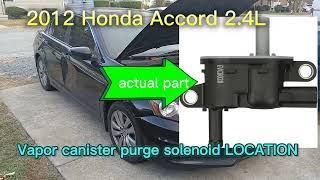
- Locate the EVAP purge valve. On the 2.4L K24Z3 engine, it's on the driver's side of the intake manifold. On the 3.5L V6, it's also easily accessible in the engine bay.
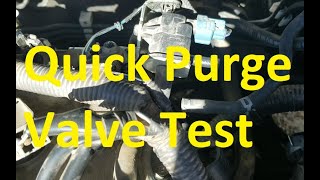
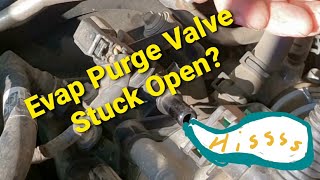
- Test the purge valve. With the ignition off, disconnect the electrical connector and hoses. Try to blow through the valve; no air should pass. If it does, the valve is stuck open and must be replaced.
- If the valve is closed, apply 12-volt power to the two pins on the valve's electrical connector. It should make an audible click and open, allowing you to blow through it. If it doesn't click or open, it has failed internally and needs to be replaced.
- If the valve functions correctly, the issue may be a clog in the line between the valve and the charcoal canister, or a more complex electrical issue. At this point, a smoke test may be needed to find the source of the incorrect flow.
Parts You'll Likely Need
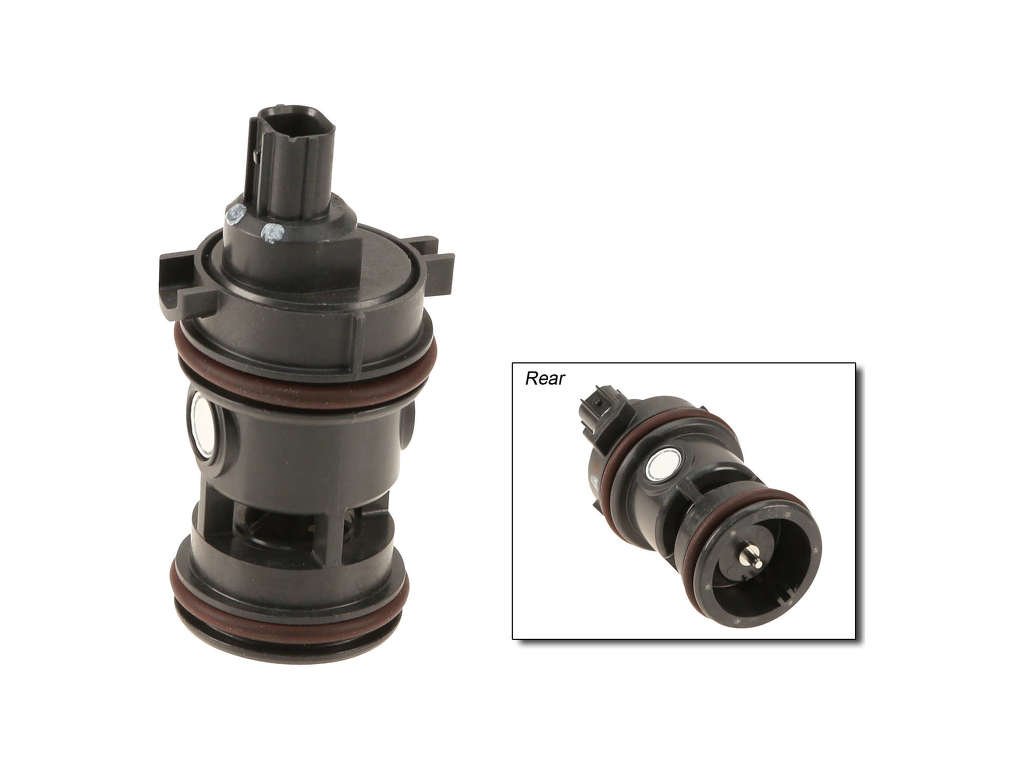
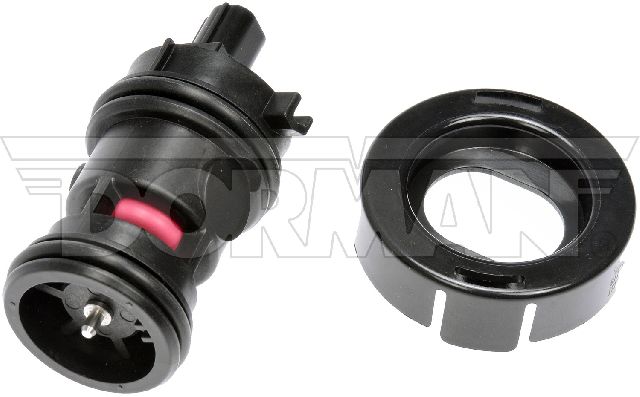
- EVAP Canister Purge Valve Solenoid (for 2.4L Engine)
(OEM #36162-RRA-A01)— This is the most common failure point for the P0441 code on the 2.4L K24Z3 engine. The valve sticks either open or closed, causing the incorrect purge flow.
Trusted brands: Acura (OEM), Dorman (911-397), Standard Motor Products, Replacement
OEM price range: $60-$90
Aftermarket price range: $20-$50 - EVAP Canister Purge Valve Solenoid (for 3.5L V6 Engine)
(OEM #36162-RDV-J01)— This is the corresponding part for the J35Z6 V6 engine, which also commonly fails and causes code P0441.
Trusted brands: Acura (OEM), Standard Motor Products, Dorman
OEM price range: $70-$100
Aftermarket price range: $30-$60
Technical Service Bulletins (TSBs) & Recalls
- Acura TSB 23-035: While for newer MDX/RDX models, this bulletin confirms a known issue with Acura purge valve springs causing them to stick and trigger code P0441, establishing a pattern of failure for this component across the brand. Manufacturer Bulletin #B23-035 specifically notes that due to variations in the purge control solenoid valve spring, the valve wears unevenly and intermittently sticks, resulting in DTC P0441.
- Bulletin #BPaS04222021902: This record indicates that American Honda Motor (AHM) has actively investigated V6 models with client complaints of the Malfunction Indicator Light (MIL) on and DTC P0441 stored to better understand the cause of the condition.
Platform-Specific Known Issues
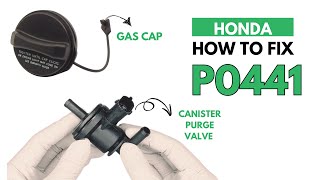
- Owner Experience: Simple Purge Valve Swap: → Shop Vapor Canister Multiple owners on forums like Acurazine and Reddit report that replacing the purge valve for a P0441 code is a 15-20 minute job requiring only a pair of pliers for the hose clamps and a 10mm socket for the mounting bolt. The consensus is that it's one of the easiest check engine light fixes for this vehicle. 🎬 Watch: Complete guide to fixing the P0441 error
Mechanic-Grade Diagnostic Values
- EVAP Canister Purge Valve Solenoid Coil Resistance — expected: Approximately 30-38 Ohms at room temperature (around 68°F/20°C).. Failure: A reading of infinite resistance (open circuit) or zero resistance (short circuit) indicates a failed solenoid coil. Readings significantly outside the expected range also suggest a fault.
- Voltage at Purge Valve Connector — expected: With the key on, engine off, one of the two pins in the electrical connector should show battery voltage (~12V).. Failure: No voltage indicates a wiring issue, blown fuse, or problem with the power supply from the PCM.
Scan Tool Commands That Help
- Acura i-HDS (Honda Diagnostic System): EVAP System Function Test — This is the official dealer-level procedure to run after replacing a component like the purge valve. It commands the system through a self-test cycle to verify the repair is successful and that no other faults exist.
Wiring & Ground Locations
- G101 — Located in the engine compartment, typically on or near the intake manifold at the top rear of the engine.. This is a primary engine ground point. A poor connection at G101 can cause erratic behavior or failure of various engine sensors and solenoids, including the EVAP purge valve, leading to false or intermittent codes.
- Purge Valve Connector — A 2-pin electrical connector attached directly to the EVAP purge valve solenoid on the intake manifold.. This is the point for testing voltage supply and the solenoid's resistance. Corrosion or a loose connection here will prevent the valve from operating, directly causing a P0441 code.
Real Owner Repair Stories
- General consensus from Acurazine.com forum threads (2009-2014 Acura TSX (both 2.4L and 3.5L)) — Check Engine Light with code P0441, sometimes accompanied by a 'Check Gas Cap' message.
❌ Tried (didn't work) Clearing the code without repairs., Replacing the gas cap (this sometimes works for other EVAP codes, but less often for P0441).
✅ What actually fixed it In the vast majority of reported cases, replacing the EVAP canister purge valve (solenoid) located in the engine bay resolved the code immediately. The repair is consistently described as taking less than 30 minutes with basic hand tools. - NHTSA ODI #11591265: An owner reported that their MIL displayed DTCs P0441 and P04F1. When they contacted the dealership, they were informed that certain TSBs for the purge system did not apply to their specific year and model, highlighting the importance of verifying part numbers for the purge solenoid.
"I Checked Everything" — The Actual Cause
- A common diagnostic trap for P0441 is performing a smoke test, finding no leaks, and incorrectly ruling out the EVAP system. The actual cause is often an intermittently sticking purge valve. As documented in Acura TSB 23-035 for other models, the valve's internal spring can wear unevenly, causing it to stick open or closed at random. If the valve is not stuck at the exact moment of the smoke test, the test will pass, but the valve will still fail during a drive cycle, triggering the P0441 code. This is why direct testing of the valve (resistance and actuation) is more conclusive than a smoke test for this specific code.
OEM Part Supersession History
Various older fuel cap part numbers→17670-T3W-A01— Improved seal design to prevent small leaks.
Heads up: While the gas cap is a less common cause for P0441, if it is suspected, using the latest OEM part number is critical. Acura TSB 13-026 and 14-006 for related EVAP codes on the TSX platform specifically address issues with older cap designs. Aftermarket caps are notorious for causing persistent EVAP codes.
Model Year Variations Within This Range
- 2009-2014: The cause and primary fix (EVAP purge valve) are consistent across the entire second generation, including the 2011 mid-model refresh. The only significant variation is the purge valve part number between the 2.4L 4-cylinder (36162-RRA-A01) and the 3.5L V6 (36162-RDV-J01) engines.
Diagnostic Flowchart
Other Known Issues on This Vehicle
Issues unrelated to this code that are worth knowing about as an owner of this generation:
- Excessive Oil Consumption (2.4L K24Z3) 🔴 High — Common on 2009-2011 models. Caused by sticking oil control rings. Consumption can be as high as 1 quart per 1,000 miles. (Ref: Acura TSB 13-006 offered an extended warranty (8 years/125,000 miles) to replace pistons and rings, but this has since expired for all affected vehicles.)
- VTC Actuator Rattle on Cold Start (2.4L K24Z3) 🟠 Medium — Very common issue where the engine produces a loud, brief rattle for 1-2 seconds upon a cold start. Caused by a faulty VTC actuator. (Ref: Acura TSB 10-024 addresses this issue for 2009-2010 models by replacing the VTC actuator (P/N 14310-R40-A01). The issue can still occur on later models.)
- Power Steering Hose Leak 🔴 High — While the official recall was for the 2004-2008 first-generation TSX, the issue of power steering hoses deteriorating from engine heat and leaking onto the hot exhaust (a fire risk) is a known problem for Honda/Acura vehicles of this era. Owners of 2nd-gen TSXs should still inspect these hoses. (Ref: NHTSA Recall 10V174000 (Acura campaign R35) was issued for the 2004-2008 TSX. No official recall exists for the 2009-2014 models, but the problem is mechanically similar.)
Used vs. New Parts: Buying Guide for This Vehicle
When a used part is the smart pick: For this specific repair, a used part is NOT recommended. The failure mode of the purge valve is mechanical wear and sticking over time. A used part from a salvage yard has an unknown number of cycles and is highly likely to either be already faulty or fail soon after installation.
What to inspect on the donor part:
- Not applicable, as new parts are strongly advised.
OEM-only on this vehicle (don't cheap out):
- Gas Cap: If the gas cap is suspected as a secondary cause, it is critical to use a genuine Acura/Honda OEM part (17670-T3W-A01). Aftermarket gas caps are widely reported by owners and mechanics to have sealing issues that lead to persistent EVAP codes.
Aftermarket brands forum-validated for this vehicle:
- Dorman (911-397 for 2.4L)
- Standard Motor Products (SMP)
Brands owners have reported issues with on this vehicle:
- Unbranded, ultra-low-cost parts from online marketplaces should be avoided. While brands like Dorman are generally acceptable, some technicians report inconsistent quality control compared to OEM. Given the low cost of the part, OEM is the safest bet, but reputable aftermarket brands are a viable alternative.
Real Owner Stories
Aggregated from forums and TSBs cited above. Mileages and costs reflect what owners reported in those sources.
2009-2014 Acura TSX
Symptoms: Check engine light on; owners noted the repair is a simple 15-20 minute job.
What fixed it: Replacing the purge valve using a pair of pliers for hose clamps and a 10mm socket for the mounting bolt.
Source hint: Acurazine.com and Reddit r/Acura forum consensus
2009-2014 Acura TSX
Symptoms: EVAP code issues appeared after fueling.
What fixed it: The owner stopped 'topping off' their fuel tank, which resolved the recurring EVAP code issues.
Source hint: Acurazine.com
2020 Acura MDX
Symptoms: P0441 code triggered by a known issue with the internal valve spring.
What fixed it: Purge valve replacement as suggested by TSB 23-035.
Source hint: Reddit r/Acura
Related OBD-II Codes
Frequently Asked Questions
Where is the EVAP purge valve located on my 2009-2014 Acura TSX?
Does Acura TSB 23-035 apply to my 2009-2014 TSX?
Can I use an aftermarket gas cap to fix the P0441 code?
Is there a recall for the power steering hose leak on my second-generation TSX?
Is the excessive oil consumption on the 2.4L engine covered under warranty?
What aftermarket brands are recommended for the purge valve if I don't buy OEM?
Helpful Videos
We Have This Part in Stock


The information in this article is provided for general reference and educational purposes only. Vehicle specifications, procedures, and part compatibility can vary by production date, trim level, and region. Always consult your vehicle's factory service manual and verify part numbers before purchasing or performing repairs. Safety-critical components such as airbags, seat belts, and braking systems should be installed by a qualified professional.
- Acura TSX:
- 🧭 Diagnostic Flowchart
- 🎬 Helpful Videos
- 🛍️ Shop This Part
- What's Unique About the 2009-2014 Acura TSX
- Symptoms You May Notice
- Most Likely Causes
- Rare But Worth Checking
- Diagnosis Steps
- Parts You'll Likely Need
- Technical Service Bulletins (TSBs) & Recalls
- Platform-Specific Known Issues
- Mechanic-Grade Diagnostic Values
- Scan Tool Commands That Help
- Wiring & Ground Locations
- Real Owner Repair Stories
- "I Checked Everything" — The Actual Cause
- OEM Part Supersession History
- Model Year Variations Within This Range
- Other Known Issues on This Vehicle
- Used vs. New Parts: Buying Guide for This Vehicle
- Real Owner Stories
- 2009-2014 Acura TSX
- 2009-2014 Acura TSX
- 2020 Acura MDX
- Related OBD-II Codes
- Frequently Asked Questions
- 🎟️ Get 5% Off