

P0442 on 2006-2010 Hyundai Sonata: EVAP Small Leak Causes and Fixes
For a 2006-2010 Hyundai Sonata, a P0442 code is most often caused by a loose gas cap or a faulty Canister Close Valve (CCV) located behind the driver's side rear wheel. Always check the gas cap first, but the CCV is a very common failure point on this specific model, often due to its exposed location. A smoke test is the best way to confirm the leak's source before replacing parts.
- Always check the gas cap first. Ensure it's tight and the seal is intact before attempting any other repairs.
- For the 2006-2010 Sonata, the Canister Close Valve (CCV) behind the driver's side rear wheel is a very common culprit for P0442.
- A smoke test is the most reliable and fastest way to diagnose the exact location of a small EVAP leak, saving you from replacing unnecessary parts.
- Driving with P0442 is not dangerous, but it will cause an automatic failure on an emissions test.
What's Unique About the 2006-2010 Hyundai Sonata
While a loose gas cap is a common cause for a P0442 on any car, the fifth-generation (NF) Hyundai Sonata is particularly known for failures of the Canister Close Valve (CCV). This valve is located in a somewhat exposed position behind the driver's side rear wheel well liner, making it susceptible to dirt, road grime, and moisture. Owners and mechanics frequently report this specific valve as the culprit after performing a smoke test, even more so than the gas cap or purge valve.
Symptoms You May Notice
- Check Engine Light is on
- A faint fuel smell may be noticeable, especially around the rear of the vehicle or in a garage.
- Difficulty starting or a rough idle immediately after refueling (if the purge valve is stuck open).
- Your vehicle will automatically fail a state emissions inspection.
- Replacing the purge valve (PCSV) in the engine bay when the actual, more common, problem is the canister close valve (CCV) at the rear of the vehicle.
- Replacing the gas cap without checking the filler neck for corrosion, which can prevent even a new cap from sealing properly.
- Guessing and replacing parts without performing a smoke test, which is the most definitive way to locate the source of a small EVAP leak.
Most Likely Causes
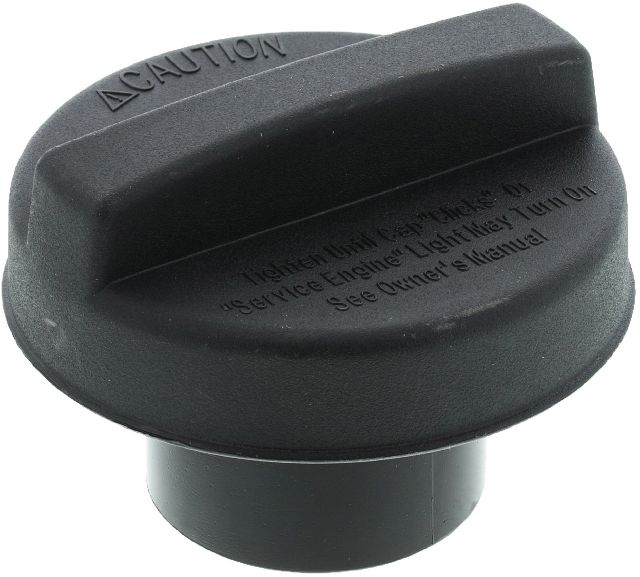
- Loose or Faulty Gas Cap 🔴 High Probability → Shop Fuel Tank Cap This is the most common cause on all vehicles due to user error (not tightening enough) or the seal wearing out over time. It is always the first thing to check.
How to confirm: Ensure the gas cap is tightened until it clicks at least 1-3 times. Inspect the rubber O-ring on the cap for cracks, brittleness, or damage. Also, inspect the fuel filler neck for rust or debris that could prevent a good seal.
Typical fix: Tighten the cap. If the seal is damaged, replace the gas cap. It is highly recommended to use a genuine OEM part for the best seal, as aftermarket caps are a known source of issues.
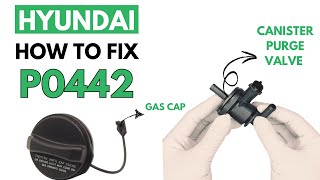
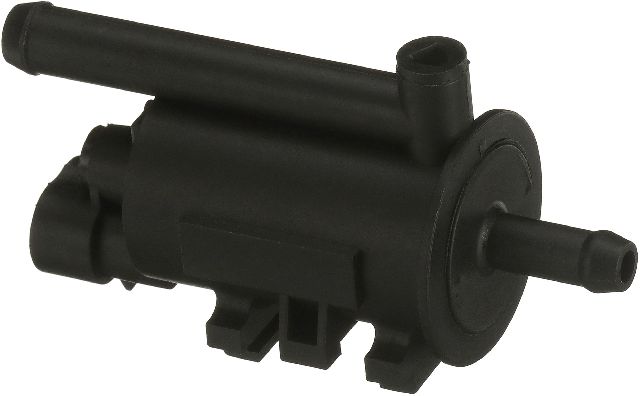
Est. part cost: $15-$35 - Faulty Canister Close Valve (CCV) 🔴 High Probability → Shop Vapor Canister This is a very common failure item on the 2006-2010 Sonata. Its location behind the rear wheel well exposes it to road grime and moisture, causing it to fail or leak. Owners report this part failing as early as 150,000 miles. 🎬 Watch this step-by-step guide to replacing the canister control valve.
How to confirm: The valve is located behind the driver's side rear wheel well liner. A smoke test is the most effective way to confirm a leak from the valve body itself. The valve is normally open and should close when voltage is applied (e.g., from a 9V battery for testing). If it doesn't close or leaks when closed, it is faulty.
Typical fix: Replace the Canister Close Valve. This requires removing the driver's side rear wheel and the plastic wheel well liner to access the part.
Est. part cost: $40-$70 - Faulty Canister Purge Valve (PCSV) 🟡 Medium Probability → Shop Vapor Canister The purge valve can become stuck open or closed due to carbon buildup or age, creating a leak or a flow issue.
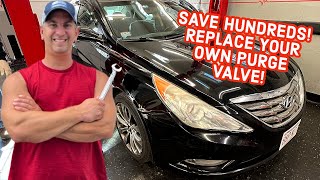
How to confirm: The valve is located in the engine bay, usually connected to the intake manifold. 🎬 See how to easily swap out the engine bay purge valve. With the engine off, remove the valve and try to blow through it; no air should pass. A handheld vacuum pump can also be used to check if it holds vacuum. A scan tool can command it to open and close to listen for a click.
Typical fix: Replace the canister purge valve.
Est. part cost: $30-$60 - Cracked or Disconnected EVAP Hoses 🟡 Medium Probability Rubber hoses become brittle and crack with age and exposure to engine heat and the elements.
How to confirm: Visually inspect all accessible EVAP lines running from the engine bay to the charcoal canister near the tank. A smoke test is the most reliable method to pinpoint small cracks that are not visible.
Typical fix: Replace the cracked section of hose and secure with new clamps.
Est. part cost: $5-$25
Rare But Worth Checking
- Cracked Charcoal Canister: → Shop Vapor Canister The canister itself can develop hairline cracks from road debris impact or age. This is usually found with a smoke test where smoke will be seen emitting from the canister body.
- Faulty Fuel Tank Pressure Sensor (FTPS): → Shop Fuel Tank While this sensor can fail, it would more commonly trigger a different code. On this Sonata, it is located on top of the fuel pump assembly, accessible from under the rear seat. A faulty sensor could falsely report a leak.
- Leaking Fuel Tank or Filler Neck: → Shop Fuel Tank Rust or damage to the fuel tank or the filler neck where the gas cap seals can cause a persistent leak. This is less common but should be considered if other components check out.
Diagnosis Steps
- Check the Gas Cap: This is the simplest and most common fix. Remove the cap, inspect the seal for damage, and retighten it until it clicks several times. Clear the code and drive for a few days to see if it returns.
- Visual Inspection: Carefully inspect all visible EVAP hoses in the engine bay and under the car near the fuel tank for obvious cracks, disconnections, or deterioration.
- Test the Canister Purge Valve (PCSV): Locate the valve on the engine. Disconnect it and test if it's sealed when closed (no air should pass through). Use a scan tool or apply power to ensure it clicks open and closed.
- Inspect the Canister Close Valve (CCV): Access the valve by removing the driver's side rear wheel and inner fender liner. Check its electrical connector and hoses. This is a very common point of failure. A DIY test can be done by applying 12V (or a 9V battery) to see if the valve actuates.
- Perform a Smoke Test: This is the most definitive way to find a small leak. A smoke machine injects low-pressure smoke into the EVAP service port (often near the purge valve in the engine bay). The leak will be revealed by the visible smoke escaping from the faulty component (hose, valve, canister, or gas cap seal). Many owners recommend paying a professional for this step to avoid guesswork. 🎬 Watch a professional smoke test diagnose a tricky P0442 leak.
Parts You'll Likely Need
- Canister Close Valve (CCV)
(OEM #31453-3K500)— This is a highly common failure point on the 2006-2010 Sonata, often causing a P0442 code. Its exposed location leads to premature failure. This part may also be called a Shut-Off Valve or Vapor Canister Vent Solenoid.
Trusted brands: Hyundai (OEM), Dorman (911-811), Standard Motor Products (CVS148)
OEM price range: $50-$70
Aftermarket price range: $30-$50 - Fuel Cap
(OEM #31010-3L600)— A worn-out gas cap seal is the number one cause of EVAP leak codes across all vehicles. Using an OEM cap is highly recommended for a perfect seal, as aftermarket caps are known to cause issues.
Trusted brands: Hyundai (OEM)
OEM price range: $25-$35
Aftermarket price range: $15-$25 - Canister Purge Valve (PCSV)
(OEM #28910-25100)— This valve in the engine bay can get stuck, causing a leak and sometimes a rough idle after refueling. It is also referred to as a Purge Control Valve.
Trusted brands: Hyundai (OEM), Bosch, Standard Motor Products
OEM price range: $40-$60
Aftermarket price range: $25-$45
Related Codes That Often Appear With This One
- P0456 — P0456 indicates a 'very small leak,' while P0442 indicates a 'small leak.' They point to the same type of problem in the EVAP system, just a different leak size threshold. You may see one or the other depending on the exact size of the leak.
- P0441 — This code indicates 'Incorrect Purge Flow.' If the purge valve is stuck open or closed, it can cause both a leak code (like P0442) and a flow code simultaneously.
- P0455 — This code indicates a 'large leak'. While less common to see with P0442, it points to a more significant breach in the same system. A component failing catastrophically could trigger this instead.
Technical Service Bulletins (TSBs) & Recalls
- While no specific TSB for P0442 on this exact model was found, Hyundai has issued TSBs for similar EVAP issues on other models, such as TSB 10-FL-003, which involved an ECM update that incidentally changed EVAP monitor reporting. Another general EVAP TSB (21-EM-002H) for newer models confirms that a stuck open purge valve or canister vent valve can cause a P0442.
- Manufacturer TSB #5NPY6N5B02 for other Hyundai models notes that the fuel filler cap seal may not provide proper sealing, triggering P0442 and P0456.
- Bulletin #21-01-035H notes that some Hyundai vehicles may experience P0442, P0455, or P0456, particularly in coastal areas.
- Manufacturer TSB #5NP-Z2J3V-04 confirms that several Hyundai models may experience a check engine warning light with DTCs P0442, P0455, or P0456 stored.
Platform-Specific Known Issues
- The Canister Close Valve (CCV), part number 31453-3K500, is a well-documented, frequent cause of code P0442 on the 2006-2010 Sonata platform. Its location behind the rear wheel makes it prone to failure from road debris and weather.
- A mechanic in one forum thread noted that he had to replace the exact same part on his own 2009 Sonata just weeks after diagnosing it on a customer's 2008 model, highlighting its commonality.
Mechanic-Grade Diagnostic Values
- Fuel Tank Pressure Sensor (FTPS) Voltage — expected: ~2.5 Volts with the system at atmospheric pressure (gas cap off).. Failure: Voltage does not hold steady when a vacuum is applied during a manual leak test, indicating a leak.
Scan Tool Commands That Help
- Hyundai GDS (or equivalent advanced scan tool): EVAP Leak Test — This is an automated, bidirectional function that commands the CCV to close and the PCSV to open, then monitors the FTPS to measure vacuum decay. It's the factory method for verifying a leak exists or confirming a repair without a smoke machine.
Wiring & Ground Locations
- G24 — Near the fuel tank.. This is a primary ground point for the fuel pump motor and fuel sender unit. While not directly tied to the Canister Close Valve (CCV), a poor ground here could cause erratic fuel system readings, potentially affecting the Fuel Tank Pressure Sensor which shares the general area and is critical for EVAP leak detection.
- Canister Close Valve (CCV) Wiring — Connector at the CCV, behind the driver's side rear wheel well liner.. The ECM provides the ground signal to close the normally-open CCV. A technician can manually ground the control wire (often Blue/Black) to test if the valve closes, helping to isolate a wiring problem from a faulty valve.
Real Owner Repair Stories
- YouTube user, DIY mechanic (2008 Hyundai Sonata, ~150,000 miles) — P0442 check engine light appeared shortly after replacing the fuel pump assembly.
❌ Tried (didn't work) Re-checking the fuel pump assembly installation multiple times, assuming the leak was there.
✅ What actually fixed it Paid a mechanic friend to perform a smoke test, which revealed smoke leaking from the Canister Close Valve (CCV) behind the driver's side rear wheel. Replacing the CCV resolved the code. The mechanic noted this is an extremely common failure on this model. - NHTSA ODI #11170436 describes an owner who struggled for two years with a P0442 code; despite bringing it to four mechanics, changing the gas cap twice, and replacing the purge valve, the issue remained unresolved.
- In NHTSA ODI #11570498, a driver reported that common codes including P0442 and P0401 would appear on their vehicle.
"I Checked Everything" — The Actual Cause
- In a case on a similar Hyundai system, a P0442 was present but a smoke test revealed no visible leaks. The technician then inspected the fuel filler neck where the gas cap seals and found rust buildup. Cleaning the rust off the filler neck with emery cloth to ensure a clean sealing surface for the gas cap ultimately fixed the small leak and resolved the code.
OEM Part Supersession History
31453-3K700→31453-3K500— Part number update/revision by Hyundai.
Heads up: The new part number (31453-3K500) is the correct replacement for the older one.
Model Year Variations Within This Range
- 2009-2010: The 2009 model year marked a mid-cycle refresh for the Sonata, which included updated engines (the new Theta-II 2.4L I4) and a revised interior. While the common EVAP system failure points like the CCV (part 31453-3K500) appear to be the same across the 2006-2010 range, the Canister Purge Valve (PCSV) in the engine bay may have a slightly different location or part number depending on whether the vehicle has the earlier 2.4L/3.3L (2006-2008) or the updated 2.4L/3.3L (2009-2010). For example, a different PCSV (28910-3C100) is listed for the 3.3L V6.
Diagnostic Flowchart
Real Owner Stories
Aggregated from forums and TSBs cited above. Mileages and costs reflect what owners reported in those sources.
2008 Hyundai Sonata
Symptoms: Check Engine Light with code P0442 (small evap leak) shortly after replacing the fuel pump.
What fixed it: Replaced the canister valve after paying a mechanic friend to perform a smoke test diagnosis.
Source hint: YouTube comment
2007 Hyundai Sonata
Symptoms: Check Engine Light on, OBD code P0442, failed state inspection.
What fixed it: Unresolved in the post, but noted a shop incorrectly replaced a 'fuel pump module' which did not clear the code.
Cost: $1000+
Source hint: Reddit r/newjersey
2009 Hyundai Sonata — ~150000 miles
Symptoms: P0442 code triggered by a faulty Canister Close Valve (CCV) located behind the rear wheel.
What fixed it: Replaced the Canister Close Valve (part number 31453-3K500).
Source hint: Mechanic forum thread
2007 Kia Optima
Symptoms: Code P0442 persisting despite replacing parts.
What fixed it: Replaced the gas cap and purge valve initially, but a professional mechanic advised a smoke test was required to find the actual leak.
Source hint: 2CarPros.com
Related OBD-II Codes
Frequently Asked Questions
Is the Canister Close Valve a common cause for code P0442 on the 2006-2010 Hyundai Sonata?
Are there any TSBs for the 2006-2010 Hyundai Sonata regarding the P0442 code?
I just replaced the fuel pump on my 2008 Sonata and now have a P0442 code. Are they related?
Can I use an aftermarket gas cap to fix a P0442 on my Sonata?
My 2006-2010 Sonata has a rough idle right after getting gas and a P0442 code. What does this mean?
Does the 2006-2010 Kia Optima share this P0442 issue with the Sonata?
Helpful Videos

We Have This Part in Stock


The information in this article is provided for general reference and educational purposes only. Vehicle specifications, procedures, and part compatibility can vary by production date, trim level, and region. Always consult your vehicle's factory service manual and verify part numbers before purchasing or performing repairs. Safety-critical components such as airbags, seat belts, and braking systems should be installed by a qualified professional.
- Hyundai Sonata:
- 🧭 Diagnostic Flowchart
- 🎬 Helpful Videos
- 🛍️ Shop This Part
- What's Unique About the 2006-2010 Hyundai Sonata
- Symptoms You May Notice
- Most Likely Causes
- Rare But Worth Checking
- Diagnosis Steps
- Parts You'll Likely Need
- Related Codes That Often Appear With This One
- Technical Service Bulletins (TSBs) & Recalls
- Platform-Specific Known Issues
- Mechanic-Grade Diagnostic Values
- Scan Tool Commands That Help
- Wiring & Ground Locations
- Real Owner Repair Stories
- "I Checked Everything" — The Actual Cause
- OEM Part Supersession History
- Model Year Variations Within This Range
- Real Owner Stories
- 2008 Hyundai Sonata
- 2007 Hyundai Sonata
- 2009 Hyundai Sonata — ~150000 miles
- 2007 Kia Optima
- Related OBD-II Codes
- Frequently Asked Questions
- 🎟️ Get 5% Off