

P0443 on 2001-2007 Ford Escape 3.0L V6: EVAP Purge Valve Circuit Causes and Fixes
On a 2001-2007 Ford Escape with the 3.0L V6, code P0443 almost always means the EVAP canister purge valve has failed. It's an inexpensive part ($25-$75) located on the driver's side strut tower, making it a very easy 15-minute DIY fix. The correct OEM part number for many of these years is 5L8Z-9C915-AA.
- P0443 on your 2001-2007 Escape 3.0L is an electrical circuit code for the EVAP purge valve, not a leak code.
- The most common cause by far is a failed purge valve, which is an inexpensive and very easy DIY replacement located on the driver's side strut tower.
- Always check the shared fuse for the O2 sensor heaters (HEGO) if you see P0443 accompanied by O2 sensor circuit codes like P0135 or P0155.
What's Unique About the 2001-2007 Ford Escape
For the first-generation Ford Escape with the 3.0L V6, the P0443 code is a very common and straightforward issue. The vapor canister purge valve is conveniently located on the driver's side strut tower in the engine bay, making it exceptionally easy to access and replace. Unlike in many other vehicles where this component can be buried, this accessibility makes it a popular and simple DIY repair for Escape owners. A notable quirk is that the fuse for the EVAP purge valve may also power the O2 sensor heaters, so if you see P0443 along with O2 sensor heater codes (like P0135, P0155), a blown fuse is the most likely culprit.
Symptoms You May Notice
- Check Engine Light is on
- Slightly rough or unstable idle
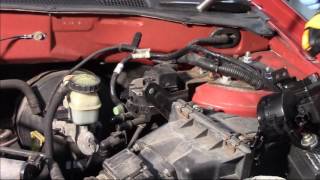
- Difficulty starting the engine right after filling the gas tank 🎬 Watch: Why your Escape might struggle to start after refueling.
- Reduced fuel economy
- Audible clicking or buzzing from the purge valve area
- Sudden loss of power while driving, particularly at speeds of 55mph or higher (as noted in NHTSA ODI #11099930)
- Replacing the gas cap. P0443 is an electrical circuit code, not a system leak code (like P0455 or P0456). A bad gas cap will not cause P0443.
- Replacing the EVAP Vent Solenoid. The vent solenoid is located near the fuel tank and has its own specific trouble code (P0446). P0443 points specifically to the purge valve circuit under the hood.
Most Likely Causes
- Failed EVAP Canister Purge Valve/Solenoid 🔴 High Probability → Shop Vapor Canister This is a very common failure item on this platform due to age and heat cycles causing the internal solenoid coil to fail electrically (open or short circuit) or the valve to stick mechanically.
How to confirm: Locate the purge valve on the driver's side strut tower. With the engine running and the electrical connector unplugged, disconnect the hose coming from the charcoal canister. If you feel any vacuum suction from the valve's port, it is stuck open and has failed. Alternatively, use a multimeter to check the resistance between the two pins on the valve; a typical good reading is between 20-30 ohms. A reading of infinity (OL) or near-zero ohms indicates a bad coil and the valve needs replacement.
Typical fix: Replace the EVAP canister purge valve assembly. 🎬 Watch: A quick walkthrough of the purge valve replacement process.
Est. part cost: $25-$75 - Damaged Wiring or Connector 🟡 Medium Probability The wiring harness in the engine bay is exposed to heat and vibration, which can lead to chafing, breaks, or corrosion over time. The connector pins can also become corroded or loose. NHTSA ODI #11633558 describes an inspection that identified an EVAP system related disconnect on a line, which can trigger multiple codes including P0443.
How to confirm: Visually inspect the wiring harness and electrical connector going to the purge valve for any signs of cracking, melting, corrosion on the pins, or loose connections. Use a multimeter to check for 12V power on one pin of the connector (with the key on) and for a ground signal from the PCM on the other (this may require a scan tool to command the valve on or back-probing while running).
Typical fix: Repair the damaged section of wire or replace the connector pigtail.
Est. part cost: $5-$25 - Blown Fuse ⚪ Low Probability On this platform, the fuse for the EVAP system can sometimes be shared with other components like the O2 sensor heaters. A short circuit in any of these components can blow the shared fuse.
How to confirm: Check your owner's manual for the fuse panel diagram and locate the fuse for the EVAP system or HEGO (Heated Exhaust Gas Oxygen) sensors. On a 2009 model, this was fuse #28 in the under-hood fuse box. For first-generation models, this is often the 15A HEGO fuse (#5 in the under-hood box). Visually inspect the fuse to see if it is blown. This is especially likely if you have P0443 along with multiple O2 sensor heater codes (P0135, P0141, P0155, P0161).
Typical fix: Replace the blown fuse. If it blows again, you must find the short circuit in the wiring of one of the connected components, most commonly a frayed O2 sensor wire.
Est. part cost: $1-$5
Rare But Worth Checking
- Faulty Powertrain Control Module (PCM): → Shop Engine Control Module (ECM) This is extremely rare. Before condemning the PCM, all other possibilities, including the valve, wiring, and fuses, must be exhaustively tested and ruled out. A PCM failure is a last resort diagnosis.
Diagnosis Steps
- Read the codes with an OBD-II scanner to confirm P0443 is present.
- Visually inspect the EVAP purge valve, its electrical connector, and the surrounding wiring on the driver's side strut tower for any obvious damage.
- Check the fuse for the EVAP system/O2 heaters in the under-hood fuse box (often 15A HEGO Fuse #5). Replace if blown and re-test. This is a critical step if multiple codes are present.
- If the fuse is good, disconnect the electrical connector from the purge valve.
- With the engine running, feel the inlet port on the valve for any vacuum suction. If suction is present, the valve is stuck open and must be replaced.
- If no suction is present, test the electrical circuit. With the key on, use a multimeter to verify one pin on the connector has battery voltage (approx. 12V).
- Check the resistance of the purge valve itself across its two pins. A reading of infinity (OL) or zero indicates a failed coil. A typical good reading is between 20-30 ohms.
- If the valve and power supply are good, the final step is to check for continuity on the ground control wire between the valve connector and the PCM and verify the PCM driver is sending a ground signal. 🎬 See how a mechanic diagnoses the P0443 circuit and valve.
Parts You'll Likely Need
- Vapor Canister Purge Valve / Solenoid
(OEM #5L8Z-9C915-AA (for 2005-2006 models), 5U5Z-9C915-AA)— This is the component that fails in the vast majority of P0443 cases on this vehicle due to electrical failure of its internal solenoid.
Trusted brands: Motorcraft, Standard Motor Products (SMP), Dorman, Bosch
OEM price range: $50-$95
Aftermarket price range: $25-$60
Related Codes That Often Appear With This One
- P0135, P0141, P0155, P0161 — On some Ford models of this era, the O2 sensor heaters are powered by the same fuse as the EVAP purge valve. A short in any of these components' wiring can blow the fuse, causing all related codes to appear at once.
- P1450 — This code for 'Unable to Bleed Up Fuel Tank Vacuum' can be caused by a purge valve that is stuck open, which is a common failure mode that also triggers the P0443 electrical code. NHTSA ODI #11633558 notes P1450 appearing alongside P0443 during diagnostic testing.
Platform-Specific Known Issues
- Owner Experience: P0443 with Multiple O2 Sensor Codes: An owner of a 2009 Ford Escape 3.0L reported a long list of codes including P0443, P0135, P0155, P0141, P0161, and others. The root cause was a blown 15A fuse (fuse #28 in the under-hood panel). The fuse blew instantly upon replacement. Further diagnosis found that the wiring for the downstream O2 sensor had chafed against the chassis, creating a short to ground. Repairing the wire and replacing the fuse cleared all the codes, including the P0443. This confirms the shared circuit and highlights the importance of checking fuses when multiple, seemingly unrelated circuit codes appear together.
Mechanic-Grade Diagnostic Values
- EVAP Canister Purge Valve Solenoid Resistance — expected: 20 - 30 Ohms. Failure: A reading of infinity (OL) indicates an open coil; a reading near zero indicates a shorted coil.
- Voltage at Purge Valve Connector Power Pin — expected: ~12V (Battery Voltage) with Key On, Engine Off. Failure: 0V indicates an open circuit in the power supply wire or a blown fuse (e.g., HEGO fuse #5).
- Voltage at Purge Valve Connector Control Pin — expected: The PCM supplies a pulsed ground to this pin to activate the valve. With a test light connected to B+, it should flash when the valve is commanded on.. Failure: No ground signal when commanded indicates an open in the control wire or a faulty PCM driver.
Scan Tool Commands That Help
- Ford IDS (or capable generic scanner like FORScan): EVAP System Test / Output State Control — This is a guided test that commands the purge and vent solenoids to check for system integrity and component response. It can confirm if the PCM is capable of controlling the circuit.
- Generic OBD-II Scanner with Active Test capability: Command EVAP Purge Valve ON/OFF (or by percentage) — Use this to verify the valve's mechanical function. Command the valve to cycle and listen for an audible click. Also used to check the PCM's control signal by back-probing the connector while commanding the valve on and off.
- Generic OBD-II Scanner with Live Data: Monitor Fuel Tank Pressure (FTP) PID — To test for a mechanically stuck-open purge valve. With the engine running, command the vent valve closed and the purge valve OFF. If the FTP value begins to drop (create a vacuum), it confirms the purge valve is leaking engine vacuum into the EVAP system when it should be sealed.
Wiring & Ground Locations
- Purge Valve Connector Power Wire — At the purge valve connector on the driver's side strut tower.. This wire supplies battery voltage to the solenoid. No voltage here points to a blown fuse or an open in the power wire. On 2008+ models, this is often a Gray/Violet wire; colors may vary on 2001-2007 models.
- Purge Valve Connector Control Wire (EVAPCP / VMV) — At the purge valve connector, running back to the PCM.. This is the wire the PCM grounds to activate the solenoid. An open or short on this wire will cause P0443. Testing this wire for continuity to the PCM and for a ground signal from the PCM is the final step before condemning the PCM itself.
- PCM Connector Pin (Control Wire) — At the main PCM connector, typically located on the firewall.. This is the origin of the control signal. A 2005 Escape 3.0L was shown to use Pin 27 (Brown/Pink wire) at connector C175E. A 2008 model diagram shows Pin 34 (Brown/Yellow wire). Verifying the signal directly at the PCM pin rules out any wiring issues between the PCM and the valve.
- Grounds G109 / G110 — On the firewall in the rear of the engine compartment.. These are primary PCM and engine ground points. While not directly in the purge valve circuit, a poor main ground can cause a variety of unpredictable electrical issues, including faulty PCM driver operation.
Real Owner Repair Stories
- New Level Auto, YouTube (2005 Ford Escape 3.0L) — Check Engine Light with code P0443. Car would stumble and run poorly when the EVAP vacuum line was connected.
❌ Tried (didn't work) The purge solenoid itself was tested and found to be functional; it would click and open when manually grounded.
✅ What actually fixed it The technician diagnosed a faulty PCM driver. Using a test light, he confirmed power was reaching the solenoid, but the PCM was not providing the ground signal on the control wire (Pin 27, Brown/Pink wire) during a key-on-engine-off test. The final diagnosis was that the PCM needed to be replaced. - NHTSA ODI #11099930 — An owner reported that their vehicle suddenly loses power while driving, accompanied by check engine light codes P2112, P0443, and C1963. This issue occurred specifically while driving at speeds of 55mph or higher.
"I Checked Everything" — The Actual Cause
- P0443 is an electrical circuit code, not a system leak code. A common misdiagnosis is to treat it like a leak code (e.g., P0455, P0456) and perform a smoke test. The smoke test will almost certainly come back clean because the fault lies within the electrical circuit (the valve's solenoid coil, wiring, fuse, or PCM driver), not a physical crack or hole in a hose. If a smoke test is performed and passes, it simply rules out a physical leak and reinforces that the problem is electrical, as the P0443 definition implies.
When the Usual Fixes Don't Work
- While replacing the purge valve solenoid fixes P0443 in the vast majority of cases, there are documented instances where the code persisted. In one such case involving a 2005 Escape, extensive testing revealed that the valve itself was good and all wiring had continuity. The root cause was a failed driver circuit within the Powertrain Control Module (PCM), which was no longer able to provide the ground signal to activate the valve. This represents a rare but important diagnostic path to consider when a new valve and fuse do not solve the problem.
OEM Part Supersession History
Unknown→5L8Z-9C915-AA— Standard part for the 2005-2006 model years. Also sold under the service part number CX1957.
Heads up: This part number is specifically listed for 2005-2006 models, suggesting earlier 2001-2004 models may use a different part.
Model Year Variations Within This Range
- 2005-2007: The PCM control wire for the purge valve on a 2005 model was identified as a Brown/Pink wire at Pin 27 of connector C175E.
- 2001-2004: May use a different purge valve part number than the 5L8Z-9C915-AA specified for 2005-2006 models. Wiring colors and PCM pinouts may also differ from the post-refresh models.
Diagnostic Flowchart
Other Known Issues on This Vehicle
Issues unrelated to this code that are worth knowing about as an owner of this generation:
- CD4E Automatic Transmission Failure 🔴 High — Very common, with failures reported from 45,000 miles onward. Symptoms include flashing O/D light, hard/erratic shifting, solenoid failure, and complete loss of forward gears. (Ref: A recall existed for remanufactured CD4E transmissions with improperly tightened shift lever bolts, but not for the widespread internal failures.)
- Front Subframe & Lower Control Arm Rust 🔴 High — Extremely common on 2001-2004 models, especially in 'salt belt' regions. Rust can cause the lower control arm to separate from the subframe, resulting in a sudden loss of steering control. (Ref: NHTSA Campaign 14V165000 (Ford Recall 14S02) was issued to install a reinforcement brace, but did not replace the subframe itself.)
- Premature Alternator Failure 🟠 Medium — Common failure item, often before 100,000 miles. The alternator is poorly located near the exhaust manifold, leading to heat damage. Replacement is labor-intensive, requiring removal of the passenger side axle shaft.
- Ignition Coil Failure (V6) 🟠 Medium — The rear bank of ignition coils (cylinders 1, 2, 3) are prone to failure due to oil leaking from the valve cover gasket, which drips directly onto the coils and boots.
- Cracked/Splitting Brake Hoses 🔴 High — The original-style smooth-jacket rubber brake hoses are known to crack and split, causing a sudden and complete loss of brake fluid and pressure.
- DPFE Sensor Failure 🟡 Low — A very common cause for EGR-related codes (P0400, P0401). The sensor or its rubber hoses fail, leading to rough idle and failed emissions tests. (Ref: TSB-04-01-17 was issued for an updated DPFE sensor.)
Used vs. New Parts: Buying Guide for This Vehicle
When a used part is the smart pick: For this specific repair, a used part from a salvage yard is NOT recommended. The failure mode is typically electrical breakdown of the solenoid coil due to age and heat cycles. A used part will have a similar amount of wear and is likely to fail in a short amount of time, offering poor value.
What to inspect on the donor part:
- Not applicable as used parts are not recommended.
OEM-only on this vehicle (don't cheap out):
- No parts for this specific repair require OEM-only sourcing. While the Motorcraft (OEM) part is high quality, reputable aftermarket brands offer reliable and more affordable alternatives.
Aftermarket brands forum-validated for this vehicle:
- Motorcraft (OEM)
- Standard Motor Products (SMP)
- Dorman
- Bosch
Brands owners have reported issues with on this vehicle:
- No-name, unbranded parts from online marketplaces should be avoided due to inconsistent quality control.
Real Owner Stories
Aggregated from forums and TSBs cited above. Mileages and costs reflect what owners reported in those sources.
2009 Ford Escape 3.0L V6
Symptoms: Check engine light with a long list of codes including P0443, P0135, P0155, P0141, and P0161. The fuse blew instantly every time it was replaced.
What fixed it: Found the wiring for the downstream O2 sensor had chafed against the chassis, creating a short to ground. Repaired the wire and replaced the 15A fuse (#28).
Source hint: vehicle_specific_issues: Owner Experience: P0443 with Multiple O2 Sensor Codes
2009 Ford Escape 3.0L V6
Symptoms: Multiple circuit codes: P0010, P0020, P0102, P0135, P0141, P0155, P0161, P0443, P0403, and P0505.
What fixed it: Identified a shorted downstream O2 sensor wire that was repeatedly blowing the shared fuse.
Source hint: ford-trucks.com - Thread '2009 FORD ESCAPE , CODE - P0010,P0020,P0102,P0135,P0141,P0155,P0161,P0443,P0403,P0505'
Ford Escape Owner Report
Symptoms: Diagnostic test results showed multiple default codes including P1016, P0365, P0299, P164D, P0369, P0443, P0456, and P1450.
What fixed it: A dealership inspection identified an EVAP system related disconnect on a line (NHTSA ODI #11633558).
Related OBD-II Codes
Frequently Asked Questions
Where is the purge valve located on my 3.0L V6 Escape?
Why do I have P0443 along with O2 sensor codes like P0135 and P0155?
Is there a recall for the steering or suspension issues on my 2001-2004 Escape?
My car is hard to start only after I fill up the gas tank; is this related to P0443?
What resistance should I see when testing the purge valve with a multimeter?
Helpful Videos

Used OEM Parts in Stock
New Aftermarket Parts Available


The information in this article is provided for general reference and educational purposes only. Vehicle specifications, procedures, and part compatibility can vary by production date, trim level, and region. Always consult your vehicle's factory service manual and verify part numbers before purchasing or performing repairs. Safety-critical components such as airbags, seat belts, and braking systems should be installed by a qualified professional.
- Ford Escape:
- 🧭 Diagnostic Flowchart
- 🎬 Helpful Videos
- 🛍️ Shop This Part
- What's Unique About the 2001-2007 Ford Escape
- Symptoms You May Notice
- Most Likely Causes
- Rare But Worth Checking
- Diagnosis Steps
- Parts You'll Likely Need
- Related Codes That Often Appear With This One
- Platform-Specific Known Issues
- Mechanic-Grade Diagnostic Values
- Scan Tool Commands That Help
- Wiring & Ground Locations
- Real Owner Repair Stories
- "I Checked Everything" — The Actual Cause
- When the Usual Fixes Don't Work
- OEM Part Supersession History
- Model Year Variations Within This Range
- Other Known Issues on This Vehicle
- Used vs. New Parts: Buying Guide for This Vehicle
- Real Owner Stories
- 2009 Ford Escape 3.0L V6
- 2009 Ford Escape 3.0L V6
- Ford Escape Owner Report
- Related OBD-II Codes
- Frequently Asked Questions
- 🎟️ Get 5% Off