

P0443 on 2017-2022 Kia Niro: EVAP Purge Valve Circuit Malfunction Causes and Fixes
On a 2017-2022 Kia Niro, code P0443 almost always means the canister purge valve has failed. This is a very common, inexpensive, and easy DIY fix, typically costing $40-$80 for the part and taking less than 30 minutes to replace. The issue is shared with its platform-mate, the Hyundai Ioniq.
- P0443 on a 2017-2022 Kia Niro indicates an electrical fault in the EVAP purge valve circuit, not a system leak.
- The most likely cause, by a wide margin, is a failed canister purge valve (OEM Part #28910-2M420).
- This is a beginner-friendly DIY repair that can be done in under 30 minutes with basic tools.
- Before buying a part, check the 'SENSORS 2' or 'SENSOR 1' fuse and test the resistance of the old valve with a multimeter (expect 15-30 ohms) to confirm the failure.
- Driving with this code is safe, but it will cause an automatic failure on an emissions test.
What's Unique About the 2017-2022 Kia Niro
Like many other Kia and Hyundai vehicles sharing the 1.6L engine, the 2017-2022 Niro is prone to premature failure of the EVAP canister purge valve. The issue is not unique to the Niro but is a common service item across the manufacturer's lineup, including the Hyundai Ioniq, Elantra, and Sonata. The failure is almost always the valve's internal solenoid coil, making diagnosis straightforward and replacement the most common and effective repair.
Symptoms You May Notice
- Check Engine Light is on
- Slightly rough or unstable idle
- Difficulty starting the engine immediately after refueling
- A faint fuel odor near the vehicle (less common)
- Slight decrease in fuel economy
- Replacing the gas cap. A loose or faulty gas cap typically causes a P0455 (large leak) or P0456 (small leak) code, not a P0443 circuit code.
- Replacing the charcoal canister. Canister failure is uncommon and usually associated with leak codes or refueling problems, not an electrical circuit code like P0443.
Most Likely Causes
- Failed Canister Purge Valve (Solenoid) 🔴 High Probability → Shop Vapor Canister The internal electrical coil of the solenoid is a common failure point on many Kia/Hyundai platforms due to wear from repeated heat cycles and engine vibration, leading to an open or short circuit inside the component.
How to confirm: Disconnect the electrical connector from the valve, which is located on the intake manifold. Use a multimeter to measure the resistance between the two pins. A healthy valve should read between 15-30 ohms (a common reading for this part is ~26 ohms). A reading of infinity/OL (Open Loop) or near-zero ohms indicates the valve has failed and requires replacement.
Typical fix: Replace the canister purge valve.
Est. part cost: $40-$80 - Damaged Wiring or Connector ⚪ Low Probability
How to confirm: Visually inspect the wiring harness and connector leading to the purge valve for any signs of breaks, corrosion, or loose pins. A pin can sometimes back out of the connector, causing an intermittent connection. Use a multimeter to check for 12V power on one wire (with ignition on) and a ground signal from the PCM on the other when the engine is running (the ground may be pulsed).
Typical fix: Repair the damaged section of the wiring harness or clean/replace the connector. Ensure pins are fully seated.
Est. part cost: $5-$25 - Blown Fuse ⚪ Low Probability
How to confirm: Check the fuse box in the engine compartment. On many Kia models, the fuse for the EVAP system is labeled 'SENSORS 2' or 'SENSOR 1'. Inspect this 10A fuse to see if it has blown.
Typical fix: Replace the blown fuse. If it blows again, a short circuit exists in the system that must be diagnosed.
Est. part cost: $1-$5
Rare But Worth Checking
- Faulty Powertrain Control Module (PCM): → Shop Engine Control Module (ECM) This is extremely rare. The PCM should only be considered after all other possibilities, including the valve and its entire circuit, have been thoroughly tested and proven to be good.
Diagnosis Steps
- Scan the vehicle for codes to confirm P0443 is the primary code.
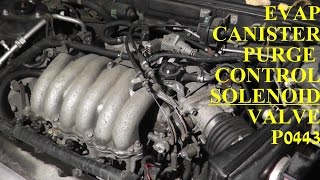
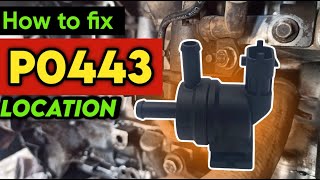
- Locate the canister purge valve on the engine's intake manifold. It is a small black plastic component with two hoses and a two-wire electrical connector.
- Inspect the fuse box in the engine bay. Check the 10A fuse labeled 'SENSORS 2' or 'SENSOR 1' or similar designation related to emissions sensors. Replace if blown.
- Inspect the electrical connector and wiring going to the purge valve for any visible damage, corrosion, or loose connections. Wiggle the connector to see if it affects engine idle.
- Disconnect the connector. With the ignition on, use a multimeter to verify that one pin has battery voltage (approx. 12V).
- Test the valve itself. Measure the resistance across the two pins on the valve. A normal reading is typically 15-30 ohms. If the reading is infinite (OL) or zero, the valve is faulty and needs replacement.
- If the wiring and valve test good, the issue may be with the ground signal from the PCM, which would require more advanced diagnostics with a tool that can command the valve to open.
Parts You'll Likely Need
- Canister Purge Valve / Solenoid
(OEM #28910-2M420)— This is the most common failure point for code P0443 on this vehicle due to internal electrical failure of the solenoid.
Trusted brands: Kia (Genuine OEM), Hyundai (Genuine OEM), Standard Motor Products (SMP), Dorman
OEM price range: $50-$80
Aftermarket price range: $30-$60
Related Codes That Often Appear With This One
- P0444 — This code indicates a purge valve circuit 'open' condition, which is a more specific version of P0443, often caused by a broken wire or a failed-open coil inside the valve.
- P0445 — This code indicates a purge valve circuit 'shorted' condition, another specific version of P0443, pointing to a short in the wiring or a shorted coil in the valve.
Platform-Specific Known Issues
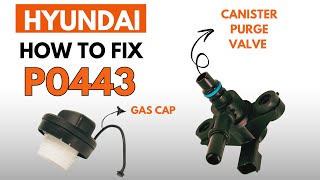
- Owner Experience: Quick DIY Fix: Multiple owners on forums like Reddit's r/MechanicAdvice and Kia-specific forums report that after getting a P0443 code, replacing the purge valve was a simple, sub-30-minute fix that resolved the check engine light. 🎬 Watch: Two ways to fix the P0443 code
- Repair Story: Bad Connector Pin: In a case involving a platform-mate (2013 Kia Sportage), an owner replaced the purge valve, but the P0443 code returned. The actual cause was a female pin that had backed out of the wiring harness connector, preventing a solid connection. Reseating the pin fixed the issue permanently.
Mechanic-Grade Diagnostic Values
- Purge Valve Solenoid Coil Resistance — expected: 15 - 30 Ohms. Failure: A reading of infinity (OL) indicates an open coil; a reading near 0 Ohms indicates a shorted coil.
- Purge Valve Connector Power Pin Voltage — expected: ~12V (Battery Voltage) with Key On, Engine Off.. Failure: 0V indicates a blown fuse (check 'SENSOR 1' or 'SENSORS 2' in the engine bay fuse box) or an open wire in the power supply circuit.
- Purge Valve Connector Control Pin Voltage (during active test) — expected: Near 0V when commanded ON by scan tool; near battery voltage when commanded OFF.. Failure: Voltage does not drop to ~0V when commanded ON, indicating an open in the control wire back to the PCM or a faulty PCM driver.
Scan Tool Commands That Help
- Kia GDS (Global Diagnostic System) or equivalent professional scan tool: Actuation Test / Active Test for Purge Control Valve — Use this after confirming the valve's resistance and power supply are good. This command forces the valve to cycle, allowing you to listen for an audible click (confirming mechanical function) and measure the control circuit's voltage response (confirming the PCM driver and wiring are intact).
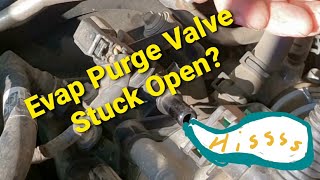
- Professional scan tool with live data and bidirectional controls: EVAP System Test (Purge and Seal) — To definitively test for a mechanically stuck-open purge valve. 🎬 See this quick test for a stuck open valve Command the purge valve OFF (closed) and the vent valve ON (closed), then monitor the Fuel Tank Pressure (FTP) sensor PID. If vacuum builds (pressure drops), it proves the purge valve is leaking engine vacuum into the sealed EVAP system, even when commanded shut.
Wiring & Ground Locations
- Engine Compartment Fuse Box — Located in the engine bay, typically on the driver's side.. This box contains the fuse that supplies 12V power to the purge control valve. A blown fuse is a simple but critical failure point that will cause a P0443 code.
- Fuse: 'SENSOR 1' or 'SENSORS 2' (10A) — Inside the engine compartment fuse box.. This is the specific fuse that often powers the purge valve circuit on Kia vehicles of this era. It should be the first component checked before testing wiring or replacing parts.
- PCM Ground Signal Wire — Runs from one of the two pins on the purge valve connector directly to a pin on the Powertrain Control Module (PCM).. The PCM controls the valve by providing a ground to complete the circuit. A break or short in this specific wire will cause a P0443 code even if the fuse, power wire, and valve itself are all good.
Real Owner Repair Stories
- Repair story based on common forum reports for similar platforms (2013 Kia Sportage (shares similar electrical architecture)) — Check Engine Light with code P0443.
❌ Tried (didn't work) Replacing the canister purge valve with a new part.
✅ What actually fixed it The P0443 code returned immediately. Further inspection of the wiring harness connector revealed a female pin had backed out slightly and was not making a solid connection with the male pin on the new valve. Pushing the pin firmly back into the connector until it clicked into place resolved the issue permanently.
"I Checked Everything" — The Actual Cause
- A common diagnostic error for P0443 is performing a smoke test. This code indicates an electrical CIRCUIT malfunction (open, short, or high resistance), not a physical LEAK in the EVAP system. A smoke test is designed to find leaks (which set codes like P0455 or P0456) and will almost always come back 'clean' or 'pass' when a P0443 is present. The actual cause is electrical and must be diagnosed with a multimeter and/or a scan tool, not a smoke machine.
When the Usual Fixes Don't Work
- While replacing the purge valve fixes the P0443 code in over 90% of cases for this vehicle, it is not a guaranteed fix. In a notable minority of cases, the code returns immediately. The most common reason for this is a fault in the connector itself, such as a pin that has backed out and is no longer making a secure connection. Before ordering a part, wiggling the connector while the engine is idling can sometimes reveal a bad connection if the idle stumbles. Always inspect the connector pins and harness integrity before assuming the part itself has failed.
OEM Part Supersession History
28910-2M420→No known supersession.— This part is still in active use on newer Kia/Hyundai models as of 2024.
Heads up: No known incompatibility issues within the 2017-2022 Kia Niro generation.
Model Year Variations Within This Range
- 2017-2022: No significant variations affecting this repair are known. The first generation (DE) Kia Niro received a cosmetic facelift for the 2020 model year, but the 1.6L hybrid powertrain and associated emissions components, including the purge valve, remained consistent.
Diagnostic Flowchart
Other Known Issues on This Vehicle
Issues unrelated to this code that are worth knowing about as an owner of this generation:
- Hydraulic Clutch Actuator (HCA) Fire Risk 🔴 High — Affects over 121,000 vehicles. Recall SC276 was issued in August 2023 for 2017-2022 Niro and 2018-2022 Niro PHEV models. (Ref: Recall SC276 / NHTSA 23V534000)
- Contaminated Hydraulic Clutch Actuator Fluid 🟠 Medium — Owners on forums report finding contaminated, 'gunky' fluid in the HCA reservoir at low mileage (e.g., under 20,000 miles), even without symptoms. This may be a precursor to the HCA failure and fire risk.
- Main Relay Overheating / Rear Seat Fire Risk 🔴 High — Affects 2017-2018 models. Inadequate connections in the Power Relay Assembly (PRA) could cause increased resistance and overheat the rear seats. (Ref: Recall SC168 / NHTSA 18V666000)
- Engine Failure / Exhaust Heat Recovery System (EHRS) Failure 🔴 High — Less common, but reported on 2018 models. The EHRS can fail, causing coolant to enter the exhaust, leading to rapid coolant loss and potential engine overheating and failure.
- Loss of Power Steering Assist 🟠 Medium — Affects some 2017 models due to a damaged Motor Driven Power Steering (MDPS) connector. (Ref: Recall SC145)
Used vs. New Parts: Buying Guide for This Vehicle
When a used part is the smart pick: Not recommended. The canister purge valve is a known high-failure part due to internal electrical coil failure. The cost of a new OEM or quality aftermarket part is low enough ($30-$80) that the risk of a used part failing shortly after installation outweighs the minimal cost savings.
What to inspect on the donor part:
- Not applicable as used parts are not recommended for this repair.
OEM-only on this vehicle (don't cheap out):
- For this specific repair (P0443), an OEM-only approach is not necessary. The purge valve is a simple solenoid where quality aftermarket alternatives perform well.
Aftermarket brands forum-validated for this vehicle:
- Standard Motor Products (SMP): Generally considered a reliable, OEM-quality alternative. Avoid their budget 'T-Series' line (often in a green box).
- BWD (BorgWarner): Also made by SMP and often identical to the SMP part in a different box, sometimes at a lower price.
Brands owners have reported issues with on this vehicle:
- Unbranded / White-Box Parts: Parts from online marketplaces with no brand name have a higher reported failure rate and should be avoided.
- Dorman: While a major supplier, some professional technicians and forum users express a preference for SMP/BWD for electrical components, citing better long-term reliability.
Real Owner Stories
Aggregated from forums and TSBs cited above. Mileages and costs reflect what owners reported in those sources.
2017-2022 Kia Niro
Symptoms: Check engine light on for P0443 code.
What fixed it: Replacing the purge valve; the owner noted it was a simple, sub-30-minute DIY fix.
Source hint: Reddit's r/MechanicAdvice and Kia-specific forums
2013 Kia Sportage (Platform-mate)
Symptoms: The P0443 code returned even after the purge valve was replaced with a new unit.
What fixed it: Reseating a female pin that had backed out of the wiring harness connector, which was preventing a solid electrical connection.
Source hint: Repair Story: Bad Connector Pin
Related OBD-II Codes
Frequently Asked Questions
Is there a recall for the P0443 code on my 2017-2022 Kia Niro?
Can I use a used purge valve from a salvage yard to fix this?
Where is the purge valve located on the Niro's 1.6L GDI engine?
Which fuse should I check for a P0443 code on my Kia Niro?
Does the Hyundai Ioniq Hybrid share this same P0443 issue?
What resistance should I see when testing the Niro's purge valve?
Helpful Videos

We Have This Part in Stock

The information in this article is provided for general reference and educational purposes only. Vehicle specifications, procedures, and part compatibility can vary by production date, trim level, and region. Always consult your vehicle's factory service manual and verify part numbers before purchasing or performing repairs. Safety-critical components such as airbags, seat belts, and braking systems should be installed by a qualified professional.
- Kia Niro:
- 🧭 Diagnostic Flowchart
- 🎬 Helpful Videos
- 🛍️ Shop This Part
- What's Unique About the 2017-2022 Kia Niro
- Symptoms You May Notice
- Most Likely Causes
- Rare But Worth Checking
- Diagnosis Steps
- Parts You'll Likely Need
- Related Codes That Often Appear With This One
- Platform-Specific Known Issues
- Mechanic-Grade Diagnostic Values
- Scan Tool Commands That Help
- Wiring & Ground Locations
- Real Owner Repair Stories
- "I Checked Everything" — The Actual Cause
- When the Usual Fixes Don't Work
- OEM Part Supersession History
- Model Year Variations Within This Range
- Other Known Issues on This Vehicle
- Used vs. New Parts: Buying Guide for This Vehicle
- Real Owner Stories
- 2017-2022 Kia Niro
- 2013 Kia Sportage (Platform-mate)
- Related OBD-II Codes
- Frequently Asked Questions
- 🎟️ Get 5% Off