

P0446 on 2001-2005 Toyota RAV4: EVAP Vent Control Circuit Causes and Fixes
On a 2001-2005 RAV4, code P0446 is most often caused by a failed charcoal canister assembly. Internal charcoal pellets break down and clog the integrated vent valve and associated lines. Simply replacing the valve is a temporary fix; the entire canister assembly must be replaced to solve the root cause. The part costs between $150-$400.
- For a 2001-2005 RAV4, P0446 almost always points to a problem with the charcoal canister assembly located under the car.
- Before buying parts, check for black charcoal pellets in the EVAP hoses. If you see them, you must replace the entire canister assembly.
- Simply replacing a single valve without replacing a failed canister will likely result in the code returning.
- This is a DIY-friendly repair with basic hand tools, but the bolts on the canister's protective shield may be rusted and difficult to remove.
What's Unique About the 2001-2005 Toyota RAV4
On this generation of Toyota RAV4, the P0446 code is overwhelmingly linked to the charcoal canister failing internally. Over time, the activated charcoal pellets inside the canister can break apart. These small, black granules then travel through the EVAP hoses, clogging the vent valve (also known as the Canister Closed Valve or CCV) and other solenoids. This means that simply replacing an individual valve is often a temporary fix, as the canister will continue to shed material and cause the problem to return. The most reliable and widely recommended repair is replacing the entire canister assembly.
Symptoms You May Notice
- Check Engine Light is on.
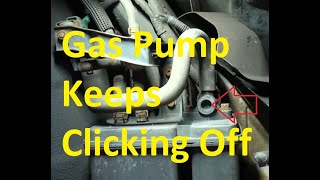
- Difficulty filling the fuel tank (the gas pump nozzle clicks off repeatedly). 🎬 Watch: Why the gas pump keeps clicking off during fill-ups.
- A faint smell of fuel from the rear of the vehicle.
- In rare cases, a whooshing sound from the gas tank area after parking the car, as pressure equalizes improperly.
- Replacing only the vent valve (VSV) without checking for charcoal pellets. If the canister is the root cause, the new valve will quickly become clogged and the code will return.
- Replacing the purge valve in the engine bay. While part of the EVAP system, the purge valve is less commonly the cause for a P0446 code specifically, which points to the vent side of the system near the tank.
Most Likely Causes
- Failed Charcoal Canister Assembly 🔴 High Probability → Shop Vapor Canister The charcoal pellets inside the original canisters are known to degrade and break apart over time, creating debris that clogs the integrated valves and lines. This is a widely documented failure pattern for this specific vehicle generation.
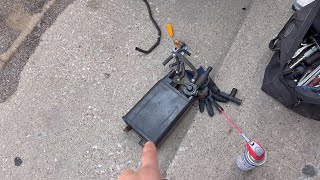
How to confirm: Disconnect the hoses from the canister and check for black, charcoal pellets inside the hoses or at the valve ports. If any pellets are present, the canister has failed and must be replaced. You can tap the canister or hoses to dislodge them.
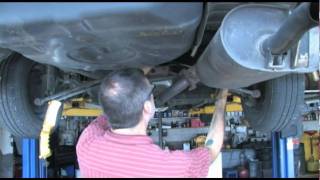
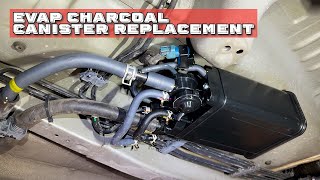
Typical fix: Replace the entire charcoal canister assembly. This part is located under the vehicle, on the driver's side, near the fuel tank. It is held in by a couple of bolts and has several hose and electrical connections. It is critical to blow out all connected EVAP lines with compressed air to remove any loose charcoal before installing the new canister. 🎬 Watch this step-by-step guide to replacing the charcoal canister.
Est. part cost: $150-$400 - Faulty Vent Valve / Vacuum Switching Valve (VSV) 🟡 Medium Probability The vent valve (often called a VSV on Toyotas) can fail electrically or become mechanically stuck. It is often clogged by debris from a failing canister, making this a secondary failure. Spiders have also been known to build nests in the vent tube, causing a blockage.
How to confirm: Test the valve's operation by applying 12V power to its terminals; you should hear a distinct click. You can also test for resistance across the terminals with a multimeter (check against factory specs). 🎬 See how to test the VSV and replace the canister. Check the hoses connected to it for blockages or charcoal debris.
Typical fix: Replace the faulty valve. However, if the old valve is full of charcoal pellets, the new one will soon fail unless the canister is also replaced. Always inspect for charcoal contamination before replacing just the valve.
Est. part cost: $40-$100 - Cracked or Disconnected EVAP Hoses ⚪ Low Probability Rubber hoses become brittle and crack with age and exposure to the elements under the vehicle. A hose can also become disconnected.
How to confirm: Visually inspect all vacuum and vapor lines running to and from the charcoal canister and fuel tank for cracks, loose connections, or blockages. A smoke test is the most effective way to find small leaks. One owner found a disconnected hose near the canister was the sole cause.
Typical fix: Replace the damaged section of hose or reconnect it.
Est. part cost: $10-$30
Rare But Worth Checking
- Damaged Wiring or Connector: The wiring harness leading to the canister assembly is under the vehicle and susceptible to corrosion or physical damage. Check the connector and nearby wires for breaks, corrosion, or loose pins before replacing parts. A 'circuit malfunction' code specifically points to a potential electrical issue.
- Loose or Faulty Gas Cap: → Shop Fuel Tank Cap While a bad gas cap typically triggers other EVAP codes like P0440, P0442 or P0455, it's a very simple and cheap item to check first. Ensure it is tight and the seal is not cracked. Always use an OEM replacement cap if needed, as aftermarket caps can cause issues.
Diagnosis Steps
- Read the code with an OBD-II scanner to confirm P0446 and check for any other related codes.
- Check the gas cap. Ensure it is tight and the seal is in good condition. A loose or faulty cap is a simple but common issue.
- Visually inspect the charcoal canister and all connected hoses under the vehicle (driver's side, near the rear). Look for obvious cracks, damage, or loose connections.
- Disconnect one of the main hoses from the canister (e.g., the line to the purge valve) and tap it to see if any black charcoal pellets fall out. If they do, the canister has failed and must be replaced.
- If no pellets are found, locate the vent valve/VSV on the canister assembly. Inspect its fresh air inlet hose for blockages like spider webs or dirt.
- Test the vent valve's function by applying 12V power to its terminals and listening for a click. Check its resistance with a multimeter against factory specifications.
- Inspect the electrical connector and wiring going to the canister assembly for corrosion, damage, or breaks. A circuit code can mean a wiring problem.
- If no obvious cause is found, a smoke test is the next step to identify any hard-to-see leaks in the hoses or canister body.
Parts You'll Likely Need
- Charcoal Canister Assembly
(OEM #77740-42071 (replaces 77740-42070 for 2001-2003 models), 77740-42072 (for 2004-2005 models))— This is the most common failure point for this code on this vehicle, as the internal charcoal breaks down and clogs the integrated valves. The part was updated for the 2004 model year refresh.
Trusted brands: Toyota (OEM), Dorman (e.g., 911-652 for 2001-2003), Aisan, Standard Motor Products
OEM price range: $265-$335
Aftermarket price range: $150-$250
Related Codes That Often Appear With This One
- P0441 — Incorrect Purge Flow. This often appears with P0446 when the system is clogged by charcoal pellets, affecting the flow dynamics of the entire EVAP system.
- P0442 — Small EVAP Leak Detected. This can be triggered alongside P0446 if a valve is stuck open due to debris or failure, causing the system to fail its leak test.
- P0440 — General EVAP System Malfunction. This is a more generic code that can accompany P0446, indicating a systemic issue within the EVAP system.
Technical Service Bulletins (TSBs) & Recalls
- EG005-01 (April 27, 2001): Titled 'EVAP SYSTEM OPERATION INFORMATION', this bulletin provides supplemental details on the design, operation, and diagnostics for the EVAP systems used on 1996-2001 Toyota models, including the RAV4.
Platform-Specific Known Issues
- A known issue for this platform is the internal failure of the charcoal canister, leading to charcoal pellets contaminating the entire EVAP system. This makes replacing the full canister assembly the most effective repair for P0446.
- Toyota issued Technical Service Bulletin (TSB) EG005-01 in April 2001 to provide information on the operation of the EVAP system used in these vehicles. While not a recall, it details the system's function for technicians.
- Some owners on forums have had success with aftermarket canisters from brands like Dorman, which can be a cost-effective alternative to the OEM part. However, some professional mechanics report a higher failure rate with aftermarket units and recommend sticking with OEM.
Mechanic-Grade Diagnostic Values
- Vent Valve (VSV) Solenoid Resistance — expected: 30 - 40 Ohms at room temperature.. Failure: A reading of infinite resistance (open circuit) or near zero resistance (short circuit) indicates a failed solenoid coil.
- Voltage at Vent Valve Connector — expected: Approximately 12V (battery voltage) on one pin with the key in the 'ON' position, engine off. The other pin is the ground control from the ECM.. Failure: No voltage suggests a problem with the power supply circuit (fuse, relay, or wiring).
Scan Tool Commands That Help
- Toyota Techstream: Evaporative System Check — This utility, found under 'Engine and ECT' -> 'Utility', forces the EVAP monitor to run without the usual 5-hour cold soak waiting period. It's essential for verifying a repair is successful. The tool commands the valves and pump through a sequence, providing a pass/fail result and detailed data that can pinpoint a malfunction more accurately than a generic OBD-II reader.
Wiring & Ground Locations
- EB — On the 2002 1AZ-FE engine, this ground point is on the intake side of the cylinder block. On the 2004 2AZ-FE, it's listed at the left rear of the cylinder block.. The Engine Control Module (ECM) and its related sensors and actuators rely on clean ground connections. A corroded or loose 'EB' ground could cause erratic voltage in the EVAP control circuits, potentially triggering a P0446 code even if the components are good.
- Canister Assembly Connector — Directly on the charcoal canister assembly, located under the vehicle on the driver's side.. This is the primary connection point for testing the vent valve circuit. You can check for 12V power, test for continuity on the ground wire back to the ECM, and measure the valve's resistance directly at this connector's pins.
Real Owner Repair Stories
- YouTube channel 'Fix It All' (2002 Toyota RAV4) — Check Engine Light with code P0442 (small leak), but the diagnostic principle applies to P0446.
❌ Tried (didn't work) A new gas cap was installed. A smoke test was performed.
✅ What actually fixed it The smoke test revealed the system was perfectly sealed, which was abnormal. This indicated the vent shut valve was stuck closed. Since the valve is integrated into the canister, the entire OEM charcoal canister assembly was replaced, which resolved the issue. The mechanic strongly recommended using an OEM part over cheaper aftermarket alternatives due to past failures with them. - Reddit user in r/MechanicAdvice (1999 Toyota RAV4 (XA10 generation, but similar EVAP principles)) — Check Engine Light with code P0446.
❌ Tried (didn't work) Tested the vent control valve solenoid and vacuum switching valve solenoid (both worked), checked for blocked vacuum lines.
✅ What actually fixed it After inspecting all the hoses connected to the canister, the owner found one vacuum line that was completely disconnected. Reconnecting the hose fixed the problem and cleared the code. - NHTSA ODI #10735783 — An owner of a similar Toyota model reported a P0446 code where the canister was found to be clogged and the VSV and purge valves were leaking. The issue was resolved by replacing the charcoal canister at 244,309 miles.
- NHTSA ODI #10086188 — A report for a related Toyota vehicle noted that a P0446 code was present for an EVAP system malfunction traced specifically to a vent control malfunction, requiring a special order VSV control for installation.
"I Checked Everything" — The Actual Cause
- A key diagnostic pattern for P0446 is when a smoke test shows the system is perfectly sealed with no leaks. This is a strong indicator that the vent valve is stuck in the *closed* position. A healthy system should be open to the atmosphere through the vent valve when not running its self-test. A 'perfect' smoke test result can be a sign of failure, leading directly to the vent valve/canister assembly as the culprit.
OEM Part Supersession History
77740-42070→77740-42071— Standard part revision by the manufacturer.
Heads up: These parts are interchangeable for the specified years. The Dorman aftermarket equivalent is 911-652.77740-42072→N/A— This is the part for the facelifted 2004-2005 models with the 2.4L engine.
Heads up: This part is not compatible with 2001-2003 models.
Model Year Variations Within This Range
- 2001-2003 vs 2004-2005: The 2004 facelift introduced the 2.4L 2AZ-FE engine, replacing the 2.0L 1AZ-FE. This change also brought a different charcoal canister assembly (PN 77740-42072 for '04-'05 vs. 77740-42071 for '01-'03). While the failure pattern is the same, the parts are not interchangeable. Wiring diagrams also show slight differences in ground point locations between these year ranges.
Diagnostic Flowchart
Other Known Issues on This Vehicle
Issues unrelated to this code that are worth knowing about as an owner of this generation:
- ECM Failure Causing Automatic Transmission Problems 🔴 High — Very common on 2001-2003 models. Solder joints inside the Engine Control Module (ECM) fail, causing harsh shifting (especially 2-3 gear), slipping, or getting stuck in gear. Often misdiagnosed as transmission failure. (Ref: No official recall, but it is a widely recognized problem. Repair involves replacing or rebuilding the ECM.)
- Excessive Oil Consumption (2.4L 2AZ-FE Engine) 🔴 High — Common on 2004-2005 models with the 2.4L engine, often starting around 70k-100k miles. Caused by a design flaw in the piston rings which get clogged with carbon and fail to scrape oil properly. (Ref: Toyota had a warranty enhancement program for this issue on later models, but these early RAV4s are likely outside the coverage period. The fix is an engine rebuild with updated pistons and rings.)
- Stripped Cylinder Head Bolts (2.4L 2AZ-FE Engine) 🔴 High — A known issue on the 2.4L 2AZ-FE engine, typically occurring at higher mileage (120k+ miles). The threads for the head bolts in the aluminum engine block can strip, leading to head gasket failure and coolant leaks. (Ref: No recall. The proper repair involves installing threaded inserts (like a Time-Sert or NS300L kit) into the block, which is a labor-intensive job.)
- Faulty Air/Fuel Ratio Sensor 🟡 Low — A fairly common failure item that will trigger a Check Engine Light, often with code P1155.
Used vs. New Parts: Buying Guide for This Vehicle
When a used part is the smart pick: For this specific repair, buying a used charcoal canister is NOT recommended. The primary failure mode is the internal breakdown of charcoal pellets, a condition that is impossible to verify visually from the outside. A used part from a salvage yard has an unknown history and is highly likely to have the same degradation issue, leading to a repeat failure.
What to inspect on the donor part:
- Not applicable for the charcoal canister due to the high risk of internal failure. For related parts like hoses or the protective shield, look for a donor vehicle from a dry, salt-free climate to minimize rust and rubber rot.
OEM-only on this vehicle (don't cheap out):
- Charcoal Canister Assembly: Multiple professional sources and owner experiences indicate that aftermarket canisters (like Dorman) can have a higher failure rate or cause compatibility issues. Given the labor involved, using a new OEM Toyota part is the most reliable, long-term solution to avoid repeat repairs.
Aftermarket brands forum-validated for this vehicle:
- While some owners report success with Dorman as a budget alternative, it is not consistently validated. For this specific, high-failure part on this vehicle, OEM is the safest choice.
Brands owners have reported issues with on this vehicle:
- Use caution with any aftermarket canister for this vehicle. Some mechanics specifically report issues with Dorman units for this application, leading to repeat work.
Real Owner Stories
Aggregated from forums and TSBs cited above. Mileages and costs reflect what owners reported in those sources.
2005 Toyota RAV4
Symptoms: Check engine light with codes P0446, P0442, P0455. Light came on after going over a bump while making a U-turn. A smoke test was performed and the gas cap was replaced, but the light remained.
What fixed it: The mechanic recommended replacing all the VSVs and the charcoal canister assembly.
Source hint: Reddit r/MechanicAdvice - '05 Toyota RAV4 owner report
1999 Toyota RAV4
Symptoms: Check engine light with code P0446.
What fixed it: Discovered a disconnected vacuum line near the charcoal canister.
Source hint: Reddit r/MechanicAdvice - ''99 Rav4 P0446 Code'
2001-2005 Toyota RAV4
Symptoms: Strong fuel smell along with the P0446 code.
What fixed it: Replacing the entire charcoal canister assembly due to internal failure and pellet contamination.
Source hint: YotaTech.com - 'P0446 code - what have you replaced to fix?'
2001-2005 Toyota RAV4
Symptoms: P0446 code; found that charcoal pellets had dumped into the lines.
What fixed it: Replacing the canister and cleaning the lines; the owner noted that the failing canister can clog a brand new VSV if not addressed.
Source hint: BobIsTheOilGuy.com - 'Anybody with dreaded P0446 on a Toyota?'
Toyota Owner Report
Symptoms: Check engine light for P0446/P0441 that would disappear in winter and reappear in summer, first noticed around 36,000 miles.
What fixed it: Documented in NHTSA ODI #10125378 regarding persistent EVAP codes on a similar Toyota platform.
Toyota Owner Report
Symptoms: Check engine light for P0446 (EVAP system vent control circuit) appearing during normal driving.
What fixed it: Documented in NHTSA ODI #11190106 as a recurring issue for the manufacturer's EVAP vent control systems.
Documented NHTSA Reports
- NHTSA ODI #11133326 describes a recurring check engine light for code P0446 on a Toyota vehicle, citing multiple technical forum discussions regarding the commonality of this specific vent control failure.
Related OBD-II Codes
Frequently Asked Questions
Is there a Technical Service Bulletin for the EVAP system on my 2001 RAV4?
Why is it recommended to replace the entire charcoal canister on this generation of RAV4 instead of just the valve?
I'm having trouble filling my gas tank; the pump keeps clicking off. Is this related to P0446?
Can I use an aftermarket Dorman canister to fix P0446 on my RAV4?
Could a spider nest really be causing my Check Engine Light?
Where is the charcoal canister located on the 2001-2005 RAV4?
Helpful Videos

Used OEM Parts in Stock
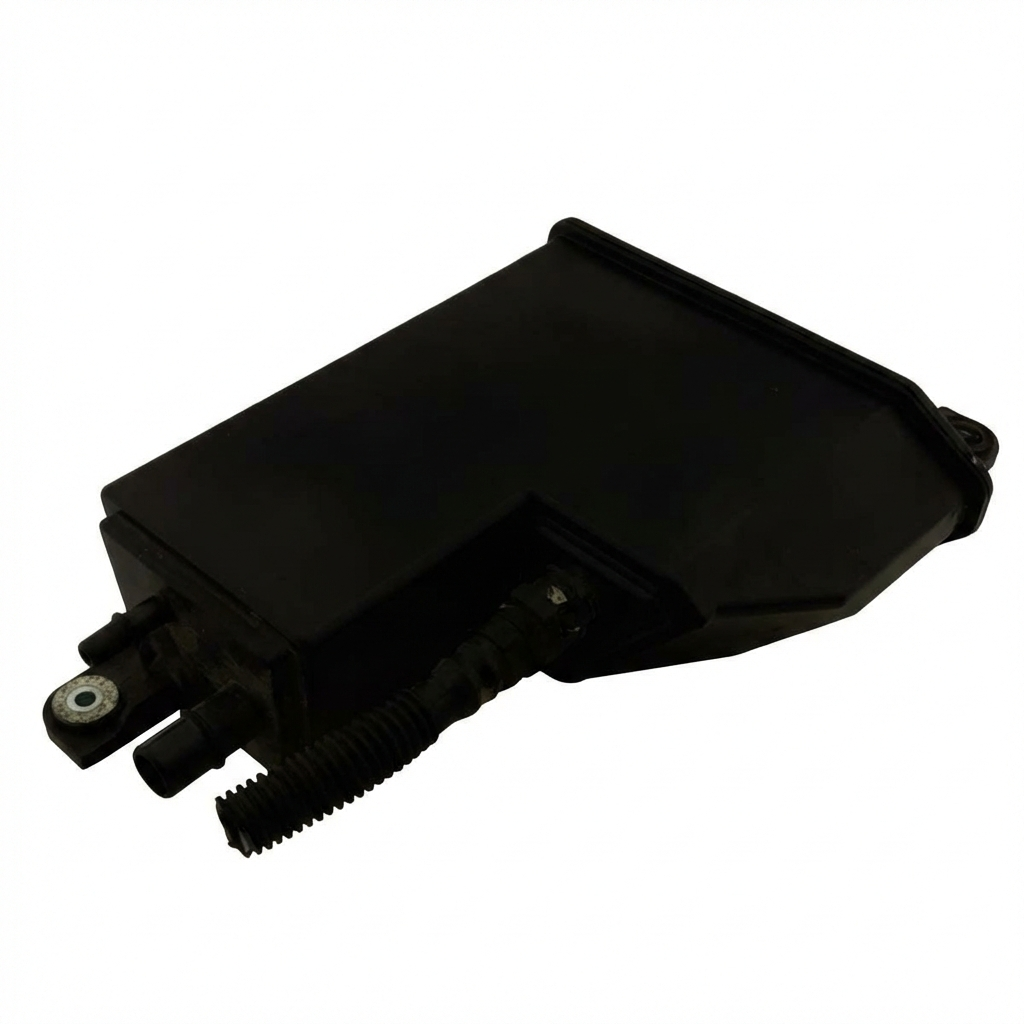
New Aftermarket Parts Available


The information in this article is provided for general reference and educational purposes only. Vehicle specifications, procedures, and part compatibility can vary by production date, trim level, and region. Always consult your vehicle's factory service manual and verify part numbers before purchasing or performing repairs. Safety-critical components such as airbags, seat belts, and braking systems should be installed by a qualified professional.
- Toyota RAV4:
- 🧭 Diagnostic Flowchart
- 🎬 Helpful Videos
- 🛍️ Shop This Part
- What's Unique About the 2001-2005 Toyota RAV4
- Symptoms You May Notice
- Most Likely Causes
- Rare But Worth Checking
- Diagnosis Steps
- Parts You'll Likely Need
- Related Codes That Often Appear With This One
- Technical Service Bulletins (TSBs) & Recalls
- Platform-Specific Known Issues
- Mechanic-Grade Diagnostic Values
- Scan Tool Commands That Help
- Wiring & Ground Locations
- Real Owner Repair Stories
- "I Checked Everything" — The Actual Cause
- OEM Part Supersession History
- Model Year Variations Within This Range
- Other Known Issues on This Vehicle
- Used vs. New Parts: Buying Guide for This Vehicle
- Real Owner Stories
- 2005 Toyota RAV4
- 1999 Toyota RAV4
- 2001-2005 Toyota RAV4
- 2001-2005 Toyota RAV4
- Toyota Owner Report
- Toyota Owner Report
- Documented NHTSA Reports
- Related OBD-II Codes
- Frequently Asked Questions
- 🎟️ Get 5% Off