

P0455 Hummer H3 (2005-2010) Guide: EVAP Large Leak Causes and Fixes
For a 2005-2010 Hummer H3, code P0455 is most often caused by a faulty EVAP vent solenoid located at the rear of the vehicle. Replacing it (and the required wiring adapter) is the most common fix after checking the gas cap. The mounting bolt for this solenoid is notoriously difficult to remove due to rust. Expect to pay $50-$100 for the parts.
- Always check the gas cap first; it's the easiest and cheapest potential fix.
- The most likely part to have failed on an H3 with a P0455 code is the EVAP vent solenoid, located near the rear axle.
- If you replace the vent solenoid, you will almost certainly need the wiring adapter harness (ACDelco 19257603) for the updated part (ACDelco 20907779).
- Be prepared for a difficult repair of the vent solenoid due to the high likelihood of a severely rusted mounting bolt.
- A smoke test is the fastest and most accurate way to diagnose any EVAP leak that isn't the gas cap.
What's Unique About the 2005-2010 Hummer H3
The Hummer H3 shares its GMT345 platform with the Chevrolet Colorado and GMC Canyon, and they all have a common, well-documented failure point for P0455: the EVAP vent solenoid. This part is located above the rear axle, where it is highly exposed to road grime and moisture, causing the valve to fail and its 13mm mounting bolt to rust severely. Many owners report having to cut the bolt off with an angle grinder to remove the old part. A key detail for this repair is that the updated GM replacement part (20907779) requires a separate wiring harness adapter (19257603), a crucial piece of information that can halt a DIY repair if not known beforehand.
Symptoms You May Notice
- Check Engine Light is on
- A faint smell of fuel, especially around the rear of the vehicle
- Failing a state emissions inspection
- Difficulty fueling (gas pump nozzle clicks off repeatedly before the tank is full).
- Replacing the gas cap repeatedly without checking for other leaks. While the cap is a common cause, if a new one doesn't fix it, the problem is almost always elsewhere in the system, most commonly the vent solenoid on an H3.
- Replacing the purge valve in the engine bay when the more common failure is the vent valve at the rear of the vehicle.
Most Likely Causes
- Loose or Faulty Gas Cap 🔴 High Probability → Shop Fuel Tank Cap This is the most common cause for any vehicle. The cap's seal can wear out over time, or it may not have been tightened correctly after refueling.
How to confirm: Ensure the gas cap clicks at least three times when tightened. Inspect the rubber O-ring on the cap for cracks or damage. If it looks worn, replacement is a cheap and easy first step.
Typical fix: Tighten or replace the gas cap.
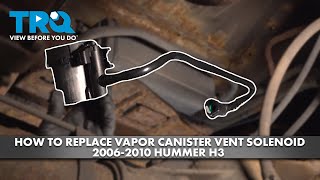
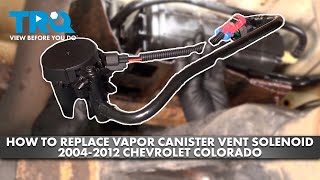
Est. part cost: $15-$30 - Faulty EVAP Vent Solenoid 🔴 High Probability → Shop Vapor Canister This is a very common failure on the H3 and its platform mates. 🎬 Watch: How to swap the vent solenoid on this shared platform. The solenoid is mounted near the charcoal canister above the rear axle, where it's exposed to water and dirt, causing it to fail internally or its 13mm mounting bolt to rust solid.
How to confirm: A smoke test is the definitive method. 🎬 Watch: A professional diagnostic walkthrough for fixing the P0455 code. Smoke will be seen exiting the vent solenoid if it's stuck open. You can also try to command it closed with a capable scan tool and see if the system holds a vacuum.
Typical fix: Replace the EVAP vent solenoid and its associated hose assembly. The mounting bolt often needs to be cut off with an angle grinder due to rust. The updated replacement part (20907779) requires a wiring adapter harness (19257603).
Est. part cost: $40-$80 for the solenoid assembly and adapter - Faulty EVAP Purge Valve/Solenoid 🟡 Medium Probability → Shop Vapor Canister This valve, located in the engine bay, can get stuck open, creating a constant vacuum leak into the engine and preventing the system from sealing for its test.
How to confirm: Disconnect the valve and try to blow through it. If air passes through, it is stuck open and needs to be replaced. It should be normally closed when no power is applied.
Typical fix: Replace the purge valve. This is typically an easy repair with one 8mm bolt and two hose connections in the engine bay.
Est. part cost: $25-$50 - Improperly Seated Fuel Filler Neck Seal ⚪ Low Probability → Shop Fuel Filler Neck A specific GM Technical Service Bulletin (TSB #05-06-04-055) notes that the seal between the plastic filler housing and the metal filler tube can be misaligned, preventing the gas cap from sealing properly even if the cap itself is good. This has been reported by owners after installing aftermarket fuel doors.
How to confirm: Even with a new gas cap, the code returns. A smoke test will show smoke leaking from around the base of the fuel filler neck area, not the cap itself.
Typical fix: Reposition the fuel filler housing seal correctly.
Est. part cost: $0 (labor only) - Cracked or Disconnected EVAP Hoses ⚪ Low Probability Over time, the plastic and rubber hoses in the EVAP system can become brittle and crack, or a connection can come loose, especially after off-road use. A YouTube repair video for a 2006 H3 showed a cracked rubber hose near the canister was the source of the leak.
How to confirm: A visual inspection may reveal an obvious break or disconnection. A smoke test is the most effective way to find small cracks or hidden leaks in the hose network.
Typical fix: Replace the damaged section of hose. In some cases, a simple rubber fuel hose and hose clamps can be used for a repair.
Est. part cost: $5-$25
Rare But Worth Checking
- Cracked Charcoal Canister: → Shop Vapor Canister The charcoal canister itself can be damaged by road debris, causing a large leak. This is uncommon but possible, especially on a vehicle designed for off-road use. A visual inspection and smoke test would confirm this.
- Broken Exhaust Manifold Bolt: In one unusual case reported on a forum, a user claimed their P0455 code was caused by a broken exhaust manifold bolt. This is not a typical cause for an EVAP code and may have been a misdiagnosis or a coincidental finding.
Diagnosis Steps
- Check the Gas Cap: Remove and reinstall the gas cap, ensuring it clicks several times. Inspect the seal for any cracks or damage. If in doubt, replace it as it's an inexpensive first step.
- Visual Inspection: Look over the EVAP hoses in the engine bay and near the rear axle/charcoal canister for any obvious cracks, disconnections, or damage. Pay close attention to rubber sections which can crack.
- Test the Purge Solenoid: Locate the purge solenoid in the engine bay. Disconnect it and try to blow through it. If air passes, it's stuck open and must be replaced.
- Perform a Smoke Test: This is the most effective way to find the source of the leak. Introduce smoke into the EVAP service port. Look for smoke coming from the gas cap, hoses, charcoal canister, or vent solenoid.
- Inspect the Vent Solenoid: If the smoke test reveals a leak from the vent solenoid (located near the rear axle), it needs to be replaced. Be prepared for the 13mm mounting bolt to be heavily rusted and require cutting. 🎬 See this step-by-step guide to replacing the H3 vent solenoid.
- Check Filler Neck Seal: If no other leaks are found, carefully inspect the fuel filler neck area for leaks as indicated by TSB #05-06-04-055, especially if any work has been done in that area.
Parts You'll Likely Need
- EVAP Canister Vent Solenoid Valve & Hose Assembly
(OEM #20907779)— This is the most common failure point on the H3 for code P0455 due to its exposed location. This is the updated part number.
Trusted brands: ACDelco (GM Genuine)
OEM price range: $40-$70
Aftermarket price range: $30-$50 - EVAP Vent Solenoid Jumper Wiring Harness
(OEM #19257603)— This adapter is required to connect the new-style vent solenoid (20907779) to the vehicle's original wiring harness. Not ordering this part with the solenoid is a common DIY mistake.
Trusted brands: ACDelco (GM Genuine)
OEM price range: $25-$40
Aftermarket price range: $15-$25 - Fuel Cap
(OEM #25827646)— A worn or loose gas cap is the simplest and a very common cause of a P0455 code.
Trusted brands: ACDelco (GM Genuine), Gates, Stant
OEM price range: $20-$30
Aftermarket price range: $15-$25 - EVAP Canister Purge Solenoid
(OEM #12606684)— This valve in the engine bay can stick open, causing a leak. It's less common than the vent solenoid but still a frequent culprit.
Trusted brands: ACDelco (GM Genuine), Standard Motor Products (SMP), Dorman
OEM price range: $30-$50
Aftermarket price range: $20-$40
Related Codes That Often Appear With This One
- P0442 — This code indicates a small EVAP leak. It can appear alongside P0455 if the system has multiple leaks of different sizes or if a leak is intermittent. Several owner reports show both codes appearing together.
- P0449 — This code specifically points to a fault in the EVAP vent solenoid valve control circuit. Seeing P0449 with P0455 is a very strong indicator that the vent solenoid is the root cause of the problem.
Technical Service Bulletins (TSBs) & Recalls
- TSB #05-06-04-055: Service Engine Soon (SES) Light On, Diagnostic Trouble Code(s) (DTC) P0442 Small Evaporative Emissions (EVAP) Leak and/or P0455 Large EVAP Leak (Reposition Fuel Filler Housing Seal).
Platform-Specific Known Issues
- TSB #05-06-04-055: Addresses an issue where the fuel filler housing seal is mispositioned, preventing the gas cap from sealing correctly and triggering EVAP codes.
Mechanic-Grade Diagnostic Values
- EVAP Canister Vent Solenoid Resistance — expected: 20 to 30 ohms. Failure: A reading outside of this range indicates a damaged solenoid winding.
- EVAP Vent Solenoid Voltage Supply — expected: Battery Voltage (approx. 12V). Failure: If a test lamp connected between the voltage supply circuit (Terminal A) and ground does not illuminate with the ignition ON, there is a fault in the power supply circuit or fuse.
- Fuel Tank Pressure (FTP) Sensor Voltage — expected: Approximately 1.5V with the gas cap off (atmospheric pressure). Voltage decreases as vacuum increases.. Failure: A faulty sensor may send incorrect readings, making the ECM believe there is a leak when there isn't one.
Scan Tool Commands That Help
- Tech2 or similar professional scan tool: EVAP System Seal / Unseal — This command is used to manually close the EVAP vent solenoid, sealing the system. This allows a technician to check if the system can hold a vacuum or pressure, which is essential for diagnosing a P0455 leak.
- Tech2 or similar professional scan tool: EVAP Purge/Seal — This function commands the purge solenoid to open and the vent solenoid to close, creating a vacuum in the system. The technician can then monitor the Fuel Tank Pressure (FTP) sensor data to see if the vacuum decays, indicating a leak.
- Tech2 or similar professional scan tool: EVAP Vent Solenoid ON/OFF — This command directly toggles the vent solenoid, allowing a technician to verify its function. When commanded ON (closed), a test lamp connected across the solenoid's connector terminals should light up, confirming the control circuit is working.
Wiring & Ground Locations
- EVAP Canister Vent Solenoid Connector — Above the spare tire, connected to the vent solenoid which is mounted to the charcoal canister bracket.. This connector and its wiring are exposed to the elements. A broken wire at this location can cause a P0449 and prevent the vent solenoid from closing, leading to a P0455. One owner reported a broken wire here was the final fix.
- EVAP Canister Purge Solenoid Connector — In the engine bay, on the driver's side of the engine, below the intake manifold.. A fault in this connector's wiring could prevent the purge valve from operating correctly, though it's a less common failure point for P0455 than the vent solenoid.
- Underhood Fuse Block — Above the left front wheel well.. Contains Fuse #31 (CNSTR VENT), which supplies power to the EVAP vent solenoid. A blown fuse will cause the solenoid to fail to close, triggering a large leak code.
- G103 — On the lower left side of the engine block, forward of the starter.. This is a primary engine ground point. While not directly tied to the rear-mounted EVAP components, a poor engine ground can cause a variety of unpredictable electrical issues.
- Rear Crossmember Ground — On or near the rear crossmember of the frame.. Wiring diagrams indicate the fuel pump and other rear components ground here. A poor connection could potentially affect the fuel tank pressure sensor or other nearby components, although it's not a commonly cited cause for P0455.
Real Owner Repair Stories
- HummerForums user (2006 Hummer H3) — Check Engine Light with code P0455
❌ Tried (didn't work) Replacing the gas cap multiple times.
✅ What actually fixed it The dealer performed a smoke test and found the EVAP vent valve near the canister was sticking and leaking. Replacing the vent valve resolved the code. - HummerForums user (2006 Hummer H3) — Check Engine Light with code P0422 (small leak), which later could present as P0455.
❌ Tried (didn't work) Dealer replaced the gas cap 3 times., Multiple smoke tests that found no leaks.
✅ What actually fixed it The dealer finally found a broken wire on the vent solenoid. Repairing the wire solved the issue. - Mac Auto Diagnostics on YouTube (2006 Hummer H3 3.5L) — Check Engine Light with P0455, unable to pass emissions.
❌ Tried (didn't work) Customer had taken it to multiple shops who could not find the issue.
✅ What actually fixed it A smoke test revealed two issues: a broken clip on a nylon EVAP line and a separate cracked rubber EVAP hose. The technician repaired the rubber hose section with a new piece of 5/8" rubber fuel hose and clamps, which fixed the leak. - HummerForums user (Hummer H3 (year not specified)) — EVAP code after installing an aftermarket fuel door.
❌ Tried (didn't work) Checking the gas cap repeatedly.
✅ What actually fixed it The rubber seal/lip between the plastic filler housing and the metal filler pipe was not seated correctly during the fuel door installation. Repositioning the seal properly allowed the gas cap to seal and fixed the code.
"I Checked Everything" — The Actual Cause
- In one documented case on HummerForums, a 2006 H3 repeatedly failed smoke tests at the dealership, yet the EVAP code persisted after multiple gas cap replacements. The ultimate cause was discovered to be a broken wire at the EVAP vent solenoid connector. The electrical fault prevented the solenoid from closing during the test cycle, creating the large leak, but because it was an electrical issue and not a physical crack, the smoke test itself was misleading.
OEM Part Supersession History
10386359, 25948082→20907779— Updated design for the EVAP Canister Vent Solenoid Valve.
Heads up: The updated part (20907779) uses a different electrical connector than the original. It is critical to also purchase the jumper wiring harness adapter, part number 19257603, to connect the new solenoid to the existing vehicle harness.
Diagnostic Flowchart
Real Owner Stories
Aggregated from forums and TSBs cited above. Mileages and costs reflect what owners reported in those sources.
Hummer H3
Symptoms: The ECU light came on noticeably after some off-roading. Scanned the vehicle using a Bluetooth OBD-II scanner and the Torque app, which pulled codes P0455 and P0442.
What fixed it: Initially replaced the gas cap, which did not fix the issue. Ultimately discovered a vent solenoid failure and replaced it, utilizing the 19257603 adapter harness for the updated part.
Source hint: Schwarttzy.com: P0455 & P0442 ECU Fault Log H3 Hummer
Hummer H3
Symptoms: Persistent P0455 code that remained even after replacing the gas cap.
What fixed it: Found a misaligned fuel filler neck seal, which had been improperly seated after the installation of an aftermarket fuel door.
Source hint: HummerForums.com: H3 Engine light PO455 EVAP help needed!
2006 Hummer H3
Symptoms: Engine warning light came on in a relatively new H3, throwing a P0455 code.
What fixed it: Repositioned the fuel filler housing seal as outlined in GM TSB #05-06-04-055.
Source hint: HummerForums.com by Elcova: engine warning light on...For the techs out there....help
Hummer H3
Symptoms: Code P0455 triggered and a new gas cap failed to resolve the issue.
What fixed it: Replaced the vapor canister vent valve with a Dorman replacement part. The repair required using PB Blaster to remove the heavily rusted mounting bolt.
Source hint: HummerForums.com: Code P0455?
Related OBD-II Codes
Frequently Asked Questions
Does TSB #05-06-04-055 apply to my Hummer H3 for code P0455?
I replaced the gas cap on my H3 but P0455 came back. What is the next most likely cause?
What parts do I need to replace the EVAP vent solenoid on my 2005-2010 Hummer H3?
Why is the EVAP vent solenoid so difficult to remove on the H3?
Can off-roading cause a P0455 code on my Hummer H3?
How do I test the EVAP purge valve in the engine bay of my H3?
Helpful Videos
We Have This Part in Stock


The information in this article is provided for general reference and educational purposes only. Vehicle specifications, procedures, and part compatibility can vary by production date, trim level, and region. Always consult your vehicle's factory service manual and verify part numbers before purchasing or performing repairs. Safety-critical components such as airbags, seat belts, and braking systems should be installed by a qualified professional.
- Hummer H3:
- 🧭 Diagnostic Flowchart
- 🎬 Helpful Videos
- 🛍️ Shop This Part
- What's Unique About the 2005-2010 Hummer H3
- Symptoms You May Notice
- Most Likely Causes
- Rare But Worth Checking
- Diagnosis Steps
- Parts You'll Likely Need
- Related Codes That Often Appear With This One
- Technical Service Bulletins (TSBs) & Recalls
- Platform-Specific Known Issues
- Mechanic-Grade Diagnostic Values
- Scan Tool Commands That Help
- Wiring & Ground Locations
- Real Owner Repair Stories
- "I Checked Everything" — The Actual Cause
- OEM Part Supersession History
- Real Owner Stories
- Hummer H3
- Hummer H3
- 2006 Hummer H3
- Hummer H3
- Related OBD-II Codes
- Frequently Asked Questions
- 🎟️ Get 5% Off