

P0457 on 2011-2014 Ford Mustang 3.7L: Capless EVAP Leak Causes and Fixes
On a 2011-2014 Mustang, P0457 almost always points to a poor seal at the capless fuel filler neck. Before buying parts, thoroughly clean the filler neck opening with the emergency funnel and a cloth. If the code returns, the next most likely culprit is a faulty canister purge valve, a common failure item on the 3.7L engine platform.
- P0457 on this Mustang is a 'loose cap' code specifically for the capless fuel filler.
- The first and most important diagnostic step is to thoroughly clean the fuel filler neck seal; this fixes the problem in many cases and costs nothing.
- If cleaning doesn't work, the next most likely cause is a bad canister purge valve, a known weak point on the 3.7L engine.
- This is a very DIY-friendly repair, with the most common fixes requiring minimal tools and expense.
- Do not ignore the code, as it will cause an automatic failure on an emissions test.
What's Unique About the 2011-2014 Ford Mustang
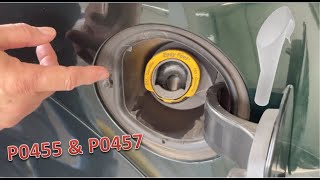
The 2011-2014 Mustang uses Ford's 'Easy Fuel' capless fuel filler system. Unlike traditional gas caps that can be left loose, P0457 on this car points directly to a sealing issue with the spring-loaded flap in the fuel filler neck. Debris, dirt, or wear can prevent it from closing properly, triggering the code. While other EVAP components can fail, the capless system is the unique starting point for diagnosis on this specific vehicle. This is a well-documented behavior across many Ford models with the capless system.
Symptoms You May Notice
- Check Engine Light is on.
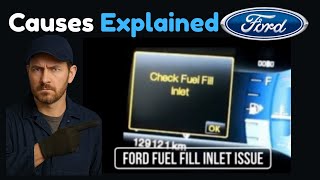
- A 'Check Fuel Fill Inlet' message may appear on the instrument cluster.
- A faint smell of fuel, especially after parking in a garage.
- In some cases, a rough idle or difficulty starting immediately after refueling if the canister purge valve is the cause.
- An owner report in NHTSA ODI #10995039 notes that the "Check Fuel Fill Inlet" warning often precedes the illumination of the check engine light for code P0457.
- Replacing the canister purge valve when the only issue is a dirty fuel filler neck. Always clean the filler neck first as it is the most common and free fix.
- Performing a smoke test before checking the purge valve. A stuck-open purge valve can sometimes be misdiagnosed as a leak elsewhere, while a P1450 code specifically points away from a leak that a smoke test would find.
Most Likely Causes
- Dirty or Faulty Capless Fuel Filler Neck 🔴 High Probability → Shop Fuel Filler Neck The capless system's seal is exposed to the elements and can accumulate dirt, dust, or pollen, preventing the internal flap from sealing completely after refueling. This is the most common cause for P0457 on any Ford with this system. Manufacturer bulletin SSM 51719 notes that this code may be due to outside contamination at the filler neck.
How to confirm: Visually inspect the fuel filler opening for any debris. Use the white emergency fuel funnel (located in the trunk with the spare tire tools) to cycle the spring-loaded door open and closed several times to check for smooth operation and to feel for a solid seal.
Typical fix: Thoroughly clean the sealing surface inside the filler neck. Use the emergency funnel to open the flap, and wipe the seal with a clean, lint-free cloth. A small amount of WD-40 or silicone lubricant on the cloth can help remove stubborn grime and lubricate the seal. If cleaning doesn't work and the seal is damaged or worn, the entire fuel filler neck assembly must be replaced.
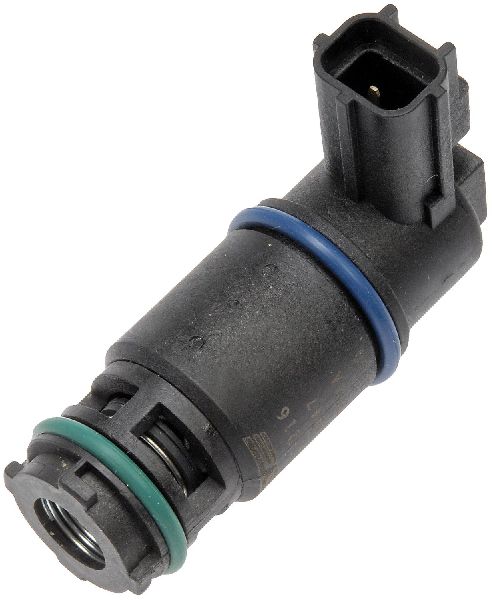
Est. part cost: $0 for cleaning, $100-$200 for a new filler neck assembly. - Faulty Canister Purge Valve (Solenoid) 🟡 Medium Probability → Shop Vapor Canister This valve is a widely documented common failure part on the Ford 3.7L Cyclone engine platform due to its location on the engine, where it's exposed to heat and vibration. It's known to get stuck open, causing a constant vacuum pull on the EVAP system.
How to confirm: The valve is located on top of the engine. A classic symptom of failure is a rough idle or the engine stumbling immediately after filling the gas tank. It may be accompanied by code P1450 ('Unable to Bleed Up Fuel Tank Vacuum'). A simple test is to unplug the valve's electrical connector, start the engine, and feel for vacuum on the port; if suction is present, the valve has failed and is stuck open.
Typical fix: Replacement of the purge valve. It is mounted on the engine and is easily accessible, held in place by a small bracket and connected by two hoses and one electrical connector. This is a common DIY repair.
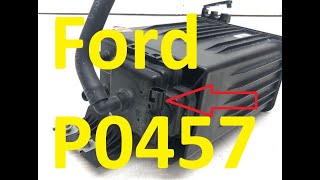
Est. part cost: $30-$70 - Faulty Canister Vent Solenoid ⚪ Low Probability → Shop Vapor Canister Located near the fuel tank and charcoal canister, this valve can get clogged with dirt and road debris, causing it to stick open and create a large EVAP leak.
How to confirm: The valve is located underneath the vehicle near the charcoal canister. It can be removed and tested with a 12v power source to see if it actuates correctly. A smoke test will also quickly reveal a vent solenoid that is stuck open.
Typical fix: Replace the canister vent solenoid.
Est. part cost: $40-$80
Rare But Worth Checking
- Cracked or Disconnected EVAP Hoses: While not common, the plastic and rubber hoses that make up the EVAP system can become brittle over time and crack. A smoke test is the most effective way to find these small, hard-to-see leaks. A Ford dealer mentioned this as a possibility, though less likely than the filler neck or valves.
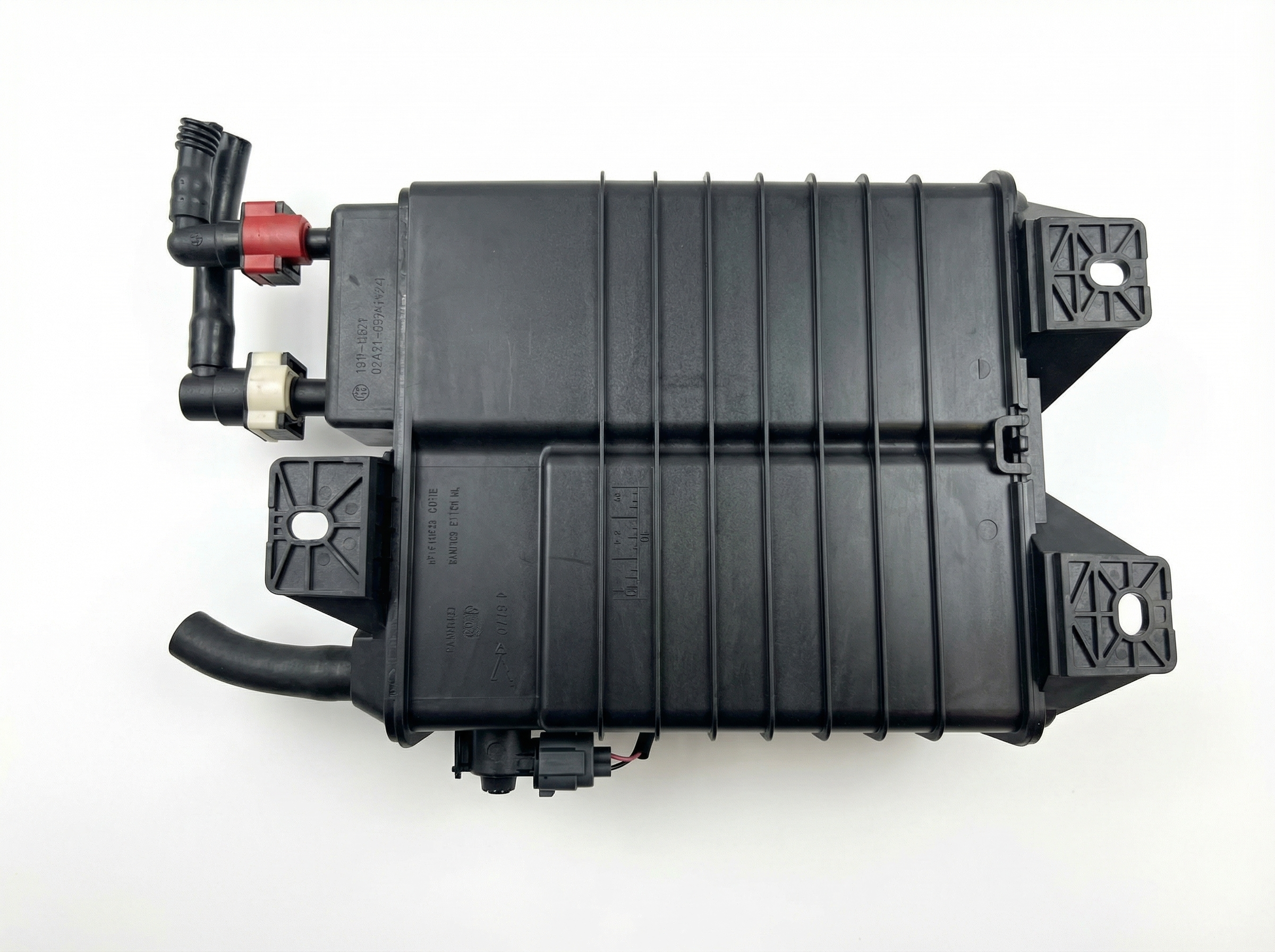
- Cracked Charcoal Canister: → Shop Vapor Canister The charcoal canister itself can develop a crack from road debris or age, creating a large leak. This is usually found during a smoke test after all other common causes have been ruled out.
Diagnosis Steps
- Read the code with an OBD-II scanner to confirm P0457 is the primary code. Check for any other codes like P0455 or P1450.
- Open the fuel door and visually inspect the capless fuel filler neck for any obvious dirt, debris, or damage.
- Use the emergency fuel funnel from the trunk to open the flap. Clean the internal sealing surface with a clean cloth and WD-40 or silicone spray.
- Insert and remove the funnel 10-15 times to ensure the spring-loaded mechanism is moving freely and not sticking.
- Clear the code with the scanner. Drive the vehicle for a few days, including a trip after refueling, to see if the code returns. A drive cycle of over 150 miles may be needed for the EVAP monitor to run and confirm the fix.
- If the code returns, especially with a P1450, locate the canister purge valve on the top of the engine. Inspect its hoses and electrical connector for damage.
- If you experience rough idle after refueling, the purge valve is highly suspect and should be replaced.
- If the purge valve seems fine, the next step is to inspect the canister vent solenoid, located near the fuel tank, for damage or being stuck open.
- If the cause is still not apparent, a smoke test should be performed by a qualified technician to find leaks in any of the EVAP system's hoses, the charcoal canister, or the filler neck assembly.
Parts You'll Likely Need
- Canister Purge Valve / Solenoid
(OEM #AU5Z-9C915-B)— This is a very common failure item on the 3.7L engine family that can cause P0457, often accompanied by P1450 and post-refueling drivability issues.
Trusted brands: Motorcraft, Standard Motor Products
OEM price range: $50-$70
Aftermarket price range: $30-$50 - Fuel Filler Neck Assembly
(OEM #AR3Z-9034-F)— If cleaning the original capless filler neck does not resolve the sealing issue, the entire assembly may be worn or damaged and require replacement. This part number fits 2011-2014 Mustangs with the 3.7L engine.
Trusted brands: Motorcraft, Dorman (574-055), Spectra Premium
OEM price range: $150-$200
Aftermarket price range: $100-$150
Related Codes That Often Appear With This One
- P0455 — P0455 indicates a 'Gross EVAP Leak'. P0457 is a more specific version of this code that the PCM logs when the gross leak is detected right after refueling, pointing suspicion toward the fuel cap/filler area. Seeing both is common. NHTSA ODI #10395615 notes that many reports show these two codes appearing simultaneously.
- P1450 — This Ford-specific code for 'Unable to Bleed Up Fuel Tank Vacuum' is very often caused by a failing canister purge valve that is stuck open or leaking. If P0457 is present with P1450, the purge valve is the most likely culprit, as it's causing excessive vacuum that the system can't vent.
Technical Service Bulletins (TSBs) & Recalls
- While no TSBs directly target P0457 on the 2011-2014 Mustang, Ford has issued numerous TSBs for other models with capless fuel systems (like SSM 51719 and SSM 50977 for F-Series/E-Series) that confirm the primary cause is contamination or improper sealing at the filler neck, reinforcing the diagnostic priority for the Mustang. Specifically, SSM 51719 notes that vehicles may exhibit an illuminated MIL with DTC P0457 and/or P0455 due to outside contamination.
Mechanic-Grade Diagnostic Values
- Canister Purge Valve (Solenoid) Resistance — expected: 14 - 30 Ohms. Failure: An infinite reading (open circuit) or near-zero reading (short circuit) indicates a failed valve.
- Canister Purge Valve Connector Power Pin Voltage — expected: ~12V (Battery Voltage) with Key On, Engine Off. Failure: No voltage or significantly low voltage points to a problem in the power supply, likely fuse F95 in the under-hood fuse box.
- Fuel Tank Pressure (FTP) Sensor Static Voltage — expected: 2.6V - 2.65V with Key On, Engine Off. Failure: If this voltage drops immediately upon starting the engine (before the purge valve is commanded on), it indicates the purge valve is stuck open, causing an immediate vacuum.
- Fuel Tank Pressure (FTP) Sensor Reading During Leak Test — expected: Target of -8.0 inches of water (-8.0 inH2O) when sealed by the vent solenoid and purged by the purge valve.. Failure: Failure to achieve this target vacuum level will trigger a P0455/P0457. Exceeding this vacuum level can trigger a P1450.
Hidden / Shadow Codes Worth Checking
- Mode $06, TID $81, $82, etc.: Ford uses Mode $06 test IDs to monitor the EVAP system's ability to hold pressure. These are not shadow codes, but raw test results from the PCM's self-diagnostics. A failing value in a test like the '0.040" leak check' or '0.020" leak check' can precede a full-blown DTC. (see via A professional scan tool capable of displaying Mode $06 data. The specific Test ID (TID) and Component ID (CID) correspond to different phases of the EVAP monitor test.)
Scan Tool Commands That Help
- Ford IDS (Integrated Diagnostic System): EVAP System Test — This is an automated, on-demand test that commands the EVAP solenoids and monitors the FTP sensor to check for large leaks, small leaks, and blockages. It provides a clear pass/fail result, which is useful for verifying a repair without waiting for the full drive cycle.
- Ford IDS (Integrated Diagnostic System): Datalogger with Active Commands (Manual EVAP Test) — This is used when the automatic EVAP test cannot run (e.g., fuel level is over 85% or under 15%). A technician can manually command the canister purge and vent valves on/off while watching the FTP sensor voltage and short-term fuel trims to diagnose component function individually.
Wiring & Ground Locations
- Fuse F95 — In the under-hood fuse box (Battery Junction Box).. This fuse often provides power to the canister purge valve. If the valve has no power at its connector, this fuse is the first place to check.
- PCM Connector C175B — The Powertrain Control Module (PCM) is located on the passenger side of the engine bay, near the firewall/cowl.. The ground signal that controls the canister purge valve originates from a pin on this connector. A break or corrosion in the wire between this connector and the valve will prevent it from operating.
- Main Engine Ground — Typically a heavy gauge wire or braided strap from the engine block to the chassis or directly to the battery negative terminal.. A poor main engine ground can cause a host of electrical issues, including erratic sensor readings and improper solenoid function. While not a direct cause, it should be checked if multiple unrelated codes are present.
Real Owner Repair Stories
- The Mustang Source forum (2012 Mustang 3.7L) — Check Engine Light with codes P0455 and P0457.
❌ Tried (didn't work) Replacing the canister purge valve.
✅ What actually fixed it After the new purge valve didn't work, the owner thoroughly cleaned the capless fuel filler neck. Another user noted it required extensive cleaning with WD-40 and repeated insertions of the emergency funnel to finally get the flap to seal properly and resolve the code. - Reddit user on r/Mustang (2014 Mustang V6) — EVAP codes described as 'couldnt vacuum from the gas tank', 'O2 sensor rich', and 'very small vapor leak'.
✅ What actually fixed it The issue was diagnosed as a partially stuck-open canister purge valve. Replacing the valve, located on top of the intake manifold, resolved all the codes and symptoms. - NHTSA ODI #11404099 — An owner reported that the P0457 code returned four times even after being "fixed," highlighting the persistent nature of these evaporative emission system leaks.
- NHTSA ODI #10876672 — A driver noted that codes P0455 and P0457 were stored in the PCM alongside throttle-related codes, showing how EVAP issues can sometimes coincide with other powertrain faults.
"I Checked Everything" — The Actual Cause
- A stuck-open canister purge valve will not be detected by a traditional EVAP smoke test. The smoke test pressurizes the system to find external leaks to the atmosphere. A stuck-open purge valve creates an internal leak into the engine's intake manifold. This condition is typically diagnosed by checking for vacuum at the valve's port at idle when it should be closed, or by the presence of a companion code like P1450.
When the Usual Fixes Don't Work
- In one documented case for a 2012 3.7L, the owner correctly identified the canister purge valve as a common failure and replaced it as a first step, but this did not solve the P0457 code. The actual fix was a more thorough and persistent cleaning of the capless fuel filler neck than initially performed, highlighting that even when a common part is known to fail, the most probable cause (a dirty filler neck) should never be skipped.
OEM Part Supersession History
AU5Z-9C915-A, AU5Z-9C915-B→AU5Z-9C915-E— Component revision by the manufacturer, likely for improved durability or performance.
Heads up: The newest part number (AU5Z-9C915-E) is the correct service replacement for the earlier versions.AR3Z-9034-A, -B, -C, -D, -E→AR3Z-9034-F— Component revision for the fuel filler neck assembly, potentially to improve the sealing of the capless mechanism.
Heads up: AR3Z-9034-F is the current replacement part for the entire 2011-2014 range.
Diagnostic Flowchart
Other Known Issues on This Vehicle
Issues unrelated to this code that are worth knowing about as an owner of this generation:
- MT-82 Manual Transmission Problems 🔴 High — Common complaint on 2011-2019 models. Issues include high-RPM lockout, grinding shifts (especially 1-2), premature synchronizer wear, and catastrophic failure. Led to a class-action lawsuit. (Ref: Multiple TSBs issued to dealers, but no federal recall. A class-action lawsuit (Gregorio et al. v. Ford Motor Company) was filed.)
- External Water Pump Failure 🟠 Medium — A notable failure point, often occurring between 60k-100k miles. While the Mustang's 3.7L engine thankfully has an external pump (unlike the catastrophic internal pump on transverse versions), failure is still common. (Ref: No specific recall, but it is a widely discussed issue in owner forums.)
- Failed Ignition Coils Damaging PCM 🟠 Medium — A failed ignition coil can short and send a voltage spike that damages the ignition coil driver circuit in the Powertrain Control Module (PCM), requiring a PCM repair or replacement along with all six coils. (Ref: No recall, but specialist repair services exist specifically for this common failure mode (codes P0351-P0356).)
- Cold Start Engine Ticking/Squeal 🟡 Low — Common on earlier models (2011-2012). A ticking noise from the LH valve cover or a squeal from the accessory belt on cold, damp starts were common enough to warrant TSBs. (Ref: TSB 12-1-17 (ticking noise), TSB 11-6-3 (belt squeal).)
Used vs. New Parts: Buying Guide for This Vehicle
When a used part is the smart pick: A used canister purge valve can be a cost-effective option. The failure mode is often electrical (coil burnout) rather than mechanical wear from high mileage. A used fuel filler neck is generally not recommended, as it may have the same wear or debris issues as the part being replaced.
Donor-vehicle mileage cap: roughly under 75000 miles for the part to have meaningful remaining life.
What to inspect on the donor part:
- For a used purge valve, inspect the electrical connector pins to ensure they are straight and free of corrosion.
- Check the plastic housing of the valve for any cracks or signs of excessive heat damage.
- Verify the O-rings are present and not cracked or brittle.
- If possible, test the resistance across the two pins with a multimeter; it should be between 14 and 30 ohms.
OEM-only on this vehicle (don't cheap out):
- No parts for this repair are strictly OEM-only, but using a Motorcraft-branded part for solenoids is often recommended for best compatibility.
Aftermarket brands forum-validated for this vehicle:
- Motorcraft (OEM)
- Standard Motor Products (SMP)
- Dorman
- Spectra Premium
Brands owners have reported issues with on this vehicle:
- No specific brands were consistently reported as problematic in owner forums, but ultra-low-cost, unbranded parts from online marketplaces may have questionable quality control.
Real Owner Stories
Aggregated from forums and TSBs cited above. Mileages and costs reflect what owners reported in those sources.
2014 Ford Mustang GT
Symptoms: The owner described the 'garbage capless fuel system throwing codes' as one of the only reliability issues with the car.
What fixed it: The context identifies this as a known annoyance related to the capless fuel system sealing issues.
Source hint: Reddit (r/Mustang)
2002 Ford Mustang GT
Symptoms: P0457 and P0455 codes were present.
What fixed it: A smoke test revealed a faulty fuel filler hose, requiring replacement of the filler neck assembly.
Source hint: StangNet (stangnet.com)
2011-2014 Ford Mustang 3.7L
Symptoms: P0457 appearing alongside P0455.
What fixed it: Cleaning the capless filler neck as a first step, though the source notes some owners mistakenly replace the purge valve first.
Source hint: The Mustang Source (themustangsource.com)
Related OBD-II Codes
Frequently Asked Questions
I have a 'Check Fuel Fill Inlet' message on my 2014 Mustang's dash. Is this the same as P0457?
My Mustang stumbles and has a rough idle right after I leave the gas station. Could this be related to P0457?
Where can I find the tool to clean the capless fuel system on my 2011-2014 Mustang?
Are there any TSBs for the capless fuel system leaks on my Mustang?
Could my P0457 code be caused by the same issue that causes the P1450 code on the 3.7L engine?
How much does it cost to fix the P0457 code on a 2011-2014 Mustang 3.7L?
Helpful Videos

Used OEM Parts in Stock
New Aftermarket Parts Available


The information in this article is provided for general reference and educational purposes only. Vehicle specifications, procedures, and part compatibility can vary by production date, trim level, and region. Always consult your vehicle's factory service manual and verify part numbers before purchasing or performing repairs. Safety-critical components such as airbags, seat belts, and braking systems should be installed by a qualified professional.
- Ford Mustang:
- 🧭 Diagnostic Flowchart
- 🎬 Helpful Videos
- 🛍️ Shop This Part
- What's Unique About the 2011-2014 Ford Mustang
- Symptoms You May Notice
- Most Likely Causes
- Rare But Worth Checking
- Diagnosis Steps
- Parts You'll Likely Need
- Related Codes That Often Appear With This One
- Technical Service Bulletins (TSBs) & Recalls
- Mechanic-Grade Diagnostic Values
- Hidden / Shadow Codes Worth Checking
- Scan Tool Commands That Help
- Wiring & Ground Locations
- Real Owner Repair Stories
- "I Checked Everything" — The Actual Cause
- When the Usual Fixes Don't Work
- OEM Part Supersession History
- Other Known Issues on This Vehicle
- Used vs. New Parts: Buying Guide for This Vehicle
- Real Owner Stories
- 2014 Ford Mustang GT
- 2002 Ford Mustang GT
- 2011-2014 Ford Mustang 3.7L
- Related OBD-II Codes
- Frequently Asked Questions
- 🎟️ Get 5% Off