

P0460 on 2016-2020 Nissan Pathfinder: Fuel Level Sensor Causes and Fixes
On a 2016-2020 Nissan Pathfinder, code P0460 is almost always caused by a faulty fuel level sensor in the gas tank. Nissan issued a technical service bulletin (NTB22-026) for this specific problem. The fix involves replacing either the sensor itself or the entire fuel pump assembly it's attached to. The separate sensor is the most common and cost-effective repair.
- P0460 on a 2016-2020 Pathfinder means your fuel gauge is unreliable due to a faulty fuel level sensor signal.
- The most likely cause is a failed fuel level sensor, a known issue confirmed by Nissan TSB NTB22-026.
- The fix is to replace the fuel level sensor (Part #25060-3KA1A), which can be done without replacing the entire expensive fuel pump assembly.
- While you can drive with this code, you risk running out of fuel unexpectedly.
- This issue is also common on the Infiniti QX60, a platform mate.
What's Unique About the 2016-2020 Nissan PATHFINDER
The 2016-2020 Pathfinder is part of the R52 generation, which is known for this specific issue. 🎬 Watch: Top 5 common problems for this Pathfinder generation. Nissan acknowledged the problem by releasing Technical Service Bulletin NTB22-026, which directly points to a faulty fuel level sensor as the cause for P0460 and related codes. This bulletin confirms that it's a recognized component failure rather than a random electrical glitch, giving owners a clear diagnostic path. The TSB explicitly states that the sensor can be replaced separately from the more expensive fuel pump assembly and warns that warranty claims for replacing the entire assembly for this issue will be charged back, highlighting the component-level nature of the failure.
Diagnostic Flowchart
Tap your situation to follow the diagnostic path that matches what you're seeing on this vehicle.
Generation note: The 2016-2020 model years all fall within the fourth generation (R52) of the Nissan Pathfinder. The specified fuel level sensor part (25060-3KA1A) fits Pathfinders from 2014-2020, indicating the issue is common to the entire generation.
Symptoms You May Notice
- Check Engine Light is on
- Fuel gauge reading is inaccurate, erratic, fluctuating, or stuck on full or empty
- Low fuel warning light illuminates randomly or not at all
- Fuel gauge needle swings rapidly while driving or idling
- Replacing the instrument cluster before testing the fuel level sensor.
- Replacing the entire fuel pump assembly when only the less expensive, separately available fuel level sensor has failed. Nissan's TSB specifically warns against this for warranty repairs.
Most Likely Causes
- Faulty Fuel Level Sensor 🔴 High Probability → Shop Fuel Tank Sending Unit This is a known issue acknowledged by Nissan in TSB NTB22-026. The sensor's resistor card or float mechanism can wear out, the float can crack and fill with fuel, or the contacts can fail.
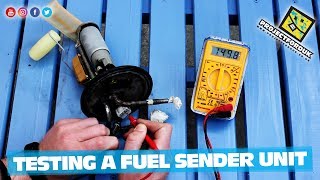
How to confirm: Access the sensor and test its resistance with a multimeter as the float arm is moved. Compare the readings to the specifications in the service manual. The resistance should change smoothly; an open circuit, dead spots, or out-of-spec resistance confirms failure. A typical range for Nissan is approximately 4-8 ohms when full and 78-84 ohms when empty.
Typical fix: Replace the fuel level sensor. The sensor can be replaced separately from the fuel pump module. TSB NTB22-026 explicitly recommends this as the primary repair.
Est. part cost: $180-$300 for an OEM sensor. - Damaged Wiring or Connectors 🟡 Medium Probability Wiring to the fuel tank is susceptible to moisture and corrosion, which can disrupt the sensor's voltage signal to the ECM.
How to confirm: Visually inspect the wiring harness leading to the fuel tank for any signs of corrosion, breaks, or loose connections, particularly at the connector on top of the fuel pump assembly. Check for continuity and voltage at the connector using a multimeter.
Typical fix: Repair the damaged section of wiring or clean/replace the corroded connector.
Est. part cost: $10-$50 for wiring repair supplies. - Faulty Fuel Pump Assembly ⚪ Low Probability → Shop Fuel Pump
How to confirm: This is usually diagnosed after confirming the sensor itself is the issue. Since the sensor is part of the assembly, replacing the whole unit is a common, though often unnecessary, repair strategy.
Typical fix: Replace the entire fuel pump and sensor assembly. TSB NTB22-026 notes this as a valid, but not required, repair path. Many shops or DIYers choose this route to preemptively replace the fuel pump while the tank is accessed.
Est. part cost: $1300-$1500 for an OEM assembly.
Rare But Worth Checking
- Faulty Instrument Cluster: → Shop Instrument Cluster While rare, the gauge itself in the instrument cluster could be malfunctioning. This is unlikely compared to the known sensor issue and should be suspected only if replacing the sensor and checking wiring does not resolve the problem.
- Faulty Powertrain Control Module (PCM): → Shop Engine Control Module (ECM) This is extremely rare and should only be considered after all other possibilities, including wiring and the sensor, have been exhaustively ruled out.
Diagnosis Steps
- Read the trouble codes with an OBD-II scanner and confirm P0460 is present. Note any other codes (P0461, P0462, P0463).
- Check for any applicable TSBs. For this vehicle, TSB NTB22-026 is highly relevant and applies to a wide range of Nissan vehicles from 2016-2022.
- Visually inspect the wiring and connector at the top of the fuel tank for any obvious damage, corrosion, or looseness. Access is typically under the rear seats.
- Using a scan tool with live data capabilities, monitor the fuel level sensor voltage. The reading should be stable and change predictably as fuel is used or added. Expect to see approximately 4.5V when full and 0.5V when empty. Erratic jumps or a fixed value points to a problem.
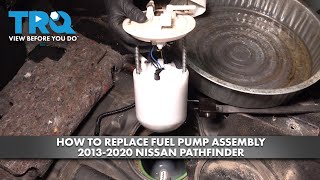
- If the signal is faulty, gain access to the top of the fuel tank (often under the rear seat). A video for a 2013-2020 Pathfinder shows the process of accessing the pump assembly.
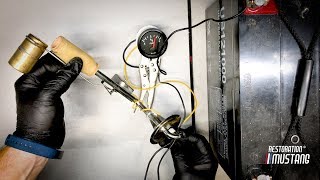
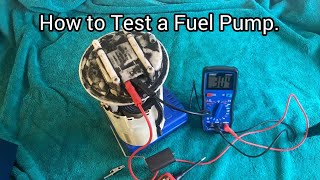
- Disconnect the fuel level sensor and test its resistance with a multimeter while manually moving the float arm. The resistance should change smoothly. For Nissan, the expected range is approximately 4-8 ohms at full and 78-84 ohms at empty. If it's open, shorted, or has dead spots, the sensor is bad.
- If the sensor tests good, the problem lies in the wiring between the sensor and the ECM, or, rarely, the ECM itself.
Parts You'll Likely Need
- Fuel Level Sensor
(OEM #25060-3KA1A)— This is the most common failure point for code P0460 on this vehicle, as confirmed by Nissan's TSB NTB22-026. It is also called a 'Fuel Tank Sending Unit' or 'Level Sensor'.
Trusted brands: Nissan Genuine
OEM price range: $180-$300
Aftermarket price range: $90-$150 - Fuel Pump and Sender Assembly
(OEM #17040-3JA0B (example, verify by VIN))— Some owners or shops prefer to replace the entire assembly to prevent future failure of the pump itself, as it includes a new sensor. The TSB lists this as a repair option but advises against it if only the sensor has failed.
Trusted brands: Nissan Genuine, Bosch, Denso
OEM price range: $1300-$1500
Aftermarket price range: $400-$700 - Fuel Pump Module Seal/Gasket
(OEM #17342-1HJ0A (example, verify by VIN))— This seal should always be replaced when the fuel pump module is removed from the tank to ensure a proper seal and prevent fuel vapor leaks.
Trusted brands: Nissan Genuine
OEM price range: $20-$40
Aftermarket price range: $10-$20
Related Codes That Often Appear With This One
- P0461 — Indicates a problem with the fuel level sensor's performance/range. [Bulletin #NTB22-026]
- P0462 — Indicates the fuel level sensor circuit input is low. [Bulletin #NTB22-026]
- P0463 — Indicates the fuel level sensor circuit input is high. [Bulletin #NTB22-026]
Technical Service Bulletins (TSBs) & Recalls
- NTB22-026: Directly addresses P0460, identifying the fuel level sensor as the primary cause and noting that it can be replaced separately or as part of the entire fuel pump assembly. It warns against replacing the full assembly under warranty for just a sensor failure.
Platform-Specific Known Issues
- Nissan Technical Service Bulletin NTB22-026 was issued to address codes P0460, P0461, P0462, and P0463 on a wide range of 2016-2022 Nissan vehicles, including the Pathfinder. It confirms a known issue with the fuel level sensor and explicitly states it can be replaced separately.
- Owner experiences on forums confirm that replacing only the sensor (25060-3KA1A) is a successful and common repair, avoiding the high cost of the full pump assembly.
Mechanic-Grade Diagnostic Values
- Fuel Level Sensor Resistance — expected: Approximately 4-8 Ohms when the float is in the 'Full' position and 78-84 Ohms when in the 'Empty' position. The resistance should sweep smoothly between these values.. Failure: Readings of infinity (open circuit), near-zero (short circuit), or erratic jumps and dead spots as the float arm is moved.
- Fuel Level Sensor Voltage (Live Data) — expected: Approximately 4.5V when the tank is full, decreasing smoothly to approximately 0.5V when the tank is empty.. Failure: Voltage that is stuck at a specific value, jumps erratically, or is outside the expected 0.5V-4.5V range.
Wiring & Ground Locations
- M57, M61 — Located on the left side of the dash.. These are main chassis ground points. While not exclusive to the fuel system, a poor connection at a major ground can cause a variety of difficult-to-diagnose electrical issues, including erratic sensor readings. Checking these for corrosion and tightness is a valid step when chasing an electrical fault.
- Fuel Pump Module Connector — On top of the fuel pump assembly, accessible under an access panel below the driver's side rear seat.. This is the primary connection point for the fuel level sensor. It is critical to inspect this connector for corrosion, moisture intrusion, or pushed-out pins before replacing any parts.
Real Owner Repair Stories
- MY350Z.COM Forum User (Nissan 350Z (system with similar behavior)) — Fuel gauge was not reading accurately after replacing both fuel level sending units.
❌ Tried (didn't work) Immediate re-check of the gauge after parts replacement.
✅ What actually fixed it The issue resolved itself over time. After several drain/refill cycles and a few hours of driving, the computer appeared to self-calibrate to the new sensors and the gauge began reading correctly.
When the Usual Fixes Don't Work
- In some cases, simply replacing the fuel level sensor may not immediately fix an inaccurate gauge. Forum reports from Nissan owners indicate that the vehicle's computer may need time to adjust to the new sensor. The gauge may only begin to read correctly after several driving cycles and at least one full-to-low fuel level transition, a process that can take hours of driving. This contradicts the expectation of an instant repair and is crucial information to prevent misdiagnosing the new part as faulty.
OEM Part Supersession History
25060-9NB0A (Potential)→25060-3KA1A— Likely a revision to improve reliability and address the common failure mode that causes P0460.
Heads up: While older part numbers may exist, 25060-3KA1A is the confirmed correct and current replacement for this vehicle range.
Model Year Variations Within This Range
- 2016 vs 2017-2020: The 2017 model year introduced a major facelift with a new direct-injection 3.5L V6 engine (VQ35DD), replacing the previous port-injection VQ35DE. However, parts catalogs confirm the fuel level sensor (25060-3KA1A) and associated fuel tank components remained the same across the 2016-2020 model years, meaning the cause and fix for P0460 are identical regardless of the engine update.
Helpful Videos
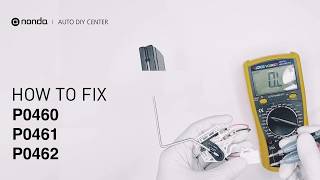


![How to Fix P0460 Engine Code in 2 Minutes [1 DIY Method / Only $11.9]](https://img.youtube.com/vi/gt5sdWRXypk/mqdefault.jpg)

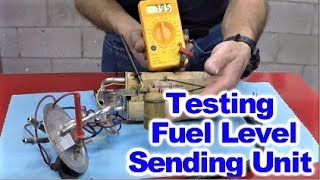
Used OEM Parts in Stock
New Aftermarket Parts Available


The information in this article is provided for general reference and educational purposes only. Vehicle specifications, procedures, and part compatibility can vary by production date, trim level, and region. Always consult your vehicle's factory service manual and verify part numbers before purchasing or performing repairs. Safety-critical components such as airbags, seat belts, and braking systems should be installed by a qualified professional.
- Nissan PATHFINDER:
- 🧭 Diagnostic Flowchart
- 🎬 Helpful Videos
- 🛍️ Shop This Part
- What's Unique About the 2016-2020 Nissan PATHFINDER
- Symptoms You May Notice
- Most Likely Causes
- Rare But Worth Checking
- Diagnosis Steps
- Parts You'll Likely Need
- Related Codes That Often Appear With This One
- Technical Service Bulletins (TSBs) & Recalls
- Platform-Specific Known Issues
- Mechanic-Grade Diagnostic Values
- Wiring & Ground Locations
- Real Owner Repair Stories
- When the Usual Fixes Don't Work
- OEM Part Supersession History
- Model Year Variations Within This Range
- 🎟️ Get 5% Off