

P0461 on 2015-2019 Hyundai Sonata: Fuel Gauge Problems and Fixes
This code means your fuel gauge is unreliable. The most common cause is a faulty fuel level sending unit inside the gas tank, which is part of the fuel pump module. Expect to pay a professional for the repair, as the part itself can be costly and requires accessing the fuel tank.
- P0461 on your Sonata means the fuel gauge is not reliable; do not trust it and track your mileage manually to avoid running out of gas.
- The most likely culprit is the fuel level sending unit located inside the fuel tank.
- While DIY replacement is possible for experienced mechanics, it involves handling fuel and accessing the fuel tank, so professional repair is recommended for most owners.
- Before replacing parts, check for owner complaints and TSBs, as this is a known issue on the platform.
- In rare cases, the problem could be the instrument cluster itself, not the sensor in the tank.
What's Unique About the 2015-2019 Hyundai Sonata
The 2015-2019 Hyundai Sonata (LF generation) is known for issues with inaccurate fuel gauge readings, with numerous owner complaints logged, especially for the 2015 model year. The issue was prevalent enough that many owners reported problems from the first day of ownership. While the cause is often a standard component failure, some owners have reported that simply having a dealer reposition the sending units inside the tank has resolved the problem, suggesting a potential sensitivity in the system's design or installation. A warranty extension (TXXS, NHTSA Campaign 23V422000) exists for the fuel pump filter on these models to address a crank/no-start condition (DTC P1233), but it does not directly cover the P0461 code.
Symptoms You May Notice
- Check Engine Light is on
- Fuel gauge behaves erratically (fluctuates, jumps to empty or full)
- Fuel gauge is stuck in one position (e.g., always on empty or full)
- Inaccurate or unavailable 'Distance to Empty' reading
- Low fuel warning light may be on even with a full tank
- Fuel gauge reads lower than expected after a fill-up (e.g., shows 7/8 full on a full tank).
- Replacing the entire fuel pump when only the sending unit has failed. While they are often part of the same assembly, sometimes the sender can be replaced separately, saving money.
- Replacing the instrument cluster before properly testing the fuel level sensor and its wiring. The sensor is the most common point of failure.
Most Likely Causes
- Faulty Fuel Level Sending Unit 🔴 High Probability → Shop Fuel Tank Sending Unit Wear and tear on the variable resistor is common across all vehicles. Owner forums and complaint sites show a distinct pattern of fuel gauge issues on this Sonata generation, pointing to the sending unit as a frequent failure point, sometimes from very low mileage.
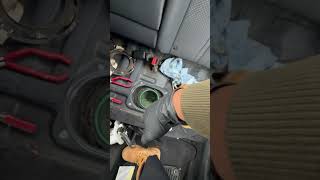
How to confirm: Access the fuel pump module (typically under the rear seat). Test the sending unit's resistance with a multimeter while moving the float arm. 🎬 Watch: How to test a fuel level sensor The resistance should change smoothly without any dead spots or sudden jumps. A scan tool can also show live data from the sensor, which should be compared to the physical fuel level.
Typical fix: Replace the fuel level sending unit. On this vehicle, it is often sold as part of the complete fuel pump module but can also be purchased separately. 🎬 See this fuel pump replacement walkthrough
Est. part cost: $70-$250 - Wiring or Connector Issue 🟡 Medium Probability The wiring harness connector on top of the fuel pump assembly can be susceptible to corrosion or damage. Rodent damage to wiring is also a possibility.
How to confirm: Visually inspect the wiring and connector pins leading to the fuel pump assembly for corrosion, damage, or loose connections. Perform a continuity test on the signal, ground, and power wires from the pump to the PCM.
Typical fix: Repair the damaged section of wiring or clean/replace the connector.
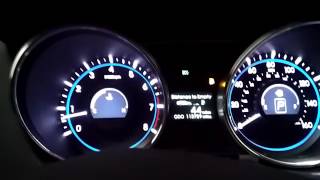
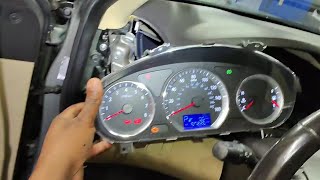
Est. part cost: $5-$50 - Faulty Instrument Cluster ⚪ Low Probability While less common, an internal failure of the instrument cluster's circuitry can prevent it from correctly displaying the fuel level, even with a good signal from the sensor. This has been documented as a fix for a Sonata with this code. 🎬 Watch: Diagnosing a Sonata fuel gauge issue that wasn't the sensor
How to confirm: If the fuel level sensor and wiring have been verified as good, the instrument cluster is the next likely culprit. A specialized shop can test the cluster, or a dealer can use diagnostic tools to command the gauge to sweep, which may help isolate the fault.
Typical fix: Replace or repair the instrument cluster. This often requires programming to the vehicle's VIN and mileage.
Est. part cost: $400-$1000
Rare But Worth Checking
- Stuck or Obstructed Float Arm: Sometimes debris in the fuel tank can prevent the float arm from moving freely. In some cases on Sonatas, owners have reported that simply having the sending unit repositioned by a dealer fixed the issue, suggesting it may have been physically hung up inside the tank.
- Powertrain Control Module (PCM) Fault: → Shop Engine Control Module (ECM) This is very rare. The PCM is the last item to consider after all other possibilities (sensor, wiring, cluster) have been exhaustively ruled out. A faulty PCM can misinterpret a normal sensor voltage as being out of range.
Diagnosis Steps
- Verify the P0461 code is present using an OBD-II scanner.
- Check for any Technical Service Bulletins (TSBs) related to the fuel system or instrument cluster for the 2015-2019 Sonata.
- Observe the fuel level reading on a scan tool's live data. Compare it to the gauge on the dash and your estimate of fuel in the tank.
- Gently rock the vehicle side-to-side to see if the fuel level reading changes. A stuck reading suggests a mechanical or electrical fault with the sender.
- Gain access to the top of the fuel tank (often under the rear seat cushion). Inspect the fuel pump module's electrical connector for any signs of corrosion, melting, or damage.
- Disconnect the connector and test the resistance (Ohms) of the two fuel level sender pins on the pump assembly. The reading should be within the manufacturer's specified range.
- While measuring resistance, have a helper gently move the float arm (if accessible) or rock the car more aggressively. The resistance reading should change smoothly. Any sudden jumps or drops to zero/infinity indicate a bad sending unit.
- If the sender tests good, check the wiring harness for continuity and for shorts to power or ground between the pump connector and the PCM.
- If wiring and the sender are confirmed good, the fault may be in the instrument cluster or, very rarely, the PCM.
Parts You'll Likely Need
- Fuel Level Sending Unit (Level Sensor)
(OEM #94460-C2500)— This is the most common failure point. The variable resistor wears out over time, causing erratic readings. This specific part number is listed for the 2015-2019 Sonata (non-hybrid).
Trusted brands: Hyundai (Genuine OE), Delphi, Bosch
OEM price range: $150-$250
Aftermarket price range: $70-$150 - Fuel Pump Module Assembly
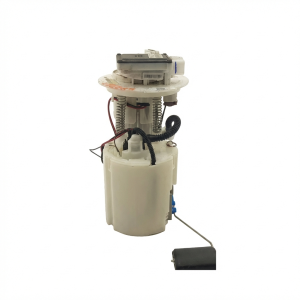
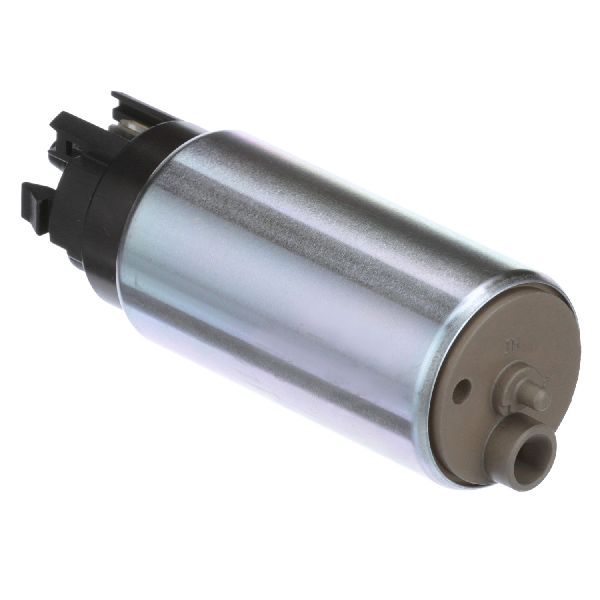
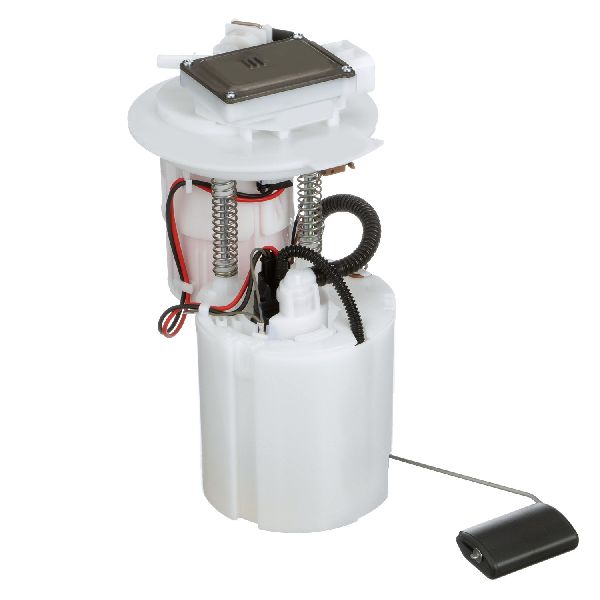
(OEM #31110-C2500)— In many cases, the sending unit is integrated with the fuel pump. It is often easier and more reliable to replace the entire module, which includes a new pump, filter, and sender. The sending unit 94460-C2500 is noted as being included with this assembly.
Trusted brands: Hyundai (Genuine OE), Delphi, Denso, Spectra Premium
OEM price range: $300-$500
Aftermarket price range: $150-$300
Related Codes That Often Appear With This One
- P0462 — Indicates the fuel level sensor circuit input is too low (short to ground). This can happen along with P0461 if the wiring is damaged or the sensor has failed.
- P0463 — Indicates the fuel level sensor circuit input is too high (open circuit). This can occur if a wire is broken or the connector is unplugged, which would also cause a P0461 performance issue.
Technical Service Bulletins (TSBs) & Recalls
- TSB 23-FL-004H (NHTSA ID 10238401): Details the fuel pump filter warranty extension (TXXS) for a 'crank/no start' condition, which is related to the fuel pump assembly but not directly for P0461.
- TSB 19-01-001H (NHTSA ID 10153975): Part of Recall Campaign 180, this addresses inspection and replacement of the high-pressure fuel pipe on certain Sonata models, a related fuel system component.
Platform-Specific Known Issues
- The 2015 model year, in particular, has a high number of owner complaints related to inaccurate fuel gauge readings from the day of purchase, with an average failure mileage reported around 10,900 miles.
- A warranty extension (TXXS, NHTSA Campaign 23V422000, TSB 23-FL-004H) was issued for the fuel pump filter assembly for 2015-2019 Sonatas, but it addresses a crank/no-start condition (DTC P1233) and not the P0461 code directly.
- Some owners on CarComplaints.com reported that a dealer fix involved simply 're-positioning the fuel level sender(s) in the fuel tank', which resolved the issue without parts replacement, suggesting a possible installation or design sensitivity.
Mechanic-Grade Diagnostic Values
- Fuel Level Sensor Resistance — expected: Approximately 10 ohms (Full) to 70-90 ohms (Empty), depending on the specific model. Some aftermarket sources suggest a range up to 82 ohms when full.. Failure: Readings that jump erratically, go to infinity (open), or show 0 when not expected. For example, a reading jumping from 15 ohms to 50 ohms and back to 12 ohms without float movement indicates a worn resistor track.
- Fuel Level Sensor Circuit Voltage (at PCM) — expected: Typically operates within a 0.5V (Empty) to 4.5V (Full) range.. Failure: A voltage reading outside this calibrated window, or a voltage drop of more than 0.2V between the sensor connector and the PCM, suggests a wiring or ground issue.
Scan Tool Commands That Help
- Hyundai GDS (Global Diagnostic System) or advanced scanner: Instrument Cluster Actuator Test / Sweep Test — After verifying the fuel level sensor and wiring are good, this command forces the fuel gauge needle to sweep through its full range of motion. If the needle moves correctly during the test, it confirms the gauge motor and its immediate driver circuit in the cluster are functional, pointing the diagnosis back towards the input signal or cluster processing. If it fails to sweep, the cluster itself is likely faulty.
- Hyundai GDS (Global Diagnostic System) or advanced scanner: Live Data Monitoring (Fuel Level Sensor Voltage/Resistance) — This is a primary step. It allows you to see the value the PCM is receiving from the sensor in real-time. Comparing this to the physical fuel level and the resistance measured at the tank helps determine if the fault is with the sensor, the wiring, or the PCM's interpretation.
Wiring & Ground Locations
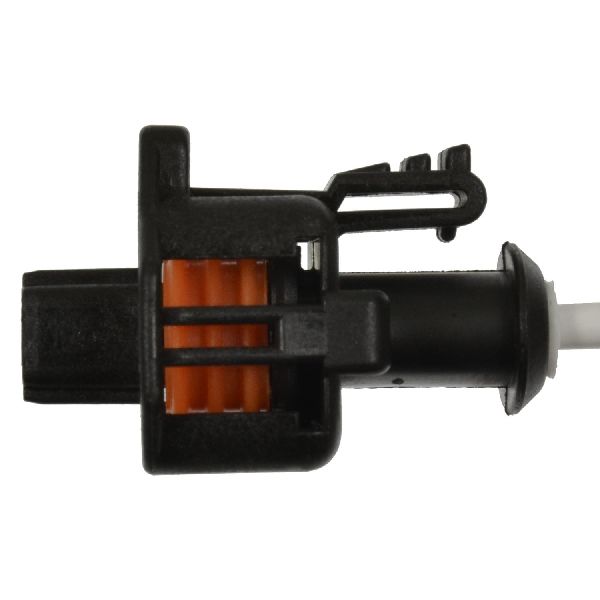
- Fuel Pump Connector — Top of the fuel tank, accessible by removing the rear seat cushion. The fuel pump motor detent is on the top right side of the fuel tank.. This is the primary connection point for the fuel level sensor. Corrosion, damage, or loose pins at this 5-terminal trapezoid connector are a common cause of erratic signals leading to P0461.
- GE02 Ground — Bottom left front of the engine compartment.. A wiring diagram for a 2015 Sonata shows a ground point GE02 in the engine compartment. While not directly for the fuel pump, a poor engine or chassis ground can introduce electrical noise and voltage offsets that affect sensitive sensor readings across the vehicle, including the fuel level circuit.
- Instrument Cluster Connector — Behind the instrument cluster, accessible after removing dashboard trim.. The signal from the fuel level sensor is ultimately processed and displayed by the instrument cluster. A poor connection at this multi-pin connector can cause the gauge to fail even if the sensor and wiring from the tank are perfect. A wiring diagram shows the fuel level signal arriving on a yellow wire.
Real Owner Repair Stories
- YouTube video from 'Robert DIY' (Hyundai Sonata (year not specified, but similar generation)) — Check engine light with codes P0462 and P0461, and the fuel gauge was not working.
❌ Tried (didn't work) Testing the fuel level sensor, which was found to be working to specifications.
✅ What actually fixed it The problem was resolved by replacing the entire instrument cluster. - YouTube video from 'RMS Diagnostics' (Hyundai (model not Sonata, but demonstrates a common failure pattern)) — Fuel gauge not working.
❌ Tried (didn't work) Testing continuity from the cluster to the sender, which was good.
✅ What actually fixed it Upon inspecting the wiring harness near the fuel tank, chewed wires from rodent damage were discovered. Repairing the broken wires restored the fuel gauge function.
Model Year Variations Within This Range
- 2018-2019: The 2018 model year introduced a major facelift for the Sonata. While the base 2.4L GDI engine remained largely the same as the 2015-2017 models, there were cosmetic and feature changes. The fuel system components, including the fuel tank capacity (18.5 gallons) and direct injection system, appear to be consistent across the 2.4L models in this generation, suggesting the P0461 causes are likely the same. However, different trim levels like the Eco with a 1.6L Turbo and Sport with a 2.0L Turbo used different transmissions (7-speed DCT and 8-speed auto, respectively), though the core fuel sending unit principle remains the same.
Diagnostic Flowchart
Other Known Issues on This Vehicle
Issues unrelated to this code that are worth knowing about as an owner of this generation:
- Theta II Engine Failure (Rod Bearing) 🔴 High — Widespread across 2.0L and 2.4L GDI engines, particularly in earlier years of the generation. Can lead to catastrophic engine seizure. (Ref: Subject of multiple recalls (e.g., Recall 180/TSB 19-01-001H), class-action lawsuits, and a lifetime warranty extension for the engine short block for affected vehicles.)
- Excessive Oil Consumption 🟠 Medium — Commonly reported issue, particularly for the 2.4L GDI engine, requiring frequent oil top-offs. Can lead to premature engine wear if not monitored. (Ref: Often related to the same engine defects covered by the Theta II lawsuits and warranty extensions.)
- 7-Speed Dual-Clutch Transmission (DCT) Issues 🟠 Medium — Affects models with the 1.6T engine (Eco trim). Owners report hesitation, shuddering, and jerky shifts, especially from a stop. (Ref: Subject of TSBs and a class-action lawsuit alleging defects in the Transmission Control Module (TCM) logic.)
- Peeling White Paint 🟡 Low — Very common on vehicles with white paint (e.g., Quartz White Pearl). Paint bubbles and peels off in large sheets, often on the hood and roof. (Ref: Hyundai issued a warranty extension (TSB 22-BD-010H, Campaign Z05) to cover repainting for affected vehicles for up to 10 years.)
- No Sound from Speakers / Audio System Faults 🟡 Low — A recurring electrical issue where the audio system produces no sound, despite the head unit appearing to function correctly. (Ref: No specific recall, but a commonly reported problem in owner forums.)
Used vs. New Parts: Buying Guide for This Vehicle
When a used part is the smart pick: A used instrument cluster from a reputable salvage yard can be a cost-effective option, provided it's from the exact same model year and trim to ensure compatibility. Since the failure is electronic and not a wear item, a used cluster is not inherently less reliable. A used fuel pump *connector* pigtail is also a good option if the original is damaged.
Donor-vehicle mileage cap: roughly under 80000 miles for the part to have meaningful remaining life.
What to inspect on the donor part:
- For a fuel pump assembly: Check the electrical connector for any signs of melting, corrosion, or heat damage.
- For an instrument cluster: Ensure the clear plastic lens is not cracked or heavily scratched. Verify the part number matches exactly.
- For any used part: Ask for the donor vehicle's VIN to verify compatibility and check for any outstanding recalls.
OEM-only on this vehicle (don't cheap out):
- Fuel Level Sending Unit/Fuel Pump Assembly: While aftermarket options exist, the high number of complaints for this specific vehicle suggests a potential sensitivity. Using a Genuine Hyundai part (OEM) is strongly recommended to avoid repeat failures, as the labor to access the tank is significant.
Aftermarket brands forum-validated for this vehicle:
- Delphi
- Denso
- Bosch
Brands owners have reported issues with on this vehicle:
- Unbranded, no-name parts from online marketplaces should be avoided for this repair. The risk of premature failure and incorrect resistance readings is high, leading to wasted time and money.
Real Owner Stories
Aggregated from forums and TSBs cited above. Mileages and costs reflect what owners reported in those sources.
2015 Hyundai Sonata — ~10900 miles
Symptoms: Fuel gauge was inaccurate from day one; it would not read full after a fill-up and would drop suddenly.
What fixed it: Re-positioning the fuel level sender(s) in the fuel tank.
Source hint: CarComplaints.com: Multiple detailed owner stories for the 2015 Sonata
2023 Hyundai Sonata SEL
Symptoms: Vehicle triggered code P0461.
What fixed it: Fuel injectors and rail replaced under warranty (as reported by a user with a similar issue in the same thread).
Source hint: Reddit (r/Hyundai) thread 'Code P0461 on a Hyundai Sonata SEL'
Related OBD-II Codes
Frequently Asked Questions
Does the fuel pump filter warranty extension (TSB 23-FL-004H) cover my P0461 code?
I have a 2015 Sonata and the fuel gauge has never been accurate. Is this a known issue?
Can I replace just the fuel level sending unit, or do I need the whole pump assembly?
Is there a way to fix the fuel gauge without buying new parts?
Does the Kia Optima suffer from the same P0461 issues as my Sonata?
Could my instrument cluster be causing the P0461 code?
Helpful Videos

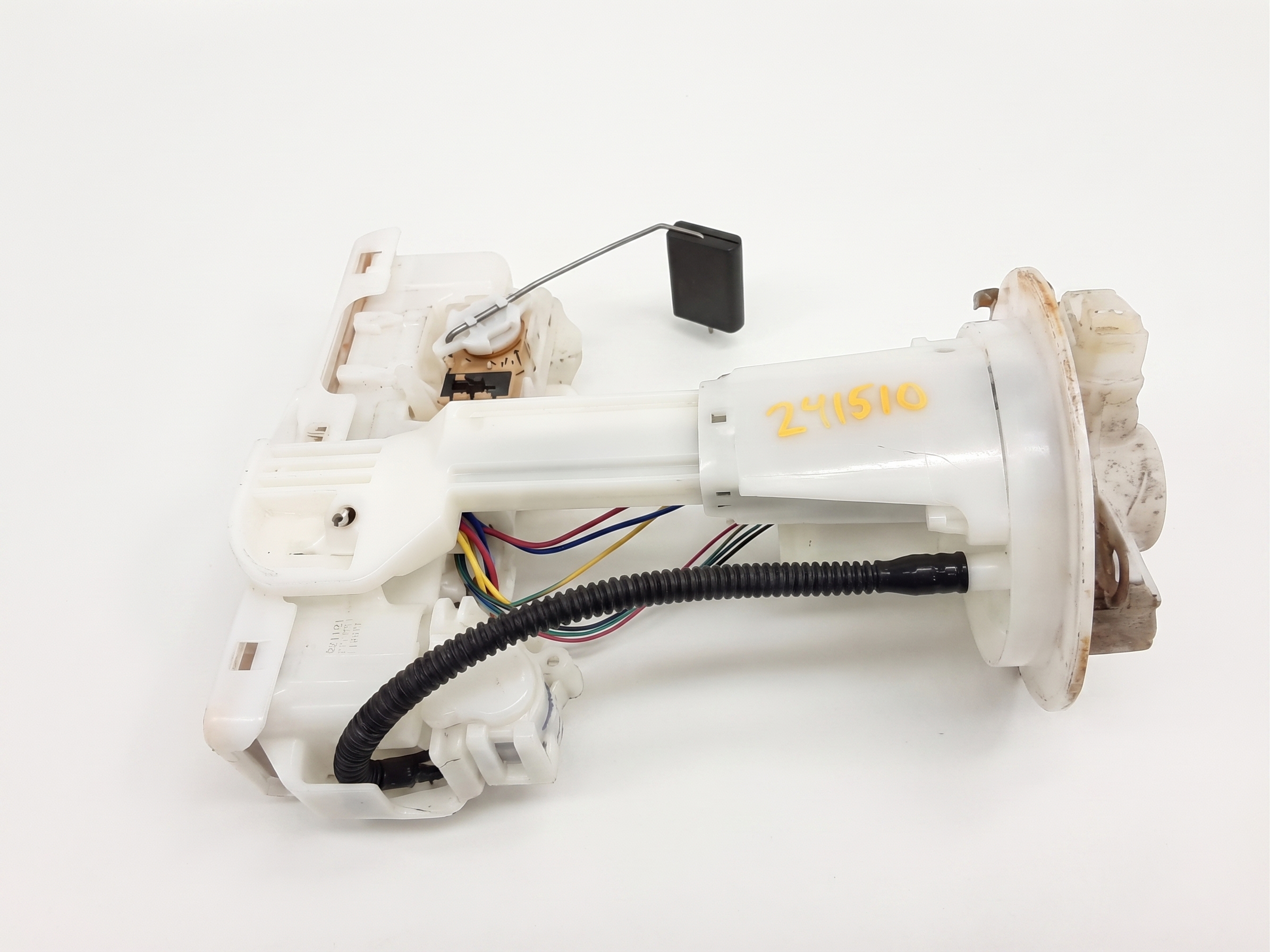
Used OEM Parts in Stock
New Aftermarket Parts Available


The information in this article is provided for general reference and educational purposes only. Vehicle specifications, procedures, and part compatibility can vary by production date, trim level, and region. Always consult your vehicle's factory service manual and verify part numbers before purchasing or performing repairs. Safety-critical components such as airbags, seat belts, and braking systems should be installed by a qualified professional.
- Hyundai Sonata:
- 🧭 Diagnostic Flowchart
- 🎬 Helpful Videos
- 🛍️ Shop This Part
- What's Unique About the 2015-2019 Hyundai Sonata
- Symptoms You May Notice
- Most Likely Causes
- Rare But Worth Checking
- Diagnosis Steps
- Parts You'll Likely Need
- Related Codes That Often Appear With This One
- Technical Service Bulletins (TSBs) & Recalls
- Platform-Specific Known Issues
- Mechanic-Grade Diagnostic Values
- Scan Tool Commands That Help
- Wiring & Ground Locations
- Real Owner Repair Stories
- Model Year Variations Within This Range
- Other Known Issues on This Vehicle
- Used vs. New Parts: Buying Guide for This Vehicle
- Real Owner Stories
- 2015 Hyundai Sonata — ~10900 miles
- 2023 Hyundai Sonata SEL
- Related OBD-II Codes
- Frequently Asked Questions
- 🎟️ Get 5% Off