

P0480 on 2011-2018 Volvo S60: Cooling Fan Circuit Malfunction Causes and Fixes
On a 2011-2018 Volvo S60, code P0480 almost always means the cooling fan control module has failed. This is a very common issue for this car and its platform mates (XC60, S80, etc.). Expect to replace the module, which costs around $50-$150 for an aftermarket part. DIY difficulty is 2/5.
- P0480 on a 2011-2018 S60 almost certainly points to a bad cooling fan control module.
- The main symptoms are a fan that won't shut off (draining the battery) or a fan that won't turn on (causing overheating).
- Do not drive the vehicle if the fan is not working, as you risk severe engine damage from overheating.
- You can often replace just the bolt-on control module for under $150, avoiding the need to buy a full fan assembly from the dealer.
What's Unique About the 2011-2018 Volvo S60
The second-generation Volvo S60 (P3 platform) is notorious for cooling fan control module failures. While P0480 is a generic code, on this vehicle it's the top suspect by a wide margin. The failure is so common that owners experience one of two distinct symptoms: the fan runs constantly at high speed, draining the battery, or it fails to activate at all, causing overheating. The module's internal electronics, likely the MOSFETs that regulate power to the fan motor, fail due to heat and age. Volvo has a history of fan module issues, having issued Recall 214 for a similar software-related problem on earlier 2008-2009 P3 models (S80, V70, XC70), though the 2011-2018 S60 was not included in that specific recall.
Symptoms You May Notice
- Check Engine Light is on
- Cooling fan runs constantly at high speed, even after the engine is off, leading to a dead battery.
- Engine overheating, especially in stop-and-go traffic or at idle.
- Air conditioning blows warm or weak air, as the A/C condenser isn't being cooled effectively by the fan.
- Loud, continuous fan noise from the engine bay.
- Replacing the battery when the actual problem is the parasitic drain from a constantly running fan caused by the failed module.
- Recharging the A/C system when it's blowing warm because the fan isn't running to cool the condenser.
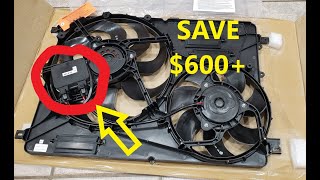
- Replacing the entire expensive cooling fan assembly from the dealer when only the less expensive, bolt-on control module has failed. 🎬 Watch: This 1-hour hack saves you $600 on fan repairs.
Most Likely Causes
- Failed Cooling Fan Control Module 🔴 High Probability → Shop Engine Cooling Fan Blade This module is a well-documented, extremely common failure point on P3 platform Volvos. The internal electronics are known to fail, causing it to get stuck 'on' (fan runs constantly) or 'off' (fan never runs).
How to confirm: If the fan runs continuously with the key off, the module is almost certainly bad. If the fan doesn't run when the engine is hot (over 220°F / 105°C) or when the A/C is commanded on, and you've verified the main fuse is good, the module is the primary suspect. A scan tool may also show specific sub-codes like P048000 or P048011.
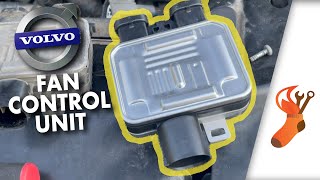
Typical fix: Replace the cooling fan control module. It is a small box bolted directly to the cooling fan shroud, making it a relatively simple unbolt-and-replace job. 🎬 See this super fast walkthrough for replacing the control unit.
Est. part cost: $50-$150 - Failed Cooling Fan Motor 🟡 Medium Probability → Shop Engine Cooling Fan Blade A fan motor nearing the end of its life can develop high electrical resistance or seize, which can overload and destroy the new fan control module. On models with dual fans, the smaller AC fan motor's brushes can wear out, causing a similar code (P048397). Sometimes both the motor and module fail together.
How to confirm: With the vehicle off, try to spin the fan blades by hand. If they feel stiff, seized, or make grinding noises, the motor is bad. You can also apply 12V power directly to the fan motor's main terminals (bypassing the module) to see if it spins. If it doesn't, the motor is dead.
Typical fix: Replace the entire cooling fan assembly, which includes the motor, shroud, and often a new control module.
Est. part cost: $200-$450 - Damaged Wiring or Connectors ⚪ Low Probability
How to confirm: Visually inspect the wiring harness leading to the fan control module and fan motor. Look for any signs of melting, corrosion, or broken wires, especially at the main connector plugs which handle high current.
Typical fix: Repair the damaged section of the wiring harness or replace the connector pigtail.
Est. part cost: $10-$50
Rare But Worth Checking
- Blown Fuse: Always a simple first check. Check the large-amperage fuse for the cooling fan in the engine bay fuse box. However, a blown fuse often indicates a deeper problem, like a shorted fan motor that is drawing too much current.
- Faulty Engine Coolant Temperature (ECT) Sensor: A faulty ECT sensor can send incorrect temperature readings to the ECM, which could theoretically cause fan control issues. However, this would typically be accompanied by other specific ECT codes like P0117 or P0118.
Diagnosis Steps
- Observe the Symptom: Does the fan stay on with the engine off (draining the battery)? Or does it never turn on, causing the engine to overheat in traffic? The symptom is your biggest clue.
- Scan for Codes: Confirm P0480 is present. Note any other codes, but be aware that on this car, P0480 often appears alone.
- Inspect the Main Fuse: Locate and check the high-amperage fuse for the cooling fan in the engine compartment fuse box. If it's blown, suspect a shorted fan motor.
- Inspect Wiring: Visually inspect the wiring and the main connector at the fan control module for melting, corrosion, or damage.
- Command Fan On (Scan Tool): Use a capable OBD-II scan tool to perform an active test, commanding the fan to turn on at various speeds. If the fan does not respond despite the command, the issue is likely in the fan circuit itself (module, motor, or wiring).
- Test Power and Ground at the Module: Using a multimeter, check for constant 12V power on the thick power wire and a good ground on the thick ground wire at the module's connector. If power and ground are present, the primary circuit is okay.
- Check the PWM Signal: This is more advanced. Using a multimeter with a duty cycle function or an oscilloscope, check the small signal wire from the ECM for a PWM signal when the fan is commanded on. A signal here but no fan action points strongly to a bad module.
- Test the Fan Motor Directly: Disconnect the fan motor from the control module. Apply 12V directly from the battery to the fan motor's power and ground terminals. If the fan spins forcefully, the motor is good, and the control module is definitively the fault. If it does not spin, the fan motor is bad.
- Replace the Faulty Component: Based on your findings, replace either the fan control module (most common) or the entire fan assembly (if the motor is bad).
Parts You'll Likely Need
- Cooling Fan Control Module
(OEM #940009402)— This is the most common failure point for the P0480 code on this specific vehicle. Other cross-reference part numbers include 940004302, 940008501, 940004204, 31338823, and 7T43-8C609-BA.
Trusted brands: Genuine Volvo, Dorman (p/n 902-710), Gates, Behr
OEM price range: $150-$250
Aftermarket price range: $50-$150 - Cooling Fan Assembly
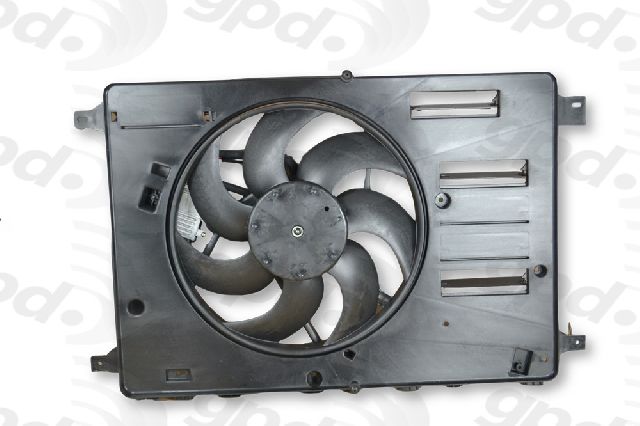
(OEM #31368622)— Required if the fan motor itself has failed. A seized or shorted motor can damage a new control module, so it's sometimes wise to replace both. Volvo dealers may only sell the complete assembly.
Trusted brands: Genuine Volvo, TYC, Four Seasons
OEM price range: $500-$700
Aftermarket price range: $200-$450
Technical Service Bulletins (TSBs) & Recalls
- Volvo Recall 214 / RTJ 21201: While not for the S60, this recall for the 2008-2009 S80/V70/XC70 addresses a fan control module failure due to a software error, showing a history of problems with this component on the P3 platform.
Platform-Specific Known Issues
- The cooling fan control module is a known, high-frequency weak point on the 2011-2018 S60 and other P3 platform Volvos. Failure is common and results in either a constantly running fan or a non-operational fan.
- Owner experiences on forums consistently point to the module as the fix. A user on VolvoForums with a 2010 XC60 (same platform) experienced P0480 and overheating, which was resolved by replacing the module. Another owner described the classic 'fan won't turn off' symptom and fixed it by replacing just the module.
Mechanic-Grade Diagnostic Values
- PWM Signal from ECM to Fan Control Module — expected: Frequency: 100 Hz; Voltage High: ~0.7 * Battery Voltage; Voltage Low: ~1.2V; Duty Cycle: 10% - 95%.. Failure: No signal, or a signal that is fixed and does not vary with engine temperature or A/C command, indicates a problem with the ECM or wiring. A correct signal reaching the module with no fan activity points to a failed module.
- Engine Coolant Temperature (ECT) Sensor Resistance — expected: Approximately 200 ohms at 200°F (93°C). The ECM commands the fan on when resistance drops below ~160 ohms.. Failure: Resistance readings that are wildly out of spec for a given temperature can prevent the ECM from commanding the fan on.
Scan Tool Commands That Help
- Volvo VIDA: Fan Activation Test — This bidirectional control allows a technician to command the fan on at various speeds directly from the scan tool. If the fan responds correctly to VIDA commands but not during normal operation, it suggests an issue with sensor inputs (like the ECT) rather than the fan circuit itself. If the fan does not respond, it confirms a fault in the module, motor, or wiring.
Wiring & Ground Locations
- Fan Control Module (4/71) — Bolted to the rear of the main cooling fan shroud.. This is the central component for the P0480 code. All power and signal wires route through it.
- Fan Control Module Connector — Plugged into the fan control module (4/71).. The connector has three key wires: a large gauge power wire (12V+), a large gauge ground wire, and a small gauge PWM signal wire (often violet) from the ECM. Verifying power, ground, and signal at this connector is the primary diagnostic step.
- Engine Bay Ground Points — Main chassis grounds are located on the inner fender/strut towers on both the driver and passenger sides of the engine bay.. A poor ground connection for the fan control module can cause high resistance and erratic operation, potentially leading to a P0480 code. While the module has a dedicated ground wire in its harness, ensuring the main chassis grounds are clean and tight is good practice.
Real Owner Repair Stories
- Volvo Forums user 'fiedel' (2010 Volvo XC60 (P3 Platform)) — Check Engine Light with code P0480. The user had previously replaced the fan module two years prior due to an overheating issue.
✅ What actually fixed it The user was confirming if the P0480 code could mean the replacement fan module was failing again. The context implies that replacing the module is the expected fix, highlighting the part's high failure rate even for replacement units.
OEM Part Supersession History
Multiple, including 940004302, 940008501, 31305106→940009402 (common aftermarket reference), 31338823 (Volvo OEM)— Part consolidation and potential minor revisions over the production run. This module was shared across many Ford, Land Rover, and Volvo models.
Heads up: The module is widely cross-compatible with part numbers like 7T43-8C609-BA (Ford) and LR002660 (Land Rover), as they are often the same physical part made by the same supplier. However, always verify fitment using the vehicle's VIN, as subtle differences could exist for specific applications (e.g., single vs. dual fan setups).
Diagnostic Flowchart
Other Known Issues on This Vehicle
Issues unrelated to this code that are worth knowing about as an owner of this generation:
- Excessive Oil Consumption (Drive-E 4-Cylinder & some 5/6-Cylinder) 🔴 High — Common on 2013-2016 models, particularly 2.0L Drive-E engines, often appearing after 80,000 miles. Caused by clogged low-tension piston rings. (Ref: Volvo Technical Journal TJ 31233 details the diagnosis and piston ring replacement procedure.)
- PCV System/Oil Trap Failure 🟠 Medium — Common failure item across many Volvo engines, including those in the S60. Can cause a whistling noise, oil leaks from seals, and lean codes.
- Automatic Transmission Shift Quality Problems 🟠 Medium — Some owners report harsh shifting, flares, or delays, particularly on earlier Geartronic and Powershift transmissions. Software updates sometimes help, but internal wear can occur. (Ref: Software updates and a B4 servo cover update were issued for earlier (P2) transmissions with similar issues, but problems can persist on P3 models.)
- AC Compressor Control Valve Failure 🟡 Low — A known issue where the AC blows warm at idle but may cool down at higher RPMs. The failure is often in the small control valve on the compressor, not the compressor itself. (Ref: Volvo Technical Journal TJ 31605 describes installing a resistor harness (P/N 32241228) to address this.)
Used vs. New Parts: Buying Guide for This Vehicle
When a used part is the smart pick: A used part is generally not recommended for the fan control module itself. Given the extremely high failure rate of this specific component due to internal electronic breakdown from heat and age, a used module from a junkyard is likely to have a very short remaining lifespan or could be faulty from the start. It only makes sense if the entire fan assembly (shroud, motor, and module) is being purchased for a very low price and the donor vehicle has very low mileage.
Donor-vehicle mileage cap: roughly under 40000 miles for the part to have meaningful remaining life.
What to inspect on the donor part:
- Check for physical damage to the fan shroud and blades.
- Spin the fan blade by hand; it should move freely with no grinding or stiffness.
- Inspect the electrical connector on the module for any signs of melting, corrosion, or burnt pins.
- If possible, verify the donor vehicle was not in a front-end collision that could have damaged the fan assembly.
Aftermarket brands forum-validated for this vehicle:
- Gates
- Behr
- Dorman (specifically part number 902-710)
Brands owners have reported issues with on this vehicle:
- Unbranded, no-name modules from online marketplaces should be treated with caution. Some owners have reported these failing within weeks or months of installation.
Real Owner Stories
Aggregated from forums and TSBs cited above. Mileages and costs reflect what owners reported in those sources.
2011 S60 T6
Symptoms: Owner reported P0480 codes and warm AC.
What fixed it: A commenter correctly identified the fan control module as the most likely failure point, describing the common failure modes (stuck on or won't turn on).
Source hint: Reddit r/Volvo - AC Issues on 2011 S60 T6 with P048000
P3 Platform Volvo
Symptoms: The fan was running constantly after parking the car, which was draining the battery.
What fixed it: The owner researched the issue, found that the fan control module was a common failure, and replaced it to fix the problem.
Source hint: YouTube - EASY 1-Hour HACK for Volvo Cooling Fan SAVES $600
2010 XC60
Symptoms: The vehicle set a P0480 code and was overheating.
What fixed it: The issue was resolved by replacing the cooling fan control module.
Source hint: vehicle_specific_issues section, citing a VolvoForums user
Related OBD-II Codes
Frequently Asked Questions
My 2012 S60's cooling fan runs constantly after I shut the car off and drains the battery. Is this the P0480 problem?
My S60 is overheating in traffic and the A/C is blowing warm, but I don't hear the fan. Could this be P0480?
Do I need to replace the entire fan assembly or just the small control module for a P0480 code?
Is there a recall for the fan control module on my 2014 Volvo S60?
I have a 2015 Land Rover LR2 with a P0480 code. Is the problem the same as on the Volvo S60?
What's the first thing I should check myself if I get a P0480 code?
Helpful Videos
We Have This Part in Stock

The information in this article is provided for general reference and educational purposes only. Vehicle specifications, procedures, and part compatibility can vary by production date, trim level, and region. Always consult your vehicle's factory service manual and verify part numbers before purchasing or performing repairs. Safety-critical components such as airbags, seat belts, and braking systems should be installed by a qualified professional.
- Volvo S60:
- 🧭 Diagnostic Flowchart
- 🎬 Helpful Videos
- 🛍️ Shop This Part
- What's Unique About the 2011-2018 Volvo S60
- Symptoms You May Notice
- Most Likely Causes
- Rare But Worth Checking
- Diagnosis Steps
- Parts You'll Likely Need
- Technical Service Bulletins (TSBs) & Recalls
- Platform-Specific Known Issues
- Mechanic-Grade Diagnostic Values
- Scan Tool Commands That Help
- Wiring & Ground Locations
- Real Owner Repair Stories
- OEM Part Supersession History
- Other Known Issues on This Vehicle
- Used vs. New Parts: Buying Guide for This Vehicle
- Real Owner Stories
- 2011 S60 T6
- P3 Platform Volvo
- 2010 XC60
- Related OBD-II Codes
- Frequently Asked Questions
- 🎟️ Get 5% Off