

P0507 on 2018-2021 Nissan KICKS: Causes and Fixes for High Idle Speed
On a 2018-2021 Nissan KICKS, code P0507 is most often caused by a dirty electronic throttle body that needs cleaning, followed by an Idle Air Volume Learning (IAVL) procedure. This is a common DIY fix costing under $20 for cleaner and a gasket. A weak battery can also be a contributing factor, as highlighted in a Nissan TSB.
- P0507 on a Nissan KICKS means the engine idle is too high.
- The most likely cause is a dirty throttle body, which is a simple fix involving cleaning and a new gasket.
- After cleaning the throttle body or replacing the battery, you MUST perform the Idle Air Volume Learning (IAVL) procedure to reset the idle.
- Check for Nissan TSB NTB21-049, especially if code P0101 is also present, as it provides a direct repair path.
- Do not replace the expensive throttle body assembly until you have tried cleaning it and performing the IAVL first.
What's Unique About the 2018-2021 Nissan KICKS
The Nissan KICKS' HR16DE engine uses a sensitive electronic throttle body that can accumulate carbon, preventing the throttle plate from closing completely. This is a very common cause for P0507. Unlike older cars with a separate Idle Air Control (IAC) valve, the KICKS integrates this function into the main throttle body. Furthermore, Nissan has a specific, and sometimes tricky, manual procedure called Idle Air Volume Learning (IAVL) that must be performed after cleaning the throttle body or disconnecting the battery to reset the idle parameters. A Technical Service Bulletin (NTB21-049) directly addresses P0507, often appearing with P0101 (MAF Sensor), and instructs technicians to first test the 12-volt battery, erase codes, and then perform the IAVL, suggesting the root cause is often related to electrical system stability or lost calibration rather than a hard part failure.
Diagnostic Flowchart
Tap your situation to follow the diagnostic path that matches what you're seeing on this vehicle.
Symptoms You May Notice
- Check Engine Light is on
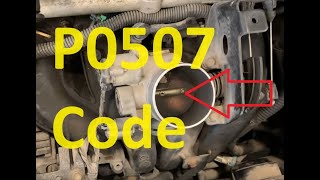
- Engine idle speed is higher than normal (e.g., over 1000 RPM at a stop) 🎬 Watch: Understanding the causes and fixes for the P0507 code
- Rough or surging idle
- Engine may stall when coming to a stop or when shifting into gear
- Hard starting
- Increased fuel consumption
- Difficulty controlling vehicle speed during acceleration or deceleration
- Replacing the entire throttle body assembly when it only needed to be cleaned and have the idle relearn procedure performed.
- Replacing the MAF sensor because it's mentioned in TSB NTB21-049, without first performing the recommended battery test and IAVL procedure.
- Assuming a vacuum leak exists without first attempting the IAVL procedure, especially if the code appeared after a battery disconnect or throttle cleaning.
Most Likely Causes
- Dirty Electronic Throttle Body 🔴 High Probability → Shop Fuel Injection Throttle Body Carbon from the crankcase ventilation system can build up around the throttle plate, preventing it from closing fully. This allows excess air into the engine, raising the idle speed. This is a very common issue on many modern electronically-controlled throttles.
How to confirm: Visually inspect the inside of the throttle body and the edges of the throttle plate for a black, sooty carbon layer after removing the intake boot.
Typical fix: Carefully clean the throttle body bore and plate with a dedicated throttle body cleaner and a soft cloth. A new throttle body gasket is recommended upon reinstallation. An Idle Air Volume Learning procedure MUST be performed after cleaning.
Est. part cost: $10-$20 - Idle Air Volume Learning (IAVL) Procedure Required 🔴 High Probability After cleaning the throttle body, disconnecting the vehicle's battery, or even due to a weak battery, the ECM's learned value for the throttle's closed position is lost or incorrect. It must be reset. TSB NTB21-049 explicitly calls for performing an IAVL to resolve this code, confirming it's a primary factory-recognized solution.
How to confirm: This is confirmed if the P0507 code appeared immediately after a battery replacement, throttle body cleaning, or other related repair. A Reddit user with a Nissan Versa (same engine family) reported this exact scenario.
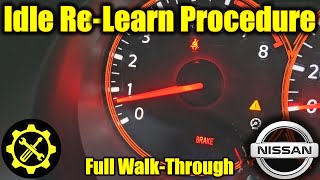
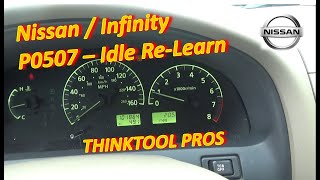
Typical fix: Perform the Idle Air Volume Learning procedure. This can be done manually with a series of timed key turns and pedal presses (the "pedal dance") or 🎬 See this walkthrough of the manual idle re-learn procedure instantly with a capable OBD-II scan tool like 🎬 Watch: How to perform the idle re-learn using a scan tool Nissan's CONSULT. The manual procedure requires strict adherence to timing and preconditions like engine temperature.
Est. part cost: $0 - Vacuum Leak 🟡 Medium Probability Hoses can become cracked or loose over time. A common area to check is the air intake flex pipe between the MAF sensor and the throttle body for cracks or loose clamps.
How to confirm: Inspect all vacuum hoses connected to the intake manifold for cracks, loose fittings, or breaks. A smoke test is the most effective way to find a hard-to-see leak. Spraying brake cleaner or starting fluid near suspected leak points and listening for a change in idle RPM can also pinpoint a leak.
Typical fix: Replace the cracked or leaking vacuum hose or gasket.
Est. part cost: $5-$50 - Faulty PCV Valve ⚪ Low Probability → Shop PCV Valve
How to confirm: A PCV valve stuck open can create a vacuum leak, causing a high idle. Remove the valve and shake it; if it doesn't rattle, it's likely stuck and needs replacement.
Typical fix: Replace the PCV valve. The OEM part number for the 1.6L HR16DE engine is 11810-5H71A.
Est. part cost: $15-$40
Rare But Worth Checking
- Faulty Electronic Throttle Body: → Shop Fuel Injection Throttle Body While cleaning usually solves the problem, the electronic motor or position sensor within the throttle body can fail, requiring a complete replacement. This is much less common than carbon buildup, and should only be considered after cleaning and the IAVL procedure fail to resolve the issue.
- Weak or Failing Battery: As per TSB NTB21-049, the first step in the diagnostic procedure is to test the 12V battery. A weak battery can cause various electronic modules, including the ECM, to behave erratically, potentially leading to incorrect idle calculations and triggering a P0507 code.
Diagnosis Steps
- Scan for any other trouble codes. If P0101 is present, follow the procedure in TSB NTB21-049, which starts with testing the battery with a professional tester like a Midtronics DSS-5000.
- If the battery is weak, charge or replace it, clear the codes, and see if the problem returns.
- If the code appeared after a battery change or throttle service, proceed directly to the Idle Air Volume Learning (IAVL) procedure.
- Visually inspect the air intake system for any obvious vacuum leaks, such as disconnected hoses or cracked intake boots between the air filter box and throttle body.
- Remove the air intake hose from the throttle body and inspect for heavy carbon buildup. If dirty, clean it thoroughly using throttle body cleaner and a rag. Do not spray directly into the electronics.
- Replace the throttle body gasket (OEM Part Number 16175-5RB0A) and reinstall the throttle body.
- Perform the Idle Air Volume Learning (IAVL) procedure. This is critical. The engine must be fully warmed up (coolant temp 158-212°F / 70-100°C) and all electrical loads (AC, lights, radio) must be OFF for the procedure to work.
- If the idle is still high, perform a smoke test to definitively check for vacuum leaks.
- Inspect the PCV valve (Part No. 11810-5H71A). If it's stuck open, it will act as a vacuum leak.
- If no leaks are found and the IAVL will not correct the idle, the electronic throttle body itself may be faulty and require testing or replacement.
Parts You'll Likely Need
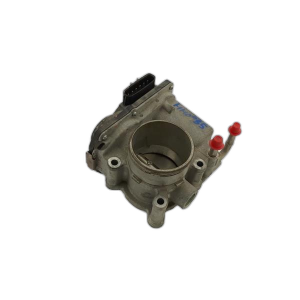
- Electronic Throttle Body
(OEM #16119-5RL0A)— This part is only needed if cleaning the original unit and performing the IAVL procedure does not resolve the high idle, indicating a failure of the internal electronics.
Trusted brands: Hitachi, Nissan (Genuine)
OEM price range: $420-$620
Aftermarket price range: $125-$250 - Throttle Body Cleaner — This is the primary tool for the most common fix: cleaning carbon buildup from the throttle plate and bore.
Trusted brands: CRC, WD-40 Specialist
Aftermarket price range: $8-$15 - Throttle Body Gasket
(OEM #16175-5RB0A)— It is best practice to replace the gasket whenever the throttle body is removed to ensure a proper seal and prevent vacuum leaks.
Trusted brands: Nissan (Genuine), Fel-Pro
OEM price range: $5-$15
Aftermarket price range: $3-$10 - PCV Valve
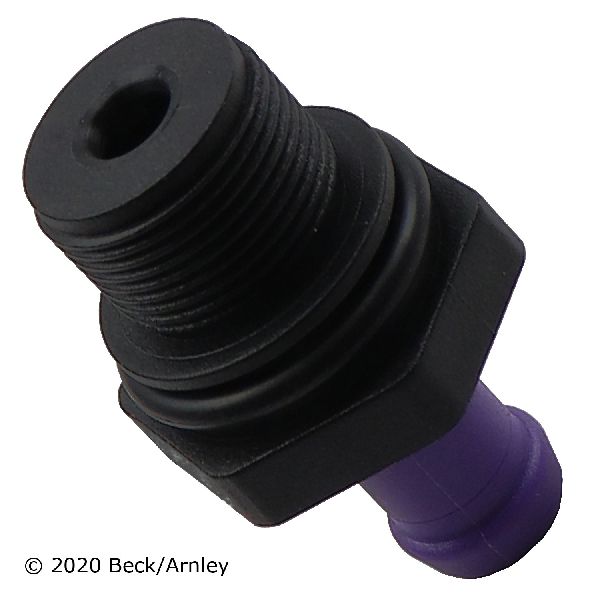
(OEM #11810-5H71A)— A stuck-open PCV valve can cause a vacuum leak, leading to a high idle. It's an inexpensive part to replace as part of diagnosis if a vacuum leak is suspected.
Trusted brands: Nissan (Genuine), Beck/Arnley
OEM price range: $20-$35
Aftermarket price range: $10-$25
Related Codes That Often Appear With This One
- P0101 — Nissan Technical Service Bulletin NTB21-049 directly links P0507 and P0101 (Mass Air Flow Sensor Circuit Performance). The bulletin suggests a weak battery or the need for an Idle Air Volume Learn procedure can trigger one or both codes. A YouTube video by a Nissan tech also documents cleaning the throttle body to address a P0101, which then requires an IAVL, showing the close relationship.
Technical Service Bulletins (TSBs) & Recalls
- NTB21-049: MIL ON WITH DTC P0101 AND/OR P0507 STORED IN THE ECM.
Platform-Specific Known Issues
- TSB NTB21-049 was issued by Nissan for the KICKS (and other models) specifically to address the MIL being on with DTC P0507 and/or P0101. The prescribed action is to test the 12V battery, erase codes, and perform an Idle Air Volume Learn (IAVL), indicating these are the most common root causes from the manufacturer's perspective.
Mechanic-Grade Diagnostic Values
- Throttle Position Sensor (TPS) Signal Voltage at Closed Throttle (Idle) — expected: 0.3V to 0.7V DC. Failure: Voltage significantly outside this range, especially if it's too high at idle (e.g., >0.9V), can indicate a misadjusted or faulty sensor, or that the throttle plate isn't closing fully.
- Throttle Position Sensor (TPS) Signal Voltage at Wide Open Throttle (WOT) — expected: Approximately 4.5V to 5.0V DC. Failure: Voltage does not increase smoothly as the throttle opens, or does not reach the expected maximum voltage.
- Battery Voltage (Precondition for IAVL) — expected: More than 12.9V (at idle). Failure: Voltage below 12.9V can cause the Idle Air Volume Learning procedure to fail or be cancelled.
- Engine Coolant Temperature (Precondition for IAVL) — expected: 70 - 100°C (158 - 212°F). Failure: If the engine is too cold or too hot, the ECM will not allow the IAVL procedure to complete successfully.
Scan Tool Commands That Help
- Nissan CONSULT (or compatible advanced scan tool like Launch/Thinktool): Idle Air Volume Learn (IAVL) — This function is mandatory after cleaning or replacing the electronic throttle body, replacing the ECM, or disconnecting the battery. It commands the ECM to relearn the throttle plate's closed position to achieve the target idle speed. Failure to perform this is the most common reason for a persistent P0507 after a repair.
- Nissan CONSULT (or compatible advanced scan tool): Throttle Valve Closed Position Learning — This is a preliminary step that must be performed before the IAVL. It learns the fully closed position of the throttle valve. It's required anytime the throttle body or ECM connector is disconnected.
- Nissan CONSULT (or compatible advanced scan tool): Accelerator Pedal Released Position Learning — This is another preliminary step required before the IAVL. It learns the fully released position of the accelerator pedal. It must be performed anytime the accelerator pedal sensor or ECM connector is disconnected.
Wiring & Ground Locations
- ECM Ground — On many Nissan vehicles, a primary engine ground runs from the intake manifold to the battery negative terminal, and another from the cylinder head (exhaust side) to the firewall. A poor ECM ground can cause a wide range of erratic behaviors, including incorrect sensor readings and idle control problems.. A faulty or corroded ground can cause incorrect voltage readings from the throttle position sensor and other engine sensors, leading the ECM to miscalculate the required idle position and potentially trigger a P0507.
- Electronic Throttle Control Actuator Connector (F29 on some diagrams) — The 6-pin connector directly on the electronic throttle body assembly.. This is the critical connection point for all power, ground, and signal wires for the throttle motor and the dual throttle position sensors. Corrosion or a loose pin here can directly cause P0507 and related throttle performance codes.
Real Owner Repair Stories
- Reddit user in r/AskAMechanic (2000 Buick Regal GS (different vehicle, but illustrates a common P0507 diagnostic path)) — High idle at 1100-1200 RPM with code P0507.
❌ Tried (didn't work) Replaced IAC valve, Replaced PCV valve and gasket, Cleaned throttle body and IAC passages, Replaced all vacuum hoses, Replaced intake manifold gasket, Replaced throttle position sensor
✅ What actually fixed it The user discovered the idle stop screw had been misadjusted. After adjusting the screw slightly, the idle returned to a normal 650-700 RPM and the code cleared. This highlights that a mechanical setting can sometimes be the root cause after exhausting electronic and vacuum possibilities.
OEM Part Supersession History
Not specified in searches→16119-5RL0A— This is the current OEM part number for the electronic throttle body assembly for the 2018-2021 Nissan Kicks.
Heads up: This part is also used on the Nissan Versa with the same engine. When replacing, a core charge is often applied, indicating the old part is expected to be returned for remanufacturing.
Model Year Variations Within This Range
- 2018-2021: Wiring harness part numbers for various sections of the vehicle (e.g., door harnesses, main body harness) changed around October 2018. While this is unlikely to affect the P0507 diagnosis directly, it's important for technicians to be aware of when ordering replacement harnesses for wiring repairs.
Helpful Videos

Used OEM Parts in Stock
New Aftermarket Parts Available



The information in this article is provided for general reference and educational purposes only. Vehicle specifications, procedures, and part compatibility can vary by production date, trim level, and region. Always consult your vehicle's factory service manual and verify part numbers before purchasing or performing repairs. Safety-critical components such as airbags, seat belts, and braking systems should be installed by a qualified professional.
- Nissan KICKS:
- 🧭 Diagnostic Flowchart
- 🎬 Helpful Videos
- 🛍️ Shop This Part
- What's Unique About the 2018-2021 Nissan KICKS
- Symptoms You May Notice
- Most Likely Causes
- Rare But Worth Checking
- Diagnosis Steps
- Parts You'll Likely Need
- Related Codes That Often Appear With This One
- Technical Service Bulletins (TSBs) & Recalls
- Platform-Specific Known Issues
- Mechanic-Grade Diagnostic Values
- Scan Tool Commands That Help
- Wiring & Ground Locations
- Real Owner Repair Stories
- OEM Part Supersession History
- Model Year Variations Within This Range
- 🎟️ Get 5% Off