

P0513 on 2005-2018 Volkswagen Jetta: Incorrect Immobilizer Key Causes and Fixes
This code means the car's anti-theft system doesn't recognize your key. The most common causes are a faulty key, a dead vehicle battery causing the system to 'forget' the key, or a bad reader coil around the ignition. You will likely need a professional with VW-specific tools to reprogram keys or replace parts.
- P0513 means your Jetta's anti-theft system has locked you out, and the car will not run.
- Before panicking, try your spare key. If it works, your primary key is faulty.
- Check your car's main battery. A weak or recently replaced battery is a very common cause for this code on VWs.
- This is not a DIY-friendly fix. Repairing this code almost always requires specialized tools to program keys or modules, so plan on visiting a dealer or a qualified independent shop.
What's Unique About the 2005-2018 Volkswagen Jetta
On the 2005-2018 Jetta (Mk5/Mk6), the immobilizer control module is integrated directly into the instrument cluster. This means a simple 'no start' issue could potentially point to a more complex and expensive problem with the entire cluster, not just a key or ignition component. Furthermore, these systems are notoriously sensitive to low vehicle battery voltage, which can corrupt the key memory in the instrument cluster and trigger a P0513 code even when all parts are working correctly. A VW-specific TPI (Technical Product Information) #2017171 was issued for similar models, noting this exact issue after a battery was fully drained. ECU tuning or replacement without properly synchronizing the immobilizer data is also a known trigger for this code on VAG vehicles.
Generation note: This range covers the Jetta A5 (Mk5, 2005.5-2010) and A6 (Mk6, 2011-2018). While the fundamental immobilizer principle is the same, the key types (e.g., Megamos 48 transponder), instrument clusters, and specific programming procedures (Immobilizer Gen 3 vs. Gen 4/5) differ. Diagnosis remains similar, but parts like keys and clusters are not interchangeable between generations.
Symptoms You May Notice
- Engine will not crank or start
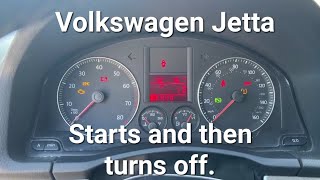
- Engine starts and then immediately stalls (within 1-2 seconds). 🎬 Watch: See how a Jetta behaves when the immobilizer fails.
- Flashing immobilizer warning light on the dashboard (a car symbol with a key).
- Check Engine Light is on.
- "SAFE" message may appear on the instrument cluster display.
- Replacing the starter motor when the engine doesn't crank. The immobilizer prevents the start signal from being sent.
- Replacing the fuel pump when the engine starts and stalls. The immobilizer cuts fuel delivery, but the pump is usually not the root cause.
- Replacing the ignition switch when the reader coil is the actual point of failure. The switch may be mechanically sound while the electronic coil around it has failed.
Most Likely Causes
- Faulty or Damaged Key Transponder 🔴 High Probability Keys get dropped, wet, or the internal transponder chip simply fails over time. Aftermarket or poorly cloned keys are also a frequent cause of this issue.
How to confirm: Try starting the car with a spare key. If the spare key works, the original key is faulty. If the key was recently dropped or taken apart (e.g., for a battery change), the small, often glass, transponder chip may have fallen out or been damaged.
Typical fix: The faulty key needs to be replaced and programmed to the vehicle by a VW dealer or a qualified automotive locksmith.
Est. part cost: $150-$400 (OEM key + programming) - Low or Dead Vehicle Battery 🟡 Medium Probability → Shop Vehicle Battery As noted in VW technical documents and owner forums, a significant voltage drop can corrupt the immobilizer memory in the instrument cluster, causing it to 'forget' valid keys. This often happens after the car sits for a long time, after a jump-start, or after battery replacement.
How to confirm: Test the vehicle's battery voltage. A reading below 12.0V is a sign of a weak battery. The issue often appears immediately after jump-starting or replacing the battery. Even with a jump, if the base battery is bad, the voltage instability can still prevent the immobilizer from working correctly.
Typical fix: Charge or replace the vehicle battery. If the code persists, the keys may need to be re-adapted to the immobilizer system using a diagnostic tool like VCDS. In some cases, leaving the key in the 'ON' position for 10-15 minutes can allow the system to re-synchronize, though this is not always successful.
Est. part cost: $150-$300 (for a new battery) - Faulty Immobilizer Reader Coil 🟡 Medium Probability The reader coil is a thin wire ring around the ignition lock cylinder that can fail due to vibration and age, leading to an intermittent or complete loss of signal from the key.
How to confirm: A VW-specific scan tool can check the status of the reader coil. A technician can also test the coil's resistance and wiring continuity back to the instrument cluster. The part is often suspected when both primary and spare keys fail to work.
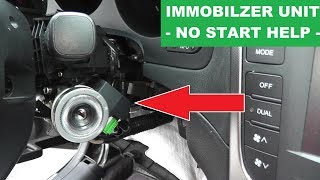
Typical fix: Replace the ignition reader coil. On many Jettas, this part is clipped onto the ignition lock housing and can be replaced separately. The OEM part number is often 5K0953254A for the Mk6 generation. 🎬 Watch: How to test and replace the immobilizer reader coil.
Est. part cost: $50-$150 - Using an Unprogrammed or Incorrectly Cloned Key ⚪ Low Probability Common with aftermarket or online key purchases. The key may be cut correctly but lacks the proper electronic programming for the car's specific immobilizer system.
How to confirm: This is confirmed if the issue started immediately after trying to use a new key. The key must be programmed by a professional with the correct tools and security access.
Typical fix: Have the key properly programmed to the vehicle by a dealer or qualified locksmith with VAG-specific tools.
Est. part cost: $75-$150 (programming service)
Rare But Worth Checking
- Faulty Instrument Cluster: → Shop Instrument Cluster Because the immobilizer is built into the instrument cluster on these Jettas, a failure of the cluster's internal electronics (e.g., from water damage or a cold solder joint) can cause P0513 and a host of other bizarre electrical issues. This is an expensive repair and should only be considered after all other causes are ruled out. A specialist may be able to repair the cluster without full replacement.
- Wiring Harness Damage: Damage to the wires between the reader coil, instrument cluster, and ECM can cause this code. This is uncommon but possible, especially if the vehicle has had previous dash, steering column repairs, or aftermarket electronics installed.
- Radio Frequency (RF) Interference: Having multiple transponder keys (even from other cars) on the same keyring can sometimes cause signal interference, preventing the car from reading the correct key. Try starting the car with only the single Jetta key near the ignition, with no other keys or fobs nearby.
- ECU/Immobilizer Data Mismatch: This can occur after ECU tuning or if either the ECU or instrument cluster has been replaced without the proper immobilizer adaptation procedure being performed. The components are 'married' to each other from the factory.
Diagnosis Steps
- Check for a flashing immobilizer light on the dashboard when trying to start the car.
- Try starting the car with a known-good spare key. If it starts, the first key is the problem.
- Remove all other keys and electronic fobs from the keyring to eliminate RF interference.
- Check the vehicle's main battery. Ensure it is fully charged (above 12.4V) and the terminals are clean and tight. A weak battery is a very common trigger for this code.
- Scan the vehicle with a VW-compatible scan tool (like VCDS or ODIS). Check for codes in the Engine (01), Instruments (17), and Immobilizer (25) modules.
- Using VCDS, check the measuring blocks in the Immobilizer module to see the status of the key (e.g., Key status, Transponder reading). This can confirm if the key is being read at all.
- If a faulty reader coil is suspected, test its wiring for continuity between the coil connector and the instrument cluster plug. Also, test the coil's resistance, which should be between 18 and 24 ohms.
- If a new key, instrument cluster, or ECU is needed, it must be programmed to the vehicle using a specialized tool and the vehicle's security PIN. This is typically a job for a professional.
Parts You'll Likely Need
- Replacement Key with Transponder
(OEM #Varies by year/model, e.g., HU66T6, 5K0837202BJ.)— This is the most common failure point. The internal chip is damaged or the key has been lost.
Trusted brands: Volkswagen OEM
OEM price range: $150-$350
Aftermarket price range: $50-$150 (plus programming) - Immobilizer Reader Coil (Ignition Switch Reader)
(OEM #5K0953254A (common for Mk6).)— This coil reads the key's transponder chip. It can fail, preventing communication even with a good key.
Trusted brands: Volkswagen OEM, Bosch
OEM price range: $70-$150
Aftermarket price range: $40-$90
Related Codes That Often Appear With This One
- 17978 (VAG-specific) / P1570 — This is the VW-specific fault code for 'Engine Start Blocked by Immobilizer'. It is the direct companion to the generic P0513 code and confirms the immobilizer is the reason for the no-start condition.
- 01128 (VAG-specific) — This code stands for 'Immobilizer Reader Coil (D2)'. It directly points to a fault in the reader coil circuit, either the coil itself or its wiring to the instrument cluster. It often accompanies P0513 when the coil is the root cause.
- 01177 (VAG-specific) — This code means 'Engine Control Unit Not Authorized' or 'Not Currently Testable'. It indicates a communication or synchronization problem between the instrument cluster (where the immobilizer lives) and the Engine Control Module (ECM). This can happen after an ECU is swapped, tuned (immo-delete), or if there's a wiring issue between the two modules.
Technical Service Bulletins (TSBs) & Recalls
- TPI 2017171: Notes that P0513 can be stored after the vehicle battery was fully drained. The fix is often to clear codes and re-adapt keys if necessary.
Platform-Specific Known Issues
- The immobilizer control unit is part of the instrument cluster, making diagnosis more complex and potential repairs more costly than on vehicles with a separate immobilizer module. A cluster failure can cause P0513.
- These systems are known to be sensitive to low voltage, and a weak or recently replaced battery can cause the immobilizer to lose its key memory, triggering P0513 even with no faulty parts.
Mechanic-Grade Diagnostic Values
- Immobilizer Reader Coil Resistance — expected: 18 - 24 Ohms. Failure: A reading outside this range indicates a faulty coil.
- Immobilizer Reader Coil Voltage (Key On) — expected: Should be >80mV initially, then drop to ~70mV.. Failure: A reading less than ~20mV indicates a fault in the system. Wiggling the green connector at the back of the instrument cluster while monitoring voltage can reveal a poor connection if the reading fluctuates between ~70mV and ~20mV.
- VCDS Measuring Block 022, Field 3 (Key Status) — expected: 1. Failure: A value of 0 means the key's transponder code could not be read or is illegitimate, and it will not be possible to adapt that key.
- VCDS Measuring Block 024, Fields 1, 2, 3 (Lock Times) — expected: 0 minutes. Failure: If any of these fields show a value greater than 0, the immobilizer is in a security lockout due to too many incorrect attempts. You must leave the ignition on for the duration of the displayed time before another attempt can be made.
Hidden / Shadow Codes Worth Checking
- 01128: Immobilizer Reader Coil (D2). This code specifically points to a problem with the ignition reader coil or its circuit, making it a primary suspect when seen with P0513. (see via VCDS or other VAG-compatible diagnostic tool, typically found in the Instrument Cluster (17) or Immobilizer (25) module.)
- 01176: Key: Signal too Low. This often accompanies code 01128 and P0513, suggesting the signal from the key's transponder is not being received strongly enough, pointing towards a weak key battery, a failing reader coil, or RF interference. (see via VCDS or other VAG-compatible diagnostic tool, typically found in the Instrument Cluster (17) or Immobilizer (25) module.)
- 01177: Engine Control Unit: Not Authorized. This indicates a failure in the handshake between the immobilizer (in the cluster) and the ECU. It's common after an ECU has been swapped or had its immobilizer function deleted via tuning. (see via VCDS or other VAG-compatible diagnostic tool, typically found in the Instrument Cluster (17) module.)
Scan Tool Commands That Help
- VCDS (VAG-COM): Measuring Blocks - Group 022 & 023 — Use this in the [17 - Instruments] module to get live data on the key's status. It will show if the key is being read, if it's authorized, and how many keys are adapted. A 'Key Status OK' value of '0' immediately tells you the key isn't being read correctly.
- VCDS (VAG-COM): Adaptation - Channel 21 (Key Matching) — This function is used to program new or existing keys to the immobilizer after obtaining the vehicle's 4-digit SKC/PIN. You set the 'New Value' to the total number of keys you want to adapt, then cycle each key in the ignition to save it.
- VCDS (VAG-COM): Login - 11 — This is a prerequisite for performing security-related functions like key adaptation. You must enter the vehicle's Secret Key Code (SKC), preceded by a zero (e.g., '01234' for PIN '1234'), to gain access to the adaptation channels.
Wiring & Ground Locations
- Instrument Cluster Ground — On Mk4 Jettas, a key ground point is located above the driver's footwell, to the left of the pedal cluster. For the Mk6 Jetta (2011), a primary ground distribution point is G44, located at the lower left 'A' pillar.. The immobilizer is integrated into the instrument cluster. A poor ground connection to the cluster can cause erratic behavior, including failure to recognize a valid key, triggering P0513.
- Reader Coil Connector — A 2-pin connector attached to the reader coil, which is clipped around the ignition lock cylinder behind the steering column shrouds.. This is the direct connection point for testing the reader coil's resistance (pins 1 and 2) and voltage. A loose or corroded connection here will prevent the key signal from reaching the instrument cluster.
- Instrument Cluster Connector (Green) — This is one of the main connectors on the rear of the instrument cluster. For many VW models, the W-line (immobilizer data) and K-line (diagnostics) connect here.. A poor pin fitment or corrosion in this specific connector can cause an intermittent loss of communication between the reader coil and the immobilizer logic board inside the cluster. A VW TSB suggests wiggling this connector while monitoring reader coil voltage to diagnose this exact issue.
Real Owner Repair Stories
- YouTube user @TallerArgento (Volkswagen Jetta 2.5L (year not specified, likely Mk5/Mk6)) — Engine starts and immediately shuts off. No immobilizer warning light was visible on the dash.
❌ Tried (didn't work) Initial checks showed no other fault codes.
✅ What actually fixed it The owner disconnected the vehicle's battery for 2 minutes. Then, reconnected the battery while the key was already in the ignition and in the 'ON' position. After reconnecting the battery, the car started and ran normally, resolving the immobilizer issue. - Ross-Tech Forums user Jesterking (2005 Jetta MKIV) — Flashing immobilizer light on the dashboard, but the vehicle would still start and drive.
❌ Tried (didn't work) Leaving the key in the 'ON' position for 20-25 minutes., Connecting a battery charger to rule out low voltage., Performing a hard reset by disconnecting the battery and touching the negative and positive cables together.
✅ What actually fixed it The user's VCDS scan showed 'Immobilizer Status 6', which is a normal operating condition. The issue was likely intermittent or had resolved, but the story highlights common but unsuccessful reset procedures that owners attempt.
OEM Part Supersession History
5K0953254→5K0953254A— Revision and update of the part. 'A' is the later, more common revision for the Mk6 Jetta and similar platforms.
Heads up: While physically similar, always match the part number to the vehicle's VIN. Using an incorrect reader coil, even if it fits, may result in communication errors.
Model Year Variations Within This Range
- 2005.5-2010 (Mk5): These models typically use Immobilizer Generation 3 or 4. Diagnosis with VCDS involves checking the 'Extra' field in [17 - Instruments] for both a VIN and a 14-digit Immo-ID to confirm Immo 3. Key adaptation requires a 4-digit PIN/SKC.
- 2011-2018 (Mk6): These models use Immobilizer Generation 4 or 5, often referred to as Immo 4A or MQB systems in later years. While the principle is the same, the underlying cryptography and adaptation procedures can be more complex, sometimes requiring dealer tools (ODIS) for component replacement (like a new cluster or ECU).
Diagnostic Flowchart
Other Known Issues on This Vehicle
Issues unrelated to this code that are worth knowing about as an owner of this generation:
- 2.0T TSI Timing Chain Tensioner Failure 🔴 High — Common on pre-2013 EA888 engines. The original tensioner design can fail without warning, often between 60k-100k miles, leading to catastrophic engine damage. (Ref: VW TSB 15-12-01 (also 2028302) was issued, and a class-action lawsuit led to a warranty extension, which has now expired for most vehicles.)
- DSG Mechatronic Unit Failure 🔴 High — Affects Jettas with the DSG automatic transmission. Can occur around 80k-120k miles, causing harsh shifting, flashing PRNDS indicator, and loss of drive. (Ref: Multiple service campaigns and warranty extensions have been issued for specific DSG issues over the years.)
- Intake Manifold Carbon Buildup (FSI/TSI Engines) 🟠 Medium — A common issue on all direct-injection engines of this era. Buildup becomes significant after 50k-80k miles, causing misfires, poor fuel economy, and reduced power.
- Water Pump & Thermostat Housing Leaks (Plastic) 🟠 Medium — The plastic water pump and thermostat housing assembly is prone to cracking and leaking, typically after 60k miles. Can lead to overheating if not addressed.
- Wiring Harness Chafing (Mk5) 🟠 Medium — On the 2005.5-2010 Jetta, wiring harnesses in the engine bay and doors can chafe, leading to various intermittent electrical faults.
- Clock Spring Failure 🟠 Medium — Common on Mk6 Jettas, leading to a loss of horn, steering wheel controls, and an airbag warning light. (Ref: Subject of a recall and subsequent investigation for recall failure.)
Used vs. New Parts: Buying Guide for This Vehicle
When a used part is the smart pick: A used Immobilizer Reader Coil is a very reasonable choice. It is a simple electronic component with a low failure rate from wear, and a used OEM part is often more reliable than a cheap aftermarket alternative. A used Instrument Cluster can also be an option, but ONLY if you use a specialist service to clone the immobilizer data from your old cluster to the used one.
Donor-vehicle mileage cap: roughly under 80000 miles for the part to have meaningful remaining life.
What to inspect on the donor part:
- For a Reader Coil: Ensure the plastic housing is not cracked and the connector pins are straight and free of corrosion.
- For an Instrument Cluster: Verify the part number matches exactly. Inspect the clear plastic lens for deep scratches or hazing. Check the rear connectors for any signs of water damage, corrosion, or bent pins. Ask the seller if the donor car had any electrical issues.
OEM-only on this vehicle (don't cheap out):
- Key Transponder: For reliable programming and function, an OEM key from the dealer or a high-quality locksmith supplier is strongly recommended. Cheap online keys often have transponder chips that fail to program or stop working shortly after.
- Instrument Cluster: Due to the integrated immobilizer, you cannot simply swap in a used cluster without specialized programming to adapt it to your car's ECU and keys. An OEM new part is the dealer-prescribed fix, though cloning by a specialist is a viable alternative.
Aftermarket brands forum-validated for this vehicle:
- Bosch (for reader coil, if available)
Brands owners have reported issues with on this vehicle:
- Unbranded, no-name keys and reader coils from online marketplaces. These frequently cause programming headaches and have high failure rates.
Real Owner Stories
Aggregated from forums and TSBs cited above. Mileages and costs reflect what owners reported in those sources.
2005 Volkswagen Jetta
Symptoms: After a battery change, the car refused to start and showed a flashing immobilizer light.
What fixed it: The issue was linked to battery voltage dropping low enough to corrupt the immobilizer memory; the fix involves testing battery voltage and potentially re-adapting keys.
Source hint: Reddit r/MechanicAdvice: '05 Jetta immobilizer after battery change? Help!
2005 Volkswagen Jetta Wagon
Symptoms: The car starts and immediately dies with the immobilizer light flashing after the battery died. Multiple keys did not solve the problem.
What fixed it: The failure was attributed to either corrupted memory from a low voltage event or a failed reader coil/instrument cluster.
Source hint: Reddit r/Volkswagen: 2005 Jetta wagon battery or immobilizer issue?
Volkswagen Jetta (Stage 1 Tune)
Symptoms: A 'SAFE' message appeared on the dash and P0513 was stored after writing a tune file to the ECU, though the car would still start.
What fixed it: The issue was caused by the ECU-Immobilizer pairing sensitivity during the tuning process.
Source hint: MHH Auto Forum: VW P0513 - SAFE
2012 Volkswagen Jetta
Symptoms: Numerous random warning lights and a no-start condition.
What fixed it: The discussion identified a potential failing instrument cluster (which houses the immobilizer) or a CAN network problem as the root cause.
Source hint: Ross-Tech Forums: Is the Instrument Cluster Defective or Is It Something Else?
Related OBD-II Codes
Frequently Asked Questions
My 2005 Jetta won't start after I replaced the battery. Does TPI 2017171 explain this?
I see a 'SAFE' message on my instrument cluster and the car stalls immediately. What does this mean?
Can I replace the reader coil on my Mk6 Jetta myself, and what is the part number?
Why did my Jetta start showing the flashing car-and-key symbol after I dropped my keys?
Will leaving my key in the 'ON' position fix the P0513 code?
I just had my ECU tuned and now I have a P0513 code. Is my immobilizer broken?
Helpful Videos

We Have This Part in Stock



The information in this article is provided for general reference and educational purposes only. Vehicle specifications, procedures, and part compatibility can vary by production date, trim level, and region. Always consult your vehicle's factory service manual and verify part numbers before purchasing or performing repairs. Safety-critical components such as airbags, seat belts, and braking systems should be installed by a qualified professional.
- Volkswagen Jetta:
- 🧭 Diagnostic Flowchart
- 🎬 Helpful Videos
- 🛍️ Shop This Part
- What's Unique About the 2005-2018 Volkswagen Jetta
- Symptoms You May Notice
- Most Likely Causes
- Rare But Worth Checking
- Diagnosis Steps
- Parts You'll Likely Need
- Related Codes That Often Appear With This One
- Technical Service Bulletins (TSBs) & Recalls
- Platform-Specific Known Issues
- Mechanic-Grade Diagnostic Values
- Hidden / Shadow Codes Worth Checking
- Scan Tool Commands That Help
- Wiring & Ground Locations
- Real Owner Repair Stories
- OEM Part Supersession History
- Model Year Variations Within This Range
- Other Known Issues on This Vehicle
- Used vs. New Parts: Buying Guide for This Vehicle
- Real Owner Stories
- 2005 Volkswagen Jetta
- 2005 Volkswagen Jetta Wagon
- Volkswagen Jetta (Stage 1 Tune)
- 2012 Volkswagen Jetta
- Related OBD-II Codes
- Frequently Asked Questions
- 🎟️ Get 5% Off