

P0606 on 2016-2018 Ford Focus ST: PCM Processor Fault Causes and Fixes
P0606 on a Focus ST indicates a critical internal failure of the main engine computer (PCM). Before condemning the expensive PCM, thoroughly check for a weak battery, charging system problems, or loose/corroded ground wires, as these are known to trigger the code. PCM replacement is not a DIY job as it requires dealer-level programming and can cost between $800 and $1,500.
- P0606 is a critical code indicating a likely PCM failure, and the vehicle should not be driven.
- Before spending money on a new PCM, you MUST first rule out a bad battery, faulty charging system, or loose/corroded ground wires.
- Information about Transmission Control Module (TCM) failure for this code does NOT apply to the Focus ST, which has a manual transmission.
- Replacing the PCM is a job for a professional with Ford-specific programming tools.
- Check for any open recalls, such as 18S32, to ensure your PCM has the latest factory software.
What's Unique About the 2016-2018 Ford Focus ST
Unlike standard Ford Focus models from this era, the Focus ST was only equipped with a manual transmission. Much of the online information about P0606 on a Focus incorrectly discusses issues with the problematic DPS6 automatic transmission and its Transmission Control Module (TCM). For the Focus ST, this code is more straightforward, typically pointing to a true PCM internal fault, a power supply issue, or a bad ground connection. It's also critical to ensure Safety Recall 18S32 has been performed, as a faulty canister purge valve can cause stalling and other symptoms that mimic PCM failure.
Symptoms You May Notice
- Check Engine Light is on
- Vehicle enters 'limp mode' with reduced power
- Sudden stalling or engine cutting out
- No-start or hard-starting condition 🎬 Watch: Diagnostic tips for a P0606 no-start condition.
- Multiple warning lights on the dashboard (ABS, Traction Control, Brake)
- Loss of power or boost
- Rough or erratic idling
- Erratic gauge behavior on the instrument cluster
- Replacing the Transmission Control Module (TCM). This is a very common misdiagnosis because it's a frequent failure on standard Focus models with automatic transmissions. The Focus ST has a manual transmission and its TCM is integrated differently; P0606 on an ST is not a TCM issue.
Most Likely Causes
- Faulty Powertrain Control Module (PCM) 🔴 High Probability → Shop Engine Control Module (ECM) While not a widespread recall issue for this specific fault, PCM failure is the ultimate diagnosis once all other possibilities are exhausted. The code P0606 is specifically designed to report this internal processor error.
How to confirm: This is a diagnosis of exclusion. A technician must first confirm that the battery, charging system, and all power and ground circuits to the PCM are functioning perfectly. If all external inputs are good, the PCM itself is declared faulty.
Typical fix: Replace the Powertrain Control Module and program it to the vehicle using Ford's IDS or equivalent J2534 tool. 🎬 See how a professional technician reprograms a Ford PCM.
Est. part cost: $600-$1200 - Low Battery Voltage or Failing Charging System 🟡 Medium Probability → Shop Vehicle Battery Modern control modules are sensitive to voltage. During engine cranking, a weak battery can cause a momentary voltage drop sufficient to trigger a false processor fault code. This should always be the first check.
How to confirm: Perform a complete battery and charging system test. Use a multimeter to check battery voltage with the engine off (should be >12.4V) and with the engine running (should be ~13.5-14.5V). A load test is the most definitive way to confirm battery health, as a battery can show good voltage but fail under load.
Typical fix: Recharge or replace the vehicle's 12V battery. If the charging system is at fault, replace the alternator.
Est. part cost: $150-$300 - Poor PCM Power or Ground Connection 🟡 Medium Probability Corrosion or loose connections at the PCM connectors or main chassis grounds can create intermittent power interruptions, confusing the module and causing it to report an internal fault. A widely reported failure point on the Focus platform are the main chassis grounds under the airbox (G101, G108) 🎬 Watch: How to locate and clean these critical chassis grounds., which can have poor contact due to paint.
How to confirm: Visually inspect the PCM wiring harness for damage. Disconnect, inspect, and clean the PCM connectors. Locate the main engine/chassis ground points under the airbox, unbolt them, sand the contact surfaces to bare metal, and re-tighten securely.
Typical fix: Clean and tighten all ground connections. Repair any damaged wiring or replace corroded connector pins.
Est. part cost: $0-$50
Rare But Worth Checking
- Faulty PCM Power Relay: The PCM is powered by a relay. If this relay fails or provides intermittent power, it can cause the PCM to shut down improperly and set codes like P068A or P0606. This is a simple and inexpensive part to check before replacing the entire PCM.
- Aftermarket Tuning: An improperly loaded or corrupt aftermarket engine tune can cause software conflicts within the PCM, potentially triggering a P0606 code. Reverting to the stock Ford calibration can help rule this out.
Diagnosis Steps
- Read all Diagnostic Trouble Codes (DTCs) from all modules, not just the PCM. Note any other codes present.
- CRITICAL: Test the 12V battery. Ensure it is fully charged and passes a load test. A weak battery is a common cause of false module codes.
- With the engine running, test the alternator output to ensure the charging system is working correctly (typically 13.5V-14.5V).
- Check the status of Safety Recall 18S32 / 19S22. This recall addresses a faulty canister purge valve and includes a mandatory PCM software update. Ensure this has been completed, as it affects PCM stability.
- Visually inspect all wiring to and from the PCM. Look for any signs of corrosion, damage, or loose connections.
- CRITICAL: Locate, disconnect, clean, and securely re-tighten the main PCM ground straps. On the Focus platform, key grounds (G101, G108) are located on the chassis frame rail under the airbox. It is common to need to sand away paint to get a good metal-to-metal connection.
- Using a wiring diagram, verify that the PCM is receiving proper voltage and has a solid ground connection on all required pins.
- Inspect and test the PCM power relay. Consider swapping it with a known-good relay of the same type to see if the problem resolves.
- If the vehicle has an aftermarket tune, flash the PCM back to the stock Ford calibration to rule out software corruption.
- If all external wiring, power, grounds, and software are confirmed to be in perfect working order, the PCM is faulty.
- Replace the PCM. This step requires a professional to program the new module to the vehicle's VIN and security system (PATS).
Parts You'll Likely Need
- Powertrain Control Module (PCM)
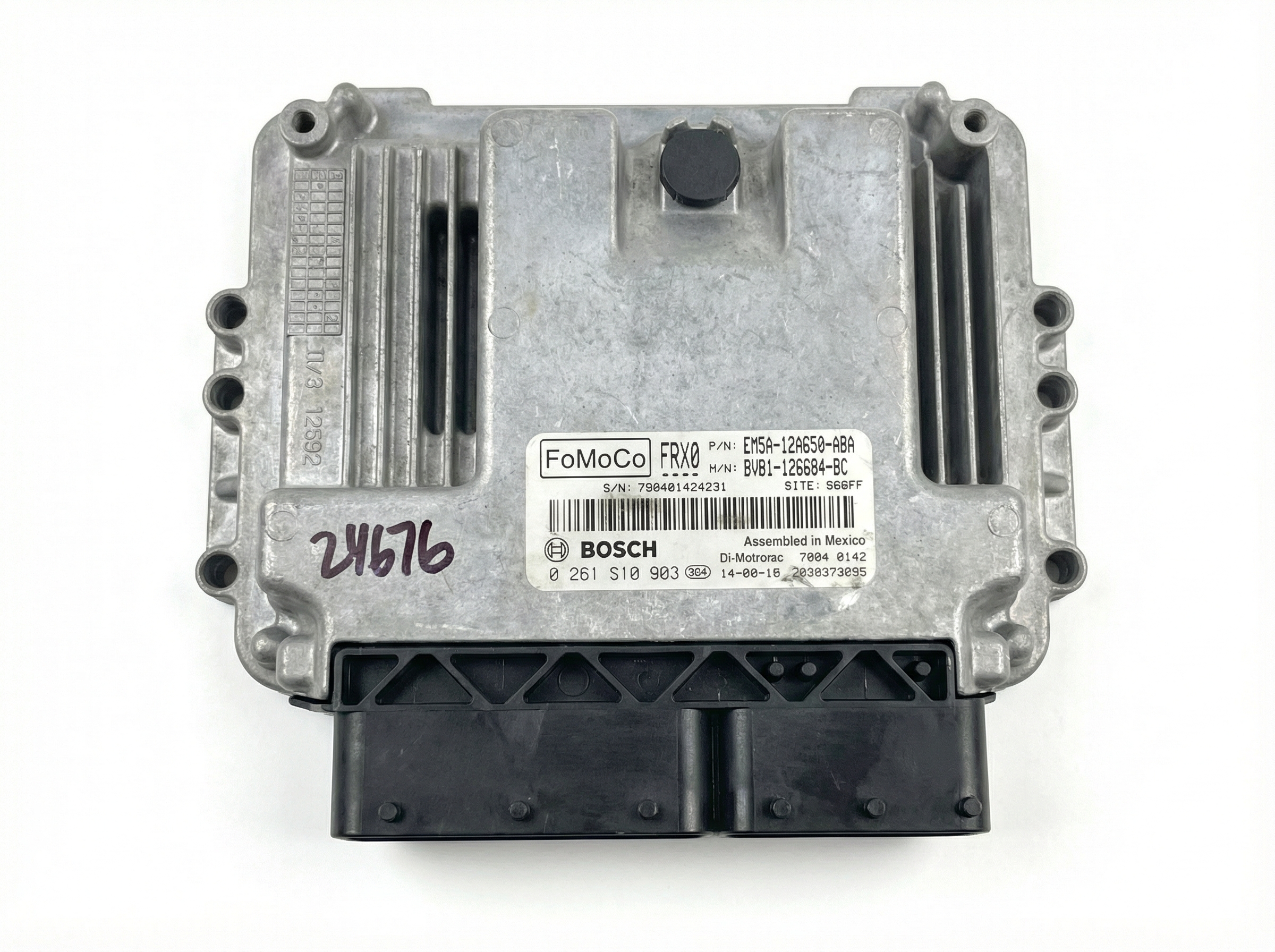
(OEM #F1EZ-12A650-AANP (Verify by VIN, other numbers like F1EA-12A650-CA may apply))— This code directly indicates an internal processor fault within the PCM. If all external electrical factors are ruled out, the module itself has failed.
Trusted brands: Motorcraft
OEM price range: $800-$1200
Aftermarket price range: $400-$800 - Vehicle Battery — A weak or failing battery can cause low voltage conditions that trigger a false P0606 code.
Trusted brands: Motorcraft, Interstate, DieHard
OEM price range: $200-$300
Aftermarket price range: $150-$250
Related Codes That Often Appear With This One
- U0100 — Lost Communication With ECM/PCM. This code often appears with P0606 because the internal fault disrupts the PCM's ability to communicate on the vehicle's CAN bus network.
- P06B8 — Internal Control Module Non-Volatile Random Access Memory (NVRAM) Error. This points to a specific memory fault within the PCM and can be seen alongside P0606, reinforcing the diagnosis of an internal PCM failure.
- P068A — ECM/PCM Power Relay De-Energized Performance – Too Early. This indicates the PCM is not powering down correctly, which can be caused by a bad relay, wiring, or an internal PCM fault. It is closely related to P0606.
- P1450 — Unable to Bleed Up Fuel Tank Vacuum. This code is often associated with a failing Canister Purge Valve, an issue addressed by recall 18S32. Since the recall involves a PCM reprogram, seeing this code alongside P0606 warrants checking the recall status.
Technical Service Bulletins (TSBs) & Recalls
- TSB 19-2313: While this TSB is officially for the 2019 Edge/Nautilus with the 8F57 transmission for harsh shifting, it involves reprogramming the PCM. It shows that Ford addresses drivability issues via PCM software updates, reinforcing the need to ensure the Focus ST has the latest calibration.
Platform-Specific Known Issues
- Safety Recall 18S32 / 19S22 was issued for 2013-2018 Focus STs to reprogram the PCM to better detect a stuck canister purge valve (CPV). A stuck CPV can cause excessive vacuum in the fuel tank, leading to deformation, erratic fuel gauge readings, and engine stalling. It is critical to ensure this recall has been performed, as the symptoms can mimic PCM failure and the fix involves a mandatory PCM software update.
Mechanic-Grade Diagnostic Values
- Battery Voltage (Engine Off) — expected: >12.4V. Failure: Voltage below 12.4V indicates a discharged or failing battery that can cause false module codes.
- Charging System Voltage (Engine Running) — expected: 13.5V - 14.5V. Failure: Voltage outside this range indicates a problem with the alternator or voltage regulator, leading to an unstable power supply for the PCM.
- PCM Ground Circuit Resistance — expected: < 0.5 Ohms. Failure: High resistance on a ground circuit indicates a poor connection, which can cause intermittent PCM resets and trigger P0606.
Scan Tool Commands That Help
- Ford IDS (Integrated Diagnostic System): PCM Self-Test — This is a key function to run early in the diagnosis. It commands the PCM to check its own internal processors and memory. A failure here strongly suggests an internal PCM fault, especially if power and grounds are good.
- Ford IDS or FORScan: PATS (Passive Anti-Theft System) Parameter Reset / Key Programming — This is not a diagnostic command, but a mandatory procedure after replacing the PCM. It syncs the replacement module to the vehicle's ignition keys and immobilizer system. The car will not start without this step.
- Ford IDS or FORScan: Module Programming / As-Built Data Configuration — Required when installing a new or used PCM. This function writes the vehicle's specific VIN and configuration data (for features like trim level, tire size, etc.) to the module.
Wiring & Ground Locations
- G101 — Left front of the engine compartment, on the frame rail, typically under the airbox assembly.. This is a primary chassis ground point for the PCM and other critical engine components. It is notorious for having paint underneath from the factory, leading to a poor connection that can cause intermittent power loss to the PCM and trigger a P0606.
- G108 (on some diagrams) — Also located under the airbox near G101 on the frame rail.. Shares the same function and failure mode as G101. Both should be removed, cleaned to bare metal, and re-secured during diagnosis.
- Transmission Ground Stud — A ground cable attached to a bell housing bolt stud that connects the engine to the transmission.. This is the main ground path for the engine and transmission assembly. A loose or broken connection here can cause a floating ground, leading to a host of electrical issues including P0606 and communication codes.
- PCM Power Relay (KL15 / R8) — In the engine bay fuse box, located next to the battery. It is often identified as relay R8 (the fourth relay down in the rightmost row).. This relay supplies the main switched ignition power to the PCM. A faulty or intermittent relay can cut power to the PCM, causing stalling and codes like P0606 or P068A.
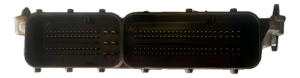
- PCM Connector C175B — This is the main electrical connector block on the Powertrain Control Module itself.. Technicians must probe specific pins on this connector to verify proper power and ground signals are reaching the PCM. For example, pins for CAN bus, power, and ground can be checked here for voltage and continuity.
Real Owner Repair Stories
- YouTube video by 'sell vinsmash.com' (2014 Ford Focus (non-ST, but with directly applicable ground issue)) — Transmission failsafe mode, P0606, P0702, and multiple body control module codes.
❌ Tried (didn't work) The owner was looking for more complex issues before checking the basics.
✅ What actually fixed it The ground cable on a transmission bell housing stud was broken and loose. The center of the ring terminal had broken out, causing intermittent contact. The fix was to clean the contact surfaces and properly secure the ground connection with washers to ensure good contact.
OEM Part Supersession History
F1EA-12A650-CA (Engineering Number)→F1EZ-12A650-AANP (Service Part Number)— Standard part number evolution and potential internal revisions.
Heads up: When replacing the PCM, the hardware must be compatible. Always match the engineering or service part number from your original module. A module from a non-ST Focus or a different model year may not be compatible.
Model Year Variations Within This Range
- 2016-2018: There were no significant engine or powertrain hardware changes that would affect the diagnosis of P0606 within this year range. The primary change was the introduction of the SYNC 3 infotainment system in 2016, which is unrelated to this fault code.
Diagnostic Flowchart
Other Known Issues on This Vehicle
Issues unrelated to this code that are worth knowing about as an owner of this generation:
- Canister Purge Valve (CPV) Failure 🔴 High — Very common. Can occur at any mileage. Symptoms include rough idle after refueling, erratic fuel gauge, and difficulty starting after fill-ups. (Ref: Recall 18S32 / 19S22)
- Low-Speed Pre-Ignition (LSPI) 🔴 High — A risk inherent to small displacement, turbocharged direct-injection engines. Occurs when applying heavy throttle at low RPM in high gears (lugging the engine). Can cause catastrophic engine damage.
- Rear Motor Mount (RMM) Failure 🟠 Medium — The factory hydraulic-filled rear motor mount is a known weak point and often fails, leading to excessive engine movement, wheel hop, and clunking noises. Many owners upgrade to a stiffer aftermarket mount.
- Cracked Cylinder Head 🟡 Low — Less common, but a known potential failure where the integrated exhaust manifold ('headifold') design can develop cracks, leading to exhaust leaks or coolant loss.
- EVAP System Canister Saturation 🟠 Medium — Often occurs as a consequence of a failed purge valve. The charcoal canister becomes saturated with fuel, causing fuel spill-over when filling the tank and other drivability issues. (Ref: Related to Recall 18S32)
Used vs. New Parts: Buying Guide for This Vehicle
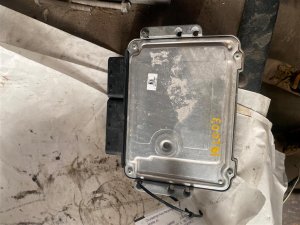
When a used part is the smart pick: A used OEM PCM from a donor Focus ST is a very cost-effective option, often saving hundreds of dollars over a new or remanufactured unit. Since the part is purely electronic and not a wear item, a used unit is viable as long as it is the correct part number and is properly programmed.
Donor-vehicle mileage cap: roughly under 150000 miles for the part to have meaningful remaining life.
What to inspect on the donor part:
- **Match Part Number EXACTLY**: The engineering number (e.g., F1EA-12A650-CA) on the sticker must match your original PCM.
- **Check for Physical Damage**: Inspect the used module for any signs of water intrusion, corrosion on the pins, or cracks in the casing.
- **Reputable Seller**: Purchase from a salvage yard or seller that offers a short-term warranty or return policy in case the unit is dead on arrival.
- **Confirm Donor Vehicle**: Ensure the PCM came from a 2016-2018 Focus ST to guarantee hardware and base software compatibility.
OEM-only on this vehicle (don't cheap out):
- Powertrain Control Module (PCM) - While aftermarket/remanufactured units exist, using a genuine used Ford (Motorcraft) PCM is the most reliable path, as it guarantees hardware compatibility for the complex programming process.
Brands owners have reported issues with on this vehicle:
- Unbranded or 'plug-and-play' PCM sellers on platforms like eBay or Amazon should be avoided. These modules are almost never truly plug-and-play for this vehicle due to the PATS immobilizer system and will require professional programming anyway.
Real Owner Stories
Aggregated from forums and TSBs cited above. Mileages and costs reflect what owners reported in those sources.
2014 Ford Focus ST 2.0L EcoBoost
Symptoms: Owner questioned if they were experiencing a total PCM failure or if another electrical issue was at play.
What fixed it: A loose ground wire was identified as the cause of the symptoms mimicking PCM failure.
Source hint: r/FocusST (reddit.com) thread titled 'Has anyone else ever experienced PCM failure? 2014 focus st'
2013-2018 Ford Focus ST 2.0L EcoBoost
Symptoms: Rough idle after refueling, erratic fuel gauge readings, and engine stalling.
What fixed it: Performing Safety Recall 18S32 / 19S22, which involves a mandatory PCM software update and addressing the canister purge valve.
Source hint: Safety Recall 18S32 / 19S22
2016 Ford Focus ST 2.0L EcoBoost
Symptoms: Internal processor fault codes and related power-up concerns.
What fixed it: Swapping the PCM relay and checking related codes like P06B8 and P068A.
Source hint: r/FocusST (reddit.com) thread titled 'Faulty pcm?'
Related OBD-II Codes
Frequently Asked Questions
Could the stalling and P0606 code on my 2016 Focus ST be related to the fuel tank recall?
I've heard the Focus platform has specific ground issues; where should I check for P0606?
Can an aftermarket tune cause a P0606 internal processor error?
Is there a specific relay I should check before replacing the expensive PCM?
How does the battery affect the PCM on a 2017 Focus ST?
Does TSB 19-2313 apply to my Focus ST's PCM issues?
Helpful Videos

Used OEM Parts in Stock
New Aftermarket Parts Available



The information in this article is provided for general reference and educational purposes only. Vehicle specifications, procedures, and part compatibility can vary by production date, trim level, and region. Always consult your vehicle's factory service manual and verify part numbers before purchasing or performing repairs. Safety-critical components such as airbags, seat belts, and braking systems should be installed by a qualified professional.
- Ford Focus ST:
- 🧭 Diagnostic Flowchart
- 🎬 Helpful Videos
- 🛍️ Shop This Part
- What's Unique About the 2016-2018 Ford Focus ST
- Symptoms You May Notice
- Most Likely Causes
- Rare But Worth Checking
- Diagnosis Steps
- Parts You'll Likely Need
- Related Codes That Often Appear With This One
- Technical Service Bulletins (TSBs) & Recalls
- Platform-Specific Known Issues
- Mechanic-Grade Diagnostic Values
- Scan Tool Commands That Help
- Wiring & Ground Locations
- Real Owner Repair Stories
- OEM Part Supersession History
- Model Year Variations Within This Range
- Other Known Issues on This Vehicle
- Used vs. New Parts: Buying Guide for This Vehicle
- Real Owner Stories
- 2014 Ford Focus ST 2.0L EcoBoost
- 2013-2018 Ford Focus ST 2.0L EcoBoost
- 2016 Ford Focus ST 2.0L EcoBoost
- Related OBD-II Codes
- Frequently Asked Questions
- 🎟️ Get 5% Off