

P0606 on 2010-2016 Mercedes-Benz E-Class: ECM Processor Fault Causes and Fixes
P0606 on a 2010-2016 E-Class indicates a critical internal failure of the Engine Control Module (ECM). While electrical issues like low voltage from the battery/alternator or bad grounds should be checked first, the most common fix is replacing the ECM. This is a complex job requiring professional programming or cloning of the original unit's data and can cost between $800 and $2,200.
- P0606 is a critical fault indicating the likely failure of your Engine Control Module (ECM).
- Do not continue to drive the vehicle, as it can stall unexpectedly at any time.
- Before replacing the expensive ECM, always have a professional thoroughly test the battery, alternator, and all power/ground connections to the module.
- Replacement of the ECM on a W212 E-Class requires specialized programming or cloning of the old unit's data; it is not a DIY job.
What's Unique About the 2010-2016 Mercedes-Benz E-Class
For the W212/C207 E-Class, this code is a serious issue that can lead to sudden stalling and no-start conditions. The primary cause is often the Engine Control Module (ECM) itself, but the repair is not a simple plug-and-play swap. The replacement ECM must be professionally programmed online with Mercedes' XENTRY system (a process called SCN Coding) or 'cloned' with the original unit's data to work with the vehicle's immobilizer and other systems. Specialized services exist specifically for cloning the Bosch MED17.7.x (like MED17.7.2 and MED17.7.3) ECUs found in many E-Class models of this era.
Generation note: The 2010-2016 year range primarily covers the W212 (Sedan/Wagon) and C207/A207 (Coupe/Convertible) generation. This guide applies to all body styles and engines within this platform, as the underlying cause is related to the Engine Control Module, which is a common failure point across various Mercedes models of this era.
Symptoms You May Notice
- Check Engine Light is on (may be flashing)
- Vehicle enters 'limp mode' with severely reduced power
- Engine stalling, potentially while driving or at idle
- Engine cranks but fails to start (no-start condition)
- Rough or erratic idling
- Sudden jerking or hesitation during acceleration
- Poor or inconsistent automatic transmission shifting
- ESP (Electronic Stability Program), ABS, or other warning lights may appear on the dash, especially after a stall event
- Loss of communication with the OBD-II scanner in some cases
- Replacing sensors (like oxygen or crankshaft position sensors) before verifying the ECM's integrity. A faulty ECM can cause other codes to appear, but P0606 points to the processor itself as the root problem.
- Immediately condemning the ECM without first performing a thorough check of the battery, alternator, and all power/ground connections. Electrical instability is a common cause for this code.
Most Likely Causes
- Internal Engine Control Module (ECM) Failure 🔴 High Probability → Shop Engine Control Module (ECM) ECUs are complex electronic devices that can fail over time due to heat cycles, vibration, and internal component degradation. While not unique to the E-Class, it is the most common reason for a P0606 code. In some Mercedes models, the ECU's location in the engine bay exposes it to significant heat and vibration, accelerating wear. Internal solder joints can crack, or microprocessors can fail.
How to confirm: This is typically a diagnosis of exclusion. If all power, ground, and communication network tests pass, the ECM itself is condemned. A technician with a Mercedes-specific tool (XENTRY) can attempt to communicate with the module and check for internal fault flags that confirm a processor error.
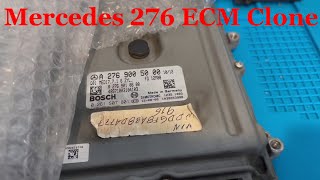
Typical fix: Replace the Engine Control Module. The new or refurbished unit must be programmed (SCN coding) or cloned from the original module 🎬 Watch: How a professional clones a Mercedes MED17 ECM. to work with the car. Some specialists offer mail-in repair or cloning services.
Est. part cost: $500-$1500 - Low or Unstable System Voltage 🟡 Medium Probability A failing battery, alternator, or even the auxiliary battery can provide inconsistent voltage to the ECM, especially during cranking. This can corrupt the processor's self-check and incorrectly trigger a P0606 code. These vehicles have complex power management systems that are sensitive to voltage fluctuations.
How to confirm: Test the main battery's state of health and charge with a professional battery tester. With the engine running, check the alternator output at the battery terminals; it should be stable, typically between 13.5 and 14.5 volts. Also, check the auxiliary battery if equipped, as its failure can cause electrical gremlins.
Typical fix: Replace the weak main battery, auxiliary battery, or faulty alternator.
Est. part cost: $200-$800 - Poor Power or Ground Connections to ECM 🟡 Medium Probability Corrosion on battery terminals, main chassis grounds, or the ECM's own ground straps can create high resistance, starving the module of stable power and causing unpredictable behavior.
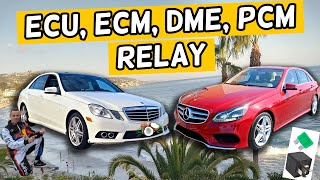
How to confirm: Perform a voltage drop test on the ECM's power and ground circuits. Visually inspect all main ground straps (engine to chassis, battery to chassis) and power cables for corrosion, looseness, or damage. The ECM fuses and relays, located in the front SAM 🎬 Watch: Locate your ECM relay and fuses in the SAM. (Signal Acquisition Module) in the engine bay, should also be inspected.
Typical fix: Clean or replace corroded terminals, cables, or ground straps. Replace any faulty fuses or relays.
Est. part cost: $10-$150
Rare But Worth Checking
- Software Corruption: Sometimes, a software glitch or a failed previous update attempt can cause the ECM to fail its internal checks. Before replacing the hardware, it's worth checking with a dealer or specialist if a software update or re-flash is available from Mercedes-Benz, as this can sometimes resolve the issue.
- CAN Bus Communication Fault: A short or fault in the Controller Area Network (CAN) wiring can disrupt communication between modules. This can flood the network with errors, which the ECM might misinterpret as an internal processor fault, triggering a P0606.
- Oil Contamination in ECU Harness: On some Mercedes engines, failing camshaft position sensors can leak oil into the wiring harness. Due to capillary action, this oil can travel all the way to the ECM connector and even inside the module itself, causing short circuits and triggering codes like P0606. Inspecting the ECM connectors for oil is a crucial diagnostic step.
Diagnosis Steps
- Verify the code: Use a high-quality, Mercedes-compatible OBD-II scanner to confirm P0606 is present and check for any other related fault codes.
- Check Battery and Charging System: Thoroughly test the main battery's health, load capacity, and the alternator's output to ensure the ECM is receiving stable voltage (13.5-14.5V when running). Don't forget to test the auxiliary battery if equipped.
- Inspect Power and Grounds: Visually inspect and clean the battery terminals, main engine/chassis grounds, and the ECM connector for any signs of corrosion, oil contamination, or damage. Check all ECM-related fuses and relays in the front SAM.
- Perform a Voltage Drop Test: With the system under load, check the ECM's main power and ground circuits to confirm there is no excessive resistance (voltage drop). This is a more definitive test than a visual inspection.
- Inspect for Oil Intrusion: Carefully disconnect the ECM harness connectors and inspect for any signs of engine oil. If oil is present, trace it back to the source, which is commonly a leaking camshaft position sensor.
- Check for TSBs and Software Updates: Ask a dealer or use a professional database to check for any Technical Service Bulletins (TSBs) or available software updates for the ECM related to P0606 for your specific VIN.
- Isolate the ECM: If all external electrical checks are good and no oil is found, the fault is highly likely to be internal to the ECM.
- Professional Confirmation: Before ordering an expensive replacement, the final diagnosis should be confirmed by a professional with a Mercedes-specific diagnostic tool (like XENTRY) to perform deep-level module checks.
Parts You'll Likely Need
- Engine Control Module (ECM/ECU)
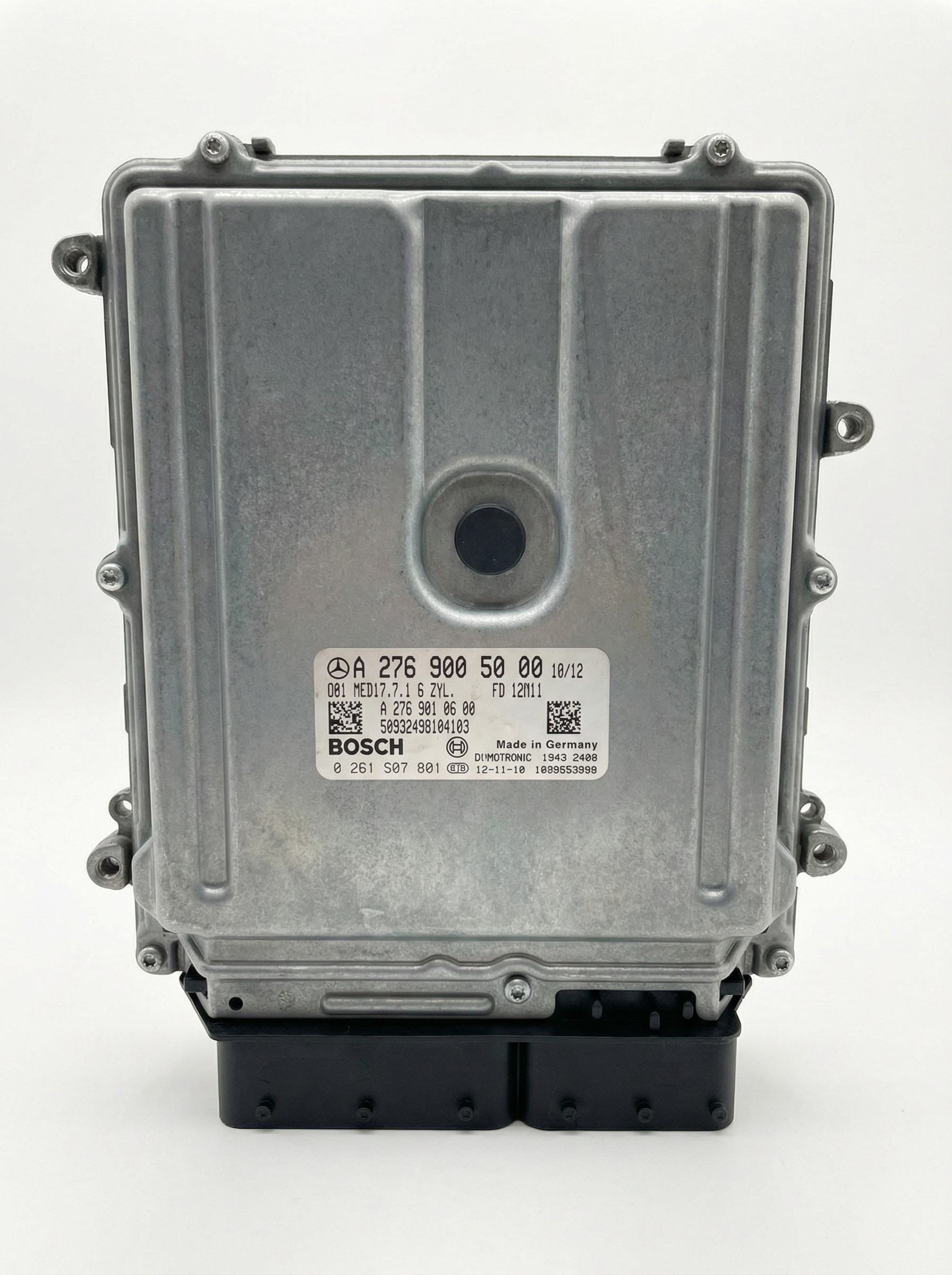
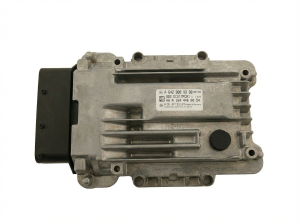
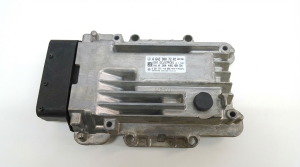
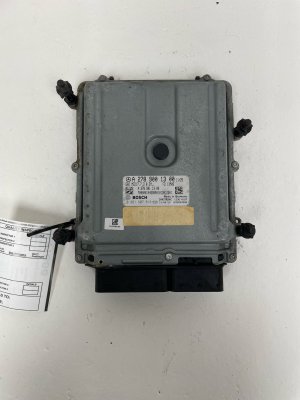
(OEM #Varies by VIN (e.g., A2769004800 for some M276 engines))— This code indicates an internal processor fault, and the most common cause is the failure of the module itself.
Trusted brands: Bosch (OEM)
OEM price range: $1200-$2500
Aftermarket price range: $400-$900 (Remanufactured/Cloned)
Related Codes That Often Appear With This One
- U-series codes (e.g., U0100) — U-series codes indicate communication problems between modules. If the ECM is failing, it may stop communicating with other control units like the Transmission Control Module (TCM) or ABS module, triggering these codes.
- Various sensor circuit codes (e.g., P2237, P2240 for O2 sensors) — A failing ECM might incorrectly report faults with sensors it controls or monitors, even if the sensors themselves are good. A user on MBWorld reported P0606 alongside O2 sensor codes.
Platform-Specific Known Issues
- On the W212 platform, replacing the ECM is not a simple swap. The replacement unit must be programmed online via Mercedes-Benz tools (SCN Coding) or have the data from the original failed unit 'cloned' onto it by a specialist service.
- The Bosch MED17.7.x series ECUs used in these cars are known to be sensitive to voltage spikes and heat.
- Oil wicking from failed camshaft position sensors into the main engine harness and eventually the ECU is a known issue that can cause a P0606 code.
Mechanic-Grade Diagnostic Values
- ECM/ME Power Supply Voltage at Connector — expected: ~12.6V (Key On, Engine Off), ~13.5-14.5V (Engine Running). Failure: Voltage significantly lower than battery voltage indicates high resistance in the power wire or a bad Front SAM connection. Voltage drop should be less than 0.5V.
- ECM/ME Ground Connection Voltage Drop — expected: Less than 0.2V. Failure: A reading higher than 0.2V between the ECM ground pin and the negative battery terminal indicates high resistance in the ground circuit.
- CAN Bus Resistance — expected: Approximately 60 Ohms. Failure: A reading of ~120 Ohms indicates an open circuit or a missing terminating resistor (one of the control modules is offline). A reading near 0 Ohms indicates a short between CAN High and CAN Low wires.
Hidden / Shadow Codes Worth Checking
- Internal Processor Fault / Event Memory Entry: While a generic scanner sees only P0606, the Mercedes-Benz XENTRY diagnostic tool will often log a more specific, non-numbered 'event' in the ME control unit's memory, such as 'Internal fault' or 'Processor malfunction'. This serves as a definitive confirmation that the fault is internal to the module and not an external circuit. (see via Mercedes-Benz XENTRY/DAS (Dealer/Specialist Tool))
Scan Tool Commands That Help
- Xentry/DAS (Mercedes Dealer Tool): ECU Cloning / Data Transfer — Used by third-party specialists to perform a 1:1 copy of all data (VIN, immobilizer, coding) from the original ECU to a donor ECU. This is the preferred method if the original ECU can still be read, as it is plug-and-play.
- Xentry/DAS (Mercedes Dealer Tool): Virginize / Renew — This function is used on a *used* donor ECU to erase its original vehicle's VIN and security data, making it 'like new'. This is required before a used ECU can be programmed to a different car using dealer tools, especially on 2014+ models with FBS4.
- Xentry/DAS (Mercedes Dealer Tool): SCN Coding (Software Calibration Number) — This is the official online programming process performed by dealers or authorized shops. It's used to program a brand-new or 'virginized' ECU, downloading vehicle-specific software and coding from Mercedes-Benz servers to match the car's exact options and VIN.
- Xentry/DAS (Mercedes Dealer Tool): Personalization and Activation — After a new or virginized ECU is installed and SCN coded, this final step writes the car's unique immobilizer keys to the ECU, permanently 'marrying' it to the vehicle.
Wiring & Ground Locations
- Front SAM (N10/1) — Located in the engine bay on the driver's side, near the brake fluid reservoir, under a black plastic cover.. The Front Signal Acquisition and Actuation Module (SAM) is the fuse and relay box that supplies power to the Engine Control Module (ME). All ECU power supply fuses and relays are located here and must be checked before condemning the ECU.
- ME Connector Power Pins — On the main multi-pin connectors of the Bosch ME/MED17.7 ECU.. On similar Bosch ECUs of this era, Pins 15 & 16 are typically +12V power feeds, and Pin 2 is the main ground. These are the exact pins to use for a voltage drop test to confirm the ECU is receiving stable power and has a solid ground connection.
- Main Engine Ground Straps — Key ground points include the main battery-to-chassis cable and one or more braided straps from the engine block to the vehicle's chassis.. A corroded or loose engine ground strap can cause unstable voltage and create electrical noise, which can disrupt the ECU's internal processor and trigger a P0606, even if the ECU's direct ground wire tests okay.
Real Owner Repair Stories
- MBWorld.org Forums (2007 Mercedes-Benz S550 (W221, similar ECU architecture)) — P0606 code along with O2 sensor codes (P2237, P2240), idles okay but has rough acceleration and lag.
❌ Tried (didn't work) Replacing upstream and downstream O2 sensors.
✅ What actually fixed it The user was advised by a forum veteran that the likely cause was oil leaking from the camshaft position sensors, wicking up the wiring harness, and contaminating the ECU. The recommended fix was to remove the ECU, open the case, and clean the circuit board thoroughly with electronics contact cleaner. The user confirmed they removed the ECU to perform this cleaning.
Model Year Variations Within This Range
- 2014-2016: Vehicles from approximately 2014 onwards use the FBS4 (Drive Authorization System 4) immobilizer. Replacing an ECU on an FBS4 vehicle is more complex than on earlier FBS3 cars. A used ECU cannot be simply cloned; it MUST be 'virginized' (reset to a factory state) by a specialist first, and then programmed online (SCN Coded) by a dealer or a shop with a dealer-level subscription. A simple clone will not work.
Diagnostic Flowchart
Other Known Issues on This Vehicle
Issues unrelated to this code that are worth knowing about as an owner of this generation:
- Rear Subframe Corrosion/Rust 🔴 High — Common in regions with road salt. Can occur at any mileage. Mercedes has issued a 20-year/unlimited mileage extended warranty for this issue. (Ref: NHTSA ID: 23V-071 (Warranty Extension))
- 7G-Tronic Transmission Conductor Plate Failure 🟠 Medium → Shop Transmission Assembly — Typically occurs between 70,000-150,000 miles. Symptoms include harsh shifting, getting stuck in gear, or limp mode.
- M276 V6 Engine: Timing Chain Tensioner Rattle on Startup 🟠 Medium — Common on earlier M276 engines. A brief rattle on cold start indicates worn tensioners, which can lead to more severe timing issues if ignored. (Ref: Mercedes issued service bulletins (LI05.10-P-056435) with updated parts (check valves, new tensioners).)
- M278 V8 Engine: Cylinder Wall Scoring 🔴 High — A known, though not universal, issue that can lead to oil consumption, misfires, and eventual engine failure. Frequent oil changes are believed to help mitigate risk.
- Fading/Cracking Wood Interior Trim 🟡 Low — Very common, especially on vehicles frequently exposed to sun. The clear coat on the wood trim delaminates, cracks, or fades over time. (Ref: LI68.10-P-050487 is a TSB related to this issue on some models.)
- Airmatic Suspension Failure 🟠 Medium — Affects models with optional air suspension. Air struts can develop leaks and the compressor can wear out, typically after 80,000 miles, causing the vehicle to sag.
Used vs. New Parts: Buying Guide for This Vehicle
When a used part is the smart pick: A used ECU is a smart, cost-effective choice IF you use a reputable 'cloning' service. This involves sending your original ECU and a used donor ECU (with an identical Bosch hardware part number) to a specialist. They will perform a 1:1 data transfer, making the used unit a plug-and-play replacement. This avoids expensive dealer programming. This is only possible if your original ECU is not completely dead and can still be read on a bench.
Donor-vehicle mileage cap: roughly under 150000 miles for the part to have meaningful remaining life.
What to inspect on the donor part:
- Hardware part number MUST be an exact match to the original ECU.
- Check for any signs of water damage, corrosion on the pins, or physical damage to the case.
- Ask the seller if the donor vehicle had any flood or fire damage.
- Ensure the unit is from the correct immobilizer generation (FBS3 vs. FBS4) to avoid compatibility issues.
OEM-only on this vehicle (don't cheap out):
- Engine Control Module (ECM/ECU) - While you can use a used OEM part, avoid generic 'rebuilt' or no-name aftermarket ECUs. The programming is highly specific. Stick with a used Bosch unit that is cloned, or a new OEM unit from the dealer.
Aftermarket brands forum-validated for this vehicle:
- For ECU replacement, there are no 'aftermarket brands'. You must use an original Bosch unit. For repair, services from specialists like DUDMD Tuning, Bimmerscan, or High Tech Mobile are frequently mentioned.
Brands owners have reported issues with on this vehicle:
- Any generic, non-Bosch ECU advertised as a replacement. They will not have the correct internal architecture or software compatibility for Mercedes-Benz SCN coding or cloning.
Real Owner Stories
Aggregated from forums and TSBs cited above. Mileages and costs reflect what owners reported in those sources.
2007 Mercedes-Benz S550
Symptoms: The car idles okay but experiences rough acceleration and occasional lagging.
What fixed it: The owner identified the P0606 code using a scanner, though the context ends before the final repair was confirmed.
Source hint: MBWorld.org Forums - Thread 'p0606 code - idles ok but rough acceleration/lag sometimes.'
Related OBD-II Codes
Frequently Asked Questions
Can oil leaking from my camshaft position sensors cause the P0606 code on my E-Class?
Is there a specific service bulletin for the timing chain rattle I hear on my M276 V6 engine along with this code?
Can I simply swap in a used ECM from another W212 E-Class to fix P0606?
Does the 20-year extended warranty for the E-Class cover P0606 issues?
Could a problem with my auxiliary battery trigger a P0606 processor code?
Where are the ECM fuses and relays located if I need to check them for power issues?
Helpful Videos

We Have This Part in Stock

The information in this article is provided for general reference and educational purposes only. Vehicle specifications, procedures, and part compatibility can vary by production date, trim level, and region. Always consult your vehicle's factory service manual and verify part numbers before purchasing or performing repairs. Safety-critical components such as airbags, seat belts, and braking systems should be installed by a qualified professional.
- Mercedes-Benz E-Class:
- 🧭 Diagnostic Flowchart
- 🎬 Helpful Videos
- 🛍️ Shop This Part
- What's Unique About the 2010-2016 Mercedes-Benz E-Class
- Symptoms You May Notice
- Most Likely Causes
- Rare But Worth Checking
- Diagnosis Steps
- Parts You'll Likely Need
- Related Codes That Often Appear With This One
- Platform-Specific Known Issues
- Mechanic-Grade Diagnostic Values
- Hidden / Shadow Codes Worth Checking
- Scan Tool Commands That Help
- Wiring & Ground Locations
- Real Owner Repair Stories
- Model Year Variations Within This Range
- Other Known Issues on This Vehicle
- Used vs. New Parts: Buying Guide for This Vehicle
- Real Owner Stories
- 2007 Mercedes-Benz S550
- Related OBD-II Codes
- Frequently Asked Questions
- 🎟️ Get 5% Off