

P0720 on 2009-2022 Kia Rio: Output Speed Sensor Circuit Malfunction Causes and Fixes
P0720 on a Kia Rio most often means the transmission's output speed sensor has failed. On many models with the 6-speed automatic, this sensor is part of an internal wire harness attached to the valve body, making replacement a complex job for a professional. Expect a shop repair to cost between $350 and $600, depending on the sensor's location. Driving with this fault can lead to harsh shifting and potential transmission damage.
- P0720 on a Kia Rio points directly to a problem with the transmission's output speed sensor or its circuit.
- The primary symptoms are severe shifting problems and a malfunctioning speedometer.
- The biggest factor in repair cost and difficulty is the sensor's location; many are inside the transmission and require professional service.
- Before replacing an internal sensor, always have the wiring and fluid level checked, as these are simpler and cheaper potential fixes.
- If you have a 2020 or newer Rio with an IVT, be aware of potential software updates that may address transmission issues.
What's Unique About the 2009-2022 Kia Rio
The 2009-2022 Kia Rio spans three generations (JB, UB, YB) and uses different transmissions. Many models, particularly from the 3rd generation (2012-2017), are equipped with an A6GF1 6-speed automatic where the input and output speed sensors are integrated into a single wire harness located inside the transmission and attached to the valve body. 🎬 See a teardown of the A6GF1 internal sensor harness. This makes replacement much more complex than on vehicles where the sensor is externally mounted, as it requires draining the fluid, dropping the pan, and removing the valve body. Later models (approx. 2020+) may use an Intelligent Variable Transmission (IVT), which has its own unique failure modes, including belt slippage and control logic issues that can cause similar symptoms but are addressed differently, often via software updates.
Generation note: This range covers the 2nd (2009-2011), 3rd (2012-2017), and 4th (2018-2022) generations of the Kia Rio. The key difference is the transmission type and sensor location. Earlier 2nd gen models may have an externally accessible sensor on a 4-speed automatic. Most 3rd gen models with the 6-speed automatic have internal sensors. The 4th generation introduced the IVT/CVT (approx. 2020+), which has different internal components and is known for control module software issues that can cause slipping or hesitation.
Symptoms You May Notice
- Check Engine Light is on
- Harsh, erratic, or delayed gear shifts
- Transmission stuck in a single gear (limp mode)
- Speedometer reads 0 MPH or behaves erratically
- Engine stalling when coming to a stop
- Cruise control not working
- Reduced fuel economy
- ABS or Traction Control light may illuminate due to conflicting speed signals
- Replacing the entire transmission when only the internal sensor harness is bad.
- Replacing an external vehicle speed sensor on the wheel hub when the fault is with the internal transmission output sensor.
- Replacing the sensor without first checking the external wiring harness for damage.
- Condemning the valve body or solenoids when the root cause is a bad speed signal from the sensor harness.
Most Likely Causes
- Faulty Internal Input/Output Sensor Harness 🔴 High Probability On the common A6GF1 6-speed automatic, the input and output sensors are integrated into a single plastic harness inside the transmission. This harness is submerged in hot transmission fluid and becomes brittle over time, leading to internal cracks in solder joints and sensor failure.
How to confirm: Use a scan tool with live data to monitor the output speed sensor reading while driving. If the reading is zero, erratic, or doesn't match the vehicle's actual speed, the sensor circuit is faulty. Given the high failure rate of the internal harness, this is the most likely culprit if wiring is intact.
Typical fix: Replace the entire input/output sensor harness assembly. This requires draining the transmission fluid, removing the oil pan, and removing the valve body to access the harness. Both sensors are replaced as a single unit.
Est. part cost: $100-$180 - Damaged Wiring or Connector 🟡 Medium Probability The external wiring harness leading to the transmission can be damaged by road debris, heat from the exhaust, or fluid leaks. The connector pins can also corrode, causing an intermittent signal.
How to confirm: Visually inspect the external wiring harness for any signs of melting, chafing, or breaks. Unplug the main transmission connector and check for corrosion, moisture, or bent pins. Test for continuity and shorts in the circuit between the sensor connector and the TCM.
Typical fix: Repair the damaged section of wiring or replace the connector pigtail.
Est. part cost: $15-$50 - Low or Contaminated Transmission Fluid ⚪ Low Probability → Shop Transmission Assembly Neglecting transmission service can lead to fluid that is low or full of clutch material and metal shavings. This debris can interfere with sensor operation or cause broader transmission issues like solenoid failure.
How to confirm: Check the transmission fluid level and condition according to the owner's manual procedure. The fluid should be at the correct level, pink/red in color (for ATF SP-IV), and not smell burnt. Note that many of these transmissions are 'sealed' and do not have a traditional dipstick.
Typical fix: Perform a transmission fluid drain-and-fill or a full fluid exchange. If the fluid is very dirty, the transmission pan should be dropped and the internal filter replaced along with the fluid.
Est. part cost: $50-$200
Rare But Worth Checking
- Faulty Powertrain or Transmission Control Module (PCM/TCM): → Shop Transmission Assembly This is a last-resort diagnosis. The control module itself can fail, but this is uncommon. All other possibilities, especially the sensor harness and external wiring, must be ruled out first before condemning the module.
- Damaged Sensor Reluctor Ring: The speed sensor reads teeth on a rotating ring (reluctor ring). While rare, this ring can be damaged or accumulate metallic debris, causing an erratic signal. This would be inspected during an internal sensor replacement.
Diagnosis Steps
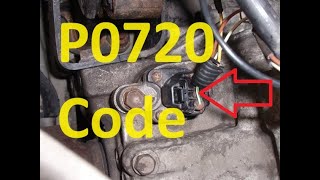
- Scan for Codes: Use an OBD-II scanner to confirm P0720 and check for other 🎬 Watch: Diagnosing output speed sensor codes and engine lights. related codes like P0717 or P0722, which strongly point to the sensor harness.
- Check Transmission Fluid: Check the level and condition of the automatic transmission fluid. On models without a dipstick, this must be done from a fill/check plug on the transmission case. Dark, burnt, or low fluid indicates a need for service and could be a contributing factor.
- Inspect External Wiring: Visually inspect the main transmission wiring harness and connectors for obvious signs of damage, melting, or corrosion.
- Live Data Analysis: Use a professional scan tool to view live data from both the Input Speed Sensor and Output Speed Sensor while driving. A reading of 0 RPM or erratic jumps from the OSS while the car is moving confirms a signal failure. Compare it to the ISS and wheel speed sensors.
- Circuit Testing: If external wiring looks good, test the circuit for continuity, shorts, and proper voltage between the main transmission connector and the TCM to rule out an external wiring break.
- Internal Inspection: If all external checks pass, the fault is almost certainly internal. The transmission pan and valve body must be removed to access and replace the input/output sensor harness.
- Inspect Reluctor Ring: While the sensor harness is being replaced, visually inspect the teeth on the reluctor ring for any damage or heavy metallic debris.
- TCM Fault: Only after replacing the sensor harness and verifying all wiring is good should a faulty Transmission Control Module (TCM) be considered.
Parts You'll Likely Need
- Transmission Input/Output Sensor Harness
(OEM #46307-3B650)— For the common A6GF1 6-speed automatic, the input and output sensors are integrated into this single harness located inside the transmission. The plastic and internal electronics fail from heat and age, making it the primary point of failure for P0720 and P0717 codes.
Trusted brands: Kia/Hyundai Genuine
OEM price range: $100-$180
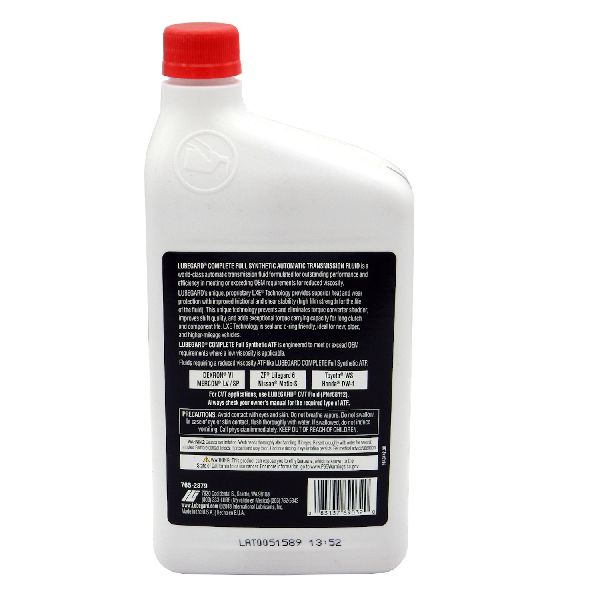
Aftermarket price range: $70-$120 - Automatic Transmission Fluid (ATF) — Replacing the internal sensor harness requires draining the transmission. You will need 4-6 quarts of compatible fluid (typically SP-IV for the 6-speed) to refill it.
Trusted brands: Kia/Hyundai SP-IV, Idemitsu TLS-LV, Valvoline MaxLife Multi-Vehicle
OEM price range: $15-$25 per quart
Aftermarket price range: $8-$15 per quart - Transmission Output Speed Sensor (External)
(OEM #964204A600)— This part is for older models (approx. pre-2012) or different transmission types (e.g., 4-speed automatic) where the sensor is mounted externally on the transmission case. It is crucial to verify the transmission type before ordering this part.
Related Codes That Often Appear With This One
- P0722 — This code means 'Output Speed Sensor Circuit No Signal,' which is a more specific version of the P0720 fault, indicating a complete loss of signal.
- P0717 — This code indicates a fault with the Input Speed Sensor ('Input/Turbine Speed Sensor Circuit No Signal'). Since the input and output sensors are on the same internal harness in the A6GF1 transmission, it is very common for them to fail together and set codes simultaneously.
- P0731 - P0735 — These codes indicate 'Incorrect Gear Ratio' for specific gears. If the TCM doesn't know the output shaft speed, it cannot verify if the correct gear ratio is achieved, leading to these codes.
Technical Service Bulletins (TSBs) & Recalls
- SA476: IVT/CVT SW LOGIC IMPROVEMENT AND/OR IVT/CVT REPLACEMENT (for 2020 Rio, related but not for P0720 specifically)
- SC199 / FL301: Voluntary Emissions Service Campaign to update TCM software on IVT-equipped vehicles to prevent belt slippage and transmission damage.
- 23V594000: Recall for a fire risk due to potential electrical shorts in the Hydraulic Electronic Control Unit (HECU) on 2012-2017 models.
Platform-Specific Known Issues
- For 2020+ models with the IVT/CVT, Service Campaigns SC199 and FL301 address issues like lack of acceleration and transmission slippage with a software update or transmission replacement. These issues stem from improper hydraulic pressure control in the TCM logic, which can destroy the transmission belt and pulleys.
- A Reddit user with a 2020 Kia Rio IVT described a jerking motion at low speeds as the torque converter locks and unlocks, a symptom another owner experienced before their IVT failed completely.
Mechanic-Grade Diagnostic Values
- Internal Output Speed Sensor (OSS) Resistance (A6GF1 6-Speed) — expected: ~5.8 MΩ (Megaohms). Failure: A significantly different reading, or an open/short circuit (OL or 0 ohms).
- Internal Input Speed Sensor (ISS) Resistance (A6GF1 6-Speed) — expected: ~3.8 MΩ (Megaohms). Failure: A significantly different reading. This is often tested with the OSS as they are on the same harness.
- Transmission Fluid Temperature Sensor Resistance (part of internal harness) — expected: Resistance should decrease as temperature increases. For example: 2.3-2.6 kΩ at 20°C (68°F) and 0.30-0.33 kΩ at 80°C (176°F).. Failure: An open circuit (OL), short circuit (0 ohms), or a reading that doesn't change with temperature indicates a failure. A faulty temp sensor on the harness can cause related codes and shifting issues.
- Live Data Comparison (Cold Engine) — expected: The Transmission Fluid Temperature and Intake Air Temperature readings should be within 5-7°F of each other before starting the engine.. Failure: A large discrepancy between the two cold readings points to a faulty transmission temperature sensor, which is part of the internal harness.
Scan Tool Commands That Help
- ScanGauge: X-Gauge for Transmission Fluid Temperature (TFT) — To monitor the transmission fluid temperature on Kia models that don't display it on the dash. This is useful for diagnosing if overheating is a contributing factor or if the temperature sensor within the harness is providing an erratic reading. The commands are: TXD: 07E121A0, RXF: 032500000000, RXD: 2008, MTH: 00090005FFD8.
Wiring & Ground Locations
- Transmission Case Ground — A grounding wire/strap is typically bolted directly from the negative battery terminal or chassis to a bolt on the transmission case.. A loose, corroded, or broken transmission ground can cause a floating ground for all transmission sensors, including the OSS. This can lead to erratic signals and intermittent P0720 codes even if the sensor and harness are good. Ensure this connection is clean and tight.
- Main Transmission Connector — This is the large, multi-pin connector where the vehicle's main harness connects to the transmission's internal harness. On the A6GF1, it's typically on the top or front of the transmission case.. This is the primary point to test the external wiring. You can check for voltage, ground, and signal continuity between this connector and the TCM/PCM without opening the transmission. Pin numbers vary by year, so a model-specific wiring diagram is essential.
Real Owner Repair Stories
- Reddit user in r/MechanicAdvice (2009 Kia Rio) — Check engine light with codes P0717 (Input Speed Sensor) and implied P0720 issues.
❌ Tried (didn't work) Replaced one of the transmission speed sensors without success.
✅ What actually fixed it The user posted a video showing the replacement of the *other* speed sensor, which on this model year was also externally accessible, implying that on some early 2nd generation models, both sensors are external but separate parts. The fix was replacing the correct sensor (in this case, the input sensor for the P0717 code).
OEM Part Supersession History
46307-3B610, 46307-3B620→46307-3B650— Revisions to improve durability and resistance to heat-related failure of the internal sensors and wiring.
Heads up: While the connectors are physically the same, it is always recommended to use the latest part number (46307-3B650) when replacing the harness in any compatible A6GF1 transmission, as it is the most robust version.
Model Year Variations Within This Range
- 2009-2011 (approx.): Some 2nd generation Rios with the 4-speed automatic may have two separate, externally mounted input and output speed sensors, making diagnosis and replacement much simpler than the later internal harness design.
- 2012-2019 (approx.): Most Rios in this range use the A6GF1 6-speed automatic with the integrated internal input/output sensor harness (PN 46307-3B650), which is the most common point of failure for P0720.
- 2020-2022 (approx.): These models are often equipped with an Intelligent Variable Transmission (IVT). While an OSS failure is possible, similar symptoms (slipping, hesitation, jerking) are frequently caused by faulty control module software. Kia issued service campaigns (e.g., SC199) to reflash the TCM to correct hydraulic pressure logic and prevent belt slip, which can be misdiagnosed as a sensor issue.
Diagnostic Flowchart
Other Known Issues on This Vehicle
Issues unrelated to this code that are worth knowing about as an owner of this generation:
- Theta II GDI Engine Failure 🔴 High — Widespread across multiple Kia/Hyundai models from 2011-2019, including some Rio model years. Can occur at various mileages, often before 100,000 miles. (Ref: Multiple recalls (e.g., SC176) and class-action lawsuits have been issued.)
- Steering Column Coupler Failure 🟠 Medium — Common issue causing a clicking or knocking sound in the steering wheel when turning. Typically occurs after 50,000 miles. (Ref: No recall, but it's a well-documented failure. The flexible coupler (Part # 56315-2K000-FFF) disintegrates.)
- Intelligent Variable Transmission (IVT) Failure/Hesitation 🔴 High → Shop Transmission Assembly — Affects later models (approx. 2019+) equipped with the IVT. Can manifest as slipping, hesitation, or total failure at low mileage. (Ref: Voluntary Service Campaigns SC199 and FL301 address the issue with a software update or transmission replacement.)
- Engine Stalling and Performance Issues 🟠 Medium — Frequently reported on 2012-2017 models between 40,000 and 100,000 miles, often linked to MAF sensors, throttle bodies, or ignition coils.
- Radiator Fan Motor Failure 🟠 Medium → Shop Radiator — Prone to premature failure between 60,000 and 100,000 miles, leading to engine overheating.
- Hydraulic Electronic Control Unit (HECU) Fire Risk 🔴 High — Affects a wide range of 2012-2017 Rio vehicles. An electrical short in the HECU can cause an engine compartment fire while parked or driving. (Ref: Recall 23V594000 was issued in August 2023.)
Used vs. New Parts: Buying Guide for This Vehicle
When a used part is the smart pick: A used Transmission Control Module (TCM) can be a cost-effective option if the module is confirmed to be the point of failure, which is rare. For most other parts related to this code, new is strongly recommended.
Donor-vehicle mileage cap: roughly under 60000 miles for the part to have meaningful remaining life.
What to inspect on the donor part:
- For a used TCM, ensure there is no corrosion on the connector pins.
- Verify the part number exactly matches the original.
- Check the donor vehicle's history for accidents or flood damage.
OEM-only on this vehicle (don't cheap out):
- Transmission Input/Output Sensor Harness: This part fails due to heat and age. A used harness has already been subjected to the same conditions and is highly likely to fail soon after installation. The high labor cost of replacement makes using a new, OEM part the only logical choice to ensure longevity.
Brands owners have reported issues with on this vehicle:
- Unbranded/generic sensor harnesses: Forum and repair video consensus indicates that cheap aftermarket harnesses often use lower-quality wire insulation and connector pins that are not rated for the high-temperature, high-vibration environment inside a transmission, leading to premature failure.
Real Owner Stories
Aggregated from forums and TSBs cited above. Mileages and costs reflect what owners reported in those sources.
2020 Kia Rio IVT
Symptoms: Jerking motion at low speeds as the torque converter locks and unlocks; this preceded a total transmission failure.
What fixed it: Total transmission replacement under warranty.
Source hint: Reddit - r/kia thread titled 'For all ivt owners'
2015 Kia Rio 6-Speed Automatic — ~80000 miles
Symptoms: Check engine light on with codes P0720, P0721, P0722, or P0723.
What fixed it: Replacement of the internal sensor harness, which required removing the transmission oil pan and valve body.
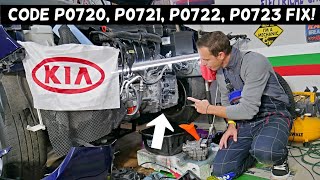
Source hint: YouTube - World Mechanics: 'KIA CODE P0720 P0721 P0722 P0723 OUTPUT SPEED SENSOR ENGINE LIGHT ON'
Related OBD-II Codes
Frequently Asked Questions
Does the 2020 Kia Rio IVT software update (SC199/FL301) fix the P0720 code?
Can I just replace the Output Speed Sensor on my 6-speed Kia Rio?
Is there a recall for the transmission issues on my 2012-2017 Rio?
Why is my speedometer reading 0 MPH while I'm driving my Rio?
Do I need to remove the transmission to fix the P0720 sensor harness?
Is the P0720 issue on my Kia Rio the same as on a Hyundai Accent?
Helpful Videos

We Have This Part in Stock

The information in this article is provided for general reference and educational purposes only. Vehicle specifications, procedures, and part compatibility can vary by production date, trim level, and region. Always consult your vehicle's factory service manual and verify part numbers before purchasing or performing repairs. Safety-critical components such as airbags, seat belts, and braking systems should be installed by a qualified professional.
- Kia Rio:
- 🧭 Diagnostic Flowchart
- 🎬 Helpful Videos
- 🛍️ Shop This Part
- What's Unique About the 2009-2022 Kia Rio
- Symptoms You May Notice
- Most Likely Causes
- Rare But Worth Checking
- Diagnosis Steps
- Parts You'll Likely Need
- Related Codes That Often Appear With This One
- Technical Service Bulletins (TSBs) & Recalls
- Platform-Specific Known Issues
- Mechanic-Grade Diagnostic Values
- Scan Tool Commands That Help
- Wiring & Ground Locations
- Real Owner Repair Stories
- OEM Part Supersession History
- Model Year Variations Within This Range
- Other Known Issues on This Vehicle
- Used vs. New Parts: Buying Guide for This Vehicle
- Real Owner Stories
- 2020 Kia Rio IVT
- 2015 Kia Rio 6-Speed Automatic — ~80000 miles
- Related OBD-II Codes
- Frequently Asked Questions
- 🎟️ Get 5% Off