

P0740 on 2006-2010 Hummer H3: Torque Converter Clutch Circuit Malfunction Guide
On a 2006-2010 Hummer H3, code P0740 is most often caused by a failed Torque Converter Clutch (TCC) solenoid inside the 4L60-E transmission. This is a very common failure point. Replacing the solenoid and the internal wiring harness, along with a transmission fluid and filter change, is the most common and recommended fix.
- P0740 on a Hummer H3 points to an electrical problem with the Torque Converter Clutch (TCC) circuit, not necessarily a major mechanical failure.
- The most likely culprit is a faulty TCC solenoid, which is located inside the transmission oil pan and is a relatively affordable part.
- Always check the transmission fluid level and condition first, as low or dirty fluid can cause this code.
- Driving for extended periods with this code can cause the transmission to overheat, leading to more expensive damage.
- The repair is moderately difficult for a DIYer but is a straightforward job for a qualified transmission shop.
What's Unique About the 2006-2010 Hummer H3
The Hummer H3 from this era uses the GM 4L60-E automatic transmission, a unit shared with millions of GM trucks and SUVs like the Chevrolet Colorado and GMC Canyon. While generally robust, the internal electronics, specifically the TCC solenoid and the internal wiring harness, are known failure points as the vehicle ages. The plastic harness and solenoid components become brittle from constant heat cycles and fluid exposure. The issue is typically not with the transmission's core mechanical components but rather with these relatively inexpensive electronic parts that can be accessed by removing the transmission oil pan.
Symptoms You May Notice
- Check Engine Light is on
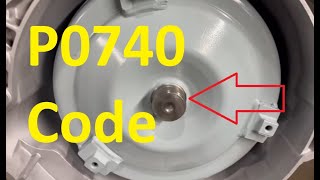
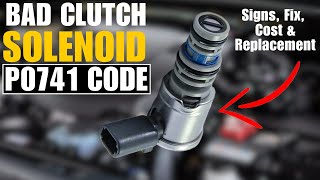
- Vehicle shudders or vibrates at highway speeds (like driving over rumble strips), especially during light acceleration between 30-50 mph. 🎬 Watch: Common symptoms and fixes for a bad TCC solenoid
- Engine RPMs fluctuate or are higher than usual at cruising speeds, as the torque converter fails to lock.
- Reduced fuel economy.
- Transmission may feel like it's slipping or shifts may feel harsh or delayed.
- Transmission may overheat, potentially triggering a warning light.
- In some cases, the engine may stall when coming to a stop if the TCC is stuck engaged (more common with P0741).
- Replacing the entire transmission when only an inexpensive solenoid and/or harness is needed.
- Replacing the torque converter before confirming the TCC solenoid and its circuit are functioning correctly.
- Assuming a P0740 code always means the TCC solenoid is bad without testing the wiring harness, which is also a common failure point.
Most Likely Causes
- Faulty Torque Converter Clutch (TCC) Solenoid 🔴 High Probability → Shop Automatic Transmission Torque Converter The TCC solenoid is an electronic part within the 4L60-E transmission that is a very common failure point due to age, heat cycles, and wear. The internal coil windings can fail, creating an open or short circuit.
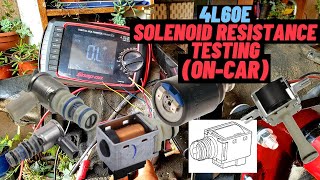
How to confirm: A mechanic can command the solenoid on and off with a professional scan tool. After removing the transmission pan, the solenoid's internal resistance can be tested with a multimeter. For the 4L60-E, the TCC solenoid should read between 20-40 ohms. 🎬 See how to test solenoid resistance while on the vehicle A reading outside this range confirms failure.
Typical fix: Replace the TCC solenoid. This is located inside the transmission on the valve body and requires removing the fluid pan.
Est. part cost: $20-$60 - Damaged Internal Wiring Harness 🟡 Medium Probability → Shop Transmission Wiring Harness The wiring harness inside the transmission becomes brittle and its connectors can degrade from constant exposure to heat and transmission fluid over many years. This can lead to poor connections or broken wires at the TCC solenoid connector.
How to confirm: After removing the transmission pan, visually inspect the wiring harness for signs of damage, brittleness, or broken wires, especially at the connector points. Check for continuity between the main transmission case connector and the solenoid connector.
Typical fix: Replace the internal transmission wiring harness. This is often done at the same time as the solenoid replacement as a preventative measure.
Est. part cost: $50-$120 - Low or Dirty Transmission Fluid 🟡 Medium Probability → Shop Transmission Assembly Neglected maintenance can lead to fluid that is low or contaminated with clutch material and metal shavings. This debris can clog the small passages in the valve body and impede the function of the TCC solenoid.
How to confirm: Check the transmission fluid level and condition using the dipstick. The fluid should be bright red and clear, not brown, black, or smelling burnt. Debris in the pan is a clear indicator.
Typical fix: Perform a transmission fluid and filter change. If the fluid is very dirty, dropping the pan to clean it is essential.
Est. part cost: $50-$150 for fluid and filter
Rare But Worth Checking
- Failed Torque Converter: → Shop Automatic Transmission Torque Converter While the code points to an electrical circuit, a mechanical failure within the torque converter's clutch can sometimes prevent proper operation, leading the computer to flag a fault. This is usually accompanied by more severe symptoms like significant metal debris in the transmission fluid pan.
- Faulty Transmission Control Module (TCM): → Shop Transmission Assembly It is rare for the TCM to fail, but it can happen. The driver circuit within the module that controls the TCC solenoid can fail. This should only be considered after all other possibilities (solenoid, wiring, fluid) have been thoroughly exhausted.
- Engine Misfire Condition: In some cases, the TCM may inhibit TCC lock-up if it detects a significant engine misfire. This is a protective measure. One H3 owner on Reddit discovered their persistent TCC lock-up issue was ultimately caused by an engine misfire count that prevented the TCM from engaging the clutch.
Diagnosis Steps
- Check for Other Codes: Use an OBD-II scanner to check for any other transmission-related codes. Multiple solenoid codes appearing at once may indicate a shared power or ground issue.
- Inspect Transmission Fluid: Check the transmission fluid level and condition. If it's low, top it off. If it's dark, burnt, or contains metallic debris, it needs to be changed and the pan should be inspected.
- Scan Tool Diagnosis: Use an advanced scan tool to monitor the TCC command status and TCC slip speed in real-time. A technician can command the TCC solenoid on and off to see if it responds electrically and if the RPMs change.
- Inspect Internal Components: If the above steps don't resolve the issue, drain the fluid and remove the transmission pan.
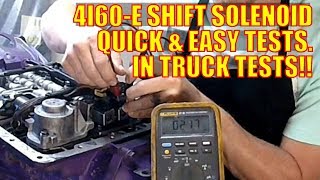
- Test the Solenoid: With the pan off, unplug the TCC solenoid. Test its resistance with a multimeter. The reading should be between 20 and 40 ohms for a typical 4L60-E TCC solenoid. An open circuit (infinite resistance) or short (near zero resistance) indicates a failed solenoid.
- Inspect and Test Wiring: Visually inspect the internal wiring harness for brittle plastic, chafed wires, or loose pins at the solenoid connector. Test for continuity from the main transmission case plug to the TCC solenoid connector pins to rule out a break in the harness.
- Test the Circuit: Check for 12V power at the harness connector for the TCC solenoid when the key is on. The other wire is the ground side, which is controlled by the TCM. This verifies the integrity of the external wiring.
- Inspect Valve Body: While the pan is off, look for any obvious signs of debris, scoring, or blockages in the valve body where the solenoid sits. A worn valve body bore can cause fluid pressure to leak, preventing the TCC from engaging even with a good solenoid.
Parts You'll Likely Need
- Torque Converter Clutch (TCC) Solenoid
(OEM #24227792 (May be superseded by 24236933))— This is the most common part to fail and cause the P0740 code. It is sometimes referred to as the TCC PWM (Pulse-Width Modulated) solenoid.
Trusted brands: ACDelco, Standard Motor Products, Rostra
OEM price range: $30-$50
Aftermarket price range: $15-$30 - Transmission Internal Wiring Harness
(OEM #24222798)— The internal harness is a frequent point of failure due to heat and fluid exposure, causing bad connections. It is highly recommended to replace this along with the solenoids.
Trusted brands: ACDelco, GM Genuine
OEM price range: $70-$120
Aftermarket price range: $40-$80 - Transmission Filter and Pan Gasket Kit — This is required for any job that involves removing the transmission pan, such as replacing a solenoid.
Trusted brands: ACDelco, ATP, Wix
OEM price range: $30-$50
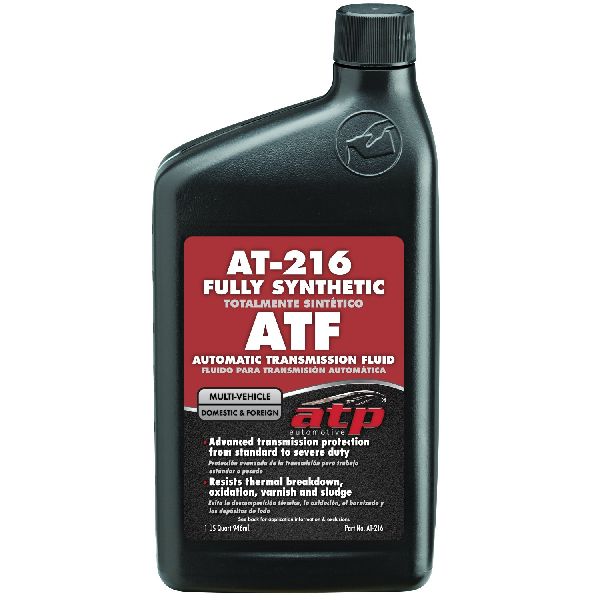
Aftermarket price range: $20-$40 - DEXRON VI Automatic Transmission Fluid — The correct type of fluid is required for a pan drop and refill. A typical pan drop requires 5-6 quarts.
Trusted brands: ACDelco, Valvoline, Castrol
OEM price range: $8-$12 per quart
Aftermarket price range: $6-$10 per quart
Related Codes That Often Appear With This One
- P0741 — This code indicates 'TCC System Stuck Off,' which is a performance-related version of the P0740 circuit fault. They often point to the same root causes, such as a bad solenoid or worn valve body.
- P0753 — This code relates to Shift Solenoid 'A' Circuit. If multiple solenoid circuit codes (P0740, P0753, P0758) appear together, it can point to a common power supply issue from a faulty ignition switch or a bad ground connection for the transmission.
- P0758 — This code relates to Shift Solenoid 'B' Circuit. Similar to P0753, seeing it with P0740 suggests a shared electrical problem rather than multiple individual solenoid failures.
- P1860 — This is a GM-specific code for the TCC PWM Solenoid Circuit. It is very closely related to P0740 and often appears with it, pointing directly to an electrical issue with the TCC control system.
Technical Service Bulletins (TSBs) & Recalls
- ATRA Technical Bulletin #583: While not a direct GM TSB, this bulletin from the Automatic Transmission Rebuilders Association discusses how codes P0740, P0753, P0758, P0785, and P1860 appearing together on 4L60E/4L80E transmissions often point to a single electrical fault in the power supply circuit (circuit 1020) from the ignition switch, rather than multiple failed solenoids.
Platform-Specific Known Issues
- A Reddit user with a 2006 H3 reported a peculiar failure mode where the TCC would only lock up when the transmission fluid was cold. As the fluid warmed and thinned, pressure would allegedly bypass a worn valve body bore, preventing the solenoid from building enough pressure to engage the clutch. This highlights how mechanical wear can sometimes manifest as an electrical code.
Mechanic-Grade Diagnostic Values
- TCC PWM Solenoid Resistance — expected: 10-15 Ohms at 68°F (20°C). Some sources state a wider range of 7-20 Ohms.. Failure: A reading of 0 ohms (short) or infinite/OL (open) indicates a failed solenoid. A reading outside the specified range also indicates a problem.
- TCC Solenoid (On/Off type, less common on this platform) — expected: 20-40 Ohms.. Failure: A reading outside this range indicates failure.
- TCC Slip Speed (Live Scan Tool Data) — expected: Should drop to near 0 RPM when the TCC is commanded to 100% lockup.. Failure: A slip speed greater than 60-100 RPM when lockup is commanded indicates the clutch is not holding, pointing to a hydraulic or mechanical issue (like a worn valve bore or bad torque converter).
- Voltage at Transmission Case Connector Pin E (Pink Wire) — expected: 12V+ with key on.. Failure: Low or no voltage indicates a problem with the power supply from the fuse block (TRANS fuse) or a known issue with a poor crimp on Circuit 1020.
Hidden / Shadow Codes Worth Checking
- P1870: Transmission Component Slipping. While not a 'shadow' code, it is a critical GM-specific code that often accompanies or follows a P0740. It specifically points to a mechanical slip detected by the TCM, which is very frequently caused by a worn TCC regulator valve bore in the valve body leaking hydraulic pressure. (see via Standard OBD-II scanner.)
Scan Tool Commands That Help
- GM Tech2 / GDS2 or equivalent professional scanner: TCC PWM Solenoid Duty Cycle Command (found in Transmission Output Controls) — This bidirectional command is used to manually activate the TCC solenoid while monitoring engine RPM and TCC slip speed. A technician can command the duty cycle from 0% to 100%. If the RPM drops and slip speed approaches zero as the command nears 100%, it confirms the solenoid, wiring, and torque converter clutch are functioning mechanically and hydraulically. If the command is sent but nothing happens, it confirms a circuit or solenoid failure.
Wiring & Ground Locations
- Transmission Case Connector — The large round connector on the passenger side of the 4L60-E/4L65-E transmission case.. This is the main electrical interface. Pin E (Pink wire) is the 12V+ power feed for all solenoids. Pin T (Tan/Black wire) is the control wire from the TCM for the TCC solenoid. Testing for power at Pin E and continuity/shorts on Pin T is a primary diagnostic step.
- G102 / G103 / G104 — On the lower left side of the engine block. G104 is in front of the starter.. These are primary engine block grounds used by the Engine Control Module (ECM) and Transmission Control Module (TCM). A loose or corroded ground here can cause erratic behavior and phantom electrical codes for any sensor or actuator controlled by the modules, including the TCC solenoid.
- Circuit 1020 (Pink Wire) — Runs from the underhood fuse block (TRANS fuse) to Pin E of the transmission case connector.. A GM Technical Service Bulletin identifies a poor factory crimp on this circuit as a cause for intermittent low voltage, which can trigger P0740 and other solenoid codes simultaneously.
Real Owner Repair Stories
- PerformanceTrucks.net Forums (GM Truck with 4L60E) — Transmission would not move in any gear, throwing code P0740.
❌ Tried (didn't work) Initial wiring check seemed okay.
✅ What actually fixed it The user discovered that Pin E (the main power feed) on the transmission connector was improperly wired to the fuse block after a harness repair. Correcting the power supply wiring resolved the issue. - GM-Trucks.com Forum (2000 Silverado with 4L60E) — P0740 code appeared and returned very quickly after being erased. Transmission was rebuilt 2 years prior and shifted fine.
❌ Tried (didn't work) Replacing the TCC solenoid did not fix the problem.
✅ What actually fixed it The thread did not have a final resolution posted by the original user, but subsequent replies pointed towards checking the internal and external wiring harness for breaks or shorts, or a potential issue with the PCM driver, which is the logical next step after a new solenoid fails to resolve a circuit code.
"I Checked Everything" — The Actual Cause
- A common scenario for P0740 (or the related P1870) is when the TCC solenoid and wiring test perfectly with a multimeter, but the code persists. The hidden cause is often a worn TCC regulator valve bore inside the transmission valve body. This wear allows hydraulic pressure to leak past the valve, so even with a perfectly functioning solenoid, there isn't enough pressure to apply the torque converter clutch. This is a mechanical failure that manifests as an electrical or performance code. The fix requires removing the valve body and installing an oversized valve and sleeve kit, such as the Sonnax 77754-04K.
OEM Part Supersession History
24227792→24227747 (as part of solenoid kits)— Part number updates and consolidation over the long production run of the 4L60-E family.
Heads up: The H3 uses a PWM-style TCC solenoid. Using an earlier, non-PWM (on/off) solenoid from a pre-1995 4L60-E will not work and will cause codes and shifting problems.
Model Year Variations Within This Range
- 2008-2010: Hummer H3 models equipped with the 5.3L V8 engine (Alpha trim) use the 4L65-E transmission. While internally stronger (e.g., 5-pinion planetaries), it shares the same valve body, solenoids, and wiring architecture as the 4L60-E. Therefore, it is susceptible to the exact same P0740 causes and fixes, including solenoid failure and TCC valve bore wear.
Diagnostic Flowchart
Used vs. New Parts: Buying Guide for This Vehicle
When a used part is the smart pick: For this repair, sourcing used parts is generally not recommended. The failure is caused by heat and age, so a used electronic part like a solenoid or wiring harness from a junkyard is likely to have a very limited remaining lifespan.
Donor-vehicle mileage cap: roughly under 80000 miles for the part to have meaningful remaining life.
What to inspect on the donor part:
- If considering a used valve body, look for one from a vehicle with the lowest possible mileage.
- Inspect the transmission fluid from the donor vehicle if possible; it should be bright red and not smell burnt.
- Avoid parts from vehicles that show signs of overheating or severe front-end damage.
OEM-only on this vehicle (don't cheap out):
- Internal Wiring Harness: OEM (ACDelco/GM Genuine) harnesses use higher-grade plastics that are more resistant to heat and fluid degradation compared to many cheaper aftermarket alternatives.
Aftermarket brands forum-validated for this vehicle:
- Sonnax: The industry standard for valve body repair parts, specifically the 77754-04K TCC regulator valve kit.
- Rostra: A well-regarded manufacturer of aftermarket transmission solenoids.
- BorgWarner: An OEM supplier for many transmission components, their solenoids are a reliable choice.
- ACDelco: The OEM parts brand for GM, offering the original factory-spec components.
Brands owners have reported issues with on this vehicle:
- Unbranded, generic 'solenoid kits' from major online marketplaces. These often have high failure rates and are a common source of frustration when the code returns shortly after the repair.
Real Owner Stories
Aggregated from forums and TSBs cited above. Mileages and costs reflect what owners reported in those sources.
2007 Hummer H2 sut
Symptoms: Stalls at idle/take off, hard to restart, rough idle. Check engine light on with multiple transmission codes (P2761, P0740, P0753, P0758, P0785).
What fixed it: The issue was a bad ignition switch; replacing it solved all the transmission codes and turned off the check engine light.
Source hint: Hummer Forums
2006 Hummer H3
Symptoms: The torque converter clutch would only lock up when the transmission fluid was cold. The problem would appear as the vehicle warmed up.
What fixed it: The final diagnosis was that the Transmission Control Module (TCM) was disabling TCC lockup due to a registered engine misfire, which was the root cause, not a primary transmission fault.
Source hint: Reddit: Hummer H3 TCC lockup issue
Hummer H3
Symptoms: RPM fluctuation at highway speed, which occurred before the Check Engine Light for code P0741 came on.
What fixed it: The fix involved identifying and replacing the correct TCC solenoid.
Source hint: Hummer4x4Offroad: Hummer H3 P0741 TCC Solenoid Circuit Performance/Stuck Off
Related OBD-II Codes
Frequently Asked Questions
My 2008 H3 is shuddering at highway speeds. Is this definitely the torque converter?
How can I test the TCC solenoid on my Hummer H3's 4L60-E transmission myself?
I have code P0740 along with P0753 and P0758. Do I need to replace all the solenoids?
Is it a good idea to replace the internal wiring harness when changing the TCC solenoid on my H3?
My H3's torque converter lock-up only fails when the transmission is fully warmed up. What could cause that?
Does this P0740 TCC solenoid issue also happen on the Chevy Colorado or GMC Canyon?
Helpful Videos

We Have This Part in Stock



The information in this article is provided for general reference and educational purposes only. Vehicle specifications, procedures, and part compatibility can vary by production date, trim level, and region. Always consult your vehicle's factory service manual and verify part numbers before purchasing or performing repairs. Safety-critical components such as airbags, seat belts, and braking systems should be installed by a qualified professional.
- Hummer H3:
- 🧭 Diagnostic Flowchart
- 🎬 Helpful Videos
- 🛍️ Shop This Part
- What's Unique About the 2006-2010 Hummer H3
- Symptoms You May Notice
- Most Likely Causes
- Rare But Worth Checking
- Diagnosis Steps
- Parts You'll Likely Need
- Related Codes That Often Appear With This One
- Technical Service Bulletins (TSBs) & Recalls
- Platform-Specific Known Issues
- Mechanic-Grade Diagnostic Values
- Hidden / Shadow Codes Worth Checking
- Scan Tool Commands That Help
- Wiring & Ground Locations
- Real Owner Repair Stories
- "I Checked Everything" — The Actual Cause
- OEM Part Supersession History
- Model Year Variations Within This Range
- Used vs. New Parts: Buying Guide for This Vehicle
- Real Owner Stories
- 2007 Hummer H2 sut
- 2006 Hummer H3
- Hummer H3
- Related OBD-II Codes
- Frequently Asked Questions
- 🎟️ Get 5% Off