

P0740 on 2000-2006 Hyundai Elantra: Torque Converter Clutch Circuit Fixes
On a 2000-2006 Elantra, code P0740 is most often caused by a faulty Torque Converter Clutch (TCC) solenoid or a broken wire in the internal transmission harness. The fix usually involves dropping the transmission pan to replace the solenoid or harness, costing around $75-$200 for parts.
- P0740 on a 2000-2006 Elantra is an electrical circuit fault, not a major mechanical failure.
- Before buying any parts, inspect the internal transmission wiring harness (P/N 46307-39050) for broken wires, as this is a very common cause.
- If you have other solenoid codes (P0750, P0755, etc.) along with P0740, the internal harness is almost certainly the problem.
- Do not replace the entire transmission or torque converter for this code; the fix is almost always a much cheaper part inside the oil pan.
- Always use Hyundai SP-III compatible transmission fluid when refilling.
What's Unique About the 2000-2006 Hyundai Elantra
For this generation of Elantra (chassis code XD), which uses the A4BF2 or A4BF3 4-speed automatic transmission, Hyundai issued service information (related to TSB 04-40-015) that specifically warns against replacing the entire transmission for solenoid circuit codes like P0740. The most common and well-documented failure is not always the solenoid itself, but the internal wiring harness (Part No. 46307-39050) located inside the transmission oil pan. The wires on this harness are known to become brittle over time from constant heat cycles and break, causing an open circuit that triggers the P0740 code.
Symptoms You May Notice
- Check Engine Light is on
- Vehicle fails to shift into the highest gear or feels like it's slipping at highway speeds
- Noticeable decrease in fuel economy
- Engine RPMs fluctuate while cruising at a steady speed
- Shuddering or vibration at low speeds or during light acceleration
- Harsh or delayed gear shifts
- Transmission may feel like it is in 'limp mode' (stuck in 3rd gear)
- Replacing the entire transmission. Hyundai specifically advises against this for P0740, as the cause is almost always a smaller, serviceable component inside the pan.
- Replacing the torque converter. P0740 is an electrical circuit code. A mechanical torque converter failure would typically set a different code, like P0741 ('TCC Performance/Stuck Off').
Most Likely Causes
- Faulty Internal Transmission Wiring Harness 🔴 High Probability → Shop Transmission Assembly The wires on the original harness inside the transmission pan (P/N 46307-39050) are known to become brittle from heat and age, often breaking at the connector for the TCC solenoid. This is a widely documented failure for this specific transmission series.
How to confirm: Visually inspect the harness after removing the transmission oil pan. Look for broken or frayed wires, especially near the solenoid connectors. If multiple solenoid codes (e.g., P0750, P0755) are present, the harness is the most likely cause.
Typical fix: Replace the internal wiring harness.
Est. part cost: $40-$70 - Faulty Torque Converter Clutch (TCC) Solenoid 🟡 Medium Probability → Shop Automatic Transmission Torque Converter The solenoid (OEM Part #46313-39051 for some applications) can fail electrically from internal coil burnout or mechanically from sticking. It is a common failure point for this code across many vehicles.
How to confirm: After accessing the solenoid, test its resistance with a multimeter. Compare the reading to the manufacturer's specification, which is typically between 12-28 Ohms for similar Hyundai solenoids. A reading of infinity (open) or zero (short) indicates a failed solenoid. A more specific test for the A4AF3/BF3 family shows some solenoids should be 2.6-3.2 Ohms while others are 20.8-23.8 Ohms.
Typical fix: Replace the TCC solenoid.
Est. part cost: $50-$90 - Low or Dirty Transmission Fluid ⚪ Low Probability → Shop Transmission Assembly While less likely to cause a purely electrical code, extremely low fluid can cause erratic solenoid operation, and fluid contaminated with metal shavings can clog solenoid passages and cause it to fail.
How to confirm: Check the transmission fluid level and condition with the engine running and warm. If the fluid is dark brown/black, smells burnt, or contains metallic particles, it needs to be changed.
Typical fix: Perform a transmission fluid and filter change. Use only Hyundai SP-III compatible fluid. Using incorrect fluid types can cause shifting problems and solenoid damage.
Est. part cost: $60-$120
Rare But Worth Checking
- Faulty Transmission Control Module (TCM): → Shop Transmission Assembly This is rare. The TCM should only be considered after all other possibilities—wiring, solenoids, and fluid—have been thoroughly ruled out. A failed driver circuit within the TCM can mimic a solenoid fault.
- Faulty Transmission Oil Temperature Sensor: → Shop Transmission Assembly A faulty oil temperature sensor (Part No. 46386-22600) can provide incorrect data to the TCM, which may prevent TCC lockup under certain conditions. This sensor is integrated into the internal wiring harness (46307-39050), so replacing the harness resolves this potential cause.
Diagnosis Steps
- Scan for Codes: Confirm P0740 and check for any other solenoid-related codes (P0750, etc.). The presence of multiple codes points strongly to the internal harness.
- Check Transmission Fluid: Verify the fluid level is correct and the condition is good. Burnt or contaminated fluid warrants a fluid and filter change before proceeding.
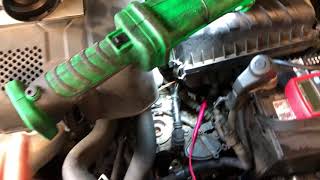
- Perform Scan Tool Actuation Test: Use a capable scan tool like a Hyundai GDS to perform an 'Actuation Test' on the TCC solenoid. Listen for an audible click from the transmission. 🎬 Watch: A real-world diagnosis and solenoid test on an Elantra. A 'TEST FAILURE' message points to a circuit or solenoid issue.
- Inspect External Wiring: Check the wiring harness leading to the transmission case for any visible damage, corrosion, or loose connections.
- Drop the Transmission Pan: Drain the fluid and remove the oil pan to gain access to the valve body, solenoids, and internal harness.
- Inspect Internal Harness: Carefully inspect the internal wiring harness (P/N 46307-39050). Pay close attention to the wires at the point where they enter the plastic connectors. Look for breaks, chafing, or brittleness. This is the most common failure point.
- Test the TCC Solenoid: If the harness appears intact, disconnect the TCC solenoid and test its resistance with a multimeter. A good solenoid should read within spec (e.g., 12-28 Ohms, though some solenoids in the pack may differ). An open circuit (OL) or a short (near 0 Ohms) confirms the solenoid is bad.
- Replace Faulty Part(s): Replace the internal harness if any damage is found. Replace the TCC solenoid if it fails the resistance test. It is often wise to replace both the solenoid and harness at the same time if the transmission has high mileage.
- Reassemble and Refill: Reinstall the transmission pan with a new gasket. Torque pan bolts to specification (typically 7-9 lb-ft for this type of pan). Refill with Hyundai SP-III or equivalent ATF to the correct level.
- Clear Codes and Test Drive: Clear the trouble codes with a scanner and perform a test drive to ensure the problem is resolved and the TCC locks up at cruising speed.
Parts You'll Likely Need
- Internal Automatic Transmission Wiring Harness
(OEM #46307-39050)— This is a well-documented failure point for P0740 on this platform. The wires become brittle and break, causing an open circuit.
Trusted brands: Hyundai (OEM)
OEM price range: $40-$70
Aftermarket price range: N/A - Torque Converter Clutch (TCC) Solenoid
(OEM #46313-39051)— This solenoid is the component controlled by the circuit. It can fail electrically, causing the P0740 code.
Trusted brands: Standard Motor Products, Wells, Rostra
OEM price range: $70-$120
Aftermarket price range: $50-$90 - Automatic Transmission Filter Kit
(OEM #46321-22731 (example, verify by VIN))— A new filter and pan gasket should always be installed whenever the transmission pan is removed for service.
Trusted brands: Beck/Arnley, WIX, ATP
OEM price range: $25-$40
Aftermarket price range: $15-$30
Related Codes That Often Appear With This One
- P0750, P0755, P0760, P0765 — These are codes for other shift solenoids. If seen with P0740, it strongly indicates a failure of the shared internal wiring harness (46307-39050) rather than multiple individual solenoids failing at once.
- P0700 — This is a generic code indicating the TCM has requested the Check Engine Light. It is an informational code that will always be present when a specific transmission code like P0740 is stored.
Technical Service Bulletins (TSBs) & Recalls
- TSB 04-40-015: Referenced in multiple service documents, it provides diagnostic procedures for solenoid circuit faults (P0740-P0770) and instructions for inspecting/replacing the internal transmission harness.
Platform-Specific Known Issues
- A Hyundai Technical Service Bulletin (TSB 04-40-015) and related service documents detail the diagnostic procedure for solenoid codes, emphasizing inspection of the internal harness before considering larger repairs.
- Owner experiences frequently confirm the internal harness (46307-39050) as the primary culprit, often with visible broken wires at the solenoid connectors.
Mechanic-Grade Diagnostic Values
- Shift & TCC Solenoid Resistance (General) — expected: 12 - 28 Ohms. Failure: A reading of infinity (OL) or near zero indicates a failed solenoid.
- A4AF3/BF3 Solenoid Pack Resistance (Specific) — expected: Varies by pin. Example: Pin 2 (Black wire) and Pin 3 (Blue wire) should be 2.6 - 3.2 Ohms. Pin 1 (White wire), Pin 4 (Yellow wire), and Pin 5 (Brown wire) should be 20.8 - 23.8 Ohms.. Failure: Readings outside these specific ranges indicate a faulty solenoid.
Scan Tool Commands That Help
- Hyundai GDS (Global Diagnostic System) / Hi-Scan Pro: Actuation Test — Use this test before dropping the transmission pan. It commands the TCM to activate a specific solenoid (like the TCC). Hearing a 'click' confirms the wiring from the TCM to the solenoid is intact and the solenoid is not seized. A 'TEST FAILURE' message on the scanner points directly to an open/short in the circuit or a failed solenoid coil.
Wiring & Ground Locations
- Internal Harness Connector — Inside the transmission, on the valve body. Accessed by removing the oil pan.. This is the location of the most common failure. The wires (P/N 46307-39050) become brittle from heat and break at the connectors for the various solenoids, causing an open circuit.
- Transmission Grounds (General) — Service manuals for the 2002 Elantra list ground points G01 through G29, but specific location diagrams are often required to pinpoint them. Common locations are on the engine block, firewall, and near the battery tray.. A poor ground for the TCM or transmission can cause erratic behavior and incorrect voltage readings, potentially triggering circuit codes. This should be checked after confirming the internal components are good.
OEM Part Supersession History
46313-39050→46313-39051— Part revision or manufacturer change.
Heads up: The parts are interchangeable; 46313-39051 is the direct replacement for the older part number.46307-39050→No supersession found— N/A
Heads up: This part number remains the correct one for the 2000-2006 Elantra and related models.
Model Year Variations Within This Range
- 2000-2006: This generation used both the A4BF2 and A4BF3 transmissions, which are part of the same family. The A4BF3 is noted to have less reliable solenoids than its predecessors. However, the primary failure mode for P0740 (internal harness P/N 46307-39050) is common to both versions used in the Elantra XD.
Diagnostic Flowchart
Other Known Issues on This Vehicle
Issues unrelated to this code that are worth knowing about as an owner of this generation:
- Timing Belt Failure 🔴 High — The timing belt has a strict replacement interval of 60,000 miles. Failure to replace it can lead to catastrophic engine damage due to the interference design.
- Front Lower Control Arm Corrosion 🔴 High — A recall was issued for early models (NHTSA Campaign ID: 09V124000) due to excessive corrosion of the front lower control arms in salt-belt states, which could lead to fracture. (Ref: NHTSA RECALL 09V124000)
- Failing Rear Engine Mount 🟠 Medium — The rear engine mount is known to wear out around 60,000-80,000 miles, causing significant vibration in the cabin, especially during acceleration or at idle.
- Thin, Easily Chipped Paint 🟡 Low — The paintwork on this generation is not particularly durable and is prone to chipping, especially on the front bumper and hood.
Used vs. New Parts: Buying Guide for This Vehicle
When a used part is the smart pick: For this specific repair, buying used parts is generally not recommended. A used TCC solenoid could be considered if it can be tested for correct resistance (e.g., 12-28 ohms) before purchase and shows no signs of contamination.
Donor-vehicle mileage cap: roughly under 80000 miles for the part to have meaningful remaining life.
What to inspect on the donor part:
- For a solenoid, ensure the electrical connector is clean and free of corrosion.
- Check the fluid from the donor transmission; if it's dark, burnt, or contains metal, avoid all parts from that unit.
- Ask for the mileage of the donor vehicle; lower is always better for transmission components.
OEM-only on this vehicle (don't cheap out):
- Internal Transmission Wiring Harness (P/N 46307-39050): This part fails due to heat and age, causing wires to become brittle. A used part from a junkyard has undergone the same stress and is highly likely to fail soon, if it hasn't already. Always buy this part new from Hyundai.
Aftermarket brands forum-validated for this vehicle:
- Solenoids: Rostra, Standard Motor Products (SMP), Wells
Brands owners have reported issues with on this vehicle:
- Unbranded, no-name solenoid kits from online marketplaces are a gamble and may have incorrect coil resistance or poor longevity.
Real Owner Stories
Aggregated from forums and TSBs cited above. Mileages and costs reflect what owners reported in those sources.
2006 Hyundai Elantra
Symptoms: The vehicle reported six solenoid codes simultaneously: P0740, P0750, P0755, P0760, P0765, and P0770.
What fixed it: Replacing the internal wiring harness (Part No. 46307-39050) resolved all six codes.
Source hint: Hyundai-Forums.com Thread 'P0740, P0750, P0755, P0760, P0765, P0770'
2001-2006 Hyundai Elantra (XD)
Symptoms: P0740 code present; transmission issues common to the XD generation.
What fixed it: The code was resolved by replacing either the internal harness or the TCC solenoid.
Source hint: ElantraClub.com XD Elantra (2001-2006) section discussions
Related OBD-II Codes
Frequently Asked Questions
Does TSB 04-40-015 apply to my 2000-2006 Hyundai Elantra regarding the P0740 code?
What is the specific part number for the internal wiring harness that often fails on this Elantra?
My Elantra has multiple solenoid codes (P0740, P0750, P0755). Does this mean all my solenoids are bad?
What type of transmission fluid should I use to avoid solenoid damage in my 2000-2006 Elantra?
Is there a recall for the front suspension on this generation of Elantra?
What is the correct resistance for a TCC solenoid on the A4AF3/BF3 transmission family?
Helpful Videos


We Have This Part in Stock

The information in this article is provided for general reference and educational purposes only. Vehicle specifications, procedures, and part compatibility can vary by production date, trim level, and region. Always consult your vehicle's factory service manual and verify part numbers before purchasing or performing repairs. Safety-critical components such as airbags, seat belts, and braking systems should be installed by a qualified professional.
- Hyundai Elantra:
- 🧭 Diagnostic Flowchart
- 🎬 Helpful Videos
- 🛍️ Shop This Part
- What's Unique About the 2000-2006 Hyundai Elantra
- Symptoms You May Notice
- Most Likely Causes
- Rare But Worth Checking
- Diagnosis Steps
- Parts You'll Likely Need
- Related Codes That Often Appear With This One
- Technical Service Bulletins (TSBs) & Recalls
- Platform-Specific Known Issues
- Mechanic-Grade Diagnostic Values
- Scan Tool Commands That Help
- Wiring & Ground Locations
- OEM Part Supersession History
- Model Year Variations Within This Range
- Other Known Issues on This Vehicle
- Used vs. New Parts: Buying Guide for This Vehicle
- Real Owner Stories
- 2006 Hyundai Elantra
- 2001-2006 Hyundai Elantra (XD)
- Related OBD-II Codes
- Frequently Asked Questions
- 🎟️ Get 5% Off